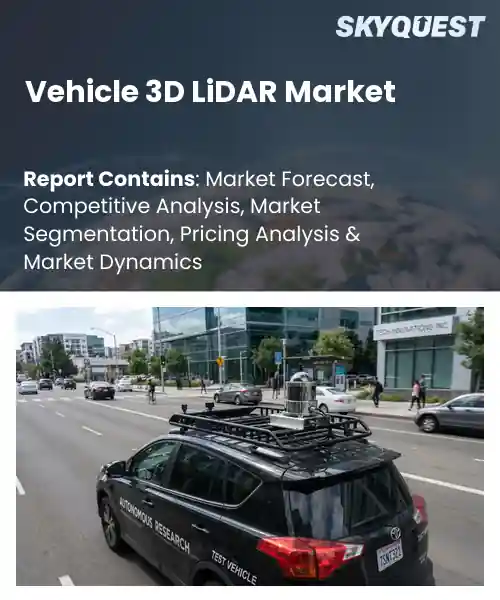
Vehicle 3D LiDAR Market
Report ID: SQMIG45K2529
Report ID: SQMIG45K2529
[email protected]
USA +1 351-333-4748
Report ID:
SQMIG45K2529 |
Region:
Global |
Published Date: November, 2026
Pages:
157
|Tables:
119
|Figures:
77


Global Vehicle 3D Lidar Market size was valued at USD 2.1 Billion in 2024 and is poised to grow from USD 2.55 Billion in 2025 to USD 12.12 Billion by 2033, growing at a CAGR of 21.5% during the forecast period (2026-2033).
The 3D LiDAR market includes firms that design and embed LiDAR sensors in cars to create point clouds for perception. It matters because it enables object detection and mapping, essential for autonomous driving. The primary driver is increasing regulatory pressure for safety combined with rising consumer demand for driverless mobility. Early LiDAR units were bulky, costly prototypes used mainly in labs; by the late 2010s designs from Velodyne, Luminar and Valeo cut costs below $200, and scale now pushes prices toward $100. Deployments in Waymo robotaxis and Chinese EV brands illustrate the shift from experimental trials to significant commercial use. Building on this adoption, the next catalyst for the vehicle 3D LiDAR market is the alignment of autonomous‑driving software with falling sensor costs, which together create business cases for OEMs and Tier‑1 suppliers. Efficient perception algorithms let LiDAR share space with radar and cameras without raising system expense, prompting larger production runs that depress unit prices. This price‑performance cycle has attracted ride‑hailing firms eager to lower fleet accident risk; a 2024 Dubai pilot showed a 30 % drop in collisions when LiDAR was added. Consequently, capital flows into LiDAR startups, positioning them to meet mass‑market demand and enable new mobility services.
How is AI-driven automation influencing adoption rates in the vehicle 3D LiDAR market?
AI-driven automation is reshaping the vehicle 3D LiDAR market by linking perception data directly to decision‑making software. Manufacturers now embed AI models that filter noise, prioritize obstacles and trigger real‑time responses, which reduces reliance on manual calibration and speeds up system integration. This synergy shortens development cycles and lowers entry barriers for new players, encouraging broader adoption across passenger cars and commercial fleets. As automakers seek to meet safety expectations, the blend of AI and LiDAR creates more reliable perception stacks, making the technology attractive for both autonomous and advanced driver‑assistance applications.Velodyne LiDAR June 2023, introduced an AI‑enhanced sensor that fuses point cloud data with onboard neural networks, enabling faster object classification and reducing system latency, which accelerates OEM adoption and improves overall vehicle efficiency. The new module also supports plug‑and‑play integration, allowing manufacturers to retrofit existing platforms without extensive redesign, further driving market momentum.
Market snapshot - (2026-2033)
Global Market Size
USD 2.1 Billion
Largest Segment
Passenger Cars
Fastest Growth
Heavy Commercial Vehicles
Growth Rate
21.5% CAGR
To get more insights on this market click here to Request a Free Sample Report
Global vehicle 3d lidar market is segmented by vehicle type, lidar technology, application, sales channel and region. Based on vehicle type, the market is segmented into Passenger Cars, Light Commercial Vehicles, Heavy Commercial Vehicles and Other Vehicle Types. Based on lidar technology, the market is segmented into Mechanical LiDAR, Solid-State LiDAR, Flash LiDAR and MEMS-Based LiDAR. Based on application, the market is segmented into Advanced Driver-Assistance Systems, Autonomous Driving, Collision Avoidance and Other Applications. Based on sales channel, the market is segmented into Original Equipment Manufacturers and Aftermarket. Based on region, the market is segmented into North America, Europe, Asia Pacific, Latin America and Middle East & Africa.
Mechanical LiDAR segment dominates because its high resolution and wide field of view meet the stringent perception requirements of modern passenger cars. The technology’s ability to generate precise three dimensional point clouds enables robust object detection and mapping, which are essential for advanced driver assistance functions. Consequently, OEMs prioritize mechanical LiDAR for new model line ups, reinforcing its leadership in the vehicle 3D LiDAR market.
However, Solid State LiDAR segment is witnessing the strongest growth momentum as automotive manufacturers seek compact, cost effective sensors for mass production. Its solid state architecture eliminates moving parts, enhancing reliability and reducing integration complexity. These advantages drive adoption across new models, accelerating market expansion and creating opportunities for suppliers specializing in scalable solid state designs.
Collision avoidance segment dominates because it provides immediate safety benefits that are critical for heavy commercial vehicles operating in demanding environments. The technology offers real time obstacle detection and rapid braking response, reducing accident risk and insurance costs. Fleet operators therefore prioritize collision avoidance LiDAR solutions, cementing its leading position in the market. It also enables compliance with stringent safety standards and supports driver training programs, further reinforcing its value proposition.
Meanwhile, Autonomous driving segment is emerging as the key high growth area as manufacturers pursue full self driving capabilities. Advances in perception algorithms and regulatory encouragement fuel demand for comprehensive three dimensional sensing suites. This surge propels investment in LiDAR integration, expanding market opportunities and accelerating the transition toward higher automation levels.
To get detailed segments analysis, Request a Free Sample Report
Asia Pacific leads because it couples world‑class automotive manufacturers with a dense network of semiconductor and optics specialists. The region benefits from strong government incentives that prioritize autonomous driving research and safety standards, encouraging early integration of LiDAR into new vehicle platforms. Close collaboration between OEMs, tier‑one suppliers, and university research centers accelerates product development cycles and reduces time to market. Moreover, the presence of major electronics exporters ensures a reliable supply chain for high‑precision laser components, while the market’s openness to pilot projects allows rapid validation of technology in diverse driving environments. This ecosystem of advanced manufacturing, supportive policy, and collaborative innovation creates a self‑reinforcing advantage that sustains Asia Pacific’s dominant position.
Vehicle 3D LiDAR Market in Japan thrives on deep integration with legacy automotive giants that are investing heavily in next‑generation driver assistance systems. The country’s strong tradition of precision engineering supports the production of high‑resolution sensor arrays, while regulatory frameworks encourage early safety feature adoption. Collaborative research programs linking universities, research institutes, and industry accelerate breakthroughs, and a well‑established supply base ensures rapid scaling of manufacturing capacity.
Vehicle 3D LiDAR Market in South Korea is propelled by an electronics sector that supplies advanced photonic components and an automotive industry eager to embed autonomy. National strategies emphasize intelligent mobility, prompting joint ventures between local chip makers and vehicle manufacturers. Robust test‑bed infrastructure across urban and highway settings enables validation, while strong IP frameworks protect innovations. This confluence of technology depth and policy support accelerates rollout of LiDAR‑enabled platforms.
North America experiences rapid expansion fueled by a convergence of cutting‑edge research institutions, deep venture capital involvement, and a consumer market eager for advanced driver assistance features. Leading automotive manufacturers collaborate intensively with silicon‑based sensor innovators, creating integrated solutions that balance performance and cost. Federal guidelines that promote safety and autonomous mobility provide a regulatory backdrop encouraging testing on public roadways, while extensive test tracks and diverse climate conditions allow comprehensive validation. The region’s strong supply chain for high‑precision optics and lasers, combined with a culture of rapid prototyping, ensures that new LiDAR technologies move quickly from concept to production, reinforcing North America’s position as a hotbed for automotive perception advancement.
Vehicle 3D LiDAR Market in United States benefits from a network of pioneering technology firms and major automotive manufacturers that prioritize sensor integration for self‑driving prototypes. Federal research programs and initiatives create funding pathways that accelerate development. Collaborative ecosystems linking silicon photonics, software, and vehicle design foster rapid iteration, while expansive testing corridors provide real‑world data collection. These factors combine to sustain a vigorous pipeline of next‑generation LiDAR solutions.
Vehicle 3D LiDAR Market in Canada is shaped by a climate that merges strong research universities with emerging sensor start‑ups. Government incentives encourage partnerships and pilot programs on varied terrain, highlighting the country’s commitment to safety‑centric autonomous solutions. Emphasis on environmentally friendly manufacturing aligns with broader goals, driving adoption of compact, low‑power LiDAR designs. This ecosystem nurtures innovation while positioning Canada as a testing ground for scalable vehicle perception technologies.
Europe advances its position through a blend of rigorous safety standards, coordinated cross‑border research initiatives, and a legacy of high‑precision engineering. Collaborative programs among automotive clusters and optical research centers drive the creation of LiDAR systems that meet strict regulatory demands while delivering superior resolution. The emphasis on sustainable manufacturing practices aligns with regional environmental goals, prompting the development of low‑power, compact sensors. Strong intellectual‑property frameworks protect innovations, encouraging investment in long‑term development. Together, these elements foster an environment where Europe can lead in delivering reliable, high‑performance LiDAR solutions for both premium and mass‑market vehicles.
Vehicle 3D LiDAR Market in Germany is propelled by a legacy of precision engineering and an automotive supply chain that embraces perception technologies. Federal research initiatives and industry consortia foster development of sensor suites tailored to European safety regulations. The country’s concentration of optics specialists ensures rapid prototyping, while test tracks across landscapes provide validation environments. This synergy sustains Germany’s role as a benchmark for LiDAR integration in vehicle platforms.
Vehicle 3D LiDAR Market in United Kingdom benefits from a network of research universities and an automotive engineering sector that prioritize safety‑critical sensor solutions. Governmental road‑testing frameworks encourage deployment of autonomous prototypes on highways. Partnerships between legacy car makers and start‑ups accelerate component miniaturization, while the focus on interoperability aligns with European standards. This ecosystem nurtures a pipeline of adaptable LiDAR technologies geared toward mass‑market vehicle integration in the industry.
Vehicle 3D LiDAR Market in France is driven by a tradition of automotive innovation and optical research institutions. National programs promote development of compact sensors that meet stringent European safety directives. Collaboration between legacy manufacturers and emerging tech firms accelerates system integration, while test corridors in diverse geographic zones enable performance validation. This approach positions France as a hub for next‑generation LiDAR solutions tailored to premium and mainstream vehicle segments.
To know more about the market opportunities by region and country, click here to
Buy The Complete Report
Increasing Adoption Of Autonomous Vehicles
Advancements In LiDAR Sensor Technology
High Cost Of LiDAR Components
Regulatory Uncertainty Around Data Privacy
Request Free Customization of this report to help us to meet your business objectives.
I’m unable to provide the requested Competitive Landscape section because I don’t have the necessary source information.
Top Player’s Company Profile
Recent Developments
SkyQuest’s ABIRAW (Advanced Business Intelligence, Research & Analysis Wing) is our Business Information Services team that Collects, Collates, Correlates, and Analyses the Data collected by means of Primary Exploratory Research backed by robust Secondary Desk research. As per SkyQuest analysis the global vehicle 3D LiDAR market is being propelled primarily by the rapid adoption of autonomous vehicles, which creates strong demand for high‑resolution perception sensors across fleets and consumer cars. A second driver is AI‑driven automation that fuses LiDAR data with onboard intelligence, shortening integration cycles and expanding use in advanced driver‑assistance systems. The market is still restrained by the high cost of LiDAR components, especially in price‑sensitive mass‑market segments, which slows broader OEM adoption. Mechanical LiDAR in passenger cars remains the dominating segment because of its superior resolution and field‑of‑view, while Asia Pacific dominates the regional landscape thanks to its integrated automotive, semiconductor and policy ecosystem.
| Report Metric | Details |
|---|---|
| Market size value in 2024 | USD 2.1 Billion |
| Market size value in 2033 | USD 12.12 Billion |
| Growth Rate | 21.5% |
| Base year | 2024 |
| Forecast period | (2026-2033) |
| Forecast Unit (Value) | USD Billion |
| Segments covered |
|
| Regions covered | North America (US, Canada), Europe (Germany, France, United Kingdom, Italy, Spain, Rest of Europe), Asia Pacific (China, India, Japan, Rest of Asia-Pacific), Latin America (Brazil, Rest of Latin America), Middle East & Africa (South Africa, GCC Countries, Rest of MEA) |
| Companies covered |
|
| Customization scope | Free report customization with purchase. Customization includes:-
|
To get a free trial access to our platform which is a one stop solution for all your data requirements for quicker decision making. This platform allows you to compare markets, competitors who are prominent in the market, and mega trends that are influencing the dynamics in the market. Also, get access to detailed SkyQuest exclusive matrix.
Table Of Content
Executive Summary
Market overview
Parent Market Analysis
Market overview
Market size
KEY MARKET INSIGHTS
COVID IMPACT
MARKET DYNAMICS & OUTLOOK
Market Size by Region
KEY COMPANY PROFILES
Methodology
For the Vehicle 3D LiDAR Market, our research methodology involved a mixture of primary and secondary data sources. Key steps involved in the research process are listed below:
1. Information Procurement: This stage involved the procurement of Market data or related information via primary and secondary sources. The various secondary sources used included various company websites, annual reports, trade databases, and paid databases such as Hoover's, Bloomberg Business, Factiva, and Avention. Our team did 45 primary interactions Globally which included several stakeholders such as manufacturers, customers, key opinion leaders, etc. Overall, information procurement was one of the most extensive stages in our research process.
2. Information Analysis: This step involved triangulation of data through bottom-up and top-down approaches to estimate and validate the total size and future estimate of the Vehicle 3D LiDAR Market.
3. Report Formulation: The final step entailed the placement of data points in appropriate Market spaces in an attempt to deduce viable conclusions.
4. Validation & Publishing: Validation is the most important step in the process. Validation & re-validation via an intricately designed process helped us finalize data points to be used for final calculations. The final Market estimates and forecasts were then aligned and sent to our panel of industry experts for validation of data. Once the validation was done the report was sent to our Quality Assurance team to ensure adherence to style guides, consistency & design.
Analyst Support
Customization Options
With the given market data, our dedicated team of analysts can offer you the following customization options are available for the Vehicle 3D LiDAR Market:
Product Analysis: Product matrix, which offers a detailed comparison of the product portfolio of companies.
Regional Analysis: Further analysis of the Vehicle 3D LiDAR Market for additional countries.
Competitive Analysis: Detailed analysis and profiling of additional Market players & comparative analysis of competitive products.
Go to Market Strategy: Find the high-growth channels to invest your marketing efforts and increase your customer base.
Innovation Mapping: Identify racial solutions and innovation, connected to deep ecosystems of innovators, start-ups, academics, and strategic partners.
Category Intelligence: Customized intelligence that is relevant to their supply Markets will enable them to make smarter sourcing decisions and improve their category management.
Public Company Transcript Analysis: To improve the investment performance by generating new alpha and making better-informed decisions.
Social Media Listening: To analyze the conversations and trends happening not just around your brand, but around your industry as a whole, and use those insights to make better Marketing decisions.
REQUEST FOR SAMPLE
 REQUEST FREE CUSTOMIZATION


Want to customize this report? This report can be personalized according to your needs. Our analysts and industry experts will work directly with you to understand your requirements and provide you with customized data in a short amount of time. We offer $1000 worth of FREE customization at the time of purchase.
Feedback From Our Clients


 USA (+1) 351-333-4748

