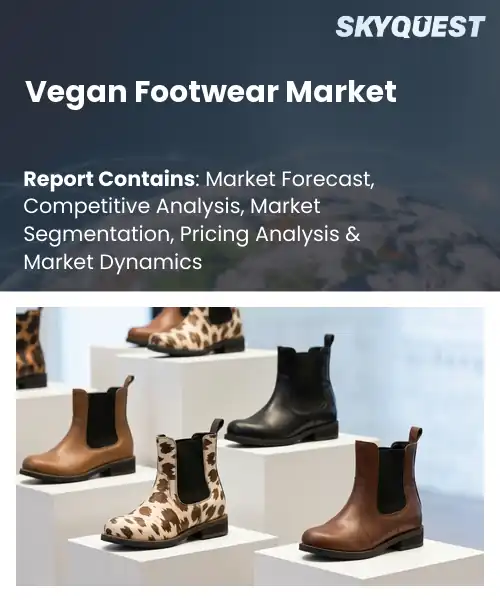
Vegan Footwear Market
Report ID: SQMIG25K2155
Report ID: SQMIG25K2155
[email protected]
USA +1 351-333-4748
Report ID:
SQMIG25K2155 |
Region:
Global |
Published Date: March, 2026
Pages:
157
|Tables:
152
|Figures:
78


Global Vegan Footwear Market size was valued at USD 165.8 Billion in 2024 and is poised to grow from USD 177.07 Billion in 2025 to USD 299.73 Billion by 2033, growing at a CAGR of 6.8% during the forecast period (2026-2033).
I identify shifting consumer values as the primary driver of the vegan footwear market, where ethical and environmental considerations have reshaped demand. Vegan footwear encompasses shoes and accessories made without animal derived materials; it matters because suppliers and consumers increasingly prioritize sustainability, traceability, and animal welfare. The market developed from niche artisanal producers into a mainstream offering as material science advanced and major brands launched plant based leather alternatives and recycled synthetics; for example, startups introduced mushroom and pineapple based leathers while legacy brands added vegan lines, signaling broader acceptance and supply chain investment over the past decade globally today.Building on mainstream acceptance, innovation in alternative materials is the key factor driving global vegan footwear growth because it reduces cost and improves performance, which in turn expands retail distribution and consumer adoption. Advances in bio based leathers, recycled polymers and waterless tanning produce durable uppers and lower carbon footprints, so retailers stock seasonally and ecommerce channels scale catalogues. As a result, manufacturers partner with suppliers to launch athletic and formal lines suited for commuters and outdoor enthusiasts, exemplified by brands using mushroom leather for dress shoes and recycled polyester for running shoes, creating sales uplifts and investor interest worldwide.
How is AI influencing product design in the vegan footwear market?
AI is reshaping vegan footwear by changing how designers choose materials and validate concepts. Key aspects include smarter material selection, generative shape exploration, personalized fit and reduced prototyping time. Today brands use AI to simulate how plant based and mycelium materials behave, to create on demand patterns, and to predict trends so fewer unsold shoes are made. This speeds iteration and helps sustainable materials reach commercial quality faster. Examples range from AI guided 3D printing workflows to machine learning that optimizes biofabrication processes, making product design both more creative and more practical.Vivobarefoot July 2025, the brand launched a mushroom based sneaker and this kind of innovation benefits from AI driven material modelling and digital prototyping which accelerate testing and scale up, supporting market growth and production efficiency.
Market snapshot - (2026-2033)
Global Market Size
USD 165.8 Billion
Largest Segment
Sneakers
Fastest Growth
Sneakers
Growth Rate
6.8% CAGR
To get more insights on this market click here to Request a Free Sample Report
Global vegan footwear market is segmented by product type, material type, gender, price range, distribution channel and region. Based on product type, the market is segmented into Sneakers, Sandals & Flip-Flops, Boots, Formal Shoes, Casual Shoes and Sports / Performance Footwear. Based on material type, the market is segmented into Synthetic Leather (PU, PVC), Recycled Materials (Plastic, Rubber), Plant-Based Materials (Pineapple Fiber, Cork, Apple Leather) and Organic Textiles (Cotton, Hemp). Based on gender, the market is segmented into Men, Women and Children. Based on price range, the market is segmented into Economy, Mid-Range and Premium / Luxury. Based on distribution channel, the market is segmented into Online and Offline. Based on region, the market is segmented into North America, Europe, Asia Pacific, Latin America and Middle East & Africa.
Plant-Based Materials segment dominates because consumer demand for cruelty free, naturally derived alternatives has shifted design palettes and sourcing priorities, prompting brands to prioritize materials like pineapple fiber, cork, and apple leather across collections. This preference drives investment in processing technologies and supply chain partnerships, enabling consistent quality and branding narratives that reinforce sustainability positioning, reduce reliance on petroleum based synthetics, and attract ethically minded consumers and retailers seeking authentic eco credentials.
However, Recycled Materials segment is the most rapidly expanding, driven by corporate commitments to circularity and innovation converting post consumer plastic and rubber into durable uppers and soles. Improved reclamation and clearer sustainability claims accelerate product launches and retail acceptance, enabling scale, lowering unit costs, and creating new brand collaborations that broaden market access.
Online segment dominates because direct to consumer platforms and specialty e tailers provide efficient channels for niche vegan footwear brands to reach ethically motivated shoppers, support storytelling, and manage inventory with agile production models. Digital marketing, influencer endorsements, and targeted sustainability narratives intensify brand discovery and conversion, prompting retailers and manufacturers to prioritize online strategies that reduce overhead, enable rapid product iteration, and facilitate data driven assortment planning.
However, Offline segment is the most rapidly expanding as experiential retail and dedicated vegan boutiques create immersive brand experiences that convert hesitant mainstream shoppers. Investment in in store sustainability certification, tactile trials of plant based materials, and partnerships with lifestyle retailers drive discovery and premiumization, enabling brands to reach new customer cohorts and deepen loyalty through physical engagement.
To get detailed segments analysis, Request a Free Sample Report
Europe commands a leading position because of a convergence of cultural, regulatory, and commercial strengths that favor ethical and sustainable consumption. Established fashion capitals have integrated vegan offerings into mainstream and luxury segments, allowing innovation in materials to move rapidly from niche to high visibility. Strong animal welfare movements, progressive public policy relating to sustainability, and sophisticated certification systems create trust for consumers. Mature retail ecosystems and skilled design communities enable rapid product development, while widespread e-commerce and omnichannel distribution broaden reach. Collaborative networks among universities, start ups, and traditional manufacturers accelerate material science advances. The result is a market where consumer values, brand credibility, and supply chain capability align to sustain leadership.
Vegan Footwear Market in Germany is characterized by engineering rigor applied to sustainable materials and functional design. Brands emphasize durability and performance while aligning with high environmental standards and robust certification practices. Domestic retailers and specialty stores support discovery alongside growing online channels. Collaboration between material developers and footwear manufacturers fosters practical alternatives to animal leather. Consumer expectations center on transparency and lifecycle thinking, encouraging companies to communicate sourcing and end of life options clearly.
Vegan Footwear Market in United Kingdom is shaped by fashion leadership and strong ethical consumerism. Trendsetters and mainstream retailers alike incorporate plant based and synthetic alternatives, supported by visible advocacy and lifestyle influence. Digital marketing and influencer ecosystems accelerate adoption, while independent designers contribute distinctive aesthetics. Retail environments blend high street accessibility with curated specialty outlets, enabling rapid product experimentation. Consumers prioritize provenance and brand values, prompting firms to highlight sustainable supply chains and credible certifications.
Vegan Footwear Market in France balances heritage craftsmanship with modern sustainability narratives. Luxury houses and emerging designers introduce elegant vegan options that reflect couture sensibilities and refined materials. Retail channels include boutique showrooms and selective online platforms that cater to discerning consumers seeking both style and ethics. The market values artisanal quality alongside innovative alternatives to animal leather, encouraging brands to present vegan offerings as both fashionable and responsible. Emphasis on provenance and storytelling strengthens consumer trust.
The North America market is expanding rapidly due to cultural shifts toward ethical consumption, strong retail infrastructure, and entrepreneurial ecosystem support for sustainable innovation. Consumers are attentive to brand values and respond to lifestyle messaging delivered through digital channels and experiential retail. Direct to consumer models and established retailers both test and scale vegan lines, while investment in material innovation and supply chain transparency enhances product appeal. Market dynamics are also influenced by cross sector partnerships that blend performance footwear technology with sustainable materials, enabling functionality that meets lifestyle and practical needs. Regional diversity in consumer priorities results in a landscape where both mass market and niche premium offerings can prosper.
Vegan Footwear Market in United States is driven by a dynamic mix of direct to consumer innovators, established retailers, and cultural influence. Brands leverage storytelling, performance claims, and celebrity or influencer endorsement to reach diverse consumer segments. Retail ecosystems support rapid product testing through pop up concepts and omnichannel strategies. Investment in scalable material technologies enables broader assortment and accessible price points. Shopper emphasis on ethics and lifestyle alignment motivates brands to enhance transparency and sustainability narratives across design, sourcing, and distribution.
Vegan Footwear Market in Canada reflects strong environmental consciousness and demand for functional, climate adapted products. Consumers prioritize locally relevant performance attributes alongside sustainable sourcing and transparent supply chains. Retail and online channels support both independent designers and select mainstream offerings, while collaborations between material suppliers and manufacturers address durability and comfort for varied conditions. The market favors clear communication on ethics and lifecycle impacts, encouraging brands to demonstrate commitments to sustainability and responsible manufacturing.
Asia Pacific is enhancing its role through a combination of manufacturing capability, material research, and rapidly evolving consumer preferences toward sustainable lifestyle choices. Regional centers of innovation are refining bio based and synthetic alternatives, while advanced production networks enable cost efficient scaling and quality control. Urban consumers and younger cohorts are receptive to fashion trends that integrate ethical considerations, creating demand across mainstream and premium segments. E-commerce platforms and social media ecosystems facilitate rapid dissemination of trends and provide access for both domestic and international brands. Strategic collaborations among universities, start ups, and established manufacturers foster product development, helping the region transition from production hub to design and innovation contributor.
Vegan Footwear Market in Japan emphasizes meticulous design, quality materials, and subtle aesthetics that resonate with local consumer preferences. Brands focus on craftsmanship and functional minimalism, integrating sustainable alternatives without compromising durability or comfort. Retail environments favor curated experiences and informed purchase decisions, while collaborations between research institutions and manufacturers support advanced material development. Consumers seek products that combine traditional attention to detail with contemporary ethical values, encouraging measured, high quality vegan offerings.
Vegan Footwear Market in South Korea is shaped by trend driven consumers and a vibrant digital culture that accelerates adoption. Fashion forward youth and lifestyle influencers amplify interest in ethical alternatives, while agile domestic brands rapidly iterate on design and marketing. Strong e-commerce ecosystems and social commerce channels enable fast market feedback and scaling. Material innovation and collaborations with textile and technology partners support fashionable, performance oriented vegan options that appeal to style conscious shoppers.
To know more about the market opportunities by region and country, click here to
Buy The Complete Report
Rising Ethical Consumer Demand
Innovation In Sustainable Materials
Higher Production and Material Costs
Limited Consumer Awareness In Regions
Request Free Customization of this report to help us to meet your business objectives.
Competitive landscape in global vegan footwear has intensified as legacy brands and DTC challengers compete on sustainable materials, supply chain transparency and retail partnerships. Competition is driven by material innovation and co development projects. Incumbents pursue partnerships and product co development such as Adidas with Allbirds on low carbon performance shoes. Legacy firms also replace animal leathers with alternatives exemplified by PUMA’s K-BETTER program and UGG’s vegan Collina Strada collaboration.
Top Player’s Company Profile
Recent Developments
SkyQuest’s ABIRAW (Advanced Business Intelligence, Research & Analysis Wing) is our Business Information Services team that Collects, Collates, Correlates, and Analyses the Data collected by means of Primary Exploratory Research backed by robust Secondary Desk research. As per SkyQuest analysis, the global vegan footwear market is primarily driven by shifting consumer values favoring ethical and environmental choices, while innovation in alternative materials further accelerates adoption by improving performance and cost dynamics. Growth is constrained by higher production and specialty material costs that pressure pricing and margins. Europe remains the dominant region thanks to strong regulatory support, fashion leadership and mature supply chains. Plant-based materials lead the product mix as pineapple fiber, cork and apple leather gain traction across premium and mainstream lines. These combined forces signal steady mainstreaming of vegan footwear but underscore the need for cost reduction and consumer education to sustain momentum.
| Report Metric | Details |
|---|---|
| Market size value in 2024 | USD 165.8 Billion |
| Market size value in 2033 | USD 299.73 Billion |
| Growth Rate | 6.8% |
| Base year | 2024 |
| Forecast period | (2026-2033) |
| Forecast Unit (Value) | USD Billion |
| Segments covered |
|
| Regions covered | North America (US, Canada), Europe (Germany, France, United Kingdom, Italy, Spain, Rest of Europe), Asia Pacific (China, India, Japan, Rest of Asia-Pacific), Latin America (Brazil, Rest of Latin America), Middle East & Africa (South Africa, GCC Countries, Rest of MEA) |
| Companies covered |
|
| Customization scope | Free report customization with purchase. Customization includes:-
|
To get a free trial access to our platform which is a one stop solution for all your data requirements for quicker decision making. This platform allows you to compare markets, competitors who are prominent in the market, and mega trends that are influencing the dynamics in the market. Also, get access to detailed SkyQuest exclusive matrix.
Table Of Content
Executive Summary
Market overview
Parent Market Analysis
Market overview
Market size
KEY MARKET INSIGHTS
COVID IMPACT
MARKET DYNAMICS & OUTLOOK
Market Size by Region
KEY COMPANY PROFILES
Methodology
For the Vegan Footwear Market, our research methodology involved a mixture of primary and secondary data sources. Key steps involved in the research process are listed below:
1. Information Procurement: This stage involved the procurement of Market data or related information via primary and secondary sources. The various secondary sources used included various company websites, annual reports, trade databases, and paid databases such as Hoover's, Bloomberg Business, Factiva, and Avention. Our team did 45 primary interactions Globally which included several stakeholders such as manufacturers, customers, key opinion leaders, etc. Overall, information procurement was one of the most extensive stages in our research process.
2. Information Analysis: This step involved triangulation of data through bottom-up and top-down approaches to estimate and validate the total size and future estimate of the Vegan Footwear Market.
3. Report Formulation: The final step entailed the placement of data points in appropriate Market spaces in an attempt to deduce viable conclusions.
4. Validation & Publishing: Validation is the most important step in the process. Validation & re-validation via an intricately designed process helped us finalize data points to be used for final calculations. The final Market estimates and forecasts were then aligned and sent to our panel of industry experts for validation of data. Once the validation was done the report was sent to our Quality Assurance team to ensure adherence to style guides, consistency & design.
Analyst Support
Customization Options
With the given market data, our dedicated team of analysts can offer you the following customization options are available for the Vegan Footwear Market:
Product Analysis: Product matrix, which offers a detailed comparison of the product portfolio of companies.
Regional Analysis: Further analysis of the Vegan Footwear Market for additional countries.
Competitive Analysis: Detailed analysis and profiling of additional Market players & comparative analysis of competitive products.
Go to Market Strategy: Find the high-growth channels to invest your marketing efforts and increase your customer base.
Innovation Mapping: Identify racial solutions and innovation, connected to deep ecosystems of innovators, start-ups, academics, and strategic partners.
Category Intelligence: Customized intelligence that is relevant to their supply Markets will enable them to make smarter sourcing decisions and improve their category management.
Public Company Transcript Analysis: To improve the investment performance by generating new alpha and making better-informed decisions.
Social Media Listening: To analyze the conversations and trends happening not just around your brand, but around your industry as a whole, and use those insights to make better Marketing decisions.
REQUEST FOR SAMPLE
 REQUEST FREE CUSTOMIZATION


Want to customize this report? This report can be personalized according to your needs. Our analysts and industry experts will work directly with you to understand your requirements and provide you with customized data in a short amount of time. We offer $1000 worth of FREE customization at the time of purchase.
Feedback From Our Clients


 USA (+1) 351-333-4748

