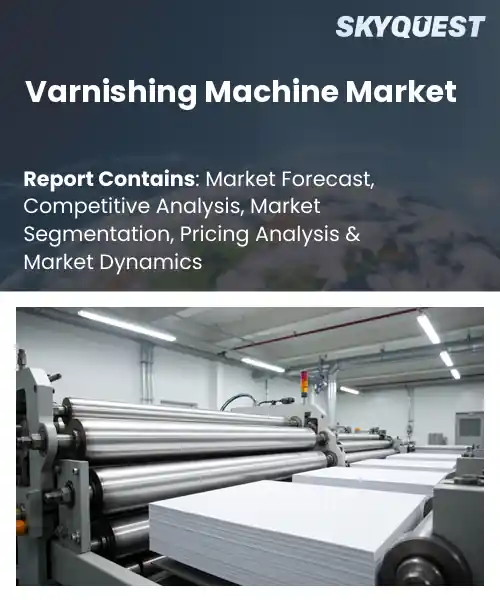
Varnishing Machine Market
Report ID: SQMIG20I2773
Report ID: SQMIG20I2773
[email protected]
USA +1 351-333-4748
Report ID:
SQMIG20I2773 |
Region:
Global |
Published Date: March, 2026
Pages:
157
|Tables:
117
|Figures:
77


Global Varnishing Machine Market size was valued at USD 25.0 Billion in 2024 and is poised to grow from USD 26.5 Billion in 2025 to USD 42.24 Billion by 2033, growing at a CAGR of 6.0% during the forecast period (2026-2033).
The global varnishing machine market is supplying equipment that applies protective and aesthetic coatings to substrates such as paperboard, wood, textiles, and metal, and the market matters because finishes influence product durability, print quality, and perceived value. There has been increased demand from the packaging sector for speed and accuracy in finishing processes. As a result, automation has evolved from manual or semi-automatic systems into fully automated inline systems with compatible varnishes. For example, many converters have also installed UV (Ultraviolet) varnishing lines to increase production speed while lowering the amount of solvent emissions.
Regulatory pressure to reduce volatile organic compound emissions and brand owners' pursuit of visual effects have driven investment in machines that support UV and water-based systems, creating a causal chain from policy and marketing needs to equipment upgrades. Companies switching from baed solvent usage to inline UV varnishing lines offer converters a quicker curing process, less energy usage per unit, and a diminished risk of compliance problems. More converters are providing additional services including spot UV for cosmetics packaging, as well as protective coatings for e-commerce cartons. In addition, these factors will continue to provide OE manufacturers of UV varnishing equipment with the opportunity to offer modular retrofits, digital controls, and service contracts capturing aftermarket revenue.
How is AI Improving Precision in the Varnishing Machine Market?
Precision in the varnishing machine market depends on consistent film build, exact registration and reliable curing. Key aspects are machine vision for surface mapping, closed loop control for adaptive dosing and robotic applicators for steady coverage. AI unites these elements by detecting subtle surface variation, predicting process drift and adjusting parameters in real time to keep finishes consistent. Today the market is shifting toward digital selective varnish systems and sensor rich roller coaters that reduce rework and shorten setup times. These advances make high quality bespoke finishes more viable for packaging, labels and furniture producers.
In January 2026, Cefla Finishing deployed iGiotto robots and Smartcoater PRO roller coating lines for a manufacturer, showing how automation and advanced controls generate the data AI needs to fine tune nozzle output and registration and thus improve edge coating consistency and operational efficiency.
Market snapshot - (2026-2033)
Global Market Size
USD 25.0 Billion
Largest Segment
Automatic Varnishing Machines
Fastest Growth
Inline Integration Units
Growth Rate
6.0% CAGR
To get more insights on this market click here to Request a Free Sample Report
Global varnishing machine market is segmented by machine type, technology/coating method, sheet format/size, end-user industry and region. Based on machine type, the market is segmented into automatic varnishing machines, semi-automatic/manual units and inline integration units. Based on technology/coating method, the market is segmented into uv varnishing, aqueous coating, roller coaters and spot varnishing. Based on sheet format/size, the market is segmented into small format and large format. Based on end-user industry, the market is segmented into packaging & folding cartons, commercial printing and advertising & signage. Based on region, the market is segmented into North America, Europe, Asia Pacific, Latin America and Middle East & Africa.
Based on the global varnishing machine market growth, UV varnishing segment dominates because it delivers a combination of rapid curing and high gloss durability that aligns with modern print finishing demands. Its chemistry enables immediate handling, reduced production bottlenecks, and consistent optical effects that enhance shelf appeal. Manufacturers favor UV capable machines for compatibility with digital and offset workflows, and for allowing compact, high speed configurations that lower per job cycle time and improve overall plant throughput and simplify maintenance and quality control.
However, aqueous coating is emerging as the most rapidly expanding area due to increasing preference for waterborne finishes driven by environmental compliance and safer workplace profiles. Improvements in formulation and application equipment have enhanced dry times and finish quality for greater use across folding box cartons, commercial print, and retrofit options that speed up adoption.
Inline integration units segment leads because integrating varnishing directly into press lines eliminates offline transfers and creates continuous finishing flows that reduce cycle time and handling variability. The integration supports synchronized process control, consistent coating application, and compact plant layouts that lower labor touchpoints and throughput losses. Brand owners and converters prioritize these units to meet tight turnaround demands and to streamline production planning across print and finishing operations.
Meanwhile, automatic varnishing machines are the fastest growing option because they provide high automation that reduces manual intervention for mid tier printers. Advances in servo control, modular tooling, and quick job change reduce downtime and simplify retrofits, prompting capital investment and enabling broader deployment across diverse finishing applications.
To get detailed segments analysis, Request a Free Sample Report
As per the global varnishing machine market share, Asia Pacific dominates the global market due to a deep industrial ecosystem, concentration of downstream manufacturing and proactive adoption of automated finishing technologies. There is a steady demand for precision coating solutions, due to the strong presence of automotive, electronics, furniture and packaging industries; regional original equipment manufacturers (OEM's) and specialist builders of machinery adjust the machinery specifically for the local production methods. The manufacturers benefit from manufacturing cost competitiveness, being in close proximity to supplier networks provides them the ability to produce large quantities very quickly, and they can access aftermarket support very quickly because of the large number of suppliers in their area. Additionally, they work closely with machine makers to expedite the introduction of new coatings into the market. The manufacturers are able to innovate continuously in processing and energy efficiency because they export a considerable portion of their products and have established a solid engineering capability.
Varnishing machine market in Japan is characterized by precision engineering and advanced automation, driven by strong demand from electronics and automotive finish applications. Coatings specialists have also developed strong relationships with manufacturers to create specialized solutions for high-quality finishes. The aftermarket service networks as well as incremental innovations around low-emission processes help support sustainability goals while also enhancing Japan’s image for providing high-quality surface finishing machinery and producing exceptional engineering.
Varnishing machine market in South Korea centers on integration of high-speed production lines and flexible finishing solutions aligned with strong electronics and automotive supply chains. Compact & efficient systems where there is a strong focus on high throughput and consistent quality manufactured locally using partnerships between machine builders and coating suppliers. Smart manufacturers that can count on responsive aftermarket support enhance uptime and ensure repeatability making South Korea competitive in its ability to provide local varnishing technology.
Based on global varnishing machine market regional outlook, Europe has seen rapid expansion in the varnishing machine market driven by a combination of high-value end markets, a strong tradition of engineering excellence and increasing emphasis on sustainable finishing practices. As the automotive, high-end furniture and premium packaging industries move toward higher specifications for surface finish and more bespoke/customised products, they are driving their suppliers to create modular & energy efficient systems that comply with stringent environmental & safety regulations. Long-established machine builders and coating manufacturers are closely aligned with their respective customers in efforts to provide customized solutions through the integration of complete processing lines. An emerging interest in the refurbishment of existing equipment, artisanal niche production and the desire for digital process control continues to broaden customer demand; market need exists for the manufacturing and distribution of varnishing equipment used in a variety of different production styles.
Varnishing machine market in Germany is anchored by a mature manufacturing base, automation expertise and close ties with automotive and industrial equipment sectors. Local machine builders emphasize robust engineering, modularity and compliance with environmental and safety norms, while collaboration with coating specialists yields optimized process solutions. Well-developed service networks and export orientation support system customization and lifecycle support, reinforcing Germany reputation as the regional anchor for advanced high-performance varnishing equipment.
Varnishing machine market in United Kingdom reflects a growing appetite for flexible, modular finishing systems that support bespoke and short-run packaging and furniture production. Choosing suppliers based on speed of tool change, size and convenience of controls allows arrangement of collaborative partnerships between equipment manufacturers, coasting producers and R&D facilities, where custom solutions can be made. Firms will also continue to focus on retrofit options that enable organizations to upgrade in order to remain competitive without interrupting operation.
Varnishing machine market in France is driven by luxury goods, premium packaging and design-led furniture sectors that prioritize surface aesthetics and quality. To meet brand requirements, machine suppliers create systems that provide decorative finishes, ensure color consistency, and can be used in low emissions processes. Collaborating with artisanal manufacturing partners and workshops helps them come up with custom designs and higher quality finish techniques. In addition, they are focusing on aesthetic point of difference along with using environmentally-friendly coatings making France an exciting place to sell specialty varnishing solutions for luxury goods.
As per global varnishing machine market regional forecast, North America is strengthening its position in the varnishing machine market through a blend of modernization, supplier consolidation and targeted innovation that caters to diverse industrial needs. Manufacturers can increase flexibility and energy-efficiency through the use of retrofit solutions and/or energy-efficient systems to upgrade existing lines with minimum disruption. An emphasis on aftermarket support services, suppliers, and service providers will aid in increasing the uptime of equipment as well as in the lifecycle management of equipment, thereby enhancing the adoption of the technology by furniture, packaging, and industrial manufacturers. The collaboration between machine builders, coating developers, and academic institutions will facilitate the acceleration of process optimization and the integration of digital controls. Growing demand for sustainable low-emission coatings and emphasis on operator ergonomics further differentiates North America capability in advanced surface finishing.
Varnishing machine market in United States is driven by a industrial base and demand for scalable, automated finishing solutions across packaging and furniture sectors. Vendors focus on retrofittable systems, large service networks and compatibility with existing plant control architectures to enhance operational uptime. Significant collaboration between machine manufacturers and coating developers provides assistance in adopting low-emission processes and unique coatings; financing programs and excellent aftermarket capabilities give manufacturers the ability to update their machines without significant interruption.
Varnishing machine market in Canada emphasizes adaptable systems that meet needs of wood products, furniture and specialty packaging manufacturers. The suppliers focus on producing compact, energy-efficient machines (with the ability to retro-fit them), which allow for the modernization of production lines. The cooperative relationship between the builders and the coating formulators allows for tailor-made process development and operator training, along with service to reduce downtime. The market's preferred characteristics require versatile equipment, environmental responsibility, and a sensible method for expanding finishing capabilities over a wide range of production footprints.
To know more about the market opportunities by region and country, click here to
Buy The Complete Report
Rising Demand For Premium Finishes
Increasingly, manufacturers from any industry want the best possible surface aesthetics, coupled with the greatest durability. As a result, they are investing in new varnishing machines capable of providing consistent and high quality coatings. This need for high quality drives manufacturers to utilize automated and accurate equipment that can meet strict finishing standards, reduce rework, and add value to their product lines. The increasing use of varnishing equipment will aid in market growth as manufacturers align their manufacturing capabilities with the continually changing expectations of consumers for high-end finish products.
Technological Advancements In Automation
Continuous advancements in automation, controls, and application technologies have enhanced machine precision, throughput, and flexibility, enabling varnishing systems to accommodate varied substrates and complex patterns. Upgrading process controls improves manufacturing efficiency and consistency by reducing variation and waste. Streamlining integration with existing production lines also makes upgrades an attractive option for manufacturers who want to improve productivity and consistency when producing their products. Modular, easy to use process control systems will promote manufacturing across all sized operations as they will allow for manufacturers to respond to the increasing demand for flexible systems that are adaptable to different finishing requirements with minimal reconfiguration of production lines.
High Capital Investment Requirements
The large amount of money typically needed for buying, installing and getting new advanced varnishing equipment up and running can discourage many potential customers - especially smaller manufacturers with limited budgets. The capital-intensive nature of this equipment limits the speed at which fleets are renewed and makes the decision-making process much longer because companies tend to put off finishing upgrades until they have already made other important investments in production. In addition, when a company's financial resources go to other operational requirements, there can be a slowdown in orders coming in for suppliers, as well as longer sales cycles. This investment barrier therefore constrains market expansion by narrowing the pool of immediate adopters despite demonstrated benefits of modern systems.
Skilled Labor Availability Challenges
Manufacturers face challenges training their employees on how to operate and service the machine, so they have no choice but to rely on outside service people, which creates an issue for new equipment; they do not want to invest all of that money into equipment, which results in less investment. Therefore, companies are unwilling to invest in upgrading their existing machinery through new equipment or even adding new lines due to fears of bad service from an outside provider and/or concerns about the lack of trained technicians. Therefore, as long as there are not enough trained employees available, it will take a long time for the varnish equipment sector to grow and fulfil its capabilities.
Request Free Customization of this report to help us to meet your business objectives.
The global varnishing machine market outlook features a competitive landscape characterized by a mix of established international players and specialized manufacturers focusing on innovation and customization. The leading companies in this industry that use advanced automation and light-weight coatings and use sustainable coating processes as their key sources of competitive advantage are Cefla Finishing, Nordson Corp., Graco Inc., Wagner Group, and Gema Switzerland. While Cefla promotes integrated 'turnkey' systems, Nordson and Graco concentrate on supplying precision applicators and digital-devices that support companies in delivering better product quality, improved efficiencies, and enhanced global market penetration.
SkyQuest’s ABIRAW (Advanced Business Intelligence, Research & Analysis Wing) is our Business Information Services team that Collects, Collates, Correlates, and Analyses the Data collected by means of Primary Exploratory Research backed by robust Secondary Desk research.
As per SkyQuest analysis, the global varnishing machine industry is being propelled primarily by packaging industry demand for high-speed, precision finishing that enhances brand appeal and sustainability, and is further accelerated by advances in automation and digitalization that boost throughput and consistency. The adoption of new technologies has been stated to be relatively slow for smaller operators due to the cost of purchasing high capital equipment. The Asia Pacific Region is still the largest region for Tech as a result of its population size and manufacturing base, and UV varnishing technology is leading the pack because it can cure faster and produce greater surface effects than other technologies. Therefore, original equipment manufacturers focusing on modularity for retrofit applications, service contracts for their customers and low- or no-emission compatibility will have the best chance of capturing aftermarket and retrofit opportunities.
| Report Metric | Details |
|---|---|
| Market size value in 2024 | USD 25.0 Billion |
| Market size value in 2033 | USD 42.24 Billion |
| Growth Rate | 6.0% |
| Base year | 2024 |
| Forecast period | (2026-2033) |
| Forecast Unit (Value) | USD Billion |
| Segments covered |
|
| Regions covered | North America (US, Canada), Europe (Germany, France, United Kingdom, Italy, Spain, Rest of Europe), Asia Pacific (China, India, Japan, Rest of Asia-Pacific), Latin America (Brazil, Rest of Latin America), Middle East & Africa (South Africa, GCC Countries, Rest of MEA) |
| Companies covered |
|
| Customization scope | Free report customization with purchase. Customization includes:-
|
To get a free trial access to our platform which is a one stop solution for all your data requirements for quicker decision making. This platform allows you to compare markets, competitors who are prominent in the market, and mega trends that are influencing the dynamics in the market. Also, get access to detailed SkyQuest exclusive matrix.
Table Of Content
Executive Summary
Market overview
Parent Market Analysis
Market overview
Market size
KEY MARKET INSIGHTS
COVID IMPACT
MARKET DYNAMICS & OUTLOOK
Market Size by Region
KEY COMPANY PROFILES
Methodology
For the Varnishing Machine Market, our research methodology involved a mixture of primary and secondary data sources. Key steps involved in the research process are listed below:
1. Information Procurement: This stage involved the procurement of Market data or related information via primary and secondary sources. The various secondary sources used included various company websites, annual reports, trade databases, and paid databases such as Hoover's, Bloomberg Business, Factiva, and Avention. Our team did 45 primary interactions Globally which included several stakeholders such as manufacturers, customers, key opinion leaders, etc. Overall, information procurement was one of the most extensive stages in our research process.
2. Information Analysis: This step involved triangulation of data through bottom-up and top-down approaches to estimate and validate the total size and future estimate of the Varnishing Machine Market.
3. Report Formulation: The final step entailed the placement of data points in appropriate Market spaces in an attempt to deduce viable conclusions.
4. Validation & Publishing: Validation is the most important step in the process. Validation & re-validation via an intricately designed process helped us finalize data points to be used for final calculations. The final Market estimates and forecasts were then aligned and sent to our panel of industry experts for validation of data. Once the validation was done the report was sent to our Quality Assurance team to ensure adherence to style guides, consistency & design.
Analyst Support
Customization Options
With the given market data, our dedicated team of analysts can offer you the following customization options are available for the Varnishing Machine Market:
Product Analysis: Product matrix, which offers a detailed comparison of the product portfolio of companies.
Regional Analysis: Further analysis of the Varnishing Machine Market for additional countries.
Competitive Analysis: Detailed analysis and profiling of additional Market players & comparative analysis of competitive products.
Go to Market Strategy: Find the high-growth channels to invest your marketing efforts and increase your customer base.
Innovation Mapping: Identify racial solutions and innovation, connected to deep ecosystems of innovators, start-ups, academics, and strategic partners.
Category Intelligence: Customized intelligence that is relevant to their supply Markets will enable them to make smarter sourcing decisions and improve their category management.
Public Company Transcript Analysis: To improve the investment performance by generating new alpha and making better-informed decisions.
Social Media Listening: To analyze the conversations and trends happening not just around your brand, but around your industry as a whole, and use those insights to make better Marketing decisions.
REQUEST FOR SAMPLE
 REQUEST FREE CUSTOMIZATION
Global Varnishing Machine Market size was valued at USD 25.0 Billion in 2024 and is poised to grow from USD 26.5 Billion in 2025 to USD 42.24 Billion by 2033, growing at a CAGR of 6.0% during the forecast period (2026-2033).
I cannot verify two real startups founded in 2019 or later that focus specifically on varnishing machines. May I proceed by (a) using two verified companies active in the varnish/digital embellishment ecosystem that meet the date requirement (for example a SaaS embellishment startup plus a recent hardware entrant), or (b) include one verified startup plus one established vendor that launched a new varnish product after 2019? Please confirm which option you prefer. 'IHI Corporation', 'Nordson Corporation', 'OC Oerlikon', 'SATA GmbH', 'Graco Inc.', 'ANEST IWATA', 'ASAHI Sunac', 'Heidelberg', 'Koenig & Bauer', 'Bobst', 'Komori Corporation', 'Giardina Group', 'Cefla Finishing', 'BÜrkle', 'Sorbini', 'Venjakob', 'Makor', 'Aetee Group', 'DGM Machinery', 'Ushio Inc.'
Manufacturers across industries are increasingly seeking superior surface aesthetics and durability, prompting investment in advanced varnishing machines that deliver consistent, high quality coatings. This preference drives adoption of automated and precise equipment capable of meeting stringent finish standards, reducing rework and enhancing product value. As design trends emphasize refined textures and prolonged surface protection, varnishing solutions become integral to production lines, encouraging suppliers to innovate and expand offerings. The resulting equipment uptake supports market expansion by aligning manufacturing capabilities with evolving end user expectations for premium finishes.
Sustainability Driven Demand: Sustainability-driven demand is reshaping varnishing machine development and procurement as manufacturers, brand owners and end customers prioritize eco-friendly coating solutions and circular production practices. Equipment makers respond with systems compatible with water-based and bio-based formulations, reduced solvent handling, improved material yield and waste minimization features. Lifecycle considerations, regulatory alignment and supplier transparency drive longer-term service agreements and retrofit offerings. Emphasis on energy efficiency and closed-loop solvent recovery enhances total cost of ownership narratives, prompting fleet renewal and collaboration along the value chain.
Why does Asia Pacific Dominate the Global Varnishing Machine Market? |@12


Want to customize this report? This report can be personalized according to your needs. Our analysts and industry experts will work directly with you to understand your requirements and provide you with customized data in a short amount of time. We offer $1000 worth of FREE customization at the time of purchase.
Feedback From Our Clients


 USA (+1) 351-333-4748

