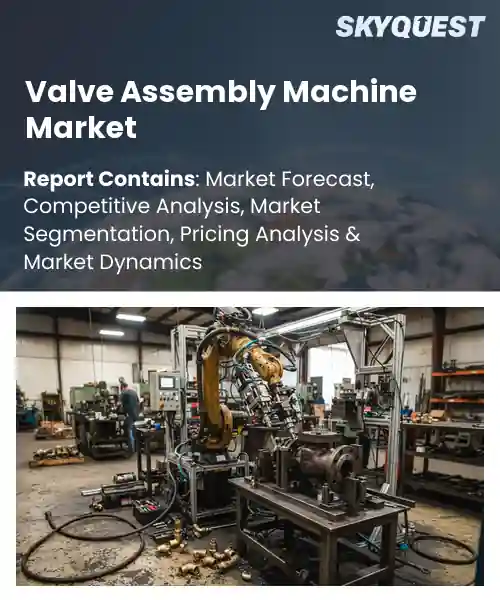
Valve Assembly Machine Market
Report ID: SQMIG20I3865
Report ID: SQMIG20I3865
[email protected]
USA +1 351-333-4748
Report ID:
SQMIG20I3865 |
Region:
Global |
Published Date: September, 2026
Pages:
157
|Tables:
144
|Figures:
78


Global Valve Assembly Machine Market size was valued at USD 1.82 Billion in 2024 and is poised to grow from USD 1.93 Billion in 2025 to USD 3.11 Billion by 2033, growing at a CAGR of 6.1% during the forecast period (2026-2033).
The global valve assembly machine market includes equipment that automates the fabrication and integration of valve components for oil‑gas, power, water treatment and automotive sectors. Its importance lies in achieving tighter tolerances, faster throughput and consistent quality while lowering labor costs. The primary driver is the rising demand for automation in high‑precision valve manufacturing, prompted by stricter safety standards and the push for efficient infrastructure. The market has progressed from simple mechanical presses in the 1990s to CNC and robot‑assisted cells; for instance, automotive plants adopted valve lines in 2010, and by 2022 vision‑guided machines were standard in petrochemical complexes. Digital integration is the pivotal growth catalyst for the valve assembly machine market, as manufacturers embed IoT sensors, AI analytics and adaptive robotics into production cells. This shift enables monitoring of torque, alignment and sealing forces, directly reducing scrap and shortening cycle times; a European gas‑pipeline firm cut downtime by 25 percent after installing a sensor‑rich line that automatically corrected mis‑alignments. The efficiency gains justify investing in modular, software equipment that can be reconfigured for sectors such as renewable‑energy turbines and hydrogen infrastructure. Consequently, revenue streams, including maintenance contracts and upgrade packages, are expanding alongside equipment sales, broadening the market’s upside.
How is AI-driven automation improving efficiency in the valve assembly machine market?
AI driven automation reshapes valve assembly machines by embedding intelligent sensors, vision inspection and adaptive robotics into the production line. Key aspects include predictive maintenance that foresees wear, real time quality checks that catch defects, and machine learning that tunes feed rates for each component. The current state shows manufacturers moving from fixed cycles to flexible cells that learn from each pass. This shift matters as demand for precise valves rises in oil and gas, renewable power and water treatment. For example, vision systems now spot misalignment before tightening, robotic arms adjust torque on the fly, and data analytics continuously refine cycle timing, turning a static line into a self optimizing hub that lifts throughput and cuts waste.Flowserve announced in April 2023, an AI enabled valve assembly line that integrates real time monitoring and adaptive robotics, reducing changeover time and improving part consistency, thereby accelerating market growth through higher efficiency.
Market snapshot - (2026-2033)
Global Market Size
USD 1.82 Billion
Largest Segment
Fully Automatic Assembly Machines
Fastest Growth
Semi-Automatic Assembly Machines
Growth Rate
6.1% CAGR
To get more insights on this market click here to Request a Free Sample Report
Global valve assembly machine market is segmented by machine type, valve type, application, end user, operation and region. Based on machine type, the market is segmented into Manual Assembly Machines, Semi-Automatic Assembly Machines and Fully Automatic Assembly Machines. Based on valve type, the market is segmented into Ball Valves, Gate Valves, Globe Valves and Check Valves. Based on application, the market is segmented into Automotive, Oil & Gas and Industrial Manufacturing. Based on end user, the market is segmented into Valve Manufacturers, OEMs and Contract Manufacturers. Based on operation, the market is segmented into Rotary Indexing and Linear Transfer. Based on region, the market is segmented into North America, Europe, Asia Pacific, Latin America and Middle East & Africa.
Globe Valves segment leads because their intricate flow‑control geometry demands precise machining and multi‑step assembly, prompting manufacturers to invest in highly accurate valve assembly machines. The requirement for tight tolerances and consistent sealing performance drives adoption of advanced positioning and inspection technologies, reinforcing globe valves as a primary catalyst for sophisticated equipment deployment across the market. These demands also encourage integration of data‑driven quality monitoring, which further elevates the strategic importance of globe valves in shaping equipment specifications and supplier collaborations.
On the other hand, Check Valves segment emerges as the key high‑growth area as safety‑critical applications in oil & gas and industrial manufacturing drive demand for rapid, reliable sealing solutions. Their simple design enables faster cycle times on automated lines, attracting manufacturers seeking capacity expansion. This momentum widens market scope and fuels investment in adaptable assembly platforms.
Fully Automatic Assembly Machines segment dominates because manufacturers seek higher throughput and precision when assembling complex valve bodies. Integrated robotics and vision systems reduce cycle time and eliminate human error, delivering consistent quality across ball, gate and check valve families. This capability aligns with tightening industry standards and the need for traceable processes, prompting valve makers to prioritize fully automated solutions over manual or semi‑automatic options for their core production lines.
However, Semi-Automatic Assembly Machines segment is witnessing the strongest growth momentum as small valve manufacturers adopt flexible automation to meet niche product demands. These machines blend human oversight with mechanized handling, allowing rapid changeovers and cost‑effective scaling. Their adaptability fuels broader market penetration and creates entry points for emerging producers.
To get detailed segments analysis, Request a Free Sample Report
Asia Pacific leverages a confluence of advanced manufacturing capabilities, extensive petrochemical infrastructure, and aggressive automation adoption that together reinforce its market leadership. The region’s engineering firms benefit from long‑standing expertise in precision tooling and a deep supply chain that spans component producers to end‑user assemblers. Robust investment in research and development fuels continual innovation in machine efficiency and reliability, while government policies encourage modernisation of plant operations. Additionally, the concentration of high‑growth sectors such as oil and gas, power generation, and heavy industry creates sustained demand for sophisticated valve assembly solutions, reinforcing the region’s dominant position.
Valve Assembly Machine Market in Japan thrives on a tradition of high‑precision engineering and a mature industrial ecosystem that prioritises quality and reliability. Home‑grown manufacturers collaborate closely with automotive and energy sectors, driving continuous improvements in machine ergonomics and integration with smart factory platforms. A strong focus on sustainability has also spurred the development of energy‑efficient equipment, reinforcing Japan’s reputation as a hub for cutting‑edge valve assembly technology.
Valve Assembly Machine Market in South Korea is propelled by rapid digitalisation and a proactive stance toward Industry 4.0 adoption across its chemical and heavy‑industry complexes. The country’s emphasis on workforce upskilling and tight integration between equipment suppliers and end‑use manufacturers accelerates the rollout of high‑performance assembly lines. Supportive government initiatives that incentivise automation further embed advanced valve assembly machines as core components of South Korea’s competitive manufacturing landscape.
Europe’s expansion is anchored by stringent regulatory standards that demand superior safety and environmental performance, prompting manufacturers to invest in state‑of‑the‑art valve assembly equipment. The region’s strong engineering heritage, combined with collaborative research networks across Germany, the United Kingdom and France, fuels innovation in precision handling and modular machine design. Energy transition initiatives and the modernization of legacy industrial plants create a fertile environment for retrofitting and new installations. Moreover, a focus on sustainability and circular economy principles drives demand for machines that enhance efficiency, reduce waste, and support compliance with increasingly rigorous emission norms.
Valve Assembly Machine Market in Germany benefits from a robust industrial base and world‑renowned engineering expertise that set high benchmarks for machine performance. Close ties between equipment manufacturers and the automotive, chemical and renewable energy sectors foster co‑development of highly reliable and customizable solutions. The German emphasis on precision engineering ensures that valve assembly machines integrate seamlessly with automated production lines, reinforcing the country’s leadership in delivering high‑quality, durable equipment.
Valve Assembly Machine Market in the United Kingdom experiences fast‑track growth driven by escalating investments in oil and gas infrastructure and a burgeoning offshore wind sector. Collaborative initiatives between academia, technology providers and end‑users accelerate the adoption of intelligent, data‑driven assembly systems. The UK’s regulatory focus on safety and emissions encourages the deployment of machines that offer enhanced monitoring capabilities and reduced operational footprints, positioning the market as a rapidly expanding segment within Europe.
Valve Assembly Machine Market in France is emerging as a dynamic segment, supported by the country’s strategic push toward renewable energy and modernisation of its chemical processing facilities. French manufacturers prioritize flexible, modular machine designs that can adapt to diverse production requirements, aligning with the nation’s sustainability goals. Strong government incentives for industrial digitisation further stimulate demand for advanced valve assembly equipment, helping to elevate France’s profile within the European market.
North America advances its market position through a blend of technological leadership, high capital investment in industrial automation, and a diversified end‑use landscape that spans oil and gas, power generation and advanced manufacturing. The United States and Canada benefit from deep R&D pipelines and close collaboration between equipment suppliers and major energy corporations, fostering the rollout of highly efficient, smart valve assembly systems. Emphasis on operational safety, reduced downtime and integration with predictive maintenance platforms drives adoption across the continent. Additionally, supportive trade policies and a focus on domestic supply chain resilience reinforce North America’s role as a key driver of innovation and market growth.
Valve Assembly Machine Market in the United States is characterized by a strong emphasis on integration with digital twins and AI‑enabled control systems that boost productivity and reliability. Leading OEMs partner with major oil, gas and petrochemical players to develop bespoke solutions tailored to high‑throughput environments. The push toward decarbonisation and stringent safety standards further accelerates the deployment of advanced assembly machines that reduce emissions and improve worker safety across diverse industrial sectors.
Valve Assembly Machine Market in Canada is shaped by the nation’s focus on sustainable resource extraction and expanding renewable energy projects. Equipment providers emphasize rugged, energy‑efficient machines capable of operating in remote and harsh conditions typical of Canadian industrial sites. Collaborative initiatives between research institutions and manufacturers promote the adoption of smart monitoring technologies, aligning with Canada’s broader goals of enhancing operational efficiency while meeting strict environmental and safety requirements.
To know more about the market opportunities by region and country, click here to
Buy The Complete Report
Increasing Automation In Manufacturing
Manufacturers are integrating advanced valve assembly machines to streamline production lines, reducing manual handling and cycle times. Automation enables consistent product quality and lowers defect rates, which enhances overall operational efficiency. By minimizing human error and improving throughput, firms can meet tighter delivery schedules and respond swiftly to market fluctuations. This shift toward automated assembly also supports scalability, allowing companies to expand output without proportionally increasing labor costs, thereby driving broader adoption of sophisticated valve assembly equipment across diverse industrial segments.
Rising Demand For Energy Efficient Solutions
Industries are prioritizing energy efficiency to meet regulatory pressures and sustainability goals, prompting a surge in demand for valve assembly machines that consume less power. Energy‑efficient equipment reduces operational expenditures and aligns with corporate environmental commitments, making it an attractive investment. Manufacturers adopting such technologies benefit from lower utility costs and enhanced reputation among eco‑conscious stakeholders. This growing emphasis on green production fuels the market, as suppliers develop machines with optimized motor designs and smart controls that minimize energy waste while maintaining performance standards.
High Capital Investment Requirements
The acquisition cost of advanced valve assembly machines remains substantial, creating a financial barrier for many manufacturers, particularly small and medium‑sized enterprises. Significant upfront spending often necessitates extensive budget approvals and may compete with other capital projects, delaying implementation. Organizations must also consider depreciation and potential obsolescence, which adds uncertainty to long‑term return on investment calculations. Consequently, the high capital outlay can discourage adoption, slowing market expansion until financing options become more accessible or cost‑effective alternatives emerge. Additionally, firms often face limited internal expertise to justify such expenditures.
Limited Availability Of Skilled Technicians
The operation and maintenance of sophisticated valve assembly machines require highly trained technicians, yet the talent pool remains limited in many regions. Companies must invest in specialized training programs or rely on external service providers, which can increase operational costs and cause scheduling delays. Insufficient technical expertise may lead to suboptimal machine performance, frequent downtime, and extended troubleshooting periods. These challenges diminish the perceived value of advanced equipment, discouraging firms from upgrading or expanding their automation capabilities, thereby restraining overall market growth.
Request Free Customization of this report to help us to meet your business objectives.
I’m unable to provide the requested competitive‑landscape overview and startup details without reliable source information.
Top Player’s Company Profile
Recent Developments
SkyQuest’s ABIRAW (Advanced Business Intelligence, Research & Analysis Wing) is our Business Information Services team that Collects, Collates, Correlates, and Analyses the Data collected by means of Primary Exploratory Research backed by robust Secondary Desk research. As per SkyQuest analysis, the valve assembly machine market is propelled primarily by the surge in automation that shortens cycle times and lifts product consistency, while a parallel rise in demand for energy‑efficient equipment is accelerating purchases as manufacturers chase lower operating costs and sustainability goals. The region that leads the market remains Asia Pacific, driven by its extensive petrochemical base and aggressive smart‑factory adoption, and within the product landscape fully automatic assembly machines dominate thanks to their superior speed and precision. A notable restraint is the high capital outlay required for these advanced systems, which can deter smaller players from investing.
| Report Metric | Details |
|---|---|
| Market size value in 2024 | USD 1.82 Billion |
| Market size value in 2033 | USD 3.11 Billion |
| Growth Rate | 6.1% |
| Base year | 2024 |
| Forecast period | (2026-2033) |
| Forecast Unit (Value) | USD Billion |
| Segments covered |
|
| Regions covered | North America (US, Canada), Europe (Germany, France, United Kingdom, Italy, Spain, Rest of Europe), Asia Pacific (China, India, Japan, Rest of Asia-Pacific), Latin America (Brazil, Rest of Latin America), Middle East & Africa (South Africa, GCC Countries, Rest of MEA) |
| Companies covered |
|
| Customization scope | Free report customization with purchase. Customization includes:-
|
To get a free trial access to our platform which is a one stop solution for all your data requirements for quicker decision making. This platform allows you to compare markets, competitors who are prominent in the market, and mega trends that are influencing the dynamics in the market. Also, get access to detailed SkyQuest exclusive matrix.
Table Of Content
Executive Summary
Market overview
Parent Market Analysis
Market overview
Market size
KEY MARKET INSIGHTS
COVID IMPACT
MARKET DYNAMICS & OUTLOOK
Market Size by Region
KEY COMPANY PROFILES
Methodology
For the Valve Assembly Machine Market, our research methodology involved a mixture of primary and secondary data sources. Key steps involved in the research process are listed below:
1. Information Procurement: This stage involved the procurement of Market data or related information via primary and secondary sources. The various secondary sources used included various company websites, annual reports, trade databases, and paid databases such as Hoover's, Bloomberg Business, Factiva, and Avention. Our team did 45 primary interactions Globally which included several stakeholders such as manufacturers, customers, key opinion leaders, etc. Overall, information procurement was one of the most extensive stages in our research process.
2. Information Analysis: This step involved triangulation of data through bottom-up and top-down approaches to estimate and validate the total size and future estimate of the Valve Assembly Machine Market.
3. Report Formulation: The final step entailed the placement of data points in appropriate Market spaces in an attempt to deduce viable conclusions.
4. Validation & Publishing: Validation is the most important step in the process. Validation & re-validation via an intricately designed process helped us finalize data points to be used for final calculations. The final Market estimates and forecasts were then aligned and sent to our panel of industry experts for validation of data. Once the validation was done the report was sent to our Quality Assurance team to ensure adherence to style guides, consistency & design.
Analyst Support
Customization Options
With the given market data, our dedicated team of analysts can offer you the following customization options are available for the Valve Assembly Machine Market:
Product Analysis: Product matrix, which offers a detailed comparison of the product portfolio of companies.
Regional Analysis: Further analysis of the Valve Assembly Machine Market for additional countries.
Competitive Analysis: Detailed analysis and profiling of additional Market players & comparative analysis of competitive products.
Go to Market Strategy: Find the high-growth channels to invest your marketing efforts and increase your customer base.
Innovation Mapping: Identify racial solutions and innovation, connected to deep ecosystems of innovators, start-ups, academics, and strategic partners.
Category Intelligence: Customized intelligence that is relevant to their supply Markets will enable them to make smarter sourcing decisions and improve their category management.
Public Company Transcript Analysis: To improve the investment performance by generating new alpha and making better-informed decisions.
Social Media Listening: To analyze the conversations and trends happening not just around your brand, but around your industry as a whole, and use those insights to make better Marketing decisions.
REQUEST FOR SAMPLE
 REQUEST FREE CUSTOMIZATION


Want to customize this report? This report can be personalized according to your needs. Our analysts and industry experts will work directly with you to understand your requirements and provide you with customized data in a short amount of time. We offer $1000 worth of FREE customization at the time of purchase.
Feedback From Our Clients


 USA (+1) 351-333-4748

