
Value-Added Services (VAS) in Retail Market
Report ID: SQMIG45B2313
Report ID: SQMIG45B2313
[email protected]
USA +1 351-333-4748
Report ID:
SQMIG45B2313 |
Region:
Global |
Published Date: March, 2026
Pages:
157
|Tables:
117
|Figures:
77


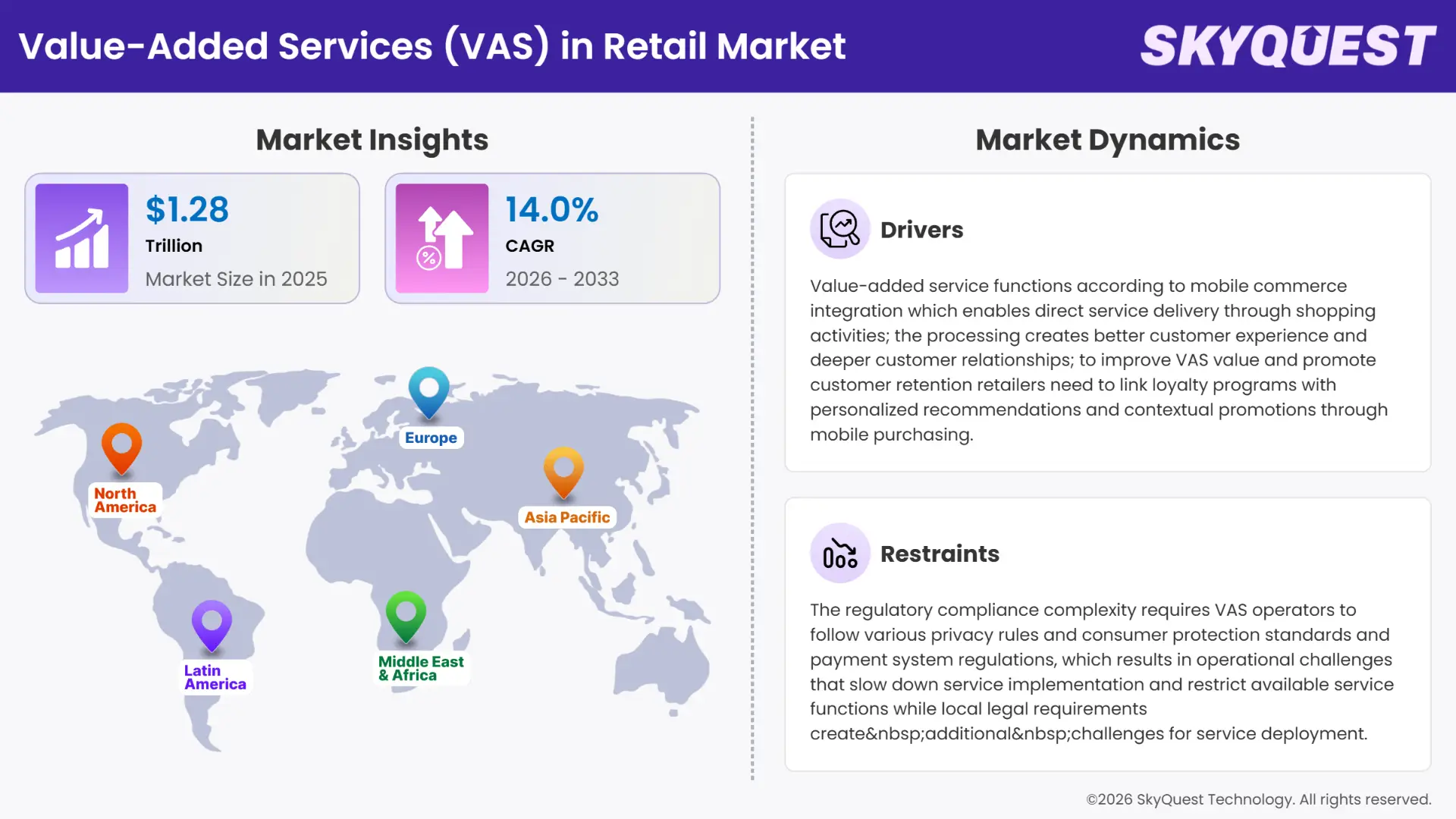
Global Value-Added Services (Vas) In Retail Market size was valued at USD 1.12 Trillion in 2024 and is poised to grow from USD 1.28 Trillion in 2025 to USD 3.64 Trillion by 2033, growing at a CAGR of 14.0% during the forecast period (2026-2033).
Key Takeaways: Market Trends & Insights
The global value-added services (VAS) in retail market growth is driven through its current demand for tailored services which offer customers convenience while building their brand loyalty and helping businesses stand out in the market. VAS includes click-and-collect services and loyalty analytics and in-store personalization and installation and warranty extensions and omnichannel fulfillment, which together creates an ecosystem that supports the main product sales of businesses. This market enables companies to attain better market positions than their competitors through their customer relationships, which provides them with more profit and customer understanding than their opponents. VAS developed into advanced data-driven services from its beginning as a basic warranty add-on service because e-commerce and mobile payments and IoT created more customer touchpoints that retailers used to track their inventory.
The global Value-Added Services (VAS) in retail market penetration depends on data monetization through omnichannel integration, which uses operational data to create customized revenue streams and service offerings. Retailers use their purchase history and location data and device interaction information to perform predictive replenishment and targeted promotions and post-sale services, which result in decreased inventory expenses and increased conversion rates. Amazon uses its subscription services to enhance customer retention while a grocery chain employs real-time analytics to maximize its click-and-collect capacity, which results in greater customer throughput. Monetized data products together with third-party service ecosystems emerge as opportunities for businesses through their platform partnerships and requirements to adhere to regulations.
How is AI Enhancing Personalized Value-added Services in the Retail Market?
AI supports personalized value-added services in retail by converting unprocessed customer signals into unique shopping experiences that create the impression of intentional product selection. The experience includes personalized recommendations, conversational shopping, visual try-ons, and contextual offers that users create based on their specific browsing activities. Retailers currently implement customized shopping experiences which utilize data from customer interactions to shape their promotional activities and product delivery and customer loyalty programs. Retailers currently use these services as essential tools for maintaining customer loyalty while growing their brand value because market conditions require businesses to provide unique customer experiences. The practical examples of AI-generated bundles enable customers to select items, and chat-based shopping assistants help users make product selections, while post-purchase assistance services operate more efficiently to improve user experience and customer contentment. Walmart, in January 2026, launched its shopping system which combines AI chat with Google Gemini to enable customers to shop and complete instant purchase transactions. The development demonstrates how value-added services in retail use AI agents to provide both personalized offers and shopping assistance, which leads to smoother transactions and enhanced operational performance.
To get more insights on this market click here to Request a Free Sample Report
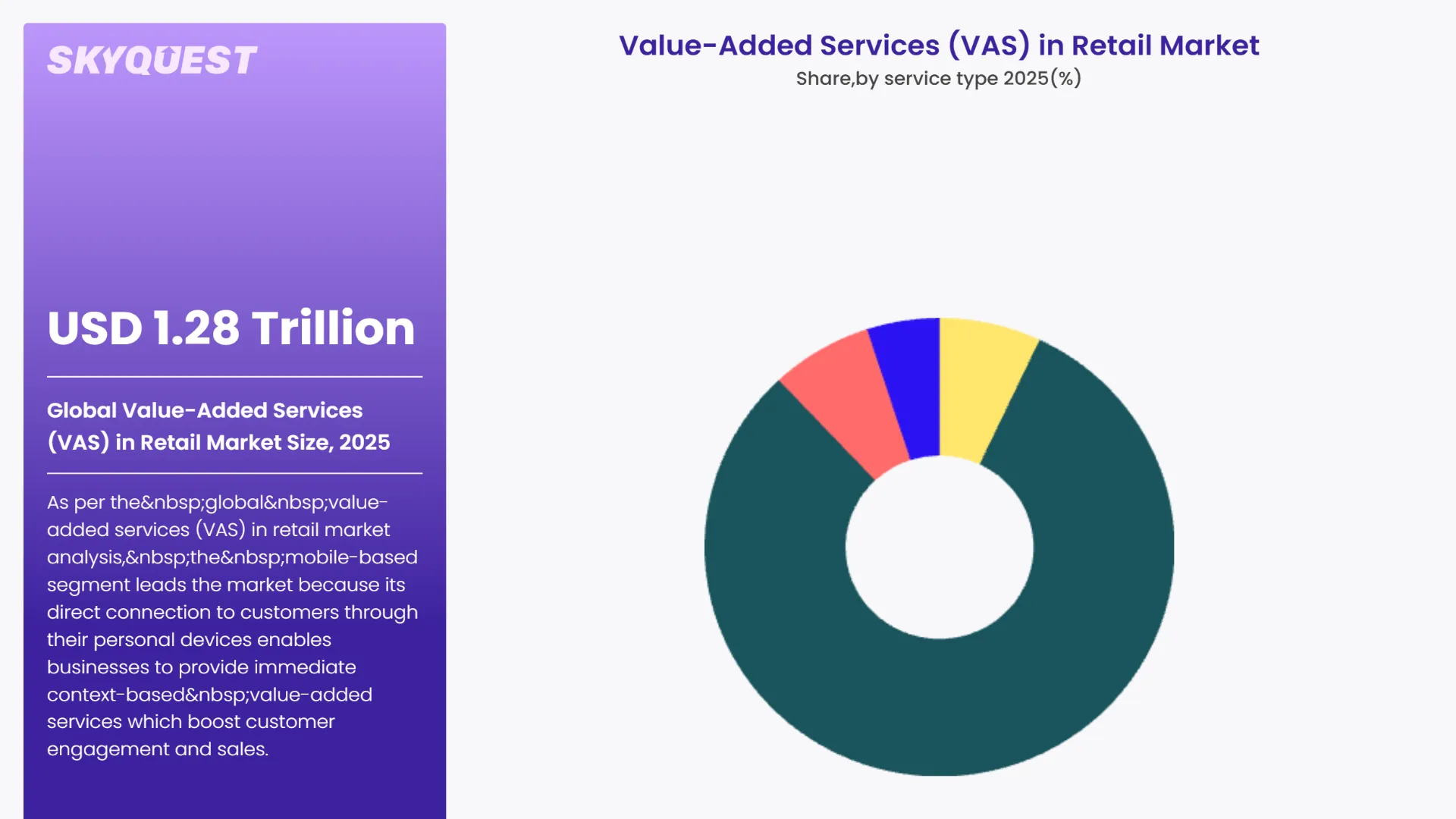
The global value-added services (VAS) in retail market is segmented based on service type, technology platform, retail category, end-user benefit, and region. By service type, the market includes financial VAS, interactive VAS, information VAS, and post-purchase VAS. In terms of technology platform, it is categorized into mobile-based platforms, web-based or e-commerce portals, and in-store digital kiosks. Based on retail category, the market is divided into consumer electronics and appliances, fashion and apparel, and grocery and FMCG. By end-user benefit, the market focuses on customer retention and engagement, as well as revenue diversification. Geographically, the market spans North America, Europe, Asia Pacific, Latin America, and the Middle East and Africa.
As per the global value-added services (VAS) in retail market analysis, the mobile-based segment leads the market because its direct connection to customers through their personal devices enables businesses to provide immediate context-based value-added services which boost customer engagement and sales. Retailers use in-app personalization and push communications together with mobile payments and location-aware offers to create shorter decision paths which help more customers access their services. The tight integration with loyalty programs together with analytics allows businesses to turn their customer interactions into useful business intelligence, which results in continuous service improvement through mobile channels that deliver paid value-enhancing services.
However, the web-based/e-commerce portals sector is currently experiencing rapid growth because online storefronts have become widely adopted by merchants who want to use advanced recommendation engines together with seamless checkout systems. Retailers who use scalable integrations with third-party marketplaces together with analytics tools can create their own service bundles which include information-rich value-added services and payment options and post-sale services to drive revenue growth and access new market opportunities.
According to the global value-added services (VAS) in retail market forecast, the Post-Purchase VAS segment dominates because businesses use after-sales contact points to create better customer experiences, which leads to improved customer retention and repeat purchases that develop into lasting customer relationships. Retailers provide services which include support and returns management together with installation and warranty handling to create smooth customer experiences, which helps them build customer trust, which leads to higher customer retention and increased customer spending. Companies achieve better customer experiences through their operational investments in service delivery and proactive customer contact, which help create trust-based customer relationships that lead to repeat purchases.
Whereas the financial VAS category is anticipated to have the highest value-added services (VAS) in retail market share because embedded payments and flexible financing options together with wallet features enable customers to pay with less difficulty, which raises the average value of their purchases. Retailers adopt new monetization models together with cross-sell strategies to expand their revenue streams through their partnership with fintech providers, who help them build better checkout systems.
To get detailed segments analysis, Request a Free Sample Report
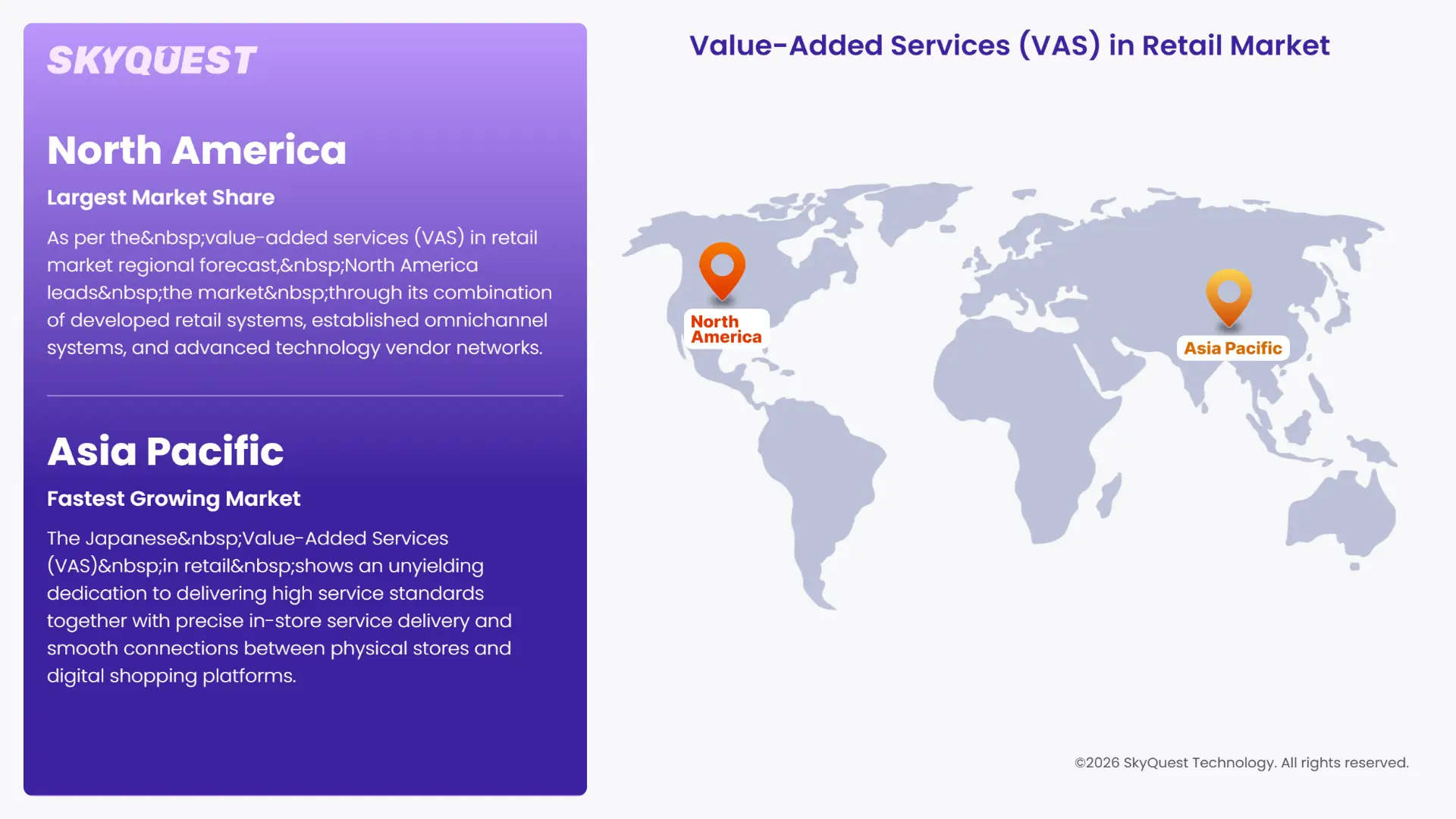
As per the value-added services (VAS) in retail market regional forecast, North America leads the market through its combination of developed retail systems, established omnichannel systems, and advanced technology vendor networks. Retailers use all payment innovations together with loyalty systems and personalized fulfillment methods to create better customer experiences while improving their operational processes. The deep partnerships which retailers create with their solution providers and logistics partners enable them to deliver services that reach beyond their essential transactional work into their after sales and customization and experiential solutions. Retailers use powerful data analytics tools which enable them to gather customer insights to develop customized VAS solutions for different retail formats which include both mainstream chains and specialty boutiques. The cross-border retail leaders in the industry use pilot programs with their agile deployment cycles to spread their successful service models into foreign markets.
The United States Value-Added Services (VAS) in retail market displays dynamic testing activities which include omnichannel fulfillment and loyalty programs and subscription services and financial products embedded within retail operations. Large retailers pilot integrated after sales care and personalized engagement through advanced data platforms, while third party providers focus on modular, scalable solutions. The strong vendor ecosystems together with the rising demand for unique shopping experiences create continuous service integration which establishes new service boundaries between retail and non-retail activities.
The Canadian Value-Added Services (VAS) in retail industry focuses on creating unified customer experiences which enable customers to move between different channels while offering local delivery services and establishing partnerships to assist small retail networks. Retailers focus on developing loyalty programs which all customers can access together with delivery systems that work for customers who live in remote areas. The service providers create bilingual solutions which meet regional requirements while they build partnerships with logistics networks to raise the quality of the last mile of services. The market shows practical adoption which centers on dependable systems that allow customers to personalize their experience while their convenience needs get fulfilled.
Asia Pacific developed urban markets which have high rates of digital consumer behavior and advanced mobile commerce usage and citizens who quickly embrace new convenience services. Local retailers and platform operators invest in tailored VAS such as integrated payments, last mile innovation, and experiential retail features to capture discerning shoppers. The main technology ecosystems in important markets enable startups to work together with existing vendors and logistics providers, which speeds up the process of creating localized solutions. The private sector partnerships between organizations and the public sector drive service diversification within markets which tolerate little service interruption. The market exists because islands and regions create fragmentation which makes businesses use modular services that work across different retail formats.
The Japanese Value-Added Services (VAS) in retail shows an unyielding dedication to delivering high service standards together with precise in-store service delivery and smooth connections between physical stores and digital shopping platforms. Retailers focus on delivering better after-sales service together with customizing services and creating special experiences that appeal to high-end customers. Automation,together with subtle personalization through technology, supports operational efficiency while maintaining hospitality service standards. The solutions which providers develop help businesses with small retail spaces to deliver high-end service to their customers.
The Value-Added Services (VAS) in retail market in South Korea exists because consumers now have maximum connectivity through advanced mobile systems and they want instant access to their desired products. Retailers use integrated payment and loyalty functions, social commerce tie ins, and fast fulfillment to differentiate offerings. The process of creating new services results from the direct interaction which occurs between technology startups and established retail businesses. The market system requires businesses to develop flexible operations which can quickly adapt to market trends while using digital services that provide both immediate access and individualized customer experiences.
European nations strengthen their position through strict regulations and advanced retail systems and their commitment to providing high-quality sustainable services. Retailers in main markets establishintegrated omnichannel value-added services which connect their physical stores with online customer benefits while their delivery and payment systems advance to enable unique service delivery. Retailers and technology vendors and logistics providers work together to create systems which enable different companies to interact and operate across international borders. Consumers demand trust and privacy protection together with customized experiences which lead providers to offer clear and excellent services for their customers. The value-added services created through sustainable packaging practices and ethical sourcing methods and inclusive accessibility initiatives establish the region as a premium market leader in socially responsible service innovations. Retailers and industry consortia conduct pilot programs to update their service offerings while maintaining customer trust, which leads to controlled product development between established brands and new market players.
The German Value-Added Services (VAS) in retail market penetration relies on which deliver dependable services through precise fulfillment and seamless operational connections between retail and logisticssystems. Providers deliver comprehensive after-sales services together with multiple pickup options and specialized services which handle intricate supply chain operations. Retailers use modular value-added services to achieve operational efficiency required by both large retailers and single-location shops. Retailers focus on sustainable packaging and transparent service terms because they want to match consumer demands for responsible retail market behavior.
The United Kingdom Value-Added Services (VAS) in Retail Market emphasize customer-centered services together with adaptable delivery methods and financial service links which strengthen customer relationships. Retailers use personalized shopping experiences together with custom product collections and value-added post-purchase services to develop stronger customer relationships with their brands. The local technology ecosystem enables businesses to test service concepts while retail companies and delivery services work together to enhance their last-mile delivery operations. The selection of vendors and the design of services depend on organizations who meet regulatory requirements and build trust with customers.
The Value-Added Services (VAS) system in France stems from its established luxury and lifestyle retail traditions, which create a demand for high-end shopping experiences and premium post-purchase support and customized product recommendations. Retailers combine sophisticated in-store customer experiences with online customer service points to deliver unbroken brand narratives throughout their various platforms. Vendors work together to create customized delivery and return systems that operate efficiently in both high-traffic city areas and specialized retail spaces. Consumers favor products which combine skilled craftsmanship with high-quality service and curated convenient options.
To know more about the market opportunities by region and country, click here to
Buy The Complete Report
Mobile Commerce Integration
Value-added service functions according to mobile commerce integration which enables direct service delivery through shopping activities; the processing creates better customer experience and deeper customer relationships; to improve VAS value and promote customer retention retailers need to link loyalty programs with personalized recommendations and contextual promotions through mobile purchasing. Retailers use seamless integration to create new service bundles which tailor services to customer preferences while establishing brand identity but increasing VAS usage across different customer groups.
Advanced Personalization Capabilities
The advanced personalization system of VAS creates tailored content delivery with contextual product offers which match each customer's shopping account and increase their perceived value of product delivery. Retailers can deliver relevant customer services through tailored recommendations and dynamic pricing and personalized customer assistance by analyzing customer behavior and purchase signals. Retailers use personalization to build stronger customer relationships while improving customer satisfaction, which leads customers to use VAS services more frequently.
Regulatory Compliance Complexity
The regulatory compliance complexity requires VAS operators to follow various privacy rules and consumer protection standards and payment system regulations, which results in operational challenges that slow down service implementation and restrict available service functions while local legal requirements create additional challenges for service deployment. Organizations tend to adopt an approach of compliance with established safety standards while introducing innovations in their VAS systems due to the presence of persistent uncertainties about upcoming regulatory changes.
Integration with Legacy Systems
Businesses face difficulties in VAS adoption because legacy system integration creates both technical and organizational obstacles which result from older systems lacking essential components that support quick implementation of new systems. Retailers must make substantial system changes to connect their services with traditional platforms, which results in extended implementation times and higher expenses for their businesses. The migration process needs thorough planning together with risk management which causes organizations to concentrate on stability maintenance instead of implementing fresh VAS solutions which prevents service market expansion and decreases service variety.
Request Free Customization of this report to help us to meet your business objectives.
The global value-added services (VAS) in retail market experiences competitive pressure from three main forces which include tuck-in acquisition mergers and partnerships between cloud technology and artificial intelligence which enable faster service implementation and product development that enables retail outlets to deliver unique customer experience at checkout. The recent market transaction which involved selling VAS marketplaces demonstrates how the industry is consolidating. The strategic cloud alliances combined with smart card technology and in-store technology partnerships serve as two main methods through which existing market leaders and new market entrants gain market advantage over their competitors.
Personalization at Scale: Retail VAS providers are prioritizing hyper personalization to deepen customer engagement and loyalty across purchase journeys. Service portfolios use customer preferences together with contextual signals to create content and offers that match individual needs while delivering support material. Organizations now need to support both modular architectures and flexible orchestration because it requires instantaneous service development which needs to keep core operations running. Vendors and retailers work together to create value-added services which work with customer lifetime value goals because this approach makes products feel more relevant to consumers and it helps build long-lasting relationships with them.
Seamless Omnichannel Experiences: Retailers are adopting VAS into their omnichannel strategies to deliver smooth customer experiences throughout their digital and physical touchpoints. Value-added services now emphasize seamless transitions between channels, consistent personalization, and synchronized inventory and support experiences, so customers perceive a single cohesive brand interaction. Companies enhance trust through their focus on three areas which are simplified fulfillment and connected returns and integrated post purchase services. Partners across the ecosystem collaborate to standardize interfaces and workflows, enabling deployment of cross-channel services that enhance convenience and strengthen customer relationships.
SkyQuest’s ABIRAW (Advanced Business Intelligence, Research & Analysis Wing) is our Business Information Services team that Collects, Collates, Correlates, and Analyses the Data collected by means ofPrimary Exploratory Research backed by robust Secondary Desk research.
As per SkyQuest analysis, Data monetization from omnichannel integration drives the global value-added services in the retail market because it converts operational signals into paid services that enhance margins and customer retention. The need for regulatory compliance creates obstacles that prevent quick implementation across different jurisdictions while making it harder to execute implementations. North America leads the market, with mobile-based platforms dominating service delivery due to direct consumer access and integrated loyalty and payment features. AI advanced personalization capabilities create a second major growth driver because they produce context-aware recommendations which drive conversational shopping and smart post-sale support that boost customer engagement and lifetime value.
| Report Metric | Details |
|---|---|
| Market size value in 2024 | USD 1.12 Trillion |
| Market size value in 2033 | USD 3.64 Trillion |
| Growth Rate | 14.0% |
| Base year | 2024 |
| Forecast period | 2026-2033 |
| Forecast Unit (Value) | USD Trillion |
| Segments covered |
|
| Regions covered | North America (US, Canada), Europe (Germany, France, United Kingdom, Italy, Spain, Rest of Europe), Asia Pacific (China, India, Japan, Rest of Asia-Pacific), Latin America (Brazil, Rest of Latin America), Middle East & Africa (South Africa, GCC Countries, Rest of MEA) |
| Companies covered |
|
| Customization scope | Free report customization with purchase. Customization includes:-
|
To get a free trial access to our platform which is a one stop solution for all your data requirements for quicker decision making. This platform allows you to compare markets, competitors who are prominent in the market, and mega trends that are influencing the dynamics in the market. Also, get access to detailed SkyQuest exclusive matrix.
Table Of Content
Executive Summary
Market overview
Parent Market Analysis
Market overview
Market size
KEY MARKET INSIGHTS
COVID IMPACT
MARKET DYNAMICS & OUTLOOK
Market Size by Region
KEY COMPANY PROFILES
Methodology
For the Value-Added Services (VAS) in Retail Market, our research methodology involved a mixture of primary and secondary data sources. Key steps involved in the research process are listed below:
1. Information Procurement: This stage involved the procurement of Market data or related information via primary and secondary sources. The various secondary sources used included various company websites, annual reports, trade databases, and paid databases such as Hoover's, Bloomberg Business, Factiva, and Avention. Our team did 45 primary interactions Globally which included several stakeholders such as manufacturers, customers, key opinion leaders, etc. Overall, information procurement was one of the most extensive stages in our research process.
2. Information Analysis: This step involved triangulation of data through bottom-up and top-down approaches to estimate and validate the total size and future estimate of the Value-Added Services (VAS) in Retail Market.
3. Report Formulation: The final step entailed the placement of data points in appropriate Market spaces in an attempt to deduce viable conclusions.
4. Validation & Publishing: Validation is the most important step in the process. Validation & re-validation via an intricately designed process helped us finalize data points to be used for final calculations. The final Market estimates and forecasts were then aligned and sent to our panel of industry experts for validation of data. Once the validation was done the report was sent to our Quality Assurance team to ensure adherence to style guides, consistency & design.
Analyst Support
Customization Options
With the given market data, our dedicated team of analysts can offer you the following customization options are available for the Value-Added Services (VAS) in Retail Market:
Product Analysis: Product matrix, which offers a detailed comparison of the product portfolio of companies.
Regional Analysis: Further analysis of the Value-Added Services (VAS) in Retail Market for additional countries.
Competitive Analysis: Detailed analysis and profiling of additional Market players & comparative analysis of competitive products.
Go to Market Strategy: Find the high-growth channels to invest your marketing efforts and increase your customer base.
Innovation Mapping: Identify racial solutions and innovation, connected to deep ecosystems of innovators, start-ups, academics, and strategic partners.
Category Intelligence: Customized intelligence that is relevant to their supply Markets will enable them to make smarter sourcing decisions and improve their category management.
Public Company Transcript Analysis: To improve the investment performance by generating new alpha and making better-informed decisions.
Social Media Listening: To analyze the conversations and trends happening not just around your brand, but around your industry as a whole, and use those insights to make better Marketing decisions.
REQUEST FOR SAMPLE
 REQUEST FREE CUSTOMIZATION
Global Value-Added Services (Vas) In Retail Market size was valued at USD 1.12 Trillion in 2024 and is poised to grow from USD 1.28 Trillion in 2025 to USD 3.64 Trillion by 2033, growing at a CAGR of 14.0% during the forecast period (2026-2033).
The competitive landscape for global value added services in retail is driven by consolidation through tuck in acquisitions, cloud and AI partnerships that accelerate deployment, and product innovation that creates service differentiation at the point of sale. Recent deals such as the sale of specialist VAS marketplaces illustrate consolidation. Strategic cloud alliances and smart cart and in store technology collaborations are concrete routes incumbents and challengers use to outpace rivals. 'Vodafone Group', 'AT&T', 'Verizon', 'Tencent', 'Google', 'Apple', 'Comviva', 'InMobi', 'OnMobile', 'ZTE', 'Ant Group', 'Klarna', 'Affirm', 'PayPal', 'Shopify', 'Salesforce', 'Oracle Retail', 'SAP', 'Square', 'Clover'
Mobile commerce integration enables value-added services to be embedded directly into shopping flows, improving convenience and creating richer engagement opportunities for consumers; by linking loyalty programs, personalized recommendations, and contextual promotions to mobile purchases, retailers can increase perceived utility of VAS and encourage repeat interactions. Seamless integration reduces friction and supports experimentation with new service bundles, allowing retailers to tailor offerings to customer preferences and thereby drive adoption of VAS across diverse customer segments while reinforcing brand differentiation and long-term engagement.
Personalization At Scale: Retail VAS providers are prioritizing hyperpersonalization to deepen customer engagement and loyalty across purchase journeys. By leveraging contextual signals and customer preferences, service portfolios now adapt in real time to individual needs, delivering targeted content, offers, and support. This shift emphasizes modular architectures and flexible orchestration to enable rapid experimentation and refinement of personalized services without disrupting core operations. Vendors and retailers collaborate closely to align value-added offerings with customer lifetime value strategies, elevating perceived relevance and driving sustained retention.
North America Dominate the Global Value-Added Services (VAS) in Retail Market.
Financial VAS services hold a major market share due to increasing adoption of digital wallets, Buy Now Pay Later (BNPL) solutions, mobile payments, and integrated financial offerings within retail ecosystems.
Mobile-based platforms are transforming the market by enabling real-time customer engagement, personalized promotions, digital payments, loyalty rewards, and location-based retail services through smartphones and retail apps.
AI enhances retail VAS through personalized product recommendations, predictive analytics, customer behavior tracking, automated support systems, targeted marketing campaigns, and intelligent loyalty program management.


Want to customize this report? This report can be personalized according to your needs. Our analysts and industry experts will work directly with you to understand your requirements and provide you with customized data in a short amount of time. We offer $1000 worth of FREE customization at the time of purchase.
Feedback From Our Clients


 USA (+1) 351-333-4748

