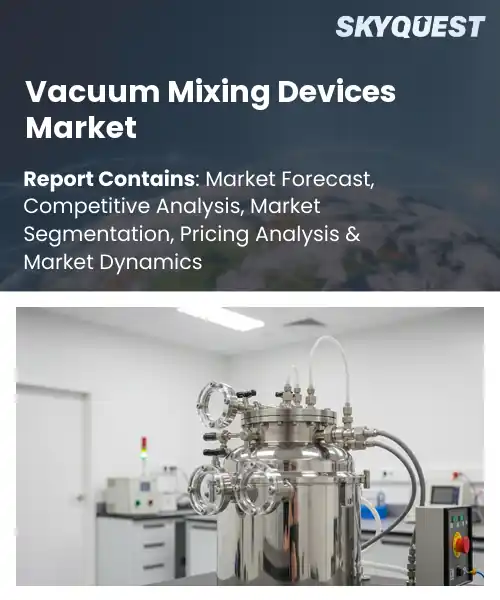
Vacuum Mixing Devices Market
Report ID: SQMIG35A4088
Report ID: SQMIG35A4088
[email protected]
USA +1 351-333-4748
Report ID:
SQMIG35A4088 |
Region:
Global |
Published Date: July, 2026
Pages:
157
|Tables:
119
|Figures:
77


Global Vacuum Mixing Devices Market size was valued at USD 222.6 Million in 2024 and is poised to grow from USD 231.06 Million in 2025 to USD 311.39 Million by 2033, growing at a CAGR of 3.8% during the forecast period (2026-2033).
Vacuum mixing devices are equipment that combine powders, liquids, or pastes under pressure to achieve uniform dispersion while minimizing air entrapment. The market relevance stems from quality standards in pharmaceuticals, food processing, and materials, where inconsistent blends can compromise safety or performance. Historically, manual mixers dominated the sector, but the 1990s saw the introduction of sealed vacuum systems that reduced oxidation and improved particle integration. Recent adoption of automated, sensor‑driven units in biotech facilities illustrates how the industry has shifted toward precision engineering. This evolution, driven by regulatory scrutiny and the need for reproducible results, underpins the sector’s significant growth. The principal growth catalyst for the vacuum mixing devices market is the rising demand for purity formulations in biologics and medicine, which forces manufacturers to adopt technologies that eliminate contamination and ensure batch consistency. As a result, companies are investing in vacuum mixers that can be integrated with environments and linked to monitoring software. This integration enables scale‑up of therapy vectors, exemplified by a biotech firm that reduced cycle time by 30 % after deploying a vacuum system. Consequently, suppliers are expanding their product portfolios to include predictive maintenance, opening revenue streams while addressing the industry’s need for uptime and compliance.
How are AI and IoT advances reshaping the vacuum mixing devices market?
AI and IoT are turning vacuum mixing devices into connected, self optimizing tools. Sensors embedded in the mixing chamber feed real time pressure, temperature and viscosity data to cloud platforms. Machine learning algorithms analyze this stream to predict optimal mixing cycles and flag deviations before they affect product quality. Operators can adjust parameters remotely through mobile dashboards, reducing manual intervention and downtime. The ability to schedule predictive maintenance based on usage patterns extends equipment life and lowers operating costs. As pharmaceutical and battery manufacturers demand tighter process control, these smart capabilities are becoming a decisive factor in equipment selection, driving market momentum.In April 2026 a leading manufacturer launched an AI enabled vacuum mixing system that integrates with IoT networks, allowing continuous performance monitoring and automatic adjustment of mixing parameters. This rollout demonstrates how intelligent automation is accelerating efficiency and supporting market growth.
Market snapshot - (2026-2033)
Global Market Size
USD 222.6 Million
Largest Segment
Vacuum Mixing Systems
Fastest Growth
Accessories
Growth Rate
3.8% CAGR
To get more insights on this market click here to Request a Free Sample Report
Global vacuum mixing devices market is segmented by product type, modality, application, end user and region. Based on product type, the market is segmented into Vacuum Mixing Systems, Mixing Cartridges and Accessories. Based on modality, the market is segmented into Benchtop Systems, Portable Devices and Handheld Devices. Based on application, the market is segmented into Bone Cement Mixing, Dental Impression Material Mixing and Pharmaceutical Compounding. Based on end user, the market is segmented into Hospitals, Ambulatory Surgical Centers, Orthopedic Specialty Clinics, Dental Clinics and Pharmaceutical Laboratories. Based on region, the market is segmented into North America, Europe, Asia Pacific, Latin America and Middle East & Africa.
Vacuum Mixing Systems segment dominates because it integrates the core mixing function with vacuum technology, delivering consistent cement quality and reduced contamination risk. Its ability to streamline workflow and meet stringent sterility standards makes it the preferred choice across clinical settings. Manufacturers focus R&D on reliability and ergonomics, reinforcing its market leadership. These devices also support a wide range of cement viscosities, enabling surgeons to tailor formulations for diverse procedures and improving overall patient outcomes.
Meanwhile, Mixing Cartridges segment emerges as a rapidly expanding area because its disposable design meets heightened infection control demands and eliminates sterilization steps. This convenience lowers operational overhead and attracts high throughput facilities, prompting manufacturers to launch advanced cartridge formulations, thereby widening market reach and generating fresh growth opportunities.
Dental Impression Material Mixing segment dominates because precise homogeneity and air free preparation are critical, and vacuum technology uniquely delivers these requirements. Clinicians rely on dedicated mixers to achieve consistent material properties, reducing defect rates and enhancing prosthetic fit. The rise of aesthetic and implant dentistry increases procedure volumes, prompting practices to adopt vacuum assisted mixers as indispensable equipment, thereby cementing its market leadership.
Conversely, Pharmaceutical Compounding segment is witnessing the strongest growth momentum as regulatory agencies emphasize sterile preparation of injectable therapies. Vacuum mixers enable accurate blending of active ingredients while preventing contamination, meeting stringent quality standards. Increased demand for personalized medicines and biologics fuels adoption, prompting manufacturers to develop specialized units, which expands market scope and creates new revenue streams.
To get detailed segments analysis, Request a Free Sample Report
North America benefits from a highly integrated industrial ecosystem that combines cutting‑edge research with large‑scale manufacturing capabilities. The presence of world‑leading engineering firms and a deep talent pool fuels continuous product innovation, while robust intellectual‑property frameworks protect advancements. Regulatory frameworks emphasize energy efficiency and emissions reduction, prompting early adoption of vacuum mixing technologies across automotive, aerospace, and specialty chemicals sectors. A mature supply chain delivers precision components quickly, reducing lead times and supporting complex system integration. Collaborative partnerships between universities, research institutes, and industry accelerate technology transfer, ensuring that North American solutions remain at the forefront of performance and reliability. This combination of innovation strength, supportive policy, and operational excellence sustains the region’s leadership in the market.
Vacuum Mixing Devices Market in the United States is driven by a strong focus on advanced manufacturing and a dense network of original equipment manufacturers. Extensive research institutions provide a pipeline of novel material handling concepts, while large‑scale industrial users demand high reliability and customization. The country’s emphasis on sustainability encourages integration of vacuum mixing solutions into energy‑intensive processes, reinforcing its position as a primary hub for technology development and deployment.
Vacuum Mixing Devices Market in Canada reflects a strategic emphasis on clean technology and engineering excellence. Federal and provincial initiatives promote low‑emission manufacturing, creating demand for efficient mixing equipment across renewable energy and specialty chemical sectors. A highly skilled workforce and world‑renowned research centers support continual product refinement, while collaborative clusters facilitate rapid adoption of new solutions. Proximity to major North American markets enhances export potential and strengthens Canada’s role in the broader regional supply chain.
Europe’s expansion is propelled by stringent environmental directives that compel manufacturers to adopt low‑emission, high‑efficiency processes. A long‑standing heritage of precision engineering dovetails with contemporary digitalization trends, fostering intelligent vacuum mixing systems that enhance productivity while reducing waste. Cross‑border collaboration within the European Union accelerates standardization and shared research, enabling rapid dissemination of innovative technologies. Strong demand from automotive, pharmaceuticals, and construction sectors, coupled with substantial investment in green manufacturing, creates a fertile environment for market growth. The region’s focus on circular economy principles further amplifies interest in vacuum mixing devices as essential tools for material reutilization and resource optimization.
Vacuum Mixing Devices Market in Germany is anchored by world‑recognised engineering prowess and a dense concentration of automotive and industrial equipment manufacturers. The country’s precision‑focused manufacturing culture drives demand for high‑performance mixing solutions that meet exacting tolerance requirements. Commitment to sustainability encourages integration of vacuum technologies to lower energy consumption across diverse processes. Robust research collaborations and a mature supplier network ensure continuous refinement and rapid availability of advanced equipment, reinforcing Germany’s dominant position.
Vacuum Mixing Devices Market in the United Kingdom benefits from a vibrant ecosystem of research universities and emerging technology firms. Policy frameworks that incentivize low‑carbon manufacturing stimulate adoption of vacuum mixing equipment within aerospace, biotech, and specialty chemicals. Growing investment in digital factories and smart manufacturing creates opportunities for integrated vacuum solutions that enhance process control. This dynamic environment positions the United Kingdom as a fast‑moving contributor to European market expansion.
Vacuum Mixing Devices Market in France is gaining momentum as the country prioritises green industrial transformation. Supportive governmental programmes encourage modernization of chemical and food processing facilities, driving interest in efficient vacuum mixing technologies. A strong tradition of industrial design combined with expanding collaborations between research institutes and manufacturers fosters innovative applications. These factors collectively elevate France’s emerging role within the European landscape.
Asia Pacific is advancing its market presence through rapid industrial diversification and a concerted push toward automation and high‑efficiency processes. Nations across the region are investing heavily in manufacturing infrastructure that prioritises precision and energy conservation, creating robust demand for vacuum mixing devices. Integration of advanced electronics and IoT capabilities enhances system intelligence, aligning with regional strategies for smart factories. Governmental policies that promote technology adoption and export competitiveness further reinforce market expansion. Coupled with a cost‑effective production base and an increasingly skilled engineering workforce, the region is poised to become a central hub for both the development and consumption of sophisticated vacuum mixing solutions.
Vacuum Mixing Devices Market in Japan is shaped by a legacy of meticulous engineering and a strong focus on high‑value sectors such as automotive and electronics. Continuous emphasis on innovation drives the development of compact, energy‑efficient mixing systems that meet stringent quality standards. Collaborative networks linking research institutions with manufacturers accelerate technology transfer, while a culture of precision manufacturing sustains demand for reliable vacuum solutions across diverse applications.
Vacuum Mixing Devices Market in South Korea reflects the country’s leadership in semiconductor, display, and advanced materials production. Government‑backed technology initiatives promote the integration of vacuum mixing equipment to improve process yield and reduce environmental impact. A highly skilled manufacturing workforce and a competitive supply chain enable rapid scaling of sophisticated solutions, reinforcing South Korea’s growing influence within the regional market.
To know more about the market opportunities by region and country, click here to
Buy The Complete Report
Increasing Adoption Of Automation
Rising Demand For Cleanroom Processes
High Initial Capital Expenditure
Stringent Regulatory Compliance Requirements
Request Free Customization of this report to help us to meet your business objectives.
The competitive landscape is shaped by intensified rivalry among established manufacturers who are accelerating M&A activity, forging strategic partnerships with material suppliers, and investing in advanced sensor integration to boost mixing efficiency. Recent joint ventures between leading equipment firms and specialty polymer companies illustrate a focus on co‑development of next‑generation vacuum mixers, while several acquisitions of niche technology providers aim to broaden product portfolios and secure proprietary vacuum control algorithms.
Top Player’s Company Profile
Recent Developments
SkyQuest’s ABIRAW (Advanced Business Intelligence, Research & Analysis Wing) is our Business Information Services team that Collects, Collates, Correlates, and Analyses the Data collected by means of Primary Exploratory Research backed by robust Secondary Desk research. As per SkyQuest analysis, the global vacuum mixing devices market is propelled primarily by the increasing adoption of automation, which lets manufacturers embed mixers into production lines for consistent quality and reduced manual effort, while a second strong driver is the rising demand for clean‑room processes that require sealed, contamination‑free mixing environments. The market faces a notable restraint in the form of high initial capital expenditure, as the sophisticated equipment and installation costs can deter smaller firms. North America remains the dominant region thanks to its advanced research ecosystem and robust supply chain, and the Vacuum Mixing Systems segment leads the market by delivering core mixing performance combined with vacuum technology.
| Report Metric | Details |
|---|---|
| Market size value in 2024 | USD 222.6 Million |
| Market size value in 2033 | USD 311.39 Million |
| Growth Rate | 3.8% |
| Base year | 2024 |
| Forecast period | (2026-2033) |
| Forecast Unit (Value) | USD Million |
| Segments covered |
|
| Regions covered | North America (US, Canada), Europe (Germany, France, United Kingdom, Italy, Spain, Rest of Europe), Asia Pacific (China, India, Japan, Rest of Asia-Pacific), Latin America (Brazil, Rest of Latin America), Middle East & Africa (South Africa, GCC Countries, Rest of MEA) |
| Companies covered |
|
| Customization scope | Free report customization with purchase. Customization includes:-
|
To get a free trial access to our platform which is a one stop solution for all your data requirements for quicker decision making. This platform allows you to compare markets, competitors who are prominent in the market, and mega trends that are influencing the dynamics in the market. Also, get access to detailed SkyQuest exclusive matrix.
Table Of Content
Executive Summary
Market overview
Parent Market Analysis
Market overview
Market size
KEY MARKET INSIGHTS
COVID IMPACT
MARKET DYNAMICS & OUTLOOK
Market Size by Region
KEY COMPANY PROFILES
Methodology
For the Vacuum Mixing Devices Market, our research methodology involved a mixture of primary and secondary data sources. Key steps involved in the research process are listed below:
1. Information Procurement: This stage involved the procurement of Market data or related information via primary and secondary sources. The various secondary sources used included various company websites, annual reports, trade databases, and paid databases such as Hoover's, Bloomberg Business, Factiva, and Avention. Our team did 45 primary interactions Globally which included several stakeholders such as manufacturers, customers, key opinion leaders, etc. Overall, information procurement was one of the most extensive stages in our research process.
2. Information Analysis: This step involved triangulation of data through bottom-up and top-down approaches to estimate and validate the total size and future estimate of the Vacuum Mixing Devices Market.
3. Report Formulation: The final step entailed the placement of data points in appropriate Market spaces in an attempt to deduce viable conclusions.
4. Validation & Publishing: Validation is the most important step in the process. Validation & re-validation via an intricately designed process helped us finalize data points to be used for final calculations. The final Market estimates and forecasts were then aligned and sent to our panel of industry experts for validation of data. Once the validation was done the report was sent to our Quality Assurance team to ensure adherence to style guides, consistency & design.
Analyst Support
Customization Options
With the given market data, our dedicated team of analysts can offer you the following customization options are available for the Vacuum Mixing Devices Market:
Product Analysis: Product matrix, which offers a detailed comparison of the product portfolio of companies.
Regional Analysis: Further analysis of the Vacuum Mixing Devices Market for additional countries.
Competitive Analysis: Detailed analysis and profiling of additional Market players & comparative analysis of competitive products.
Go to Market Strategy: Find the high-growth channels to invest your marketing efforts and increase your customer base.
Innovation Mapping: Identify racial solutions and innovation, connected to deep ecosystems of innovators, start-ups, academics, and strategic partners.
Category Intelligence: Customized intelligence that is relevant to their supply Markets will enable them to make smarter sourcing decisions and improve their category management.
Public Company Transcript Analysis: To improve the investment performance by generating new alpha and making better-informed decisions.
Social Media Listening: To analyze the conversations and trends happening not just around your brand, but around your industry as a whole, and use those insights to make better Marketing decisions.
REQUEST FOR SAMPLE
 REQUEST FREE CUSTOMIZATION


Want to customize this report? This report can be personalized according to your needs. Our analysts and industry experts will work directly with you to understand your requirements and provide you with customized data in a short amount of time. We offer $1000 worth of FREE customization at the time of purchase.
Feedback From Our Clients


 USA (+1) 351-333-4748

