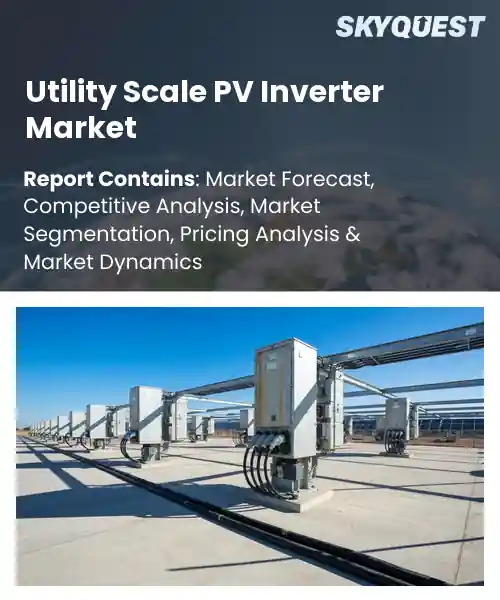
Utility Scale PV Inverter Market
Report ID: SQMIG20D2715
Report ID: SQMIG20D2715
[email protected]
USA +1 351-333-4748
Report ID:
SQMIG20D2715 |
Region:
Global |
Published Date: June, 2026
Pages:
157
|Tables:
143
|Figures:
78


Global Utility Scale Pv Inverter Market size was valued at USD 11.51 Billion in 2024 and is poised to grow from USD 12.18 Billion in 2025 to USD 19.2 Billion by 2033, growing at a CAGR of 5.85% during the forecast period (2026-2033).
The utility scale PV inverter market is being driven by the rapid expansion of large-scale solar projects, with inverters converting DC output into grid-ready AC power, while also providing system stability and control. As technology matured over the past decade, the sector has moved from bulky central inverters to modular higher efficiency units, as seen in projects like India’s Bhadla and California’s Topaz. The declining price of modules and the growing corporate and policy driven demand for offtake created a need for higher rated, remotely manageable equipment, which in turn made inverter reliability and performance a critical factor for project economics and long term bankability and investor confidence.
Global utility scale PV inverter demand is being driven by increasingly stringent grid requirements and the need for more sophisticated inverter functions, forcing developers to demand units that offer reactive power support, low voltage ride through, and frequency response. Following the increases in interconnection standards by California and European grid codes, manufacturers responded by upgrading their firmware and hardware, producing smart and hybrid inverters that integrated storage, and offering ancillary services. This evolution creates the opportunity for revenue stacking where projects are earning from energy and grid services, and spurs the retrofit markets for legacy central inverters, and mandates the investor to favor suppliers with proven control platforms and analytics globally.
How is AI improving performance optimization in the utility-scale PV inverter market?
Forecasting, adaptive control, and fleet-level analytics embedded into operational workflows enhance performance optimization for utility-scale PV inverters through AI. The key aspects are machine learning based irradiance and generation prediction, model predictive control for dynamic MPPT and anomaly detection for predictive maintenance. Today vendors and operators use edge AI, cloud orchestration and telemetry driven tuning to reduce downtime and smooth output to grid requirements. As the market shifts from pure capacity build out to system value these capabilities increase energy yield and minimize lifecycle costs. Real-world deployments show AI adjusting inverter behavior to site conditions and changing grid signals.
Sigenergy April 2026, launched a utility scale 506 kW inverter platform that combines fast control with AI driven analytics for MPPT, forecasting and fleet operations optimization, enabling smoother grid integration and lower O&M burden and driving adoption of smart inverter solutions.
Market snapshot - (2026-2033)
Global Market Size
USD 11.51 Billion
Largest Segment
Central Inverters
Fastest Growth
String Inverters
Growth Rate
5.85% CAGR
To get more insights on this market click here to Request a Free Sample Report
Global utility scale pv inverter market is segmented by inverter type, phase type, connection type, integration technology, sales channel and region. Based on inverter type, the market is segmented into Central Inverters, String Inverters and Others. Based on phase type, the market is segmented into Three-Phase Units and Others. Based on connection type, the market is segmented into On-Grid Designs, Off-Grid Solutions and Others. Based on integration technology, the market is segmented into Hybrid PV-Storage Solutions, Bidirectional Inverters and Others. Based on sales channel, the market is segmented into Direct Utility Project Sales, EPC Contractors and Others. Based on region, the market is segmented into North America, Europe, Asia Pacific, Latin America and Middle East & Africa.
The Central Inverters segment is dominant, as utility-scale deployments favor high-power consolidation, simplified plant-level control, and lower per-megawatt balance-of-system complexity. The design enables centralized monitoring and maintenance workflows that reduce operational friction and integrate seamlessly with existing transmission infrastructure. Thus, for large contiguous arrays, developers and utilities prefer centralized architectures, because economies of scale, proven reliability, and simplified grid interconnection reduce perceived project risk and simplify system engineering.
However, String Inverters are emerging as the fastest growing area due to the modular deployment flexibility, easier redundancy and faster installation cycles. Their ability to enable distributed panel-level optimization, easier fault isolation and compatibility with tracker-based arrays is unlocking new utility applications, and accelerating developer preference for staged, scalable plant builds.
The Hybrid PV-Storage Solutions segment is distinctive because the integrated inverters allow for coordination between generation and storage, providing dispatchable output and ancillary services that system operators appreciate. The combination simplifies plant control architecture, reduces risks of inter-equipment compatibility and simplifies procurement and commissioning for utility scale projects. The integrated approach described herein tackles the changing grid demands for flexibility and ramp control, and considers hybrid-ready inverter platforms a favoured technology direction for new utility-scale assets.
But the Bidirectional Inverters that can handle two-way power flow, allowing dynamic energy dispatch and frequency response, are enjoying the strongest growth momentum. Improved inverter control firmware and grid scale storage architectures expand application scope and create new revenue streams, accelerating adoption in utility scale projects.
To get detailed segments analysis, Request a Free Sample Report
Asia Pacific’s market leadership is driven by integrated manufacturing ecosystems, targeted developer activity and forward-thinking grid modernization initiatives. The large domestic demand from diverse markets provides inverter producers with economies of scale, and integrated supply chains simplify procurement and enable quick deployment. Local manufacturers invest in a local service network and in product variants tailored to different grid codes and climate conditions . Strategic investment in research and industrial capacity by the public and private sectors strengthens technology leadership, while experience in executing high-volume projects strengthens the reputation. Cross border collaboration and export orientation further enhance the region influence, helping companies to improve performance, bring down total system costs in practice and respond swiftly to the demands of utility scale developers in different markets.
Japan Utility Scale PV Inverter Market is characterized by a strong emphasis on reliability, grid code compliance and integration of advanced power electronics. Domestic manufacturers focus on the rugged designs suitable to tough interconnection requirements and high quality standards. System integrators are looking for long term operational stability, local service presence and proven inverter platforms with lifecycle support. Utilities and technology companies are working together to develop customized solutions for resilience and integration with new distribution network management approaches.
A few key players dominate the utility-scale PV inverter market in South Korea and technology partnerships between manufacturers and developers are strong. Local conglomerates are using their existing electronics capabilities to create competitive inverter solutions, focusing on efficiency and modularity. The market is moving towards integration with energy storage and advanced controls to meet grid flexibility needs. Readiness to export and compliance to international standards will be the basis for participation in cross border projects and sustained competitiveness of suppliers.
Growth in North America is being driven by diverse demand from utilities, independent power producers and corporate offtakers for scalable and reliable inverter solutions. The emphasis on system flexibility and interoperability with storage and grid management platforms has resulted in the use of advanced inverters with advanced control capabilities. The heightened focus on the resilience of domestic supply chains and domestic manufacturing capacity is also driving preferences for procurement of equipment with local support. Digital monitoring and commissioning and long term maintenance service ecosystems improve the bankability of the projects. Suppliers are customizing their product mix and aftermarket services to the growing sophistication of utilities and developers across a spectrum of regulatory jurisdictions. The market participants want cybersecurity readiness, performance guarantees and grid supportive features;
The United States Utility Scale PV Inverter Market is driven by the demand for high performance, grid friendly solutions with integrated system level asset management. Developers and utilities want manufacturers with a big service network and a proven track record of success in large scale deployments. Suppliers are encouraged to deliver modular designs and flexible communication standards with a focus on interoperability with storage and advanced control platforms. Procurement decisions are often made on the basis of lifecycle support, local technical expertise and supply chain robustness.
The Canadian Utility Scale PV Inverter Market is targeting strong inverter technologies which can operate under various climate conditions and grid configurations. Project stakeholders are seeking suppliers that offer strong local support and the flexibility to accommodate regional interconnection needs. Utility scale storage driven product selection. Demand response integration and purchasing strategies are driven by long term operational reliability and maintenance access. Developers and manufacturers are teaming up to showcase tailored solutions for installations at the remote and grid edge.
The harmonisation of regulatory frameworks, the promotion of technology standardisation and joint industry cooperation between member states can consolidate Europe’s position on the market. Focusing on grid code harmonization and interoperability removes barriers to entry for suppliers and allows for wider market adoption of advanced inverter functionality. Strong engineering DNA and strong service ecosystem enable fast iteration on product features like network stability and reactive power management. Invest in local manufacturing and applied research to increase competitiveness. Cross border projects and utility scale pilots offer a validation platform. In Europe, players are focused on lifecycle support, sustainability of supply chains and meeting demanding quality and safety norms, which all underpin a stronger market presence.
Germany’s utility scale PV inverter market is characterized by a mature engineering ecosystem and stringent technical standards that create a demand for advanced control functions and high reliability. Developers and utilities want vendors who can demonstrate that they can meet demanding grid requirements, and provide full maintenance and performance guarantees. Local manufacturing and full service network enables rapid deployment and life cycle management. The preferred points are Storage integration and Reactive power management for system stability and grid support services.
United Kingdom Utility Scale PV Inverter Market is concerned with flexibility, fast integration with grid services, and supplier responsiveness to regulatory changes. Project owners are looking for inverter solutions with advanced monitoring, grid support capability and robust service provisions. The vendors who can provide fast technical support and customize products to local interconnection practices are the winners in the market. Collaboration between utility, developer and technology provider fosters innovation in inverter capabilities and operating strategies.
The utility-scale PV inverter market in France is marked by a high emphasis on quality, compliance and alignment with national priorities for grid management. Developers prefer suppliers that supply custom solutions that meet local interconnection rules and environmental considerations. Partnership models that include commissioning support and long term service agreements are driving procurement decisions. The market is driving technology evolution to more sophisticated inverter functionality to meet grid stability and renewable integration goals.
To know more about the market opportunities by region and country, click here to
Buy The Complete Report
Declining Component Costs
Advanced Grid Integration Capabilities
Interconnection Complexity
Supply Chain Constraints
Request Free Customization of this report to help us to meet your business objectives.
The global utility-scale PV inverter market is highly competitive and driven by strategic M&A, manufacturer partnerships and rapid power electronics innovation. Siemens folding Kaco assets and increasing local manufacturing, and supply deals between semiconductor suppliers and inverter OEMs and DOE-backed startups, highlight recent actions underscoring competition centered on reliability, supply chain resilience and differentiated wide band gap technology.
Our Business Information Services team, ABIRAW (Advanced Business Intelligence, Research & Analysis Wing) of SkyQuest Collects, Collates, Correlates and Analyses the Data collected by means of Primary Exploratory Research backed by robust Secondary Desk research.
According to SkyQuest analysis, the main driver of the global utility scale PV inverter market is the declining component costs with advanced grid integration capabilities as a second driver supporting demand for smarter hybrid-ready platforms. Central inverters are the most common type, thanks to economies of scale and simpler control at the plant level. Activity is strongest in Asia Pacific, supported by strong manufacturing ecosystems and large developer pipelines. But the complexity of interconnections is a big constraint, slowing approvals and raising the risk of project execution. Those vendors that focus on reliability, digitalization and storage-integrated designs will be well-placed to capture growth as developers seek bankable service-oriented inverter solutions that balance performance, supply resilience and evolving grid requirements.
| Report Metric | Details |
|---|---|
| Market size value in 2024 | USD 11.51 Billion |
| Market size value in 2033 | USD 19.2 Billion |
| Growth Rate | 5.85% |
| Base year | 2024 |
| Forecast period | (2026-2033) |
| Forecast Unit (Value) | USD Billion |
| Segments covered |
|
| Regions covered | North America (US, Canada), Europe (Germany, France, United Kingdom, Italy, Spain, Rest of Europe), Asia Pacific (China, India, Japan, Rest of Asia-Pacific), Latin America (Brazil, Rest of Latin America), Middle East & Africa (South Africa, GCC Countries, Rest of MEA) |
| Companies covered |
|
| Customization scope | Free report customization with purchase. Customization includes:-
|
To get a free trial access to our platform which is a one stop solution for all your data requirements for quicker decision making. This platform allows you to compare markets, competitors who are prominent in the market, and mega trends that are influencing the dynamics in the market. Also, get access to detailed SkyQuest exclusive matrix.
Table Of Content
Executive Summary
Market overview
Parent Market Analysis
Market overview
Market size
KEY MARKET INSIGHTS
COVID IMPACT
MARKET DYNAMICS & OUTLOOK
Market Size by Region
KEY COMPANY PROFILES
Methodology
For the Utility Scale PV Inverter Market, our research methodology involved a mixture of primary and secondary data sources. Key steps involved in the research process are listed below:
1. Information Procurement: This stage involved the procurement of Market data or related information via primary and secondary sources. The various secondary sources used included various company websites, annual reports, trade databases, and paid databases such as Hoover's, Bloomberg Business, Factiva, and Avention. Our team did 45 primary interactions Globally which included several stakeholders such as manufacturers, customers, key opinion leaders, etc. Overall, information procurement was one of the most extensive stages in our research process.
2. Information Analysis: This step involved triangulation of data through bottom-up and top-down approaches to estimate and validate the total size and future estimate of the Utility Scale PV Inverter Market.
3. Report Formulation: The final step entailed the placement of data points in appropriate Market spaces in an attempt to deduce viable conclusions.
4. Validation & Publishing: Validation is the most important step in the process. Validation & re-validation via an intricately designed process helped us finalize data points to be used for final calculations. The final Market estimates and forecasts were then aligned and sent to our panel of industry experts for validation of data. Once the validation was done the report was sent to our Quality Assurance team to ensure adherence to style guides, consistency & design.
Analyst Support
Customization Options
With the given market data, our dedicated team of analysts can offer you the following customization options are available for the Utility Scale PV Inverter Market:
Product Analysis: Product matrix, which offers a detailed comparison of the product portfolio of companies.
Regional Analysis: Further analysis of the Utility Scale PV Inverter Market for additional countries.
Competitive Analysis: Detailed analysis and profiling of additional Market players & comparative analysis of competitive products.
Go to Market Strategy: Find the high-growth channels to invest your marketing efforts and increase your customer base.
Innovation Mapping: Identify racial solutions and innovation, connected to deep ecosystems of innovators, start-ups, academics, and strategic partners.
Category Intelligence: Customized intelligence that is relevant to their supply Markets will enable them to make smarter sourcing decisions and improve their category management.
Public Company Transcript Analysis: To improve the investment performance by generating new alpha and making better-informed decisions.
Social Media Listening: To analyze the conversations and trends happening not just around your brand, but around your industry as a whole, and use those insights to make better Marketing decisions.
REQUEST FOR SAMPLE
 REQUEST FREE CUSTOMIZATION
Global Utility Scale Pv Inverter Market size was valued at USD 11.51 Billion in 2024 and is poised to grow from USD 12.18 Billion in 2025 to USD 19.2 Billion by 2033, growing at a CAGR of 5.85% during the forecast period (2026-2033).
The competitive landscape in the global utility scale PV inverter market is driven by strategic M&A, manufacturer partnerships and rapid power electronics innovation. Recent moves such as Siemens integrating Kaco assets and expanded local manufacturing, supply agreements between semiconductor suppliers and inverter OEMs, and DOE-backed startups show competition centering on reliability, supply chain resilience and differentiated wide band gap technology. 'Huawei', 'Sungrow', 'SMA Solar Technology', 'Power Electronics', 'TMEIC', 'Sineng Electric', 'Fimer', 'Solis', 'GoodWe', 'Growatt', 'Delta Electronics', 'Ingeteam', 'Kaco New Energy', 'Chint Power', 'SolarEdge', 'Enphase Energy', 'Toshiba', 'Mitsubishi Electric', 'Gamesa Electric', 'Siemens'
Declining component costs lower capital expenditure per megawatt for utility scale installations, making large photovoltaic projects more financially appealing to developers and investors. Lower hardware prices enable wider deployment by reducing payback periods and facilitating bankability of projects, encouraging utilities and independent power producers to plan larger arrays. Cost reductions also permit allocation of budget to system optimization and grid integration, which increases project viability in diverse markets and supports sustained demand for high capacity inverters as essential system components. This dynamic encourages manufacturers to scale production and innovate.
Hybridization With Energy Storage: Integration of battery and inverter systems is reshaping procurement and value propositions for utility scale projects, enabling smoother dispatch, enhanced grid support and improved revenue certainty through flexible generation profiles. Developers and utilities prioritize inverters designed for seamless coupling with storage, simplified controls and coordinated protection. This trend drives suppliers to offer integrated hardware, standardized interfaces and lifecycle services that reduce project complexity, accelerate interconnection readiness, and open opportunities for differentiated offerings focused on reliability, dispatchability and long-term operational economics.
Why does Asia Pacific Dominate the Global Utility Scale PV Inverter Market? |@12


Want to customize this report? This report can be personalized according to your needs. Our analysts and industry experts will work directly with you to understand your requirements and provide you with customized data in a short amount of time. We offer $1000 worth of FREE customization at the time of purchase.
Feedback From Our Clients


 USA (+1) 351-333-4748

