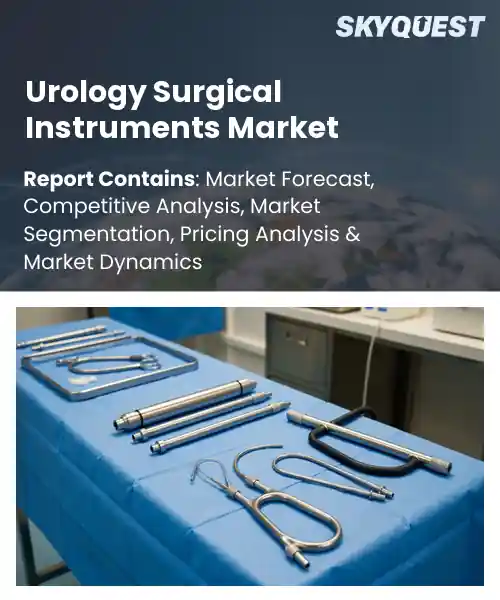
Urology Surgical Instruments Market
Report ID: SQMIG35A3453
Report ID: SQMIG35A3453
[email protected]
USA +1 351-333-4748
Report ID:
SQMIG35A3453 |
Region:
Global |
Published Date: May, 2026
Pages:
157
|Tables:
120
|Figures:
72


Global Urology Surgical Instruments Market size was valued at USD 2.52 Billion in 2024 and is poised to grow from USD 2.69 Billion in 2025 to USD 4.52 Billion by 2033, growing at a CAGR of 6.72% during the forecast period (2026-2033).
The primary driver for the urology surgical instruments market growth is a rising prevalence of urological conditions due to population aging and lifestyle changes worldwide, which results in more cases of prostate disease, kidney stones, and bladder issues. The market also covers devices for the diagnosis and management of urinary tract organs, and it matters because these conditions push clinical workloads and healthcare costs higher, while at the same time reducing patient well-being.
In addition, technological innovation in endoscopy and robotic platforms is probably the most influential factor here, because when the tools get better, minimally invasive surgery becomes safer and more widely usable. Then as outcomes improve, clinicians tend to use ureteroscopy with Holmium laser lithotripsy more often, and also robot-assisted prostatectomy. That pushes hospitals to buy advanced scopes and consumables, which then leads to shorter stays in hospital and lower overall treatment costs. After that, more capital investment shows up and manufacturers get extra motivation to roll out single-use scopes and integrated imaging, mainly so that infection risk goes down and diagnosis improves. So basically the result is rising demand in emerging regions, and a stronger need for training programs, service contracts and more outpatient procedural volumes.
AI is enhancing precision and outcomes in the urology surgical instruments industry by improving preoperative planning, giving intraoperative guidance, and tightening instrument control. The key elements show up as image-based segmentation and instrument tracking, machine learning-assisted decision support, and automated motion scaling for robot-assisted work. Right now, the state of things is that AI is being integrated more and more into robotic platforms and imaging workflows, which helps with surgical accuracy and consistency across different operators. The market context also reflects that clinicians are increasingly interested in tools that reduce variability and that can shorten the learning curve. Some examples include AI-guided prostate MRI interpretation and AI-enabled waterjet and robotic systems that provide real-time feedback to surgeons during the steps.
Market snapshot - (2026-2033)
Global Market Size
USD 2.52 Billion
Largest Segment
Lithotripsy Devices
Fastest Growth
Lithotripsy Devices
Growth Rate
6.72% CAGR
To get more insights on this market click here to Request a Free Sample Report
The global urology surgical instruments market is segmented by instrument type, technology, application, end user, and region. Based on instrument type, the market is segmented into Endoscopes (Cystoscopes, Ureteroscopes), Lithotripsy Devices, Biopsy Instruments, Graspers & Forceps, and Others. Based on technology, the market is segmented into Robotic-Assisted, Laparoscopic, and Open Surgery. Based on application, the market is segmented into Kidney Stone Treatment, Prostate Disorders, Bladder Cancer, and Urinary Incontinence. Based on end-user, the market is segmented into Hospitals and Urology Clinics. Based on region, the market is segmented into North America, Europe, Asia Pacific, Latin America and Middle East & Africa.
As per the urology surgical instruments marker analysis, the ureteroscopes segment dominates, because their combination of therapeutic reach and diagnostic fidelity, in one lane, one procedural pathway, lets endourological care happen in a comprehensive way. High-resolution optics and miniaturized designs make it possible to access the ureter and intrarenal anatomy with only minimal tissue disruption, and that’s why many clinicians lean toward them. Reusable versus single-use options add some extra procedural flexibility, while compatibility with imaging and adjunct tools improves overall workflow efficiency, so providers end up prioritizing ureteroscope acquisition, service support, and training investments.
However, the Lithotripsy Devices segment is showing up as the fastest-growing area. That’s mainly because innovations in energy delivery and stone fragmentation improve clearance outcomes while helping reduce recovery time. A rising preference for minimally invasive stone care, wider clinical adoption of advanced lithotripsy platforms, and the expansion of outpatient pathways are all pushing device investment. This also creates new therapeutic and service-line opportunities for both manufacturers and providers.
According to the urology surgical instruments market forecast, the robotic-assisted segment leads since its platforms deliver enhanced articulation, tremor filtration, and three-dimensional visualization. Those features really do matter because they improve the surgeon's dexterity in complex urological procedures, and that makes the whole experience more controlled. With that, more precise dissection and suturing become feasible for prostatectomies and reconstructive surgeries, so specialized centers feel encouraged to adopt. Ongoing industry investment in instrument innovation, integrated imaging, and structured procedural training keeps catalyzing uptake, and it sets up a high-value ecosystem for advanced instruments and bundled service offerings across the market.
Whereas the Laparoscopic segment is predicted to achieve the largest urology surgical instruments market share driven by instrument miniaturization and sharper optics, and workflows that tend to be more cost-effective. That blend broadens adoption in both hospitals and clinics. Advances in energy devices, single-port access, and focused training reduce procedure duration, expand indications, and ultimately drive wider market penetration, higher device uptake, and new product opportunities for manufacturers.
To get detailed segments analysis, Request a Free Sample Report
As per the urology surgical instruments market regional forecast, North America leads the way, mostly because it has a mature healthcare infrastructure, solid clinical research networks, and a bunch of concentrated investment in newer surgical technologies. Big market players keep broad portfolios and they also try to stay innovative, not just alone but by working with academic centers, specialty clinics too, which is the whole thing. On top of that, reimbursement rules and this early adoption mindset from clinicians help the quick merging into day to day practice , especially for minimally invasive and robotic assistance instruments. Strong distribution channels and already well established regulatory pathways make it easier for companies to launch products , and also manage the full lifecycle. Demand is pulled by aging populations, and higher prevalence of urological conditions which then leads to more diagnostics and interventions. Then there’s the service and training ecosystem, it supports device use, while partnerships and acquisitions push consolidation and easier access to specialized technologies. Thus, overall it locks in regional leadership for urology surgical instruments.
United States Urology Surgical Instruments Market
The Urology Surgical Instruments industry in the United States benefits a lot from dense academic medical centers and specialized urology clinics, they basically push adoption and clinical validation. There’s also a firm base of well established device manufacturers and a very active innovation ecosystem, so products keep getting refined. Mature reimbursement and procurement processes help advanced instruments get used more widely. Training programs, and education for clinicians that industry supports, help spread techniques faster, while collaborations between manufacturers and health systems speed up clinical integration.
Canada Urology Surgical Instruments Market
The Urology Surgical Instruments sector in Canada shows a publicly oriented healthcare setting, where centralized procurement really influences what gets adopted. Regional health authorities often choose cost effective technologies and focus heavily on clinical outcomes, and that nudges evidence based adoption. Distribution networks and partnerships with manufacturers help keep access open to advanced instruments. There is also a clear emphasis on clinician training and multidisciplinary care models, so utilization stays consistent. Collaborative initiatives between hospital networks and industry also help local clinician engagement, and it supports some local innovation.
Europe is witnessing rapid urology surgical instruments market penetration because of a mix of progressive clinical adoption, active medtech competition, and healthcare modernization that’s coordinated across major markets. Regulatory alignment is improving in many countries , and structured clinical assessment pathways make it easier to introduce products across borders. This builds confidence for urologists. Established medical device manufacturers and several smaller innovative firms, invest in minimally invasive and imaging integrated instruments. Hospitals, research institutions, and industry form collaborative networks, which speeds up evidence generation. Patient-centered care , and outpatient procedure models, also drives demand for devices that improve procedural efficiency and recovery timing. Reimbursement arrangements in key countries, and targeted training, support clinician uptake, and strategic partnerships allow scalable deployment of advanced urology solutions across the region. This shifting environment helps keep innovation alive and keeps clinical adoption moving forward.
Germany Urology Surgical Instruments Market
The Urology Surgical Instruments Market in Germany benefits from strong manufacturing ability and a fairly concentrated medtech ecosystem , with suppliers and engineering firms that actually know the work. University hospitals and clinical research centers help evaluate and improve devices before scaling. The focus stays on quality standards and structured procurement within hospital networks, which supports adoption of advanced instruments. Collaboration between industry and clinical specialists , along with established regulatory and reimbursement approaches, helps reinforce Germany’s leading role in developing and commercializing urology instruments.
United Kingdom Urology Surgical Instruments Market
The Urology Surgical Instruments Market in United Kingdom is picking up a strong pace, supported by innovation clusters and collaboration between research hospitals and manufacturers. National procurement often emphasizes value based care and simplified adoption pathways, which makes it easier for minimally invasive and image guided instruments to gain traction. There are focused clinician training programs too, and engagement with private clinics complements public sector demand. All of this supports clinical integration and it also helps advanced urology technologies spread faster across different healthcare environments.
France Urology Surgical Instruments Market
The Urology Surgical Instruments Market in France is developing as modern clinical practices, together with targeted investments, increase interest in advanced instruments. There’s closer collaboration between academic hospitals, regional care centers, and innovative suppliers which supports evaluation and adoption. Policy direction is leaning toward better surgical outcomes and more ambulatory care, so minimally invasive solutions fit naturally. Also , growing incubators and private partnerships strengthen product development and ongoing training, which positions France as an emerging area for urology instrument innovation.
Asia Pacific is getting stronger through very focused efforts on tech development , clinical capability strengthening, and those strategic links between local manufacturers and global device players. Regional decision makers are putting more attention on precision engineering and the integration that mixes imaging, navigation and robotic assistance, because surgical needs keep changing. At the same time, specialty hospital networks are widening and there is growing emphasis on minimally invasive procedures, so there’s real potential for clinicians to try things out and for real-world evaluation to kick in. Government schemes and industry partnerships help align regulatory requirements and improve market entry, while local production makes the supply chain more sturdy and the overall costs more competitive. There are also clinician training tracks that are targeted and regional centers of excellence that help spread new techniques, so Asia Pacific can move from simple adoption toward co development and innovation in urology surgical instruments.
Japan Urology Surgical Instruments Market
The Urology Surgical Instruments Market in Japan benefits from precision manufacturing and routine integration of robotic and imaging tech inside operating rooms. Joint research among universities, specialty hospitals, and manufacturers leads to validated clinical uses and also iterative improvements to design. The hospital environment is mature, and clinician communities tend to be selective, so higher quality instruments are preferred. Domestic firms together with multinational partnerships aim for localized product adaptations, and dedicated training programs , which helps adoption keep going and technology refinement stay consistent across different surgical settings.
South Korea Urology Surgical Instruments Market
The Urology Surgical Instruments Market in South Korea is fueled by a solid manufacturing platform and strong capability in medical electronics, with robotics integration as a core strength. Collaboration between hospitals, research organizations, and new startups speeds up the creation of image-guided and minimally invasive instruments. National support aimed at broader commercialization and exports improves competitiveness in the market. Clinician training that is focused, and strategic partnerships with global companies, and quick regulatory engagement, work together to enable faster clinical uptake and continuous product improvement in practice.
To know more about the market opportunities by region and country, click here to
Buy The Complete Report
Aging Population And Disease Burden
Technological Advancements In Instruments
High Procedure Costs And Reimbursement
Regulatory Complexity And Approval
Request Free Customization of this report to help us to meet your business objectives.
In urology surgical instruments, the competition is getting pushed by M&A, digital collaborations, and quick technological progress, so the landscape feels more, I don’t know, crowded all the time. For example, Johnson & Johnson’s 2019 takeover of Auris Health changed the way people think about robotics assets. Then in 2023, Olympus bought Odin Vision, which, well, sped up the adoption of AI in endoscopy. Also, the rise of single-use cystoscopes, Ambu is active here, and the market releases of robotic ureteroscopy platforms like Zamenix, all of that has intensified the vendor rivalry more than before.
Method AI was founded in 2021, and their core aim is to build AI-supported surgical navigation for robotic procedures, delivering continuous deep tissue imaging along with real-time help, in other words, guidance that supports precision. The idea is to improve robotic urology and oncology workflows without extra friction. Most recently, they completed a Series A in 2025, expanded clinical partnerships, the Cleveland Clinic was mentioned for operating room validation, reported first clinical integrations, and scaled product engineering so they could run wider multicenter trials. Leadership, from what is said, focuses on seamless integration with existing robotic platforms and the hospital routines, so the surgeon’s cognitive load is reduced, and adoption happens quicker.
Top Player’s Company Profile
Recent Developments in the Urology Surgical Instruments Market
SkyQuest’s ABIRAW (Advanced Business Intelligence, Research & Analysis Wing) is our Business Information Services team that Collects, Collates, Correlates, and Analyses the Data collected by means of Primary Exploratory Research backed by robust Secondary Desk research.
As per SkyQuest analysis, the global urology surgical instruments market is driven mainly by an aging population and increasing prevalence of urological disorders, and that is still the key driver, while one big restraint remains the high procedure costs and variable reimbursement. That mix can slow adoption. North America stays dominating, which ties back to mature infrastructure and early technology uptake, and the ureteroscopes segment is the dominant segment because of their versatile diagnostic and therapeutic role. Another driver is rapid technological innovation in endoscopy and robotic platforms, which supports minimally invasive care, encourages single-use device uptake, and improves outcomes, too, even while manufacturers and providers deal with regulatory hurdles and cost pressures, as they move through those challenges.
| Report Metric | Details |
|---|---|
| Market size value in 2024 | USD 2.52 Billion |
| Market size value in 2033 | USD 4.52 Billion |
| Growth Rate | 6.72% |
| Base year | 2024 |
| Forecast period | (2026-2033) |
| Forecast Unit (Value) | USD Billion |
| Segments covered |
|
| Regions covered | North America (US, Canada), Europe (Germany, France, United Kingdom, Italy, Spain, Rest of Europe), Asia Pacific (China, India, Japan, Rest of Asia-Pacific), Latin America (Brazil, Rest of Latin America), Middle East & Africa (South Africa, GCC Countries, Rest of MEA) |
| Companies covered |
|
| Customization scope | Free report customization with purchase. Customization includes:-
|
To get a free trial access to our platform which is a one stop solution for all your data requirements for quicker decision making. This platform allows you to compare markets, competitors who are prominent in the market, and mega trends that are influencing the dynamics in the market. Also, get access to detailed SkyQuest exclusive matrix.
Table Of Content
Executive Summary
Market overview
Parent Market Analysis
Market overview
Market size
KEY MARKET INSIGHTS
COVID IMPACT
MARKET DYNAMICS & OUTLOOK
Market Size by Region
KEY COMPANY PROFILES
Methodology
For the Urology Surgical Instruments Market, our research methodology involved a mixture of primary and secondary data sources. Key steps involved in the research process are listed below:
1. Information Procurement: This stage involved the procurement of Market data or related information via primary and secondary sources. The various secondary sources used included various company websites, annual reports, trade databases, and paid databases such as Hoover's, Bloomberg Business, Factiva, and Avention. Our team did 45 primary interactions Globally which included several stakeholders such as manufacturers, customers, key opinion leaders, etc. Overall, information procurement was one of the most extensive stages in our research process.
2. Information Analysis: This step involved triangulation of data through bottom-up and top-down approaches to estimate and validate the total size and future estimate of the Urology Surgical Instruments Market.
3. Report Formulation: The final step entailed the placement of data points in appropriate Market spaces in an attempt to deduce viable conclusions.
4. Validation & Publishing: Validation is the most important step in the process. Validation & re-validation via an intricately designed process helped us finalize data points to be used for final calculations. The final Market estimates and forecasts were then aligned and sent to our panel of industry experts for validation of data. Once the validation was done the report was sent to our Quality Assurance team to ensure adherence to style guides, consistency & design.
Analyst Support
Customization Options
With the given market data, our dedicated team of analysts can offer you the following customization options are available for the Urology Surgical Instruments Market:
Product Analysis: Product matrix, which offers a detailed comparison of the product portfolio of companies.
Regional Analysis: Further analysis of the Urology Surgical Instruments Market for additional countries.
Competitive Analysis: Detailed analysis and profiling of additional Market players & comparative analysis of competitive products.
Go to Market Strategy: Find the high-growth channels to invest your marketing efforts and increase your customer base.
Innovation Mapping: Identify racial solutions and innovation, connected to deep ecosystems of innovators, start-ups, academics, and strategic partners.
Category Intelligence: Customized intelligence that is relevant to their supply Markets will enable them to make smarter sourcing decisions and improve their category management.
Public Company Transcript Analysis: To improve the investment performance by generating new alpha and making better-informed decisions.
Social Media Listening: To analyze the conversations and trends happening not just around your brand, but around your industry as a whole, and use those insights to make better Marketing decisions.
REQUEST FOR SAMPLE
 REQUEST FREE CUSTOMIZATION
Global Urology Surgical Instruments Market size was valued at USD 2.52 Billion in 2024 and is poised to grow from USD 2.69 Billion in 2025 to USD 4.52 Billion by 2033, growing at a CAGR of 6.72% during the forecast period (2026-2033).
Competition in urology surgical instruments is increasingly driven by M&A, digital partnerships, and rapid tech innovation. Johnson & Johnson's acquisition of Auris Health in 2019 reshaped robotics assets. Olympus's 2023 purchase of Odin Vision accelerated AI integration in endoscopy. Growth of single-use cystoscopes by Ambu and commercial introductions of robotic ureteroscopy platforms such as Zamenix have intensified vendor rivalry. 'Karl Storz SE', 'Olympus Corporation', 'Stryker Corporation', 'Richard Wolf GmbH', 'Boston Scientific', 'Intuitive Surgical (da Vinci)', 'Medtronic plc', 'Teleflex Inc.', 'CONMED Corporation', 'Caldera Pharmaceuticals', 'Dornier MedTech', 'ELMED', 'Lismed GmbH', 'Schoelly Fiberoptic', 'Urotech'
Growing elderly populations increase the prevalence of urological disorders and create sustained demand for surgical interventions, prompting healthcare providers to expand procedural capacity. This demographic shift encourages investment in specialized instruments and fosters procurement of a broader range of devices to manage complex cases. Manufacturers respond by developing dedicated product lines and supporting clinical training, which lowers barriers for adoption among surgeons. The resulting alignment of clinical need, device availability, and provider capability supports consistent market expansion and product portfolio diversification.
Robotic Assisted Surgery: Adoption of robotic assisted platforms is reshaping urology by enabling precision, stability and ergonomics during complex procedures. Surgeons and hospitals are prioritizing systems that enhance visualization and dexterity while offering integration with complementary devices. This shifts procurement toward ecosystem partners and fuels demand for purpose designed instruments compatible with robotic interfaces. Training programs and partnerships with manufacturers emphasize workflow optimization and safety, accelerating clinical acceptance and expanding indications as clinicians seek consistent outcomes, profiles, and improved patient satisfaction with procedures.
Why does North America Dominate the Global Urology Surgical Instruments Market? |@12


Want to customize this report? This report can be personalized according to your needs. Our analysts and industry experts will work directly with you to understand your requirements and provide you with customized data in a short amount of time. We offer $1000 worth of FREE customization at the time of purchase.
Feedback From Our Clients


 USA (+1) 351-333-4748

