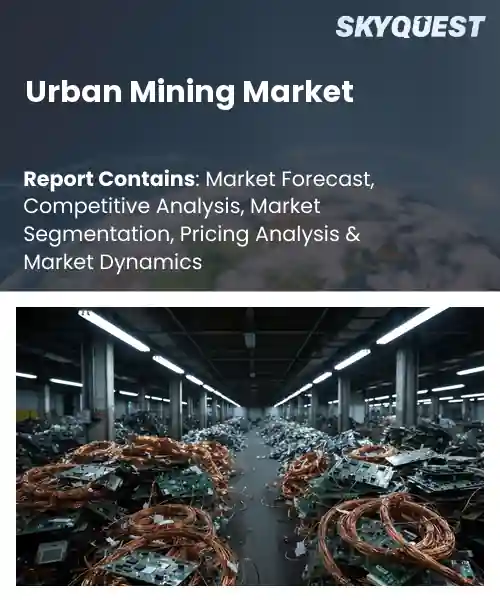
Urban Mining Market
Report ID: SQMIG15J2227
Report ID: SQMIG15J2227
[email protected]
USA +1 351-333-4748
Report ID:
SQMIG15J2227 |
Region:
Global |
Published Date: July, 2026
Pages:
157
|Tables:
153
|Figures:
78


Global Urban Mining Market size was valued at USD 42.87 Billion in 2024 and is poised to grow from USD 51.19 Billion in 2025 to USD 211.45 Billion by 2033, growing at a CAGR of 19.4% during the forecast period (2026-2033).
Urban mining market share recycle valuable metals, plastics and electronics from city waste streams, cutting reliance on virgin ore, lowering carbon emissions and ensuring critical inputs for high-tech sectors. The main reason is the increase in electronic waste, which has increased from about 50 million tons in 2010 to more than 100 million tons in 2023, providing a lot of recoverable material. Early measures such as the EU's WEEE directive showed that regulation could turn waste into valuable feedstock, prompting companies in Japan and the United States to install automated disassembly lines. Urban mining has thus evolved from a niche recycling idea to a billion-dollar global industry with efficient supply chains.
The policy incentives coupled with the corporate sustainability targets that turn the environmental compliance into the financial advantage are the key factors accelerating the global urban mining market trends. Governments in China, the EU and Canada now offer tax credits or reduced landfill fees for facilities that can prove they achieve a certain minimum recovery rate, prompting investors to put money into advanced sensor-based sorting technologies. Corporations such as Apple and Tesla have made public pledges to purchase reclaimed cobalt and lithium, establishing a reliable demand pipeline for constructing large-scale plants. This alignment of regulation and corporate ambition is constantly driving down stream innovations including blockchain tracked material provenance, which then further reduces transaction costs and draws in more secondary market traders, increasing the market size and scope well beyond electronics to batteries, automotive scrap and rare earth rich wind turbine blades future.
How is AI-driven Automation Influencing the Urban Mining Market's Metal Recovery Efficiency?
Automation driven by AI is reshaping urban mining market growth by embedding sensors and machine learning into the steps of collection, sorting and extraction. Smart sensors determine the composition of materials at the point of entry, so robots can sort metals more accurately than human labor. Machine learning models optimize process parameters in real-time and lead to less contamination and higher recovery yields. Autonomous guided vehicles integration optimizes e‐waste transport within recycling facilities reducing time and energy consumption during handling. These technologies also allow for constant monitoring of process health, triggering predictive maintenance that keeps lines running efficiently and facilitates the move to more circular supply chains.
In July 2026, ALU CHINA demonstrated an AI-guided shredding system that improved the clarity of metal separation and showed how intelligent automation can boost recovery efficiency and accelerate market growth.
Market snapshot - (2026-2033)
Global Market Size
USD 42.87 Billion
Largest Segment
Construction & Demolition Waste
Fastest Growth
Electronic Waste
Growth Rate
19.4% CAGR
To get more insights on this market click here to Request a Free Sample Report
Global urban mining market is segmented by resource type, material recovered, recovery process, end user, application and region. Based on resource type, the market is segmented into electronic waste, construction & demolition waste, end-of-life vehicles, industrial scrap and others. Based on material recovered, the market is segmented into precious metals, base metals, rare earth elements, plastics and others. Based on recovery process, the market is segmented into mechanical processing, hydrometallurgical processing, pyrometallurgical processing, bioleaching and others. Based on end user, the market is segmented into metal refiners, recycling companies, electronics manufacturers, automotive manufacturers and others. Based on application, the market is segmented into metal recovery, material reuse, circular manufacturing and others. Based on region, the market is segmented into North America, Europe, Asia Pacific, Latin America and Middle East & Africa.
The electronic waste segment is the largest as it contains high density of valuable metals and components that are easily available for extraction. The abundance of target materials in smartphones, laptops and printed circuit boards is providing a steady stream of investment in collection infrastructure. In addition, regulatory pressure to divert e waste from landfills feeds continuous supply, while consumer awareness drives return programs, reinforcing its central role in the urban mining ecosystem.
However, the construction & demolition waste segment is the fastest growing segment, with redevelopment projects producing large volumes of material that contain embedded metals and reusable composites. Sustainable mandates and innovations in shredding and sorting technologies open up value in concrete and steel remnants, creating opportunities and driving market growth.
The precious metals segment is dominant as it is the one which has the highest economic incentive in urban mining, generating significant revenue potential which attracts capital and technology development. Recyclers see a clear value proposition in the concentration of gold, silver and palladium in electronic components and catalytic converters. Furthermore, the emphasis on the extraction of these metals, the establishment of a robust supply chain and the strengthening of its leadership in the market are backed by stringent environmental laws and the increase in commodity prices.
Meanwhile, rare earth elements segment is witnessing highest growth momentum since technology applications require magnets and phosphors which can be obtained from urban waste streams. Enhanced recovery yields from selective leaching and low temperature processes. Policy incentives for mining reduction encourage investment. These factors generate more opportunities and accelerate market expansion.
To get detailed segments analysis, Request a Free Sample Report
Europe is leading the way in urban mining with its strong environmental regulations, its deeply rooted culture of a circular economy, and its closely-connected industrial ecosystem. The area is equipped with well-developed waste-management infrastructures, which allow for the efficient collection, sorting and processing of valuable resources contained in discarded products. Further innovation in extraction technologies is driven by cross-university and industry collaborative networks for research. Investment in sustainable supply chains is supported by strong policy incentives. These factors together create a resilient market environment that attracts established recyclers and new technology companies and reinforces Europe’s leading position in global urban mining.
Urban mining market outlook in Germany is characterized by sophisticated material‑recovery facilities that leverage cutting‑edge automation and advanced sensor‑based sorting. Stringent e‑waste directives drive high collection rates, while the nation’s tradition of industrial symbiosis enables seamless transfer of secondary raw materials between sectors. Public‑private partnerships support research into next‑generation recycling processes, positioning Germany as a benchmark for efficiency and technological excellence in the urban mining domain.
Urban mining market forecast in the United Kingdom thrives on a supportive policy framework that offers incentives for resource recovery and circular‑business models. The country’s strong academic institutions collaborate closely with industry to accelerate innovation in metal extraction and battery reuse. Growing consumer awareness fuels demand for responsibly sourced components, prompting a surge in specialized recycling enterprises. This synergy between regulation, research and market demand sustains the United Kingdom’s leadership in urban mining initiatives.
Urban mining market regional forecast in France is propelled by a national commitment to circularity that emphasizes the refurbishment and recycling of high‑value materials. Robust legislation mandates extended producer responsibility, encouraging manufacturers to design for disassembly and material recovery. Collaborative clusters bring together automotive, electronics and battery sectors to develop integrated recovery solutions. Focused investment in advanced hydrometallurgical processes enhances the efficiency of precious‑metal extraction, reinforcing France’s role as a key player in Europe’s urban mining ecosystem.
The Asia Pacific region is witnessing an upsurge in urban mining activity driven by the intensity of consumer electronics consumption, rapid urbanization and strategic emphasis on resource security. Regional governments are setting ambitious recycling targets and are offering financial incentives to build advanced recovery plants. A strong culture of technological innovation spurs the development of efficient extraction methods, and increasing awareness of environmental impacts drives companies towards circular-economy practices. This alignment of policy, market demand and technical expertise is accelerating the growth of urban mining, turning the Asia Pacific into a busy hub for secondary raw material supply.
Urban mining market regional outlook in Japan leverages the nation’s expertise in precision engineering to develop highly efficient processes for extracting rare earths and precious metals from electronic waste. Government‑backed initiatives promote collaboration between electronics manufacturers and specialized recyclers, fostering closed‑loop supply chains. Advanced sorting technologies and stringent waste‑handling standards ensure high recovery rates, while research institutions continuously refine eco‑friendly extraction chemistries. These strengths enable Japan to lead the region in high‑value material reclamation.
Urban mining market analysis in South Korea is driven by a fast‑moving consumer electronics landscape and proactive government policies that mandate comprehensive recycling programs. Strong public‑sector support encourages the establishment of state‑of‑the‑art processing plants focused on battery and device recovery. Innovation clusters integrate semiconductor firms with recycling startups, accelerating the development of low‑impact extraction techniques. This coordinated approach positions South Korea as a fast‑growing hub for urban mining within the Asia Pacific region.
North America bolsters its urban mining credentials with extensive waste collection networks, heavy private sector investment and a culture of technological entrepreneurship. Strong regulatory frameworks require manufacturers to be in charge of end-of-life product management, and large-scale recycling facilities use advanced mechanical and hydrometallurgical methods to achieve the highest possible material yield. Consumer demand for responsibly sourced components is encouraging companies to use secondary materials in their supply chains. Research institutions, startups and established firms will join forces to help accelerate the commercialization of innovative recovery solutions so that North America continues to be a key source of reclaimed resources for industries around the world.
Urban mining market penetration in the United States benefits from a sprawling e‑waste collection infrastructure supported by both municipal programs and private enterprises. A vibrant ecosystem of technology startups pioneers novel extraction techniques, often partnering with major manufacturers to integrate recycled content. Strong consumer advocacy for sustainability fuels market demand for responsibly sourced components. Federal and state policies encourage extended producer responsibility, creating a conducive environment for scaling efficient urban mining operations across the country.
Urban mining industry in Canada is shaped by stringent environmental regulations that prioritize the reduction of landfill disposal and the recovery of valuable metals. Investment in modern processing facilities, particularly for battery and automotive scrap, enhances national capacity to reclaim critical resources. Collaborative initiatives between provincial governments, research centres and industry accelerate the development of greener extraction methods. This concerted effort underlines Canada’s commitment to advancing urban mining as a cornerstone of its sustainable resource strategy.
To know more about the market opportunities by region and country, click here to
Buy The Complete Report
Increasing Demand for Sustainable Materials
Regulatory Support for Resource Recovery
High Initial Capital Investment
Complexity of Material Separation Processes
Request Free Customization of this report to help us to meet your business objectives.
The urban mining market is becoming increasingly competitive as established metals producers, recycling companies, and emerging technology developers invest in advanced recycling processes to recover critical raw materials from electronic waste, end-of-life batteries, and industrial scrap. Market participants are expanding hydrometallurgical and mechanical recycling capabilities, strengthening partnerships across the recycling value chain, and investing in innovative technologies that improve recovery rates while reducing environmental impact. Growing demand for critical minerals, circular economy initiatives, and government policies promoting resource efficiency continue to drive competition and technological innovation across the sector.
Top Player’s Company Profile
Recent Developments in the Urban Mining Market
SkyQuest’s ABIRAW (Advanced Business Intelligence, Research & Analysis Wing) is our Business Information Services team that Collects, Collates, Correlates, and Analyses the Data collected by means of Primary Exploratory Research backed by robust Secondary Desk research. As per SkyQuest analysis, the urban‑mining market is being propelled primarily by the rising demand for sustainable materials, which pushes manufacturers toward circular sourcing and fuels investment in recovery technologies. A second strong driver is robust regulatory support for resource recovery that offers tax credits and mandatory recycling targets, further encouraging firms to build advanced facilities. Europe continues to dominate the market thanks to its stringent environmental legislation and mature waste‑management infrastructure, while the electronic‑waste segment holds the largest revenue share due to its high concentration of valuable metals. However, the sector’s growth is tempered by the high initial capital investment required to establish specialized processing plants, posing a notable restraint.
| Report Metric | Details |
|---|---|
| Market size value in 2024 | USD 42.87 Billion |
| Market size value in 2033 | USD 211.45 Billion |
| Growth Rate | 19.4% |
| Base year | 2024 |
| Forecast period | (2026-2033) |
| Forecast Unit (Value) | USD Billion |
| Segments covered |
|
| Regions covered | North America (US, Canada), Europe (Germany, France, United Kingdom, Italy, Spain, Rest of Europe), Asia Pacific (China, India, Japan, Rest of Asia-Pacific), Latin America (Brazil, Rest of Latin America), Middle East & Africa (South Africa, GCC Countries, Rest of MEA) |
| Companies covered |
|
| Customization scope | Free report customization with purchase. Customization includes:-
|
To get a free trial access to our platform which is a one stop solution for all your data requirements for quicker decision making. This platform allows you to compare markets, competitors who are prominent in the market, and mega trends that are influencing the dynamics in the market. Also, get access to detailed SkyQuest exclusive matrix.
Table Of Content
Executive Summary
Market overview
Parent Market Analysis
Market overview
Market size
KEY MARKET INSIGHTS
COVID IMPACT
MARKET DYNAMICS & OUTLOOK
Market Size by Region
KEY COMPANY PROFILES
Methodology
For the Urban Mining Market, our research methodology involved a mixture of primary and secondary data sources. Key steps involved in the research process are listed below:
1. Information Procurement: This stage involved the procurement of Market data or related information via primary and secondary sources. The various secondary sources used included various company websites, annual reports, trade databases, and paid databases such as Hoover's, Bloomberg Business, Factiva, and Avention. Our team did 45 primary interactions Globally which included several stakeholders such as manufacturers, customers, key opinion leaders, etc. Overall, information procurement was one of the most extensive stages in our research process.
2. Information Analysis: This step involved triangulation of data through bottom-up and top-down approaches to estimate and validate the total size and future estimate of the Urban Mining Market.
3. Report Formulation: The final step entailed the placement of data points in appropriate Market spaces in an attempt to deduce viable conclusions.
4. Validation & Publishing: Validation is the most important step in the process. Validation & re-validation via an intricately designed process helped us finalize data points to be used for final calculations. The final Market estimates and forecasts were then aligned and sent to our panel of industry experts for validation of data. Once the validation was done the report was sent to our Quality Assurance team to ensure adherence to style guides, consistency & design.
Analyst Support
Customization Options
With the given market data, our dedicated team of analysts can offer you the following customization options are available for the Urban Mining Market:
Product Analysis: Product matrix, which offers a detailed comparison of the product portfolio of companies.
Regional Analysis: Further analysis of the Urban Mining Market for additional countries.
Competitive Analysis: Detailed analysis and profiling of additional Market players & comparative analysis of competitive products.
Go to Market Strategy: Find the high-growth channels to invest your marketing efforts and increase your customer base.
Innovation Mapping: Identify racial solutions and innovation, connected to deep ecosystems of innovators, start-ups, academics, and strategic partners.
Category Intelligence: Customized intelligence that is relevant to their supply Markets will enable them to make smarter sourcing decisions and improve their category management.
Public Company Transcript Analysis: To improve the investment performance by generating new alpha and making better-informed decisions.
Social Media Listening: To analyze the conversations and trends happening not just around your brand, but around your industry as a whole, and use those insights to make better Marketing decisions.
REQUEST FOR SAMPLE
 REQUEST FREE CUSTOMIZATION
Global Urban Mining Market size was valued at USD 42.87 Billion in 2024 and is poised to grow from USD 51.19 Billion in 2025 to USD 211.45 Billion by 2033, growing at a CAGR of 19.4% during the forecast period (2026-2033).
The competitive landscape is shaped by aggressive M&A activity, strategic partnerships with waste‑management firms, and rapid tech innovation such as AI‑driven material sorting and low‑temperature urban‑mining processes, which intensify rivalry as companies race to secure scarce metal streams and differentiate through proprietary recycling chemistries. 'Umicore NV', 'Aurubis AG', 'Boliden AB', 'Sims Limited', 'Dowa Holdings Co., Ltd.', 'Mitsubishi Materials Corporation', 'Glencore plc', 'TES-AMM Pte. Ltd.', 'EnviroLeach Technologies Inc.', 'ERI (Electronic Recyclers International)', 'Stena Metall AB', 'Veolia Environnement S.A.', 'SUEZ SA', 'Mitsui Mining & Smelting Co., Ltd.', 'Johnson Matthey Plc', 'Befesa S.A.', 'Li-Cycle Holdings Corp.', 'Redwood Materials, Inc.', 'Ascend Elements, Inc.', 'Cyclic Materials Inc.'
Urban mining addresses growing pressure on virgin resources by providing a circular pathway for extracting metals from end‑of‑life infrastructure, thereby extending material lifecycles. This approach aligns with corporate sustainability agendas and satisfies stakeholder expectations for responsible sourcing, fostering brand credibility. As cities expand, the volume of decommissioned structures and electronic waste increases, creating a steady feedstock stream that manufacturers can tap, reducing reliance on traditional mining and supporting long‑term supply security. It also encourages investment in innovative recycling technologies and creates new employment opportunities within local economies.
Circular Design Integration: Manufacturers are embedding circular‑economy principles directly into product architecture, designing goods for easier disassembly, material recovery, and reuse. This shift encourages early‑stage consideration of component recyclability, standardized fasteners, and modular structures, reducing extraction costs and waste. As urban mining becomes a strategic supply source, firms collaborate with recyclers to map end‑of‑life pathways, ensuring critical metals can be efficiently reclaimed from electronic and automotive streams. The resulting design ethos not only shortens material loops but also builds resilience against geopolitical supply shocks.
Why does Europe Dominate the Global Urban Mining Market? |@12


Want to customize this report? This report can be personalized according to your needs. Our analysts and industry experts will work directly with you to understand your requirements and provide you with customized data in a short amount of time. We offer $1000 worth of FREE customization at the time of purchase.
Feedback From Our Clients


 USA (+1) 351-333-4748

