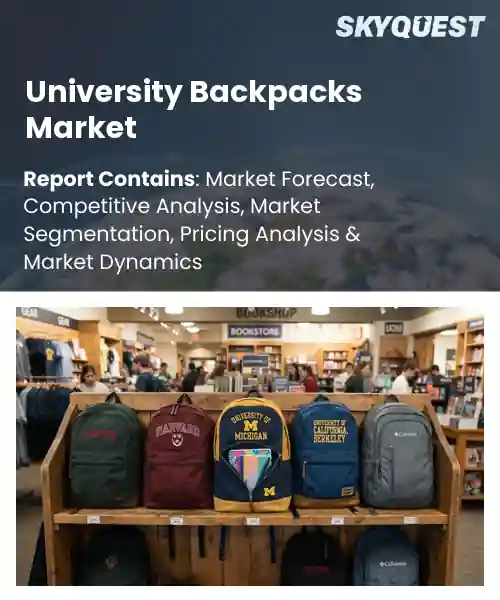
University Backpacks Market
Report ID: SQMIG25K2287
Report ID: SQMIG25K2287
[email protected]
USA +1 351-333-4748
Report ID:
SQMIG25K2287 |
Region:
Global |
Published Date: October, 2026
Pages:
157
|Tables:
121
|Figures:
77


Global University Backpacks Market size was valued at USD 2.45 Billion in 2024 and is poised to grow from USD 2.57 Billion in 2025 to USD 3.77 Billion by 2033, growing at a CAGR of 4.9% during the forecast period (2026-2033).
The global university backpacks market comprises products designed for college‑age students to carry books, laptops, and personal items. Its significance stems from the rise in higher‑education enrollment, which fuels demand for durable, multifunctional bags. Historically, the sector evolved from simple canvas satchels of the 1970s to tech‑friendly backpacks featuring padded compartments and weather‑proof fabrics. For example, a 2015 study showed a 25 % increase in sales of anti‑theft models as campuses tightened security. This shift reflects students’ need to protect valuable electronics while meeting fashion expectations, establishing a robust growth foundation for the market in the worldwide academic environment today overall. Building on that enrollment‑driven demand, digitalization of coursework has become the market’s second catalyst, prompting manufacturers to embed smart features such as USB charging ports and solar panels. Universities that adopt hybrid learning models create a ripple effect: students require longer battery life, which fuels sales of energy‑efficient backpacks. For instance, a leading European retailer reported a 40 % surge in purchases of solar‑powered models after a campus‑wide e‑learning initiative. This cause‑and‑effect chain opens opportunities for sustainable material sourcing, as eco‑conscious institutions favor recycled‑fabric bags, thereby expanding market share for brands that combine technology with green credentials in the global arena.
How is AI-driven inventory automation reshaping the university backpacks market?
AI-driven inventory automation is redefining how university backpacks are stocked and delivered. By linking demand forecasting with real‑time sales data, manufacturers can predict which styles, sizes, and features students will need each semester, reducing overproduction and stockouts. Smart sensors in warehouses trigger automatic reordering when thresholds are reached, while machine‑learning algorithms adjust production schedules to align with campus calendars. This seamless flow cuts lead times, lowers holding costs, and ensures that retailers always have the right mix of durable frames, ergonomic straps, and tech‑friendly compartments on hand. The result is a more responsive supply chain that keeps students equipped without the frustration of missing or delayed products.
Market snapshot - (2026-2033)
Global Market Size
USD 2.45 Billion
Largest Segment
Standard Student Backpacks
Fastest Growth
Convertible & Multifunctional Backpacks
Growth Rate
4.9% CAGR
To get more insights on this market click here to Request a Free Sample Report
Global university backpacks market is segmented by product type, material, price category, distribution channel and region. Based on product type, the market is segmented into Laptop Backpacks, Standard Student Backpacks, Convertible & Multifunctional Backpacks and Travel & Campus Backpacks. Based on material, the market is segmented into Polyester, Nylon, Canvas, Leather & Synthetic Leather and Other Materials. Based on price category, the market is segmented into Economy, Mid-Range and Premium. Based on distribution channel, the market is segmented into Online Retail, Specialty Stores, Department Stores and Other Retail Channels. Based on region, the market is segmented into North America, Europe, Asia Pacific, Latin America and Middle East & Africa.
Laptop Backpacks segment dominates because university students prioritize protecting electronic devices, especially laptops, while commuting between lectures and labs. The integrated padded compartments, ergonomic straps, and dedicated charging ports directly address core functional needs, creating persistent demand. This focus aligns with curriculum shifts toward digital coursework, reinforcing the segment’s relevance and driving consistent purchase decisions across the market in brick and mortar retail shelves and digital platforms, further solidifying its market leadership.
However, Convertible & Multifunctional Backpacks segment emerges as the fastest growing area because flexible designs that transition from day to night use appeal to students seeking versatility. Innovations such as modular compartments, detachable laptop sleeves, and integrated smart features are spurring adoption, expanding the market’s appeal beyond traditional backpack expectations in today.
Canvas material segment leads because its natural texture, durability, and eco friendly perception resonate with environmentally conscious students. The breathable weave offers comfort during long campus walks, while the classic aesthetic aligns with fashion trends on campuses. This combination of functional longevity and sustainable branding creates strong loyalty, encouraging repeat purchases and reinforcing the material’s prominence across university backpack offerings in both brick and mortar retail shelves and digital marketplaces, further solidifying its market position.
On the other hand, Synthetic Leather material segment is witnessing the strongest growth momentum because it blends premium appearance with cruelty free sourcing, meeting rising ethical expectations. Advances in PU coating provide water resistance and lightweight feel, attracting students who desire stylish yet functional bags, thereby expanding the market’s premium niche.
To get detailed segments analysis, Request a Free Sample Report
North America maintains a leading position in the global university backpacks market due to a combination of mature higher‑education ecosystems, strong consumer purchasing power, and a well‑established retail infrastructure. Universities across the United States and Canada generate consistent demand for backpacks that blend functionality with contemporary style, prompting manufacturers to invest heavily in product innovation and brand differentiation. The region benefits from advanced supply‑chain networks that ensure rapid product turnover and widespread availability through both brick‑and‑mortar and digital channels. Sustainability considerations also play a pivotal role, with consumers favoring eco‑friendly materials and manufacturers responding with greener product lines. Moreover, a culture that values personal expression through accessories reinforces the appeal of premium and tech‑enabled backpack solutions, reinforcing the region’s dominance.
University Backpacks Market in the United States reflects a vibrant ecosystem where large campus populations drive demand for diverse product offerings. Consumers prioritize ergonomic comfort, integrated technology, and fashion relevance, prompting brands to launch collections that cater to both academic and lifestyle needs. Robust e‑commerce platforms complement traditional retail, enabling swift adoption of new designs. Sustainability trends further shape purchasing decisions, with a growing preference for recycled fabrics and responsible manufacturing practices.
University Backpacks Market in Canada is shaped by a strong emphasis on durability and outdoor functionality, mirroring the country’s active lifestyle. Students seek backpacks that combine weather‑resistant materials with sleek design, leading manufacturers to focus on high‑performance fabrics and versatile features. Eco‑consciousness influences buying behavior, encouraging the adoption of sustainable materials. Distribution channels include specialty outdoor retailers and online marketplaces, ensuring broad accessibility across campus communities.
Europe experiences rapid expansion in the university backpacks market as a result of heightened consumer focus on design excellence, sustainability, and multifunctionality. Academic institutions across Germany, the United Kingdom, and France foster a culture that values both practicality and aesthetic appeal, prompting manufacturers to deliver products that meet rigorous quality standards while reflecting contemporary fashion trends. Regulatory encouragement of environmentally responsible production fuels the shift toward recycled and bio‑based materials. Additionally, the rise of digital learning environments creates demand for tech‑compatible backpacks equipped with charging capabilities and secure compartments. Strong online retail ecosystems and a tradition of premium craftsmanship further accelerate market growth, positioning Europe as a dynamic hub for innovative backpack solutions.
University Backpacks Market in Germany is characterized by a strong engineering mindset that prioritizes precision, durability, and ergonomic design. Students and professionals alike favor backpacks that offer robust construction, functional compartments, and sustainable material choices. The country’s well‑established manufacturing base supports rapid prototyping and high‑quality output, reinforcing a reputation for reliable products. Retail channels blend specialized outdoor stores with sophisticated online platforms, ensuring that innovative designs reach a broad audience across university campuses.
University Backpacks Market in the United Kingdom is propelled by fast‑growing demand driven by a youthful demographic that embraces fashion-forward accessories. Consumers seek backpacks that seamlessly integrate technology, such as built‑in charging ports and secure laptop sleeves, while maintaining a stylish silhouette. The vibrant e‑commerce landscape accelerates product diffusion, allowing brands to quickly respond to emerging trends. Sustainability remains a key consideration, with increasing preference for recycled fabrics and transparent supply chains, further stimulating market expansion.
University Backpacks Market in France is emerging as a notable segment where style and environmental awareness intersect. French students gravitate toward sleek designs that reflect contemporary fashion sensibilities, coupled with a growing appetite for eco‑friendly materials. Brands are responding with collections that emphasize minimalist aesthetics, lightweight construction, and responsible sourcing. Distribution is increasingly digital, with online retailers offering curated selections that resonate with the campus community, fostering gradual but steady market development.
Asia Pacific strengthens its position in the university backpacks market through a confluence of expanding higher‑education enrollment, rising disposable income, and a cultural shift toward globally influenced lifestyle accessories. Nations such as Japan and South Korea combine advanced manufacturing capabilities with a keen appetite for technologically integrated products, prompting the introduction of smart backpacks featuring connectivity, power solutions, and innovative storage. Consumer preferences lean toward minimalist yet functional designs that align with urban mobility trends. The region’s robust digital commerce infrastructure accelerates product adoption, while local brands leverage heritage craftsmanship to differentiate offerings. Together, these dynamics elevate Asia Pacific as a burgeoning center for forward‑looking backpack solutions.
University Backpacks Market in Japan is defined by a minimalist aesthetic that values clean lines, high‑quality materials, and functional precision. Students prioritize lightweight yet durable backpacks that accommodate daily commuting and academic needs. Integration of subtle technology, such as discreet charging ports, complements the understated design ethos. Domestic manufacturers excel in craftsmanship, ensuring meticulous attention to detail, while retail channels blend specialty boutiques with sophisticated online platforms, delivering refined products to campus consumers.
University Backpacks Market in South Korea reflects a fast‑moving environment where tech‑savvy students demand highly connected accessories. Backpacks often incorporate smart features, including wireless charging, RFID protection, and modular compartments, catering to a digitally integrated lifestyle. Fashion consciousness drives bold designs that merge contemporary trends with functional performance. Strong e‑commerce ecosystems and rapid product cycles enable swift market responsiveness, positioning South Korea as a leader in innovative university backpack offerings.
To know more about the market opportunities by region and country, click here to
Buy The Complete Report
Increasing Campus Mobility Demand
Shift Toward Sustainable Materials
High Cost of Technical Features
Supply Chain Disruptions Impact Production
Request Free Customization of this report to help us to meet your business objectives.
The global university backpacks market is shaped by intense competition as brands race to differentiate through sustainability, smart‑technology integration and campus partnerships; these drivers intensify rivalry among established manufacturers and emerging innovators. Recent strategic moves include Targus partnering with Microsoft to create Surface‑compatible backpacks, Swiss Gear collaborating with Samsung for Galaxy Tab‑ready designs, and several firms investing in RFID‑enabled and solar‑charging features to capture tech‑savvy student segments.
Top Player’s Company Profile
Recent Developments
SkyQuest’s ABIRAW (Advanced Business Intelligence, Research & Analysis Wing) is our Business Information Services team that Collects, Collates, Correlates, and Analyses the Data collected by means of Primary Exploratory Research backed by robust Secondary Desk research. As per SkyQuest analysis the global university backpacks market continues to expand driven primarily by rising campus mobility demand as students seek comfortable, durable bags that accommodate laptops and textbooks, while a second powerful driver is the growing integration of smart connectivity such as USB ports and solar panels that align with hybrid learning. The laptop backpacks segment leads the market because it directly meets the core need for device protection. North America remains the dominant region thanks to strong purchasing power and an established retail network. However, the high cost of advanced technical features restrains adoption among price‑sensitive students and can slow growth in emerging markets.
| Report Metric | Details |
|---|---|
| Market size value in 2024 | USD 2.45 Billion |
| Market size value in 2033 | USD 3.77 Billion |
| Growth Rate | 4.9% |
| Base year | 2024 |
| Forecast period | (2026-2033) |
| Forecast Unit (Value) | USD Billion |
| Segments covered |
|
| Regions covered | North America (US, Canada), Europe (Germany, France, United Kingdom, Italy, Spain, Rest of Europe), Asia Pacific (China, India, Japan, Rest of Asia-Pacific), Latin America (Brazil, Rest of Latin America), Middle East & Africa (South Africa, GCC Countries, Rest of MEA) |
| Companies covered |
|
| Customization scope | Free report customization with purchase. Customization includes:-
|
To get a free trial access to our platform which is a one stop solution for all your data requirements for quicker decision making. This platform allows you to compare markets, competitors who are prominent in the market, and mega trends that are influencing the dynamics in the market. Also, get access to detailed SkyQuest exclusive matrix.
Table Of Content
Executive Summary
Market overview
Parent Market Analysis
Market overview
Market size
KEY MARKET INSIGHTS
COVID IMPACT
MARKET DYNAMICS & OUTLOOK
Market Size by Region
KEY COMPANY PROFILES
Methodology
For the University Backpacks Market, our research methodology involved a mixture of primary and secondary data sources. Key steps involved in the research process are listed below:
1. Information Procurement: This stage involved the procurement of Market data or related information via primary and secondary sources. The various secondary sources used included various company websites, annual reports, trade databases, and paid databases such as Hoover's, Bloomberg Business, Factiva, and Avention. Our team did 45 primary interactions Globally which included several stakeholders such as manufacturers, customers, key opinion leaders, etc. Overall, information procurement was one of the most extensive stages in our research process.
2. Information Analysis: This step involved triangulation of data through bottom-up and top-down approaches to estimate and validate the total size and future estimate of the University Backpacks Market.
3. Report Formulation: The final step entailed the placement of data points in appropriate Market spaces in an attempt to deduce viable conclusions.
4. Validation & Publishing: Validation is the most important step in the process. Validation & re-validation via an intricately designed process helped us finalize data points to be used for final calculations. The final Market estimates and forecasts were then aligned and sent to our panel of industry experts for validation of data. Once the validation was done the report was sent to our Quality Assurance team to ensure adherence to style guides, consistency & design.
Analyst Support
Customization Options
With the given market data, our dedicated team of analysts can offer you the following customization options are available for the University Backpacks Market:
Product Analysis: Product matrix, which offers a detailed comparison of the product portfolio of companies.
Regional Analysis: Further analysis of the University Backpacks Market for additional countries.
Competitive Analysis: Detailed analysis and profiling of additional Market players & comparative analysis of competitive products.
Go to Market Strategy: Find the high-growth channels to invest your marketing efforts and increase your customer base.
Innovation Mapping: Identify racial solutions and innovation, connected to deep ecosystems of innovators, start-ups, academics, and strategic partners.
Category Intelligence: Customized intelligence that is relevant to their supply Markets will enable them to make smarter sourcing decisions and improve their category management.
Public Company Transcript Analysis: To improve the investment performance by generating new alpha and making better-informed decisions.
Social Media Listening: To analyze the conversations and trends happening not just around your brand, but around your industry as a whole, and use those insights to make better Marketing decisions.
REQUEST FOR SAMPLE
 REQUEST FREE CUSTOMIZATION


Want to customize this report? This report can be personalized according to your needs. Our analysts and industry experts will work directly with you to understand your requirements and provide you with customized data in a short amount of time. We offer $1000 worth of FREE customization at the time of purchase.
Feedback From Our Clients


 USA (+1) 351-333-4748

