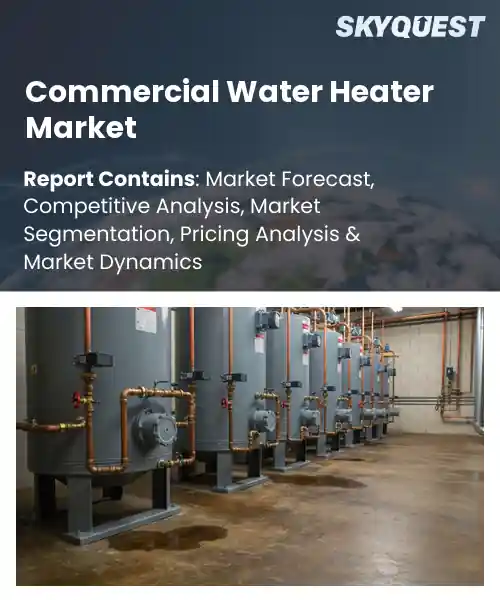
Commercial Water Heater Market
Report ID: SQMIG20I3021
Report ID: SQMIG20I3021
[email protected]
USA +1 351-333-4748
Report ID:
SQMIG20I3021 |
Region:
Global |
Published Date: May, 2026
Pages:
157
|Tables:
119
|Figures:
77


Global Commercial Water Heater Market size was valued at USD 3.82 Billion in 2024 and is poised to grow from USD 4.05 Billion in 2025 to USD 6.52 Billion by 2033, growing at a CAGR of 6.12% during the forecast period (2026-2033).
Commercial water heater market centers on equipment and systems that supply hot water to businesses and institutions, and its primary driver is regulatory and economic pressure to improve energy efficiency. There needs to be reliable supply of hot water to facilitate smooth operations within a business's operation, guest satisfaction vehicle an actual business's level of concern regarding overhead costs, safety and satisfaction level of any end-user involved within that establishment. Throughout history this particular industry has evolved along with the growth of urban areas, state and municipal regulatory codes, as well as advances in technology. Specifically, as states have mandated improvements through building codes and encouraged retrofits , many products within this category have come from outside their respective area due to these price incentives.
One key trend driving the global commercial water heater sector is tightening efficiency standards, which force manufacturers to innovate and operators to replace legacy units sooner, creating growth opportunities for heat-pump and condensing technologies. As regulations continue to raise the minimum performance standard, both installation contractors as well as facility management are utilizing the latest in electric heat pump technology to reduce their operating cost, while also accelerating the payback periods through incentives, enabling hospitals, hotels and laundries to prioritize and complete retrofitting their facility. With recent advancements in improved controls and IoT-based monitoring technologies, facility operators will now be able to achieve better uptime while reducing maintenance costs and optimizing load scheduling.
How Is IoT Improving Efficiency in the Commercial Water Heater Market?
By combining smart sensors with remote monitoring and automated controls, commercial water heating utilizes IoT to increase efficiency. Real-time diagnostics that can detect faults before they lead to downs allow for more intelligent scheduling, which allows operations to take place during lower-cost times, and centralizes management of multi-unit systems to better manage demand. There are currently many manufacturers developing connectivity solutions in a market that regulators are pushing toward increasing efficiency; therefore, this context makes it more attractive for building owners and service personnel to implement smart features into their facilities. Practical instances include units with built in recirculation control and leak detection that allow remote servicing and faster response, preserving uptime and cutting wasted energy.
In March 2025, Rheem launched the IKONIC commercial tankless line with integrated Wi Fi and EcoNet technology. Those connected features enable coordinated load shifting, remote troubleshooting and leak alerts which reduce operator visits and energy waste while supporting broader adoption of high efficiency commercial systems.
Market snapshot - (2026-2033)
Global Market Size
USD 3.82 Billion
Largest Segment
Storage Water Heaters
Fastest Growth
Heat Pump Water Heaters
Growth Rate
6.12% CAGR
To get more insights on this market click here to Request a Free Sample Report
Global commercial water heater market is segmented by type, fuel, end-use, capacity and region. Based on type, the market is segmented into Storage Water Heaters, Tankless (On-Demand) Heaters and Heat Pump Water Heaters. Based on fuel, the market is segmented into Natural Gas, Electric, Oil and Solar-Assisted. Based on end-use, the market is segmented into Hotels & Hospitality, Restaurants, Healthcare Facilities and Educational Institutions. Based on capacity, the market is segmented into Below 100 Gallons, 100-300 Gallons and Above 300 Gallons. Based on region, the market is segmented into North America, Europe, Asia Pacific, Latin America and Middle East & Africa.
Based on the global commercial water heater market growth, heat pump water heaters segment dominates because growing emphasis on energy efficiency and lower operating costs drives adoption in commercial installations, leading buyers to favor systems that reduce overall facility energy demand. As a result of their increased efficiency under a variety of load conditions and their ability to be integrated into existing HVAC systems in buildings, facility managers want these units first. Additionally, incentives and corporate sustainability goals are contributing to the decision-making process and the long-term retrofit planning activities in the commercial water heater market.
However, tankless on demand heaters are emerging as the fastest growing area due to their compact footprint and ability to deliver continuous hot water for variable commercial demand, enabling space constrained facilities and incremental capacity additions. New building designs and installation of new technology provide greater flexibility and potential for future growth.
Natural gas segment dominates because its high heat output and compatibility with large volume commercial applications meet the intense simultaneous demand patterns common in hotels, hospitals, and eateries, making it a default choice for capacity and reliability. The foundation for fuel distribution systems and established maintenance practices greatly reduce the amount of deployment friction experienced by operators for facilities utilizing commercial water heaters. Predictable service and reliability of the entire system will aid engineers and procurement teams specifying products in the commercial water heater marketplace who are looking for assurance of reliable performance.
However, electric segment is witnessing the strongest growth as rising electrification priorities, simplified installation for sites lacking on site fuel connections, and improvements in high efficiency electric elements drive adoption. Regulatory incentives and corporate decarbonization goals favor electric conversions, while modular designs and easier integration with renewable power sources accelerate retrofit activity and create new procurement and service opportunities.
To get detailed segments analysis, Request a Free Sample Report
As per the global commercial water heater market outlook, Asia Pacific dominance in the industry is driven by a convergence of structural and technological strengths. Rapid urbanization and sustained commercial construction have expanded demand across hospitality, healthcare and industrial segments, while major regional manufacturers deliver cost competitive products and extensive service networks. The implementation of energy efficiency policies and standards for appliances have led to the increased implementation of advanced heat pumps and condensing boilers. Greater integration of the supply chain between the manufacturers and suppliers of components reduces lead times and encourages innovation. Export-oriented companies and investment in R&D and product customization mean that the suppliers can support a diverse range of climates and regulations across the region thereby solidifying their market position through scale, local expertise and continuous product improvements.
Commercial water heater market in Japan features advanced engineering focus, with manufacturers prioritizing compact, high efficiency units tailored for constrained urban spaces. The strong regulatory focus on energy performance provides a strong push and incentive to employ heat pump and hybrid technology in commercial installations. The already-dominant service networks, together with OEM after-sales support, facilitate easy and rapid maintenance and upgrades, whereas sustained product innovation and integration with building management systems keep the segment competitive domestically and in export markets now and in the future.
Commercial water heater market in South Korea is characterized by rapid technology adoption and strong manufacturing capabilities, with a focus on compact modular systems suitable for dense urban developments. The establishment of regulations and incentives related to energy efficiency serves as an impetus for the implementation of advanced heat pumps and electrical solutions throughout the hospitality and healthcare sectors. By partnering together, manufacturers and contractors are able to provide tailored system integration, supported by strong export channels and service networks to add to the region’s overall competitiveness and confidence.
Based on global commercial water heater regional forecast, rapid expansion of the industry in North America reflects a combination of infrastructure renewal and shifting policy emphasis toward decarbonization and operating cost reduction. As building owners and facility managers continue to place a greater value on energy efficient systems with low maintenance costs, the trend towards using modular, high efficiency, electrically driven technologies for new construction and retrofit projects is growing. With incentive programs and efficiency standards providing catalysts for investment, strong networks of contractors and distributors help facilitate an effective means for expanding into the marketplace quickly. Furthermore, smart controls and remote monitoring of these systems enhance lifecycle management and are aligned with corporate sustainability goals. The mature aftermarket ecosystem, as well as the collaborations between technology providers and utilities, is further driving the deployment of these technologies at scale throughout commercial buildings of all types.
Commercial water heater market in United States is influenced by extensive commercial building stock and active retrofit cycles, with owners seeking energy efficient, low maintenance solutions. Distributors and contractual entities, combined with strong manufacturing processes, allow for the quick acceptance and usage of new products. The creation of utility and regulatory policy allows for both electrification and the use of highly efficient systems, which creates a need for modular systems and the integration of smart controls. Collaboration among manufacturers and large-scale users of facilities allow for customized solutions and guaranteed performance to be consistently delivered.
Commercial water heater market in Canada centers on urban retrofit activity and regional infrastructure resilience, with emphasis on cold climate performance and durable systems. Heat pumps and highly-efficient electrical solutions installed in commercial buildings are supported by various provincial incentives and energy efficiency programs. Strong partnerships between suppliers and contractors support timely maintenance as well as customized installations. Suppliers continue to manufacture robust products with individual pieces able to meet the different regional energy strategies and building types.
As per global commercial water heater regional outlook, Europe is strengthening its industry position through coordinated policy action and industry innovation that prioritize energy performance and system electrification. The government sets high performance requirements and provides high incentives to support large installations of heat pump and condensing technologies. Integration of heat pumps with district heating systems and renovation efforts creates new commercial installation opportunities. Local manufacturers use their engineering talent to develop modular, dependable equipment that is adaptable to different types of business operations. The harmonization of standards across borders, the increasing skill of installers, and the focus on providing lifecycle services will create a smoother adoption process for major facility owners. Investment in smart control systems and system integration creates better visibility and more efficient management of operational costs, thus maintaining Europe as the preeminent provider of high efficiency commercial water heating systems.
Commercial water heater market in Germany leverages engineering strength and industrial demand to favor robust, high efficiency solutions. Designing energy performance and industry integration to encourage application of heat recovery system & heat pump systems. Manufacturing companies place a heavy emphasis on the use of long-lasting materials & parts that are manufactured strictly in accordance with regional standards. Comprehensive service networks provide maintenance & retrofit services that meet the needs of manufacturing plants, commercial buildings and institutions that place emphasis on long-lasting reliability and resiliency.
Commercial water heater market in United Kingdom is shaped by a strong renovation market and regulatory focus on energy efficiency, prompting adoption of compact, high performance systems in commercial buildings. The channels for service and installation are well established enough to produce an effective cycle for retrofitting. Manufacturers provide many options that may be considered flexible in a modular format as well as smart controls that fit various commercial applications.
Commercial water heater market in France reflects policy driven renovation and integration with district heating, encouraging efficient heat pump and condensing systems in commercial buildings. Manufacturers tailor equipment for centralized heating compatibility and smart building control integration. In addition to the support provided by manufacturers, collaboration among equipment suppliers and facility managers helps identify ways to improve energy performance and operational continuity through innovative solutions in various locations, including hospitality, retail and institutional locations.
To know more about the market opportunities by region and country, click here to
Buy The Complete Report
Rising Energy Efficiency Demand
Growth In Construction and Retrofit
High Upfront Capital Costs
Complex Regulations and Standards
Request Free Customization of this report to help us to meet your business objectives.
Competitive intensity in the global commercial water heater market outlook is driven by electrification mandates and tightening efficiency regulations that force incumbents into concrete moves such as acquisitions, cloud partnerships, and product reinvention. Recent examples include Rheem’s acquisition of Nortek Global HVAC to broaden air and water capabilities and appliance makers’ multi year partnerships with Google Cloud for AI enabled diagnostics; startups are simultaneously commercializing intelligent heat pump and turbocompressor technologies.
Top Player’s Company Profile
Recent Developments
SkyQuest’s ABIRAW (Advanced Business Intelligence, Research & Analysis Wing) is our Business Information Services team that Collects, Collates, Correlates, and Analyses the Data collected by means of Primary Exploratory Research backed by robust Secondary Desk research.
As per SkyQuest analysis, the global commercial water heater industry is being propelled by tightening efficiency standards that accelerate replacement of legacy units and encourage adoption of high efficiency technologies, while a key restraint remains high upfront capital costs that can delay retrofits. Asia Pacific currently dominates the market due to rapid urbanization, strong manufacturing capabilities and supportive policies, and heat pump water heaters are the leading segment as buyers prioritize lower operating costs and electrification. A second important growth driver is ongoing construction and retrofit activity which sustains demand for modern, code compliant systems and packaged solutions and encourages investment in smart controls and new service models that improve uptime and lifecycle value.
| Report Metric | Details |
|---|---|
| Market size value in 2024 | USD 3.82 Billion |
| Market size value in 2033 | USD 6.52 Billion |
| Growth Rate | 6.12% |
| Base year | 2024 |
| Forecast period | (2026-2033) |
| Forecast Unit (Value) | USD Billion |
| Segments covered |
|
| Regions covered | North America (US, Canada), Europe (Germany, France, United Kingdom, Italy, Spain, Rest of Europe), Asia Pacific (China, India, Japan, Rest of Asia-Pacific), Latin America (Brazil, Rest of Latin America), Middle East & Africa (South Africa, GCC Countries, Rest of MEA) |
| Companies covered |
|
| Customization scope | Free report customization with purchase. Customization includes:-
|
To get a free trial access to our platform which is a one stop solution for all your data requirements for quicker decision making. This platform allows you to compare markets, competitors who are prominent in the market, and mega trends that are influencing the dynamics in the market. Also, get access to detailed SkyQuest exclusive matrix.
Table Of Content
Executive Summary
Market overview
Parent Market Analysis
Market overview
Market size
KEY MARKET INSIGHTS
COVID IMPACT
MARKET DYNAMICS & OUTLOOK
Market Size by Region
KEY COMPANY PROFILES
Methodology
For the Commercial Water Heater Market, our research methodology involved a mixture of primary and secondary data sources. Key steps involved in the research process are listed below:
1. Information Procurement: This stage involved the procurement of Market data or related information via primary and secondary sources. The various secondary sources used included various company websites, annual reports, trade databases, and paid databases such as Hoover's, Bloomberg Business, Factiva, and Avention. Our team did 45 primary interactions Globally which included several stakeholders such as manufacturers, customers, key opinion leaders, etc. Overall, information procurement was one of the most extensive stages in our research process.
2. Information Analysis: This step involved triangulation of data through bottom-up and top-down approaches to estimate and validate the total size and future estimate of the Commercial Water Heater Market.
3. Report Formulation: The final step entailed the placement of data points in appropriate Market spaces in an attempt to deduce viable conclusions.
4. Validation & Publishing: Validation is the most important step in the process. Validation & re-validation via an intricately designed process helped us finalize data points to be used for final calculations. The final Market estimates and forecasts were then aligned and sent to our panel of industry experts for validation of data. Once the validation was done the report was sent to our Quality Assurance team to ensure adherence to style guides, consistency & design.
Analyst Support
Customization Options
With the given market data, our dedicated team of analysts can offer you the following customization options are available for the Commercial Water Heater Market:
Product Analysis: Product matrix, which offers a detailed comparison of the product portfolio of companies.
Regional Analysis: Further analysis of the Commercial Water Heater Market for additional countries.
Competitive Analysis: Detailed analysis and profiling of additional Market players & comparative analysis of competitive products.
Go to Market Strategy: Find the high-growth channels to invest your marketing efforts and increase your customer base.
Innovation Mapping: Identify racial solutions and innovation, connected to deep ecosystems of innovators, start-ups, academics, and strategic partners.
Category Intelligence: Customized intelligence that is relevant to their supply Markets will enable them to make smarter sourcing decisions and improve their category management.
Public Company Transcript Analysis: To improve the investment performance by generating new alpha and making better-informed decisions.
Social Media Listening: To analyze the conversations and trends happening not just around your brand, but around your industry as a whole, and use those insights to make better Marketing decisions.
REQUEST FOR SAMPLE
 REQUEST FREE CUSTOMIZATION
Global Commercial Water Heater Market size was valued at USD 3.82 Billion in 2024 and is poised to grow from USD 4.05 Billion in 2025 to USD 6.52 Billion by 2033, growing at a CAGR of 6.12% during the forecast period (2026-2033).
Competitive intensity in the global commercial water heater market is driven by electrification mandates and tightening efficiency regulations that force incumbents into concrete moves such as acquisitions, cloud partnerships, and product reinvention. Recent examples include Rheem’s acquisition of Nortek Global HVAC to broaden air and water capabilities and appliance makers’ multi year partnerships with Google Cloud for AI enabled diagnostics; startups are simultaneously commercializing intelligent heat pump and turbocompressor technologies. 'A.O. Smith Corporation', 'Bradford White Corporation', 'Rheem Manufacturing', 'Rinnai Corporation', 'Lochinvar (A.O. Smith)', 'Navien Inc.', 'Noritz Corporation', 'Bosch Thermotechnology', 'Vaillant Group', 'Baxi Group', 'Viessmann Group', 'Weil-McLain', 'LAARS Heating Systems (Bradford White)', 'Smith Water Heaters', 'Aerco International', 'Raypack Inc.', 'PVI Industries (Watts)', 'HTP (Heat Transfer Products)', 'American Water Heaters (A.O. Smith)', 'Pentair plc'
Manufacturers are responding to strengthened requirements for energy-efficient heating by developing commercial water heaters with improved heat exchange, smarter controls, and reduced standby losses, which increases product appeal across building owners and facility managers. This demand stimulates investment in research and development and encourages companies to expand product lines and retrofit services, thereby expanding market availability and adoption. As buyers prioritize lower operating costs and sustainability credentials, suppliers that emphasize efficiency features gain competitive advantage and drive broader market growth through differentiated offerings.
Decarbonization Driven Shift: Manufacturers and facility operators are prioritizing low carbon heating solutions, accelerating adoption of advanced heat pump systems, hybrid offerings, integration with renewable energy sources. Product roadmaps emphasize reduced greenhouse gas footprints, lifecycle efficiency, and compatibility with onsite generation. Suppliers are reorienting services toward commissioning, system optimization, and emissions reporting to meet corporate sustainability commitments. Demand is increasingly shaped by tenant expectations and corporate procurement policies that favor verified environmental performance, driving collaboration across supply chains to deliver demonstrable carbon reductions.
Why does Asia Pacific Dominate the Global Commercial Water Heater Market? |@12


Want to customize this report? This report can be personalized according to your needs. Our analysts and industry experts will work directly with you to understand your requirements and provide you with customized data in a short amount of time. We offer $1000 worth of FREE customization at the time of purchase.
Feedback From Our Clients


 USA (+1) 351-333-4748

