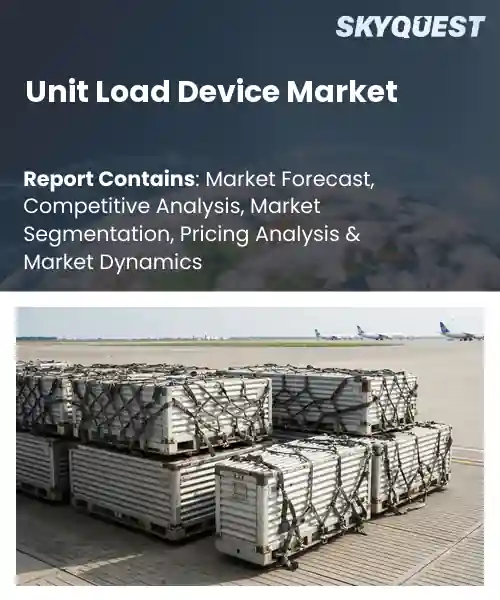
Unit Load Device Market
Report ID: SQMIG20R2095
Report ID: SQMIG20R2095
[email protected]
USA +1 351-333-4748
Report ID:
SQMIG20R2095 |
Region:
Global |
Published Date: July, 2026
Pages:
157
|Tables:
178
|Figures:
79


Global Unit Load Device Market size was valued at USD 3.2 Billion in 2024 and is poised to grow from USD 3.33 Billion in 2025 to USD 4.63 Billion by 2033, growing at a CAGR of 4.2% during the forecast period (2026-2033).
The unit load device market centers on containers and pallets that consolidate airfreight for efficient handling and protection. Its primary driver is growing global air cargo demand and time-sensitive e-commerce volumes which force carriers to increase throughput and reduce turn times. This market matters because standardized ULDs directly influence aircraft payload optimization, ground operation costs and cargo security. Over time the sector evolved from metal and wooden pallets to lightweight composite containers and intelligent ULDs with embedded sensors. Carriers adopted RFID tagging and third-party pooling to lower capital expenditure while integrators like DHL and FedEx redesigned processes around LD3 fleets.A critical factor shaping the global ULD market is rapid digitalization and pooling which increases asset visibility and utilization. When airlines and handlers fit containers with IoT sensors and RFID tags they can track location and temperature, reducing loss and idle time and cutting replacement costs. Consequently leasing firms expand offerings because higher utilization yields better returns and enables investment in lightweight composites and temperature-controlled units for pharma. Deployments by SITA, Envirotainer and airport pooling pilots show how data-driven operations unlock revenue while lowering emissions through optimized load planning. This improves turnaround at hubs and supports regulatory compliance for shipments.
How is IoT improving asset tracking efficiency in the Unit Load Device market?
IoT improves asset tracking for unit load devices by combining small location and condition sensors with persistent network connectivity and cloud analytics. Key aspects are real time location, environmental sensing and automated inventory reconciliation. In the current market many airlines and ULD managers deploy battery powered tags, Bluetooth labels and multi mode satellite cellular modules to shrink search time and simplify maintenance cycles. This reduces operational friction at hubs and lowers the risk of misplacement during interline transfers. Practical examples include temperature alerts on pallets and route aware feeds that speed return to service for high value containers.Jettainer March 2026, launched next generation IoT tracking with Lufthansa Cargo, showing how persistent ULD telemetry cuts search time, enables predictive maintenance workflows, and streamlines asset returns to reduce ground delays and manual audits while supporting more efficient fleet utilization.
Market snapshot - (2026-2033)
Global Market Size
USD 3.2 Billion
Largest Segment
Fastest Growth
Growth Rate
4.2% CAGR
To get more insights on this market click here to Request a Free Sample Report
Global unit load device market is segmented by product type, material, deck type, aircraft type, ownership model, end user and region. Based on product type, the market is segmented into Containers (AKE, AMA, ALF, etc.), Pallets (PMC, PAG, PQA, etc.), Nets & Restraint Systems and Other Unit Load Devices. Based on material, the market is segmented into Aluminum, Composite Materials, Plastic and Other Materials. Based on deck type, the market is segmented into Lower Deck ULDs and Main Deck ULDs. Based on aircraft type, the market is segmented into Passenger Aircraft and Freighter Aircraft. Based on ownership model, the market is segmented into Airline-Owned ULDs and ULD Leasing & Pooling. Based on end user, the market is segmented into Commercial Airlines, Air Cargo Carriers, ULD Leasing & Pooling Companies, Ground Handling Service Providers and Logistics & Freight Forwarding Companies. Based on region, the market is segmented into North America, Europe, Asia Pacific, Latin America and Middle East & Africa.
[Containers segment dominates because enclosed, standardized containers provide superior cargo protection and handling uniformity across airline fleets. Their standard sizes and interface features simplify loading systems, ensure weatherproof transport for diverse goods, and reduce in transit damage and handling variation. Widespread adoption by passenger and mixed fleet operators, combined with strong interoperability with conveyor and automation systems, drives procurement preference and operational efficiency for carriers across network operations.
However, pallets (PMC, PAG, PQA, etc.) are witnessing the strongest growth as carriers and integrators prioritize flexible bulk loading for outsized or nonstandard freight. Simpler construction and ease of handling during freighter configurations enable higher throughput on main decks, while demand for adaptable, lightweight pallet solutions accelerates fleet capacity upgrades and commercial opportunity.
[Aluminum segment dominates because decades of proven performance, recyclability and established manufacturing make it the default material choice for a wide range of unit load devices. Its predictable strength, repairability and mature supply chain reduce maintenance complexity for operators and supportable repair networks. Familiar certification pathways and cost-efficient production incentivize airlines and lessors to favor aluminum, reinforcing its entrenched role across fleets and handling ecosystems and operational continuity.
Meanwhile, Composite Materials are emerging as the fastest growing material category due to intensive lightweighting initiatives and advanced manufacturing techniques that enable complex, durable ULD designs. Rising adoption is driven by airline fuel efficiency goals and regulatory pressure to reduce emissions, spurring investment in composites and creating opportunities for higher performance, longer lasting and lower lifecycle cost ULDs.
To get detailed segments analysis, Request a Free Sample Report
Asia Pacific dominance in the global unit load device market is driven by deep rooted airline networks, high cargo traffic across major trade corridors, and concentrated manufacturing hubs that demand efficient freight handling solutions. Regional carriers and integrators prioritize lightweight, modular, and reusable ULDs to optimize payloads and turnaround times, while leasing and maintenance ecosystems support fleet flexibility. Strong partnerships between OEMs, ground handlers, and airports enable rapid adoption of standardized containers and pallets, and technology adoption in tracking and materials accelerates operational resilience. Robust intra regional and intercontinental trade flows, combined with strategic investments in cold chain and e commerce logistics, reinforce market leadership and create an environment where scale, innovation, and service integration sustain long term competitive advantage and momentum.
Unit Load Device Market in Japan is characterized by regulatory compliance, mature airline fleets, and emphasis on durability and precision engineering. Domestic integrators and ground handlers favor standardized, high quality ULDs that align with efficient gate operations and short haul rotations. Collaboration among manufacturers, leasing firms, and airport authorities fosters tailored solutions for temperature sensitive cargo and premium logistics services, reinforcing reliability and refining material selection and lifecycle management practices.
Unit Load Device Market in South Korea reflects advanced manufacturing capabilities, close integration between carriers and logistics providers, with focus on lightweight materials and automation. Airports and ground handlers prioritize turnarounds and modular ULD designs to support intense cargo flows. Partnerships among OEMs, leasing companies, and technology suppliers drive innovations in tracking and maintenance, while export oriented industries sustain demand for reliable, scalable solutions in cold chain and express logistics.
Rapid expansion of the unit load device market in North America arises from a dense network of integrators, robust e commerce fulfillment systems, and emphasis on supply chain resilience among shippers and carriers. Air freight operators and specialized cargo airlines seek flexible leasing arrangements and technologically enabled ULDs to support varied payloads and multimodal distribution. Investment in automated handling, enhancements in cold chain capabilities, and collaborative initiatives between airports, ground handlers, and OEMs drive operational efficiency. Regulatory focus on safety and interoperability encourages standardized designs, while strong logistics service demand from varied industry sectors reinforces the need for scalable, maintainable ULD fleets and end to end tracking solutions that improve visibility and uptime. Strategic partnerships and robust aftermarket services further support lifecycle optimization and cost containment across operator networks.
Unit Load Device Market in United States is shaped by freight integrators, strong demand for rapid delivery, and advanced automation at cargo hubs. Operators prioritize modular, lightweight ULDs compatible with diverse fleet types and intermodal transfers. Collaboration between OEMs, leasing providers, and ground handlers emphasizes reliability, standardized maintenance, and scalable asset pools. Focus on visibility, compliance, and aftermarket services supports utilization across express, e commerce, and temperature sensitive freight segments.
Unit Load Device Market in Canada emphasizes cross border connectivity, resilient cold chain logistics, and handling at gateways. Carriers and freight forwarders favor adaptable ULD solutions suited for international services and domestic feeder networks. Investment in tracking technologies, standardized maintenance practices, and strategic leasing relationships enhances operational continuity. Focus on integration with ground transportation and regional distribution centers supports efficient end to end movement for perishable and high value cargo.
Europe is strengthening its position in the unit load device market through harmonization of standards, investments in durable and recyclable materials, and close collaboration among airlines, airports, and ground handlers. Regional emphasis on sustainability and lifecycle management prompts adoption of lighter, longer lasting ULDs and advances in repair and refurbishment networks. Integration of digital tracking and interoperable systems enhances visibility across multimodal supply chains, while aftermarket services and leasing models support fleet flexibility. Strategic partnerships between OEMs and logistics service providers, together with focus on specialized cargo segments such as temperature sensitive and high value shipments, reinforce operational efficiency and competitiveness across European hubs and corridors. Regulatory alignment and innovation clusters across key markets facilitate pilot programs for material science, repair techniques, and ULD tracking, accelerating broader uptake and cost effective maintenance practices.
Unit Load Device Market in Germany is driven by excellence, focus on sustainability, and integration with manufacturing and export networks. Airlines and logistics providers prioritize durable, repairable ULDs that align with safety and operational standards. Collaboration between OEMs, technology firms, and maintenance providers fosters advanced materials adoption and refurbishment cycles. Emphasis on interoperability with rail and road transport supports multimodal distribution, enhancing reliability for temperature sensitive and value cargo movements.
Unit Load Device Market in United Kingdom benefits from airport infrastructure, strong express networks, and emphasis on agile supply chain solutions. Operators favor lightweight, standardized ULDs that support handling and cross border trade. Collaboration among airlines, ground handlers, and leasing firms promotes efficient maintenance practices. Integration of digital tracking and compliance focused procedures enhances cargo visibility and supports specialist sectors such as pharmaceuticals and value e commerce shipments across markets.
Unit Load Device Market in France is influenced by cargo hubs, emphasis on sustainability, and coordination between carriers and logistics operators. Demand focuses on modular, recyclable ULDs that can be efficiently repaired and refurbished within regional networks. Partnerships among OEMs, maintenance providers, and leasing firms foster standardized processes and reliable spare part availability. Integration with multimodal transport and temperature controlled logistics enhances service offerings for perishables and premium freight sectors.
To know more about the market opportunities by region and country, click here to
Buy The Complete Report
Expansion Of Air Cargo Operations
Shift Toward Lightweight Materials
High Initial Capital Requirements
Inconsistent Regulatory Requirements
Request Free Customization of this report to help us to meet your business objectives.
Competition in the global ULD market centers on real time visibility, asset utilisation and temperature safe transport, driving partnerships, acquisitions and product innovation. Recent moves include SkyCell partnering with ACL Airshop for IoT enabled ULD management. Unilode collaborating with OnAsset on enhanced in flight and ground tracking. The acquisition of ACL Airshop by Alinda Capital illustrates consolidation shaping service scale and leasing strategies.
Top Player’s Company Profile
Recent Developments
SkyQuest’s ABIRAW (Advanced Business Intelligence, Research & Analysis Wing) is our Business Information Services team that Collects, Collates, Correlates, and Analyses the Data collected by means of Primary Exploratory Research backed by robust Secondary Desk research. As per SkyQuest analysis, the global unit load device market is being driven primarily by rising air cargo volumes and time-sensitive e-commerce growth, while a parallel push toward digitalization and IoT-enabled pooling further accelerates visibility and utilization. Growth is tempered by high initial capital requirements for advanced ULDs and certification, which slow fleet renewal. Asia Pacific remains the dominant region due to dense trade corridors and manufacturing hubs, and containers continue to dominate product mix because of standardized protection and handling efficiency. Overall, demand favors lightweight, connected ULDs and leasing models as carriers and integrators seek to optimize payload, turnaround and cold chain performance.
| Report Metric | Details |
|---|---|
| Market size value in 2024 | USD 3.2 Billion |
| Market size value in 2033 | USD 4.63 Billion |
| Growth Rate | 4.2% |
| Base year | 2024 |
| Forecast period | (2026-2033) |
| Forecast Unit (Value) | USD Billion |
| Segments covered |
|
| Regions covered | North America (US, Canada), Europe (Germany, France, United Kingdom, Italy, Spain, Rest of Europe), Asia Pacific (China, India, Japan, Rest of Asia-Pacific), Latin America (Brazil, Rest of Latin America), Middle East & Africa (South Africa, GCC Countries, Rest of MEA) |
| Companies covered |
|
| Customization scope | Free report customization with purchase. Customization includes:-
|
To get a free trial access to our platform which is a one stop solution for all your data requirements for quicker decision making. This platform allows you to compare markets, competitors who are prominent in the market, and mega trends that are influencing the dynamics in the market. Also, get access to detailed SkyQuest exclusive matrix.
Table Of Content
Executive Summary
Market overview
Parent Market Analysis
Market overview
Market size
KEY MARKET INSIGHTS
COVID IMPACT
MARKET DYNAMICS & OUTLOOK
Market Size by Region
KEY COMPANY PROFILES
Methodology
For the Unit Load Device Market, our research methodology involved a mixture of primary and secondary data sources. Key steps involved in the research process are listed below:
1. Information Procurement: This stage involved the procurement of Market data or related information via primary and secondary sources. The various secondary sources used included various company websites, annual reports, trade databases, and paid databases such as Hoover's, Bloomberg Business, Factiva, and Avention. Our team did 45 primary interactions Globally which included several stakeholders such as manufacturers, customers, key opinion leaders, etc. Overall, information procurement was one of the most extensive stages in our research process.
2. Information Analysis: This step involved triangulation of data through bottom-up and top-down approaches to estimate and validate the total size and future estimate of the Unit Load Device Market.
3. Report Formulation: The final step entailed the placement of data points in appropriate Market spaces in an attempt to deduce viable conclusions.
4. Validation & Publishing: Validation is the most important step in the process. Validation & re-validation via an intricately designed process helped us finalize data points to be used for final calculations. The final Market estimates and forecasts were then aligned and sent to our panel of industry experts for validation of data. Once the validation was done the report was sent to our Quality Assurance team to ensure adherence to style guides, consistency & design.
Analyst Support
Customization Options
With the given market data, our dedicated team of analysts can offer you the following customization options are available for the Unit Load Device Market:
Product Analysis: Product matrix, which offers a detailed comparison of the product portfolio of companies.
Regional Analysis: Further analysis of the Unit Load Device Market for additional countries.
Competitive Analysis: Detailed analysis and profiling of additional Market players & comparative analysis of competitive products.
Go to Market Strategy: Find the high-growth channels to invest your marketing efforts and increase your customer base.
Innovation Mapping: Identify racial solutions and innovation, connected to deep ecosystems of innovators, start-ups, academics, and strategic partners.
Category Intelligence: Customized intelligence that is relevant to their supply Markets will enable them to make smarter sourcing decisions and improve their category management.
Public Company Transcript Analysis: To improve the investment performance by generating new alpha and making better-informed decisions.
Social Media Listening: To analyze the conversations and trends happening not just around your brand, but around your industry as a whole, and use those insights to make better Marketing decisions.
REQUEST FOR SAMPLE
 REQUEST FREE CUSTOMIZATION


Want to customize this report? This report can be personalized according to your needs. Our analysts and industry experts will work directly with you to understand your requirements and provide you with customized data in a short amount of time. We offer $1000 worth of FREE customization at the time of purchase.
Feedback From Our Clients


 USA (+1) 351-333-4748

