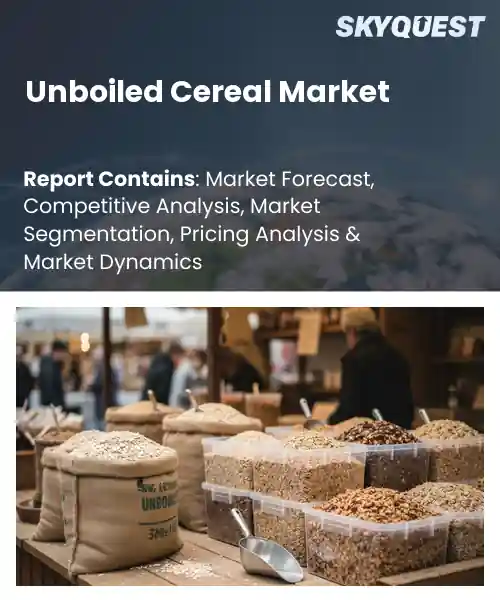
Unboiled Cereal Market
Report ID: SQMIG30I2893
Report ID: SQMIG30I2893
[email protected]
USA +1 351-333-4748
Report ID:
SQMIG30I2893 |
Region:
Global |
Published Date: March, 2026
Pages:
157
|Tables:
145
|Figures:
78


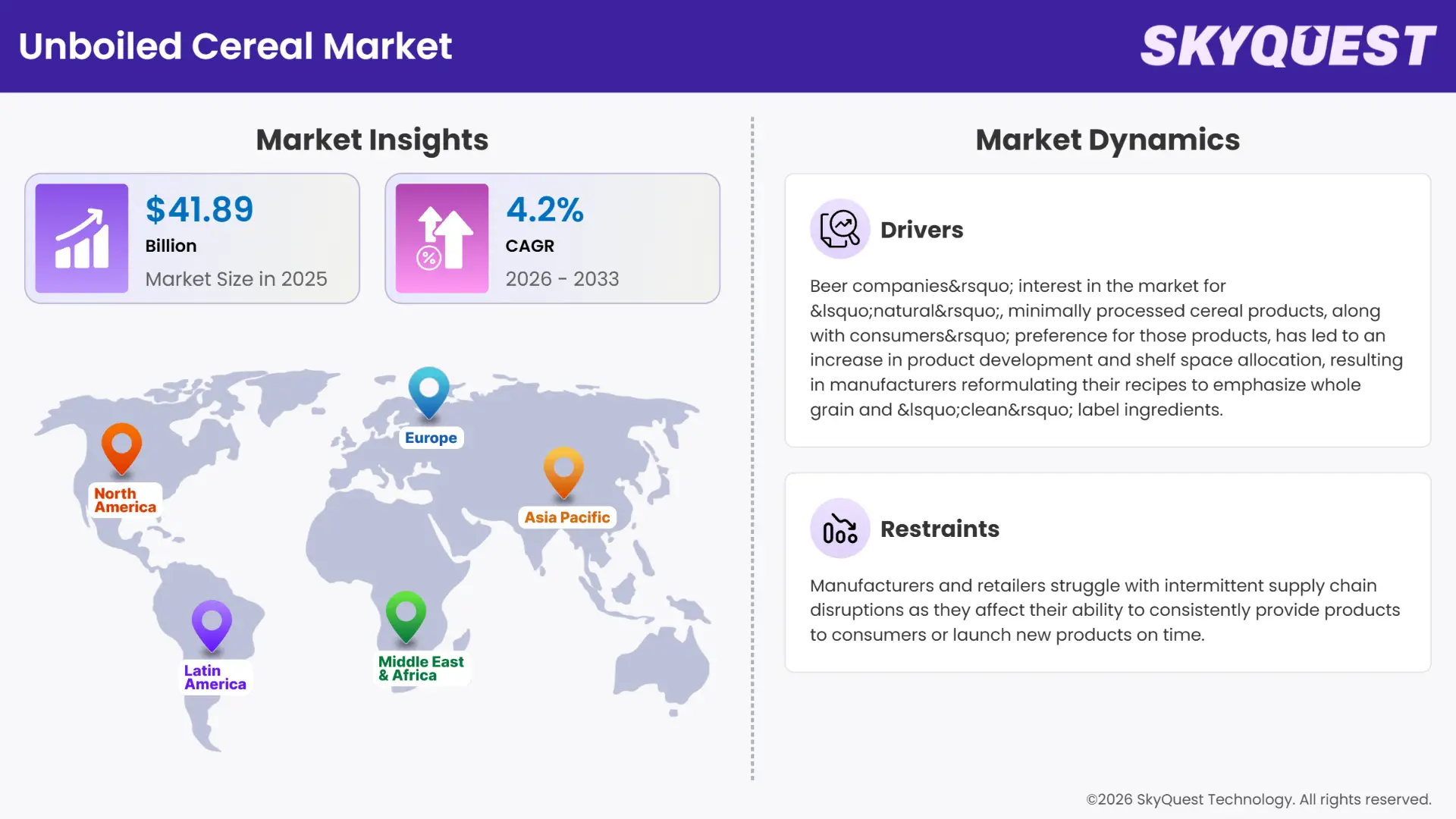
Global Unboiled Cereal Market size was valued at USD 40.2 Billion in 2024 and is poised to grow from USD 41.89 Billion in 2025 to USD 58.22 Billion by 2033, growing at a CAGR of 4.2% during the forecast period (2026-2033).
Key Takeaways: Market Trends & Insights
The primary driver of the unboiled cereal market is the demand for convenience driven by changing lifestyles, which has reshaped breakfast habits globally. Ready-made flakes, granola, and muesli sourced from unprocessed cereals, which don't require any cooking, are ideal for use in a hurry for breakfast and while out and about. The appeal of this type of product is related to nutrition, retail space and the positioning of both the manufacturer and retailer. The size of this market is a consideration for all of these reasons combined. Historically the category evolved from traditional hot porridges toward mass-produced cold cereals in the twentieth century, propelled by industrialization, branding and supermarket expansion; iconic examples include Kellogg’s Corn Flakes and General Mills’ cereals, while recent decades saw premiumization and clean-label responses.
A key trend driving the global unboiled cereal sector growth is rising health consciousness combined with product innovation, which causes manufacturers to reformulate recipes and broaden formats to match consumer goals. As people become increasingly aware of the benefits of fiber, protein, and gut health, manufacturers are launching new products such as high-fiber oats, protein-added or gluten-free muesli so that people can use them in new ways like as a yogurt topping or in portable breakfast bars or shake. The diversification of these products will not only help to increase retail penetration and e-commerce sales. It also helps achieve sustainability goals including commitments to source oats sustainably and reduce sugar by creating premium niches where brands capture higher margins and encourage trial in new markets.
How is IoT Improving Quality Control in the Unboiled Cereal Market?
IoT improves quality control in the unboiled cereal market by giving producers continuous, sensor driven visibility from grain intake to final pack. Key aspects include real time moisture and temperature monitoring, optical sorting to remove defects, inline composition checks for texture and flavor consistency, and connected equipment health monitoring to avoid surprises. The current state shows adoption across plants seeking to reduce recalls and improve repeatable texture and mouthfeel. In practice this means faster detection of contamination, automated recipe adjustments to keep batches uniform, and traceable data that speeds root cause analysis and supplier feedback, all of which make production more reliable and more responsive to consumer expectations.
In January 2025, Bühler acquired CEREX which expanded precise puffing and digital control capabilities. This real world development shows how IoT enabled inline sensors and closed loop controls support consistent texture, reduce waste from off spec batches and improve overall efficiency in the unboiled cereal market.
To get more insights on this market click here to Request a Free Sample Report
Global unboiled cereal market is segmented by grain composition, product category, processing level, distribution channel, packaging format and region. Based on grain composition, the market is segmented into oat grains, wheat & barley variants, ancient grains and multigrain blends. Based on product category, the market is segmented into organic/non-GMO certified, gluten-free formulations and high-protein/functional raw cereals. Based on processing level, the market is segmented into whole raw grains, crushed/flaked grains and raw muesli & granola bases. Based on distribution channel, the market is segmented into supermarkets/hypermarkets, health & wellness specialty stores and online D2C/E-commerce. Based on packaging format, the market is segmented into bulk/loose packaging, pouch/bagged retail units and jar/rigid container units. Based on region, the market is segmented into North America, Europe, Asia Pacific, Latin America and Middle East & Africa.
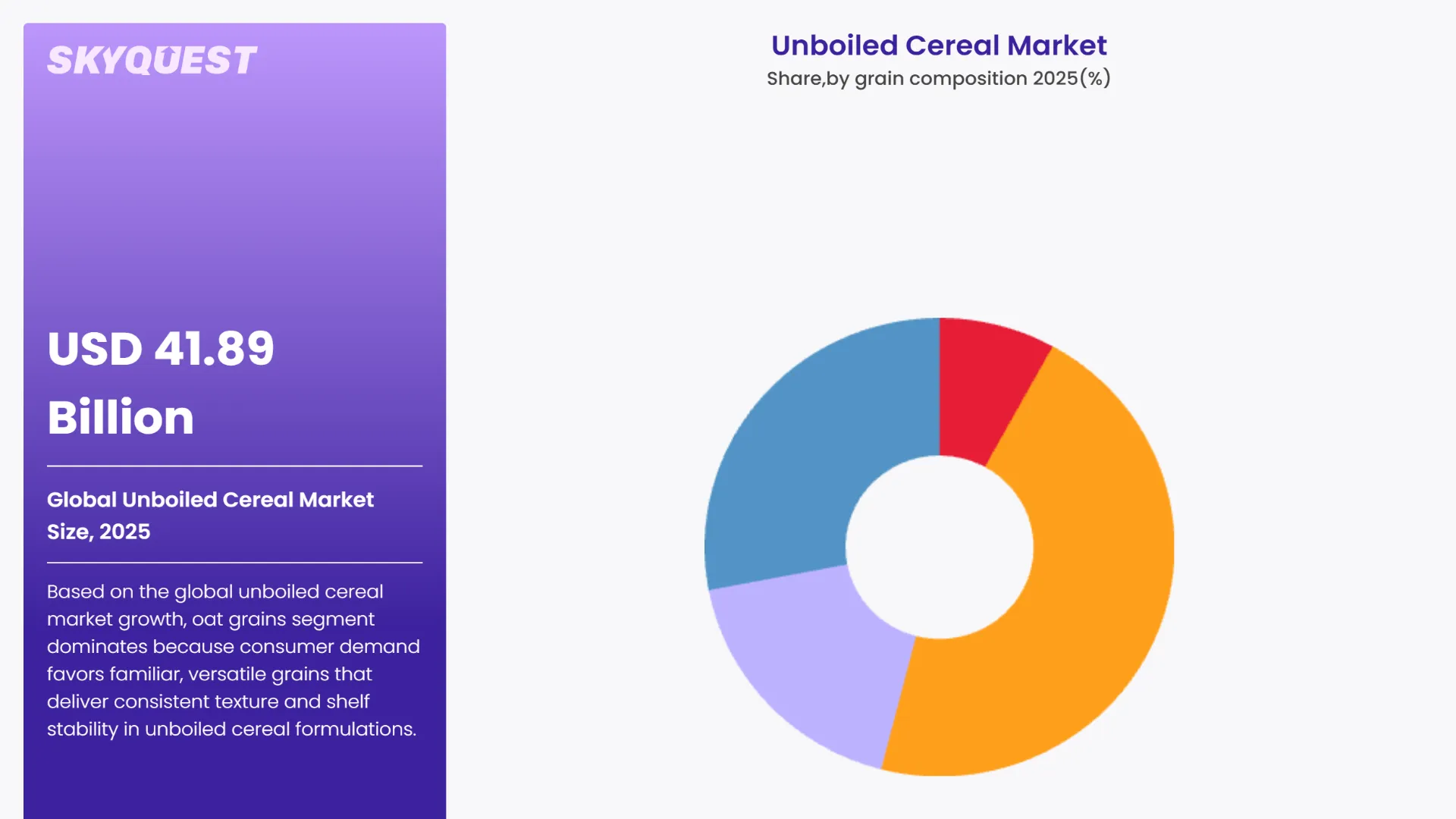
Based on the global unboiled cereal market growth, oat grains segment dominates because consumer demand favors familiar, versatile grains that deliver consistent texture and shelf stability in unboiled cereal formulations. Manufacturers can easily create recipes using these mild-flavored products, which will be readily accepted by a wide variety of consumers in both homes and restaurants. Supply chain familiarity and established milling practices and formulation flexibility reduce production friction, enabling cost-efficient scaling and steady retailer listing, which reinforces their leadership position across product ranges.
However, ancient grains are the most rapidly expanding area thanks to rising interest in provenance and unique nutritional profiles that attract adventurous consumers. Processing innovations and creative culinary applications are widening their incorporation into premium blends, generating retailer attention and enabling differentiated product introductions that fuel new demand and opportunity.
Organic/non-GMO certified segment dominates because consumer willingness to pay for perceived purity and transparency elevates these products into premium shelf positions within unboiled cereal assortments. Health-oriented consumers can experience reduced purchase barriers through certification, along with clear labeling stories retailers can use to promote products. Certifications also help establish manufacturer-certified sources, help create and maintain long-term relationships between suppliers and retailers as both know that all the products being purchased will consistently meet the quality standards set by the manufacturer.
Meanwhile, high-protein/functional raw cereals are experiencing the strongest growth momentum driven by consumer demand for satiety, muscle support, and portable convenience. Through innovation in the use of ingredients, and through fortifying them, new options for use can be created across breakfast and snack formats, increasing the amount of investment from manufacturers and providing a category expansion and functional position to open new channels.
To get detailed segments analysis, Request a Free Sample Report
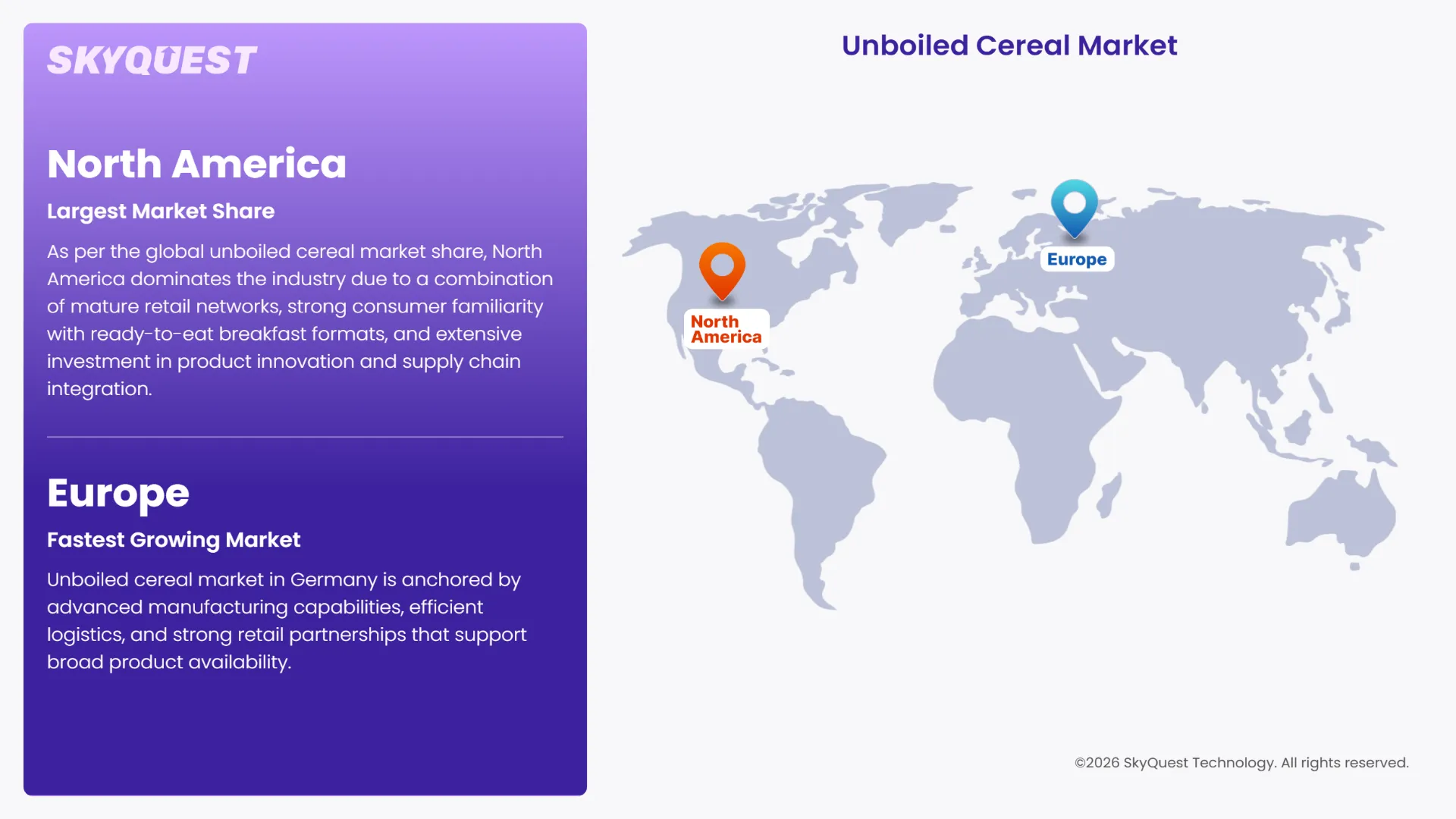
As per the global unboiled cereal market share, North America dominates the industry due to a combination of mature retail networks, strong consumer familiarity with ready-to-eat breakfast formats, and extensive investment in product innovation and supply chain integration. Using close collaboration, leading grocery chains work with food manufacturers, giving them strong private label penetration that provides them with volume and shelf presence. The development of strong logistics and cold chain capabilities supports both the consistency of product quality and the year round supply of these products. Highly sophisticated marketing techniques as well as the use of both social media(, ) celebrity endorsements, and influencer engagement will continue to strengthen the food manufacturers' leadership position. Clear government regulations on food safety as well as product labeling make it easier for food manufacturers to introduce new products.
Unboiled cereal market in the United States is characterized by retail penetration, strong private label activity, and a culture of convenience that favors ready-to-eat formats. Brands invest in formulation and packaging innovation, leveraging health positioning and flavor diversification to capture diverse consumer segments. Collaboration between manufacturers and retailers supports shelf placement and promotional programs. Expansion of distribution channels along with the removal of regulatory red tape are increasing access to distribution while establishing credibility with consumers and allowing for a rapid introduction to the market.
Unboiled cereal market in Canada benefits from retail networks and consumer openness to premium formulations. Local producers want to attract shoppers who are looking for a healthy way to eat by using a clean label source for their products and offering new types of food in special categories. Retailers are using an assortment of products according to the different tastes of customers living in the provinces; as well, retail partner with both natural and specialty stores in order to increase their reach in the marketplace.
Based on global unboiled cereal market regional forecast, Europe is experiencing rapid expansion in the industry driven by evolving consumer preferences toward healthful, convenient breakfast options and a surge in demand for clean label and specialty ingredient offerings. Experiments are possible due to the variety of retail formats and strong private label strategies that exist across the entire continent. The presence of innovation hubs in multiple countries will create additional product and formulation choice and offer an artisan product approach. Additionally, cross-border trade and harmonized regulations will allow for more effective product rollouts. Urbanization, along with the emergence of two key drivers of sustainability and provenance, will provide significant opportunities for brands to focus on providing transparent sourcing and recycled packaging. Strategic collaboration with both foodservice operators and digital platforms is likely to enhance consumer trial and brand adoption.
Unboiled cereal market in Germany is anchored by advanced manufacturing capabilities, efficient logistics, and strong retail partnerships that support broad product availability. Emphasizing high-quality ingredients and rigorous standards for safety enable manufacturers to penetrate domestic markets and develop an export orientation. The strength of private label programs and their ability to execute in trade as well as the collaboration of centers of innovation with ingredient suppliers to create clean label formulations that possess functional benefits all serve to enhance the prominence of brands on retail shelves.
Unboiled cereal market in the United Kingdom is marked by rapid innovation and consumer appetite for novel formats and functional ingredients. Retail cycles that use e-commerce to promote rapid adoption of launches allow retailers to promote rapidly-creating and experiencing new products using brand marketing and influencer marketing channels to drive product trial. Private label and premium brands offer consumers a variety of products to meet their specific preferences. Various types of retailer promotions and out-of-home convenience channels allow for additional consumption opportunities outside of the breakfast daypart driving innovation and growth of product categories.
Unboiled cereal market in France is emerging through a focus on artisanal positioning, premium ingredient sourcing, and culinary flavor profiles that resonate with discerning consumers. Smaller producers leverage craft credentials and organic certifications to differentiate, while retailers expand shelf space for niche premium offerings. Culinary collaborations and foodservice innovations are used to create awareness and generate interest in trying these niche products among consumers in urban areas. Sustainability messaging and storytelling about product provenance help to create a premium position for the product category and an attractive brand image and messaging, as well as to provide an attractive premium package.
As per global unboiled cereal market regional outlook, Asia Pacific is strengthening its position in the industry through a combination of local innovation, channel diversification, and rising consumer demand for convenient, health oriented foods. Companies in the food industry tailor their products to different tastes and textures in regions around the world, and they also invest in creating better quality packaging and portion sizes so their products are convenient and stay fresh longer. The e-commerce, modern trade, and densely populated convenience store networks are all ways for people to try and buy many different products repeatedly. Through partnerships with global suppliers of food ingredients and local research & development (R&D) centers, product development can happen quickly. Local manufacturers tailor ingredient blends to regional palates and adjust packaging technology to suit varied climatic and retail conditions.
Unboiled cereal market in Japan is characterized by premium positioning, meticulous attention to texture and flavor balance, and advanced packaging innovations that prioritize freshness and portion control. Convenience store distribution and well developed e-commerce channels enable rapid consumer access and trial. Manufacturers focus on refined ingredient sourcing and functional benefits tailored to local preferences. As a result, retailers develop collaborative partnerships with manufacturers; this creates innovative products through a collaborative approach between grocery buyers and manufacturers while providing newness to categories from limited-time seasonal editions.
Unboiled cereal market in South Korea is driven by trend savvy consumers and flavor innovation that blends international influences with local taste. There are strong online retail ecosystems and convenience store networks that help customers discover products and generate repeat purchases. Working with food brands and social media 'influencers' increases awareness; however, continuing to excite and maintain consumer loyalty through packaging design and limited-time flavor offerings, is equally important.
To know more about the market opportunities by region and country, click here to
Buy The Complete Report
Rising Demand For Natural Ingredients
Beer companies’ interest in the market for ‘natural’, minimally processed cereal products, along with consumers’ preference for those products, has led to an increase in product development and shelf space allocation, resulting in manufacturers reformulating their recipes to emphasize whole grain and ‘clean’ label ingredients. In response, retailers are allocating additional shelf space and promotional support to increase the visibility of and trial of these products. Trade partners and suppliers work together to provide consistency in ingredient quality in order to increase production and distribution capacity and support the market’s ability to meet growing consumer demand.
Expansion Of Retail and E Commerce
Wider retail distribution and growth of E-Commerce channels allow a broader range of consumers to access and try products leading manufacturers to create different sizes of packaging and run different promotions based on where the consumer is purchasing. More partnerships with retailers and online platforms provide greater opportunities for shelf presence and for targeted marketing, thereby reducing barriers to product discovery. Improved logistics and fulfillment capabilities allow for quicker replenishment and better geographic coverage, providing ongoing sales growth while creating incentive for new product line and innovative investment to meet the diverse shopper needs in different modes of purchase.
Supply Chain Disruptions
Manufacturers and retailers struggle with intermittent supply chain disruptions as they affect their ability to consistently provide products to consumers or launch new products on time. Variability in ingredient supply forces companies to find alternative suppliers, often requiring changes to their formulas. This could result in reduced consistency of products and more operational complexity. Retailers often will limit their whole assortment, and/or will not reorder frequently enough to manage their risk, limiting consumer choice and availability of products on the shelf. All of these operational issues will divert the management’s attention away from developing contingency plans and mitigating costs slowing their ability to grow and invest in new product development within the unboiled cereal segment.
Price Sensitivity Among Consumers
Manufacturers' capacity to pass on the costs related to higher-priced raw materials and/or ethically sourced products is constrained by high consumer sensitivity. When value is the predominant factor of influence for consumers, they are more likely to choose brands that have competitive pricing and/or promotional activity. This in turn places pressure on brands to respond with lower prices and further reduces both margins and the ability to fund innovation, packaging enhancements, and marketing. Retailers will gravitate toward less expensive product lines, resulting in the reduction of shelf space available for higher cost specialty products.
Request Free Customization of this report to help us to meet your business objectives.
The competitive landscape in global unboiled cereal market outlook legacy multinationals against digitally native challengers, with competition driven by consumer demand for lower sugar, higher protein, and premium clean ingredients. Firms deploy concrete tactics such as venture funded DTC brands scaling into national retail, incumbents executing co branded product collaborations, and cross company partnerships on personalized nutrition platforms.
SkyQuest’s ABIRAW (Advanced Business Intelligence, Research & Analysis Wing) is our Business Information Services team that Collects, Collates, Correlates, and Analyses the Data collected by means of Primary Exploratory Research backed by robust Secondary Desk research.
As per SkyQuest analysis, the global unboiled cereal industry is being propelled by demand for convenience driven by changing lifestyles, while rising health consciousness and rapid product innovation further expand premium and functional offerings. Due to supply chain disruptions, growth may not accelerate, resulting in reduced product availability and greater challenges in formulating products. North America will continue to be the leading regional market globally due to its extensive network of established retailers, strong private label and innovation-based production systems. Oats will continue to dominate market segments for their versatility, consumer familiarity, and mature supply chain assets. Those companies that can offer must have convenience; communicate a clear, compelling health message; and maintain reliable sources of supply will be the marketplace leaders.
| Report Metric | Details |
|---|---|
| Market size value in 2024 | USD 40.2 Billion |
| Market size value in 2033 | USD 58.22 Billion |
| Growth Rate | 4.2% |
| Base year | 2024 |
| Forecast period | 2026-2033 |
| Forecast Unit (Value) | USD Billion |
| Segments covered |
|
| Regions covered | North America (US, Canada), Europe (Germany, France, United Kingdom, Italy, Spain, Rest of Europe), Asia Pacific (China, India, Japan, Rest of Asia-Pacific), Latin America (Brazil, Rest of Latin America), Middle East & Africa (South Africa, GCC Countries, Rest of MEA) |
| Companies covered |
|
| Customization scope | Free report customization with purchase. Customization includes:-
|
To get a free trial access to our platform which is a one stop solution for all your data requirements for quicker decision making. This platform allows you to compare markets, competitors who are prominent in the market, and mega trends that are influencing the dynamics in the market. Also, get access to detailed SkyQuest exclusive matrix.
Table Of Content
Executive Summary
Market overview
Parent Market Analysis
Market overview
Market size
KEY MARKET INSIGHTS
COVID IMPACT
MARKET DYNAMICS & OUTLOOK
Market Size by Region
KEY COMPANY PROFILES
Methodology
For the Unboiled Cereal Market, our research methodology involved a mixture of primary and secondary data sources. Key steps involved in the research process are listed below:
1. Information Procurement: This stage involved the procurement of Market data or related information via primary and secondary sources. The various secondary sources used included various company websites, annual reports, trade databases, and paid databases such as Hoover's, Bloomberg Business, Factiva, and Avention. Our team did 45 primary interactions Globally which included several stakeholders such as manufacturers, customers, key opinion leaders, etc. Overall, information procurement was one of the most extensive stages in our research process.
2. Information Analysis: This step involved triangulation of data through bottom-up and top-down approaches to estimate and validate the total size and future estimate of the Unboiled Cereal Market.
3. Report Formulation: The final step entailed the placement of data points in appropriate Market spaces in an attempt to deduce viable conclusions.
4. Validation & Publishing: Validation is the most important step in the process. Validation & re-validation via an intricately designed process helped us finalize data points to be used for final calculations. The final Market estimates and forecasts were then aligned and sent to our panel of industry experts for validation of data. Once the validation was done the report was sent to our Quality Assurance team to ensure adherence to style guides, consistency & design.
Analyst Support
Customization Options
With the given market data, our dedicated team of analysts can offer you the following customization options are available for the Unboiled Cereal Market:
Product Analysis: Product matrix, which offers a detailed comparison of the product portfolio of companies.
Regional Analysis: Further analysis of the Unboiled Cereal Market for additional countries.
Competitive Analysis: Detailed analysis and profiling of additional Market players & comparative analysis of competitive products.
Go to Market Strategy: Find the high-growth channels to invest your marketing efforts and increase your customer base.
Innovation Mapping: Identify racial solutions and innovation, connected to deep ecosystems of innovators, start-ups, academics, and strategic partners.
Category Intelligence: Customized intelligence that is relevant to their supply Markets will enable them to make smarter sourcing decisions and improve their category management.
Public Company Transcript Analysis: To improve the investment performance by generating new alpha and making better-informed decisions.
Social Media Listening: To analyze the conversations and trends happening not just around your brand, but around your industry as a whole, and use those insights to make better Marketing decisions.
REQUEST FOR SAMPLE
 REQUEST FREE CUSTOMIZATION
Global Unboiled Cereal Market size was valued at USD 40.2 Billion in 2024 and is poised to grow from USD 41.89 Billion in 2025 to USD 58.22 Billion by 2033, growing at a CAGR of 4.2% during the forecast period (2026-2033).
The competitive landscape for global unboiled cereal pits legacy multinationals against digitally native challengers, with competition driven by consumer demand for lower sugar, higher protein, and premium clean ingredients. Firms deploy concrete tactics such as venture funded DTC brands scaling into national retail, incumbents executing co branded product collaborations, and cross company partnerships on personalized nutrition platforms. 'Kellogg Co.', 'General Mills', 'PepsiCo', 'Post Holdings', 'Nestlé S.A.', 'ABF', 'Bob's Red Mill', 'Nature's Path', 'Weetabix', 'Bagrry’s', 'Hometown Food', 'Grain Millers Inc.', 'Bunge Limited', 'ADM', 'Cargill', 'Richardson Intl', 'Ardent Mills', 'Wilmar International', 'Olam International', 'LT Foods'
Consumer preference for minimally processed, natural cereals drives product development and shelf expansion, encouraging manufacturers to reformulate recipes and emphasize whole grains and clean label ingredients. Retailers respond by allocating more shelf space and promotional support, increasing visibility and trial. Marketing strategies highlight provenance and simple ingredient lists to build trust, which strengthens brand loyalty and repeat purchases. Trade partners and suppliers collaborate to secure consistent ingredient quality, supporting scale up of production and distribution while reinforcing the market's capacity to respond to growing consumer demand.
Plant Based Innovation Driving Demand: Consumers increasingly seek convenient, nutrient-forward cereal options that align with plant-based diets and sustainable ethics, prompting manufacturers to reformulate textures and flavors to mimic traditional breakfasts while emphasizing whole grains, seeds, and alternative proteins. Retailers and foodservice operators are expanding shelf space and co-developing exclusive ranges, while marketing shifts toward transparent sourcing, clean-label storytelling, and recipe versatility to capture evolving tastes driven by lifestyle choices and environmental consciousness across demographics and adventurous flavor experiments globally.
North America Dominate the Global Unboiled Cereal Market.
The Unboiled Cereal Market comprises cereal products that undergo minimal processing and retain much of their natural nutritional content. These products include oats, wheat, barley, ancient grains, and multigrain blends consumed in breakfast foods, snacks, and health-focused diets.
Oat grains represent a major segment due to their high fiber content, heart-health benefits, and growing popularity among health-conscious consumers seeking nutritious breakfast options.
The market faces challenges such as fluctuating raw material prices, supply chain disruptions, competition from processed breakfast alternatives, and maintaining product freshness during storage and transportation.


Want to customize this report? This report can be personalized according to your needs. Our analysts and industry experts will work directly with you to understand your requirements and provide you with customized data in a short amount of time. We offer $1000 worth of FREE customization at the time of purchase.
Feedback From Our Clients


 USA (+1) 351-333-4748

