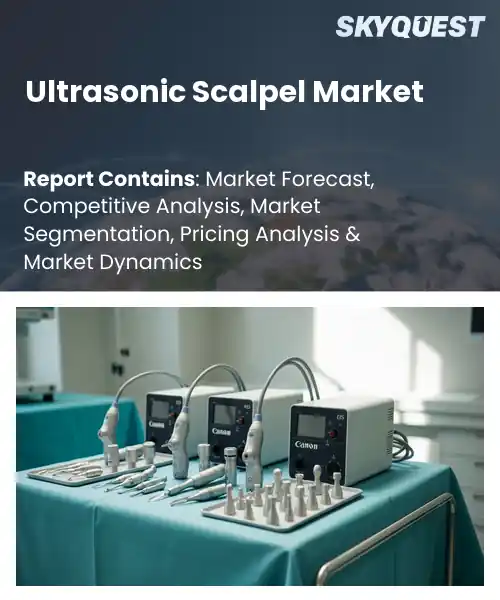
Ultrasonic Scalpel Market
Report ID: SQMIG35A3465
Report ID: SQMIG35A3465
[email protected]
USA +1 351-333-4748
Report ID:
SQMIG35A3465 |
Region:
Global |
Published Date: May, 2026
Pages:
157
|Tables:
120
|Figures:
77


Global Ultrasonic Scalpel Market size was valued at USD 2.9 Billion in 2024 and is poised to grow from USD 3.13 Billion in 2025 to USD 5.7 Billion by 2033, growing at a CAGR of 7.8% during the forecast period (2026-2033).
High adoption of minimally invasive surgical procedures, increasing demand for advanced energy-based surgical devices, rising focus on reducing surgical complications, advancements in ultrasonic surgical technologies, and expansion of ambulatory surgical centers are driving demand for ultrasonic scalpels.
The increasing adoption of ultrasonic scalpels across laparoscopic surgery, gynecological procedures, thyroid surgery, gastrointestinal surgery, and other complex surgical applications is expected to boost sales of ultrasonic scalpel in the future. Expansion of ambulatory surgical centers, bundled procurement models, and adoption of robotic-assisted surgery platforms are also estimated to create new business scope. Additionally, clinical evidence that shows lower blood loss, reduced operation time, and fast patient recovery can be said to support growth in demand for ultrasonic scalpels. This is because hospitals and other institutions have been spending more on cordless equipment, smoke evacuation systems, integration of robotics in surgeries, and single-use ultrasonic surgical devices. Rising preference for minimally invasive surgeries around the world coupled with rising demand for surgical devices that provide precise cutting and effective coagulation are expected to primarily drive ultrasonic scalpel market growth.
On the contrary, high device and procedural costs, limited affordability in low-resource healthcare settings, competition from alternative advanced surgical energy devices, and stringent regulatory approval requirements are slated to impede ultrasonic scalpel market penetration over the coming years.
How is AI Enhancing Clinical Performance of Ultrasonic Scalpels?
Improvements are being made to clinical efficiency of ultrasonic scalpels by using AI through integrating intelligent sensing technologies, energy control, and intelligent software-assisted surgical systems. Moreover, neural processing units and tissue sensing technology are being developed to enhance cutting and vessel sealing performances in real-time. The integration of AI-based ultrasonic scalpels with robotic surgeries and advanced processing technologies to ensure greater precision, lesser thermal effect, and improved consistency in the result of surgical procedures is becoming increasingly popular.
Market snapshot - (2026-2033)
Global Market Size
USD 2.9 Billion
Largest Segment
Ultrasonic Scalpel Systems
Fastest Growth
Ultrasonic Scalpel Accessories
Growth Rate
7.8% CAGR
To get more insights on this market click here to Request a Free Sample Report
Global ultrasonic scalpel market is segmented by product, procedure type, application, end user, and region. Based on product, the market is segmented into ultrasonic scalpel systems, ultrasonic scalpel generators, and ultrasonic scalpel accessories. Based on procedure type, the market is segmented into open surgery and minimally invasive surgery. Based on application, the market is segmented into general surgery, gynecological surgery, cardiovascular surgery, urological surgery, orthopedic surgery, and others. Based on end user, the market is segmented into hospitals, ambulatory surgery centers, specialty clinics, and others. Based on region, the market is segmented into North America, Europe, Asia Pacific, Latin America, and Middle East & Africa
The ultrasonic scalpel systems segment is estimated to account for the highest global ultrasonic scalpel market share going forward. The integration of the cutting and coagulating capabilities into one system in an integrated device architecture reduces the need for swapping between devices, thus simplifying the workflow of the surgical procedures performed. Better ergonomics and clinical outcomes promote greater comfort levels and hence favorability among surgeons, and vendors supporting both the training and procurement process further increase the adoption rate of these devices.
However, ultrasonic scalpel generators are emerging as the fastest-growing segment as per this ultrasonic scalpel market forecast. Enhanced modularity, better energy control, and improved handpiece compatibility open up possibilities for this market segment. Enhanced intelligence and connectivity within generators facilitate customized energy delivery and optimize procedures, thus motivating hospitals to purchase platform updates and after-sales services, which will, in turn, open business possibilities.
The minimally invasive surgery segment is projected to spearhead the global ultrasonic scalpel market revenue generation in the future. Requirements for accurate energy transfer and minimal heat dissipation can be fulfilled by ultrasonic devices because of their inherent benefits, which is why such systems have become standard in laparoscopic and endoscopic procedures. The capability to seal and dissect using tiny incisions results in fewer complications and faster healing, leading to the adoption of ultrasonic systems in MIS procedures.
In the meantime, open surgery has been revealed as the fastest-growing segment with the help of ultrasonic devices, which enhance surgeons' abilities to control bleeding and perform their work more precisely during complicated and highly vascularized procedures. The increased attention to hybrid solutions along with the enhancement of surgical instruments will provide room for further development.
To get detailed segments analysis, Request a Free Sample Report
Favorable reimbursement pathways, concentrated medtech presence, and strong research capacity are forecasted to help this region hold sway over others. Established strong collaboration across clinical networks and surgeons’ familiarity with minimally invasive techniques is also creating a new business scope. Regulatory and purchasing practices for surgical instruments and equipment, as well as the rapid introduction and local support for new products, facilitate timely access to market for new products and the opportunity for scale across the many different types of clinical settings. The major medtech manufacturers in North America have regional headquarters and engage in primary research within the region. Strong academic hospital networks and active clinical trials provide evidence to support adoption by opinion leaders for new indications, and the investment by medtech manufacturers in surgeon education and service infrastructure reduces the barriers to the implementation of new surgical techniques. Finally, the competitive supplier landscape for surgical instruments and supply provides ongoing product enhancement and extensive post-market support, which builds surgeon confidence. The combined result of these factors creates an environment in which ultrasonic surgical instruments are a top priority for surgical strategies and procurement cycles.
Ultrasonic Scalpel demand in the United States benefits from concentrated medical device innovation, large integrated hospital systems, and early adoption by tertiary surgical centers. Market trends indicate that there is significant purchasing power in the industry as well as demand for technology that increases accuracy and decreases operative trauma. Structures of payors and investment in minimally invasive surgery enable regular use in all medical specialties. The existence of clinical training programs and good cooperation between surgeons and the companies enable quick adaptation and implementation of new devices.
Publicly funded hospital network with an emphasis on cost-effective technology evaluation and centralized procurement are shaping ultrasonic scalpel sales in Canada. Cooperation between academic hospitals and medical device companies helps in obtaining clinical proof and surgeon training to allow for progressive introduction of ultrasound devices into routine surgeries in related fields. Technologies that can improve efficiencies and enhance patient recoveries receive more attention from health organizations and facilitate their adoption at surgery centers conducting high-volume procedures.
Integrated healthcare systems, strong surgical tradition, and coordinated regulatory pathways are helping boost ultrasonic scalpel innovation and demand in the region. Supportive reimbursement environments and procurement procedures differ among many markets and each influences the speed of acceptance into the respective marketplace which causes manufacturers to adapt their market access strategies accordingly. The health technology industry in Europe is healthy, as well as the collaborative research networks that develop clinical evidence and provide training programs for the acceptance of ultrasound technology among many of the surgical specialties across Europe. The clinicians’ societies and the key opinion leaders play an active role in establishing techniques and making procurement decisions. ultrasonic scalpel manufacturers take advantage of the regional regulatory alignment of the member states to launch their products across the region, and form partnerships with the hospitals to develop clinical evidence and provide training programmes. The differences between member states’ national procurement policies presents an opportunity to pilot the use of devices at a centre of excellence before expanding to the neighboring markets.
Ultrasonic scalpel market in Germany benefits from a dense hospital network and strong tradition of surgical specialization. Well-resourced surgical departments and established procurement frameworks facilitate evaluation and adoption of advanced devices. Presence of domestic medical technology manufacturers and active clinical research networks supports rapid evidence generation and localized product development. Clinician engagement and training infrastructure enable routine integration of ultrasonic instruments within surgical practice across multiple specialties and hospitals.
Sales of ultrasonic scalpels in the United Kingdom are shaped by dynamic adoption driven by public health system modernization and private provider interest. Cost efficiency and patient recovery considerations will drive hospitals to try out ultrasonic equipment. Innovation centers and specialized surgical suites will test out new methods that will be facilitated through collaborations in clinical research and purchasing projects. The training initiatives and the surgical champions’ network will expedite knowledge dissemination among surgeons.
Selective uptake of ultrasonic scalpels in academic centers and specialized hospitals where clinical benefit and pathway efficiencies are demonstrated augments market development in France. Collaboration between hospitals and the suppliers of the technologies helps prove the value of their application in different surgical procedures, paving the way for wider adoption of ultrasonic solutions. The centralized assessment and procurement procedures for health technologies lead to adoption strategies that prompt manufacturers to develop local evidence and educate clinicians.
Coordinated investments in surgical capacity, expanding clinical training programs, and growing local manufacturing capabilities are helping create new opportunities in the Asia Pacific. Regulatory reform and more interactions with global standards allow for easier access to the market; and partnerships between large global device companies and local distributors can expedite both distribution and service networks. National centers of excellence operate as a point for both clinical innovation and training; also, national centers for excellence create a vehicle through which knowledge can be transferred throughout various peripheral markets. Local manufacturers and researchers continue to develop more products that meet the needs of their regional surgical inclinations and economic constraints. A more robust post-market support and service infrastructure builds clinician confidence; additionally, through a collaborative effort with global partners, new knowledge of device features and implementation will assist in developing local training opportunities.
Ultrasonic scalpel demand in Japan is characterized by advanced surgical infrastructure and close collaboration between clinical researchers and manufacturers. High expectations for device quality and reliability drive local adaptation and rigorous clinical evaluation. Hospitals and surgical centers emphasize minimally invasive techniques, supporting adoption where clear clinical benefits are demonstrated. Strong domestic engineering expertise and a culture of innovation enable refinement of ultrasonic platforms to meet surgeon preferences across hospital systems.
The growth of ultrasonic scalpel sales in South Korea is facilitated by an active technology environment as well as the active use of ultrasonic scalpel technologies in advanced hospitals. Local manufacturing companies and academic institutions cooperate with surgeons closely in order to make the devices appropriate for procedures performed in clinics. The focus on training surgeons plays a critical role in achieving quick adoption of ultrasonic technologies in specialty hospitals.
To know more about the market opportunities by region and country, click here to
Buy The Complete Report
Rising Preference For Minimally Invasive Surgery
Technological Advancements In Device Design
High Procedure and Device Costs
Limited Reimbursement Coverage
Request Free Customization of this report to help us to meet your business objectives.
Competitive landscape in the global ultrasonic scalpel market is shaped by incumbents protecting consumable and energy-platform advantages while challengers push robotic compatibility and system integration. Strategic moves include targeted partnerships and product integrations to reach robot-assisted suites, for example Implanet and 8i Robotics co-exhibiting to pair ultrasonic osteotomes with multi-arm robots, and established firms forming alliances or acquiring niche teams as startups commercialize miniaturized ultrasonic tools.
SkyQuest’s ABIRAW (Advanced Business Intelligence, Research & Analysis Wing) is our Business Information Services team that Collects, Collates, Correlates, and Analyses the Data collected by means of Primary Exploratory Research backed by robust Secondary Desk research.
As per SkyQuest analysis, rising adoption of minimally invasive surgical procedures and increasing demand for advanced energy-based surgical devices are anticipated to drive the demand for ultrasonic scalpels going forward. However, high device and procedural costs and competition from alternative surgical energy systems are slated to slow down the adoption of ultrasonic scalpels in the future. North America is slated to spearhead the demand for ultrasonic scalpels owing to advanced healthcare infrastructure and high adoption of minimally invasive and robotic-assisted surgeries. Development of AI-enabled surgical guidance systems and increasing integration of ultrasonic scalpels with robotic surgery platforms are anticipated to be key trends driving the ultrasonic scalpel industry in the long run.
| Report Metric | Details |
|---|---|
| Market size value in 2024 | USD 2.9 Billion |
| Market size value in 2033 | USD 5.7 Billion |
| Growth Rate | 7.8% |
| Base year | 2024 |
| Forecast period | (2026-2033) |
| Forecast Unit (Value) | USD Billion |
| Segments covered |
|
| Regions covered | North America (US, Canada), Europe (Germany, France, United Kingdom, Italy, Spain, Rest of Europe), Asia Pacific (China, India, Japan, Rest of Asia-Pacific), Latin America (Brazil, Rest of Latin America), Middle East & Africa (South Africa, GCC Countries, Rest of MEA) |
| Companies covered |
|
| Customization scope | Free report customization with purchase. Customization includes:-
|
To get a free trial access to our platform which is a one stop solution for all your data requirements for quicker decision making. This platform allows you to compare markets, competitors who are prominent in the market, and mega trends that are influencing the dynamics in the market. Also, get access to detailed SkyQuest exclusive matrix.
Table Of Content
Executive Summary
Market overview
Parent Market Analysis
Market overview
Market size
KEY MARKET INSIGHTS
COVID IMPACT
MARKET DYNAMICS & OUTLOOK
Market Size by Region
KEY COMPANY PROFILES
Methodology
For the Ultrasonic Scalpel Market, our research methodology involved a mixture of primary and secondary data sources. Key steps involved in the research process are listed below:
1. Information Procurement: This stage involved the procurement of Market data or related information via primary and secondary sources. The various secondary sources used included various company websites, annual reports, trade databases, and paid databases such as Hoover's, Bloomberg Business, Factiva, and Avention. Our team did 45 primary interactions Globally which included several stakeholders such as manufacturers, customers, key opinion leaders, etc. Overall, information procurement was one of the most extensive stages in our research process.
2. Information Analysis: This step involved triangulation of data through bottom-up and top-down approaches to estimate and validate the total size and future estimate of the Ultrasonic Scalpel Market.
3. Report Formulation: The final step entailed the placement of data points in appropriate Market spaces in an attempt to deduce viable conclusions.
4. Validation & Publishing: Validation is the most important step in the process. Validation & re-validation via an intricately designed process helped us finalize data points to be used for final calculations. The final Market estimates and forecasts were then aligned and sent to our panel of industry experts for validation of data. Once the validation was done the report was sent to our Quality Assurance team to ensure adherence to style guides, consistency & design.
Analyst Support
Customization Options
With the given market data, our dedicated team of analysts can offer you the following customization options are available for the Ultrasonic Scalpel Market:
Product Analysis: Product matrix, which offers a detailed comparison of the product portfolio of companies.
Regional Analysis: Further analysis of the Ultrasonic Scalpel Market for additional countries.
Competitive Analysis: Detailed analysis and profiling of additional Market players & comparative analysis of competitive products.
Go to Market Strategy: Find the high-growth channels to invest your marketing efforts and increase your customer base.
Innovation Mapping: Identify racial solutions and innovation, connected to deep ecosystems of innovators, start-ups, academics, and strategic partners.
Category Intelligence: Customized intelligence that is relevant to their supply Markets will enable them to make smarter sourcing decisions and improve their category management.
Public Company Transcript Analysis: To improve the investment performance by generating new alpha and making better-informed decisions.
Social Media Listening: To analyze the conversations and trends happening not just around your brand, but around your industry as a whole, and use those insights to make better Marketing decisions.
REQUEST FOR SAMPLE
 REQUEST FREE CUSTOMIZATION
Global Ultrasonic Scalpel Market size was valued at USD 2.9 Billion in 2024 and is poised to grow from USD 3.13 Billion in 2025 to USD 5.7 Billion by 2033, growing at a CAGR of 7.8% during the forecast period (2026-2033).
Competitive landscape in the global ultrasonic scalpel market is shaped by incumbents protecting consumable and energy-platform advantages while challengers push robotic compatibility and system integration. Strategic moves include targeted partnerships and product integrations to reach robot-assisted suites, for example Implanet and 8i Robotics co-exhibiting to pair ultrasonic osteotomes with multi-arm robots, and established firms forming alliances or acquiring niche teams as startups commercialise miniaturised ultrasonic tools. 'Johnson & Johnson', 'Medtronic plc', 'Olympus Corporation', 'Stryker Corporation', 'B. Braun SE', 'Miconvey', 'Heal Force Bio-Meditech Holdings Limited', 'Ethicon Inc.', 'Söring GmbH', 'CONMED Corporation', 'BOWA-electronic GmbH & Co. KG', 'KLS Martin Group', 'Mizuho Medical Co., Ltd.', 'Erbe Elektromedizin GmbH', 'Applied Medical Resources Corporation', 'Bovie Medical Corporation', 'Zimmer Biomet Holdings, Inc.', 'Integra LifeSciences Holdings Corporation', 'Smith & Nephew plc', 'Karl Storz SE & Co. KG'
Ultrasonic scalpels support the shift toward minimally invasive surgery by enabling precise tissue dissection with simultaneous coagulation, which reduces collateral tissue damage and enhances procedural efficiency. Surgeons favor tools that improve visualization and control while minimizing thermal injury, leading hospitals to adopt technologies that can improve patient recovery trajectories and workflow. As minimally invasive procedures become more common, demand for instruments that integrate with laparoscopy and robotic systems increases, encouraging manufacturers to prioritize ultrasonic designs that meet clinical preferences and procedural needs.
Minimally Invasive Surgery Preference: Surgeons and healthcare systems increasingly prefer procedures that reduce tissue trauma, shorten recovery and lower complication risk. Ultrasonic scalpels align with these priorities by enabling precise cutting and coagulation with limited collateral damage, supporting outpatient pathways and faster patient turnover. Adoption is driven by clinician demand for tools that preserve anatomy while improving workflow efficiency, and by hospital initiatives to enhance patient experience and optimize operating-room utilization. Ongoing education and clinical evidence foster greater trust and routine use across specialties.
Why does North America Dominate the Global Ultrasonic Scalpel Market? |@12


Want to customize this report? This report can be personalized according to your needs. Our analysts and industry experts will work directly with you to understand your requirements and provide you with customized data in a short amount of time. We offer $1000 worth of FREE customization at the time of purchase.
Feedback From Our Clients


 USA (+1) 351-333-4748

