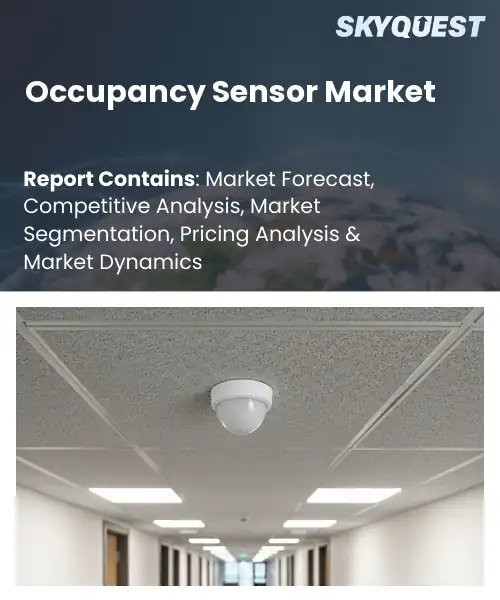
Occupancy Sensor Market
Report ID: SQMIG20D2713
Report ID: SQMIG20D2713
[email protected]
USA +1 351-333-4748
Report ID:
SQMIG20D2713 |
Region:
Global |
Published Date: June, 2026
Pages:
157
|Tables:
157
|Figures:
78


Global Occupancy Sensor Market size was valued at USD 2.6 Billion in 2024 and is poised to grow from USD 2.88 Billion in 2025 to USD 6.49 Billion by 2033, growing at a CAGR of 10.7% during the forecast period (2026-2033).
The convergence of energy efficiency regulations and the rise of smart buildings have elevated sensors from convenience features to essential infrastructure, driving the occupancy sensor market. Occupancy sensors use technologies like passive infrared, ultrasonic and radar to detect presence and matter because they help reduce HVAC and lighting waste and allow for space utilization analytics for facility managers. Over the last decade the market has evolved from basic motion triggered lighting controls to integrated systems that offer IoT connectivity, cloud analytics and interoperability with building management systems; commercial offices are pairing sensors with demand controlled ventilation for energy savings.
This trend of integration is influencing the global occupancy sensor market and one of the key drivers is the interoperability of the sensors with the IoT ecosystems, as the seamless data exchange increases the value of presence detection and drives adoption across industries. By feeding real time occupancy data from sensors into energy management and security platforms, building operators can reduce utility costs and optimize space allocation, as campuses do by consolidating classrooms and hospitals improve cleaning schedules. This cause and effect chain creates commercial incentives for vendors to provide standardized protocols and cloud analytics, creating opportunities for partnerships, recurring software revenue, and differentiated models around the world.
How is AI improving accuracy in the occupancy sensor market?
AI allows us to better interpret raw sensor signals, leading to better accuracy, in the occupancy sensor market. Important aspects include sensor fusion, which blends thermal radar and motion inputs with machine learning models that learn normal human patterns. The current state shows more processing at the edge so that models can reduce false triggers and adapt to changing layouts . The market context is in favor of solutions that strike a balance between accuracy and privacy and power efficiency, as buildings require smarter energy use and better space utilization. Examples from modern vendors illustrate AI driven spatial inference and context aware filtering that make sensors more reliable in complex indoor environments.
PointGrab The company launched the CogniPoint 2 Flex in March 2026, which uses an MCU with built-in NPU to run AI models at the edge. This innovation enhances spatial inference and power efficiency allowing for broader scalable deployments that contribute to the market’s growth and better efficiency.
Market snapshot - (2026-2033)
Global Market Size
USD 2.6 Billion
Largest Segment
Infrared Sensors
Fastest Growth
Hybrid Sensors
Growth Rate
10.7% CAGR
To get more insights on this market click here to Request a Free Sample Report
Global occupancy sensor market is segmented by sensor type, technology, mounting type, application, end use industry and region. Based on sensor type, the market is segmented into Passive Infrared (PIR) Sensors, Ultrasonic Sensors, Microwave Sensors, Dual-Technology Sensors, Tomographic Sensors and Others. Based on technology, the market is segmented into Wired Occupancy Sensors, Wireless Occupancy Sensors, IoT-enabled Smart Sensors and Hybrid Systems. Based on mounting type, the market is segmented into Ceiling Mounted, Wall Mounted, Desk/Table Mounted and Embedded/Integrated Sensors. Based on application, the market is segmented into Lighting Control, HVAC Control, Security & Surveillance, Space Utilization & Smart Building Management, Energy Management Systems and Others. Based on end use industry, the market is segmented into Residential, Commercial Buildings, Industrial Facilities, Healthcare, Education, Hospitality, Retail and Others. Based on region, the market is segmented into North America, Europe, Asia Pacific, Latin America and Middle East & Africa.
The Passive Infrared (PIR) Sensors segment is expected to hold the largest market share during the forecast period owing to its low power consumption and ease of installation, making it an affordable option for general lighting applications and basic occupancy sensing requirements. The advanced detection algorithms also offer dependable presence detection in normal indoor environments and are engineered for easy integration with existing lighting and HVAC controls. They are widely used with good vendor support and the installation is well understood and so they are quickly adopted for retrofits and new construction .
However, Ultrasonic Sensors have the strongest growth momentum with transducer cost falling and signal processing continuing to improve, enhancing their ability to sense subtle motion in occluded or irregular spaces. The improvements make them ideal for complex layouts and high ceilings where the line of sight is limited, thus extending the use cases for smart building management and specialized commercial environments, unlocking new opportunities for deployment.
The wired occupancy sensors segment is expected to hold a dominant position in the market owing to the fact that wired sensors have a consistent power supply and stable connectivity, which is consistent with long term infrastructure planning and mission critical building operations. The reliable performance and low interference susceptibility allow simple integration with centralized building management and security systems. The preference for wired architectures is driven by expectations of reliability, ease of serviceability over a life cycle and procurement patterns in large installations where sustained operational control and deterministic responses are valued.
Meanwhile, IoT-enabled Smart Sensors are emerging as the key high growth area as cloud connectivity, edge analytics and remote provisioning turn occupancy data into actionable intelligence. They enable predictive maintenance, dynamic space optimization and tenant experience enhancements; they attract operators and service providers; they drive investments in sensor networks and platform services that unlock downstream operational and monetization opportunities.
To get detailed segments analysis, Request a Free Sample Report
The region is also the largest market for building automation systems due to the advanced technology ecosystem and the increased focus on energy efficiency in commercial and institutional buildings. The region is home to a thriving eco-system of innovation-driven start-ups and established vendors, delivering fast product development and integrated solutions. In mature markets, smart building platforms and the interoperability standards that enable integration with lighting and HVAC management are widely used. Good Service. Network Distribution. Aftermarket Services and Rollouts. Full support Companies are using occupancy sensing systems to help them meet their sustainability goals and reduce operating expenses Regional leadership cooperates with technology vendors, system integrators and facility managers to enable continuous innovation and value-added services.
In the U.S. region, the Occupancy Sensor market is widely used in corporate, retail, healthcare and educational sectors with a high emphasis on integration with building management systems. Technology vendors and integrators are working to provide interoperable solutions that link occupancy sensing with lighting and HVAC controls to maximize operational efficiency. Pilots and deployments are funded with the help of corporate sustainability programs and private sector investment. Channel partners and service providers speed adoption by providing turnkey offerings and ongoing facility optimization services.
In Canada, the Occupancy Sensor market is being driven by increasing awareness about energy efficiency and the upgrading of commercial and public buildings, supported by collaboration between the government and industry. Local integrators develop solutions tailored to local climate and building operation, focusing on reliability and retrofit capability. The demand is coming from institutional and commercial property owners who want cost effective automation and better comfort for occupants; and service ecosystems to help with long term maintenance and data driven optimisation strategies.
There is rapid growth across Europe with a thriving retrofit market, policy initiatives around energy performance in buildings and an overall interest in smart city projects. Many local manufacturers, integrators and technology partners are adapting solutions to national building codes and buying habits, and influencing the market dynamics. The demand is being driven by commercial and public sector projects that want to reduce energy consumption and meet sustainability goals, with interoperability and privacy being key considerations in the design of solutions. Pilot programs and deployments at the municipal level showing technologies at scale are good for the region and cross border collaborations and standardization efforts will help drive wider adoption and innovation in sensor technologies and analytics.
Engineering excellence and a drive for robust, standards-compliant solutions that integrate into complex building automation environments are the key drivers of the German occupancy sensor market. Quality, regulatory compliance and long term serviceability are the core values of the industrial and commercial sectors, resulting in partnerships between local manufacturers and system integrators. Adoption focuses on solutions for practical energy savings and operational control, with a market focus on durable products and integrated building management strategies for the modernization of existing installations.
Occupancy Sensor Market in United Kingdom is characterized by dynamic adoption across office, retail and public infrastructure triggered by flexible workspace trends and active retrofit programs. Market growth is supported by a vibrant services market that bundles sensing hardware with analytics and managed services that enable rapid deployment. Buyers are focusing on solutions that improve the occupant experience, while also providing operational efficiencies, and suppliers are offering scalable solutions that meet the evolving needs of the workplace and urban redevelopment projects.
The French Occupancy Sensor Market is growing due to the upgrade of commercial and public buildings and the increasing focus on energy performance. Local integrators and manufacturers are providing solutions which meet regulatory expectations as well as architectural sensitivities with a focus on aesthetics, occupant comfort and integration with legacy systems. Adoption pathways are via public sector initiatives and urban renewal programs and suppliers are developing partnerships to demonstrate value in new build and retrofit applications.
Asia Pacific’s position is reinforced by rapid urbanization, rising investments in smart building and improvements in in-country sensor technology and systems integration. Regional manufacturers and technology companies are expanding their product portfolios to satisfy the diverse needs of the market and offering scalable, cost-effective solutions that are attractive in new construction and retrofit markets. Government programs, private sector energy efficiency programs and smart city deployments accelerate the validation and adoption. Indoor environmental quality and occupant comfort are interested in intelligent sensing, while integration with building management systems and IoT platforms is attracting more attention in the region. Global vendors teaming up with regional players means knowledge transfer and localized innovation, which means a bigger contribution from the region to the global market.
Japan Occupancy Sensor Market is characterized by high technology sophistication with precision sensing and reliable integration with advanced building control systems. Adoption is more commonly used in commercial and high performance facilities where accuracy and interoperability of sensors are of crucial importance. Local manufacturers are focusing on miniaturisation, quality and compatibility with smart building platforms, supporting both new builds and targeted retrofits. Solutions are often a combination of indoor environmental concerns with energy optimization to meet demanding operational expectations.
Occupancy Sensor Market in South Korea supported by robust electronics manufacturing base and rapid adoption of IoT enabled building solutions with focus on smart office and commercial deployments. Technology companies and integrators are working to deliver tightly integrated systems that combine sensing, analytics and facility management capabilities. The market is receptive to innovation, rapid iteration and solutions for dense urban environments and modern workspace models, with local and international vendor collaboration speeding up the adoption of sophisticated sensing technologies and deployment know-how.
To know more about the market opportunities by region and country, click here to
Buy The Complete Report
Rising Smart Building Adoption
IoT and Cloud Integration
Integration and Interoperability Challenges
Privacy and Data Security Concerns
Request Free Customization of this report to help us to meet your business objectives.
The global occupancy sensor market is competitive with incumbents using acquisitions and partnerships to add analytics and system integrations, while startups are going after privacy preserving sensing and quick product launches. Examples include Siemens’ acquisition of Enlighted to embed multi sensor IoT lighting and Gentex’ asset acquisitions and partnership activity to broaden sensing capabilities. The major drivers of the market are integrated analytics and anonymous sensing.
SkyQuest’s ABIRAW (Advanced Business Intelligence, Research & Analysis Wing) is our Business Information Services team that Collects, Collates, Correlates, and Analyses the Data collected by means of Primary Exploratory Research backed by robust Secondary Desk research.
As per SkyQuest analysis, the global occupancy sensor market is poised for strong growth driven primarily by energy efficiency mandates and smart building adoption, which position sensors as essential infrastructure for lighting and HVAC optimization. IoT and cloud integration acts as a secondary driver by turning presence data into actionable analytics and enabling remote management services. However, fragmented communication standards and interoperability challenges remain a key restraint that can complicate deployments and extend procurement cycles. The market is currently dominated by North America, supported by mature automation ecosystems, and by Passive Infrared sensors as the pragmatic, low‑power choice for widespread lighting and HVAC control.
| Report Metric | Details |
|---|---|
| Market size value in 2024 | USD 2.6 Billion |
| Market size value in 2033 | USD 6.49 Billion |
| Growth Rate | 10.7% |
| Base year | 2024 |
| Forecast period | (2026-2033) |
| Forecast Unit (Value) | USD Billion |
| Segments covered |
|
| Regions covered | North America (US, Canada), Europe (Germany, France, United Kingdom, Italy, Spain, Rest of Europe), Asia Pacific (China, India, Japan, Rest of Asia-Pacific), Latin America (Brazil, Rest of Latin America), Middle East & Africa (South Africa, GCC Countries, Rest of MEA) |
| Companies covered |
|
| Customization scope | Free report customization with purchase. Customization includes:-
|
To get a free trial access to our platform which is a one stop solution for all your data requirements for quicker decision making. This platform allows you to compare markets, competitors who are prominent in the market, and mega trends that are influencing the dynamics in the market. Also, get access to detailed SkyQuest exclusive matrix.
Table Of Content
Executive Summary
Market overview
Parent Market Analysis
Market overview
Market size
KEY MARKET INSIGHTS
COVID IMPACT
MARKET DYNAMICS & OUTLOOK
Market Size by Region
KEY COMPANY PROFILES
Methodology
For the Occupancy Sensor Market, our research methodology involved a mixture of primary and secondary data sources. Key steps involved in the research process are listed below:
1. Information Procurement: This stage involved the procurement of Market data or related information via primary and secondary sources. The various secondary sources used included various company websites, annual reports, trade databases, and paid databases such as Hoover's, Bloomberg Business, Factiva, and Avention. Our team did 45 primary interactions Globally which included several stakeholders such as manufacturers, customers, key opinion leaders, etc. Overall, information procurement was one of the most extensive stages in our research process.
2. Information Analysis: This step involved triangulation of data through bottom-up and top-down approaches to estimate and validate the total size and future estimate of the Occupancy Sensor Market.
3. Report Formulation: The final step entailed the placement of data points in appropriate Market spaces in an attempt to deduce viable conclusions.
4. Validation & Publishing: Validation is the most important step in the process. Validation & re-validation via an intricately designed process helped us finalize data points to be used for final calculations. The final Market estimates and forecasts were then aligned and sent to our panel of industry experts for validation of data. Once the validation was done the report was sent to our Quality Assurance team to ensure adherence to style guides, consistency & design.
Analyst Support
Customization Options
With the given market data, our dedicated team of analysts can offer you the following customization options are available for the Occupancy Sensor Market:
Product Analysis: Product matrix, which offers a detailed comparison of the product portfolio of companies.
Regional Analysis: Further analysis of the Occupancy Sensor Market for additional countries.
Competitive Analysis: Detailed analysis and profiling of additional Market players & comparative analysis of competitive products.
Go to Market Strategy: Find the high-growth channels to invest your marketing efforts and increase your customer base.
Innovation Mapping: Identify racial solutions and innovation, connected to deep ecosystems of innovators, start-ups, academics, and strategic partners.
Category Intelligence: Customized intelligence that is relevant to their supply Markets will enable them to make smarter sourcing decisions and improve their category management.
Public Company Transcript Analysis: To improve the investment performance by generating new alpha and making better-informed decisions.
Social Media Listening: To analyze the conversations and trends happening not just around your brand, but around your industry as a whole, and use those insights to make better Marketing decisions.
REQUEST FOR SAMPLE
 REQUEST FREE CUSTOMIZATION
Global Occupancy Sensor Market size was valued at USD 2.6 Billion in 2024 and is poised to grow from USD 2.88 Billion in 2025 to USD 6.49 Billion by 2033, growing at a CAGR of 10.7% during the forecast period (2026-2033).
Competition in the global occupancy sensor market centers on incumbents using acquisitions and partnerships to add analytics and system integrations while startups push privacy preserving sensing and rapid product launches. Examples include Siemens acquisition of Enlighted to embed multi sensor IoT lighting and Gentex asset acquisitions and partnership activity to broaden sensing capabilities. This drive for integrated analytics and anonymous sensing is a primary market driver. 'Signify N.V.', 'Acuity Brands, Inc.', 'Legrand S.A.', 'Schneider Electric SE', 'Honeywell International Inc.', 'Johnson Controls International plc', 'Siemens AG', 'ABB Ltd.', 'Panasonic Holdings Corporation', 'Eaton Corporation plc', 'Lutron Electronics Co., Inc.', 'Leviton Manufacturing Co., Inc.', 'Hubbell Incorporated', 'Cree Lighting USA LLC', 'OSRAM Licht AG', 'Zumtobel Group AG', 'Steinel GmbH', 'Sensata Technologies Holding plc', 'Murata Manufacturing Co., Ltd.', 'Texas Instruments Incorporated'
Occupancy sensors have become integral to smart building strategies, driving adoption as organizations seek automated control of lighting, HVAC, and space utilization to improve operational efficiency and occupant comfort. By enabling responsive systems that reduce waste and optimize asset use, these sensors support organizational sustainability goals and facility management priorities. The clear linkage between sensor deployment and measurable improvements in energy performance and user experience encourages building owners and developers to invest in sensor technologies as part of broader modernization programs and ongoing infrastructure upgrades.
Edge Ai Driven Sensing: Deployment of on device machine intelligence enables occupancy sensors to infer presence patterns, classify activities, and adapt sensing parameters locally, reducing reliance on central processing and improving responsiveness. This shift fosters privacy preserving analytics, lower latency, and scalable edge orchestration, enabling richer real time control of lighting, HVAC, and asset tracking. Manufacturers are investing in compact compute modules and optimized models to deliver context aware detection that supports diverse environments across offices, retail, and healthcare, creating product tiers and services.
Why does North America Dominate the Global Occupancy Sensor Market? |@12


Want to customize this report? This report can be personalized according to your needs. Our analysts and industry experts will work directly with you to understand your requirements and provide you with customized data in a short amount of time. We offer $1000 worth of FREE customization at the time of purchase.
Feedback From Our Clients


 USA (+1) 351-333-4748

