Ultrasonic Microscopes Market
Report ID: SQMIG45J2434
Report ID: SQMIG45J2434
[email protected]
USA +1 351-333-4748
Report ID:
SQMIG45J2434 |
Region:
Global |
Published Date: March, 2026
Pages:
157
|Tables:
118
|Figures:
77


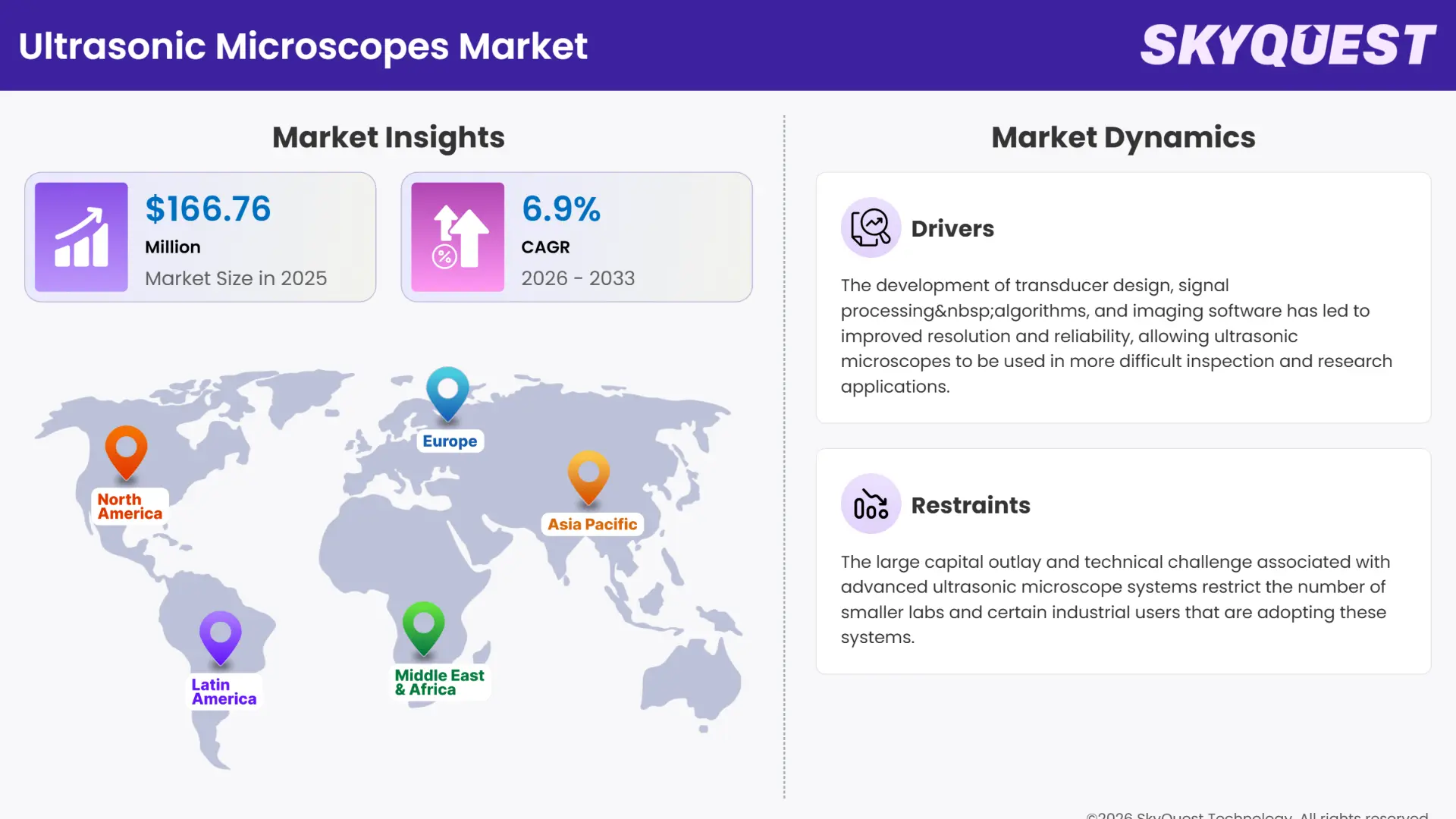
Global Ultrasonic Microscopes Market size was valued at USD 156.0 Million in 2024 and is poised to grow from USD 166.76 Million in 2025 to USD 284.4 Million by 2033, growing at a CAGR of 6.9% during the forecast period (2026-2033).
Key Takeaways: Market Trends & Insights
• North America dominated the Cleanroom Adhesive Pad market with the largest market share in 2025.
• The U.S. Cleanroom Adhesive Pad market is expected to grow significantly over the forecast period.
• By Product Type, the Disposable Adhesive Pads segment held the largest market share in 2024.
• The Multi-Layer Adhesive Pads segment is expected to be the fastest-growing segment over the forecast period.
• North America: Largest Market in 2025.
• Asia Pacific: Fastest Growing Market.
• 2025 Market Size: USD 13.90 Billion.
• 2026 Projected Market Size: USD 14.86 Billion.
• 2033 Projected Market Size: USD 23.70 Billion.
• CAGR (2026-2033): 6.9%.
Ultrasonic microscopy has been developed into the newest class of tools that utilize high frequency acoustic waves to non-destructively image the subsurface microstructures of materials. This type of imaging is especially valuable because many of the limitations of traditional optical and electron microscopy cannot be overcome in instances where internal microstructures need to be evaluated for internal interfaces, voids or delaminations. Over thirty years the market has developed from prototype scanning acoustic microscopy systems to affordable compact ultrasonic microscopes (broadband transducer based and immersion systems) that utilize sophisticated signal processing capabilities to create three-dimensional images.
The main driver for the continued growth of the ultrasonic microscopes market is the increasing complexity of semiconductor and microelectronic packaging. Many manufacturers use acoustic testing techniques to identify voids or failures of bonds in a multilayer assembly or to identify internal cracks in a multilayer assembly, thus improving yields, reliability and failure analysis of products produced across factories.
Additionally, as transducer technologies and signal processing methods have advanced rapidly, ultrasonic microscopes are providing higher resolutions and faster production times than in the past. Ultrasonic microscopes are being adopted in various industries requiring laboratory inspection techniques. For example, many semiconductor fabrication facilities have installed acoustic testing equipment for wafer and package inspection to reduce the amount of yield losses associated with defects.
Similarly, many battery manufacturers use ultrasonic mapping and acoustic testing techniques to eliminate electrode oxygen porosity which contributes to capacity loss, thus enhancing battery life. Additionally, many aerospace and automotive suppliers are evaluating material performance using ultrasonic microscopy to assess composite delaminations, thus reducing in-service failures and warranty costs.
How is AI Improving Image Analysis in the Ultrasonic Microscopes Market?
Enhanced by Artificial Intelligence (AI), ultrasonic microscopes can now provide greatly improvedaccuracy and functionality for interpreting images. There have been several ways in which AI has improved the ultrasonic imaging process, including combining noise reduction with model driven image enhancement and integrating automated segmentation and defect classification. As a result, when operators utilize ultrasonic microscopes, they can generate fewer variable results while they enhance the clarity of the images produced from the raw acoustic signals.
With this type of improvement, the amount of time required to gain insightful analysis of possible failures in material studies is reduced. The success that vendors and laboratories are experiencing today as they implement more intelligent software that facilitates 3D reconstruction and the development of automated workflows is that all involved parties can produce more reliable outcomes sooner, moving more quickly from scanning to interpreting data. These advancements have particular significance for the semiconductor packaging and advanced materials inspection sectors of our current marketplace.
To get more insights on this market click here to Request a Free Sample Report
Global ultrasonic microscopes market is segmented into system type, frequency range, application vertical, component/software and region. Based on system type, the market is segmented into scanning acoustic microscope (SAM), scanning laser acoustic microscope (SLAM) and c-mode acoustic microscope (C-SAM). Based on frequency range, the market is segmented into low frequency, standard frequency and high frequency. Based on application vertical, the market is segmented into semiconductor & microelectronics, material science & NDT, life sciences & biology and aerospace & automotive components. Based on component/software, the market is segmented into transducer probes, image analysis software and digital acquisition systems. Based on region, the market is segmented into North America, Europe, Asia Pacific, Latin America and Middle East & Africa.
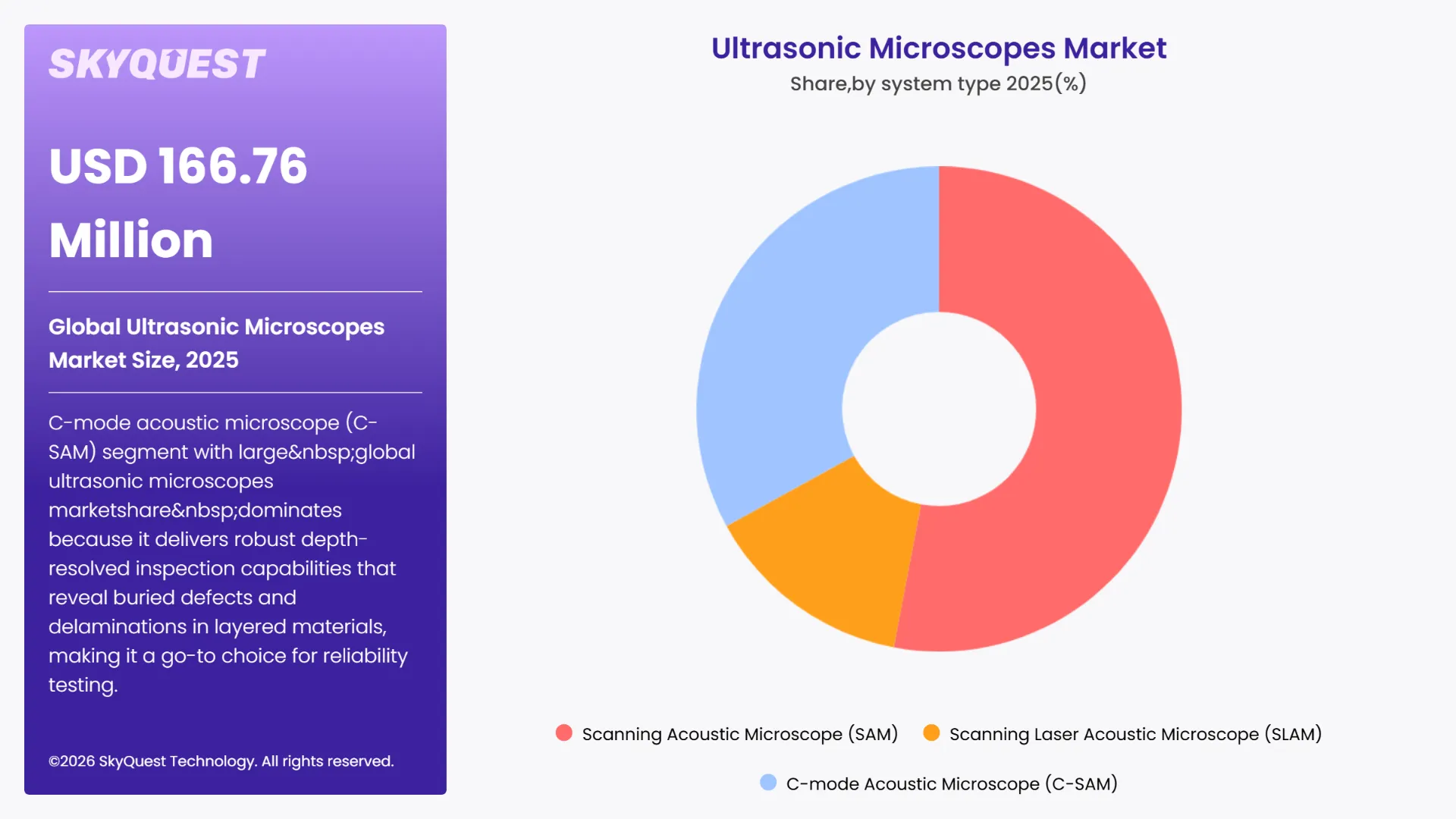
C-mode acoustic microscope (C-SAM) segment with large global ultrasonic microscopes marketshare dominates because it delivers robust depth-resolved inspection capabilities that reveal buried defects and delaminations in layered materials, making it a go-to choice for reliability testing. This non-destructive profiling provides a method for the quality assurance of different types of surface layers and establishes a well-defined process that allows manufacturers to use the same method to determine whether there are buried defects (in-between) that could cause failure, as well as provide a traceable and accurate way of characterizing the defects.
As per global ultrasonic microscopes market forecast, the scanning laser acoustic microscope (SLAM) is the fastest growing category of the C-SAM product line, offering an opportunity for manufacturers to use non-contact, very high resolution (for high quality) imaging that supports new applications in both fragile and biologically active samples. As a result of advancements in laser excitation technologies, ease of integration with automated scanning systems, growing demand for non-contact inspection, and interest in applying C-SAM technology to both basic and precision manufacturing applications, the demand for SLAM is increasing rapidly.
As per global ultrasonic microscopes market analysis, the high frequency segment dominates due to its ability to produce high spatial resolution necessary for identifying very fine microstructural elements and near-surface defects essential to inspecting semiconductors and performing microelectronic failure analysis. Advancements made in transducer construction and signal processing have improved the quality of images provided by high-frequency instruments that require detailed material contrast and precise characterization to dramatically affect yield and reliability evaluations.
According to the global ultrasonic microscopes market outlook, standard frequency is emerging as the most rapidly expanding sub-segment because it balances penetration and resolution for broad industrial applications, enabling versatile inspection across varying material thicknesses. The increased need for economical multi-purpose instruments, coupled with enhanced image analysis software, improved system integration (networking) capabilities, and lower cost equipment.
To get detailed segments analysis, Request a Free Sample Report
As per global ultrasonic microscopes market regional forecast, Asia Pacific region is primarily driven by the concentration of advanced manufacturing in Japan, electronics and semiconductor-based industries as well as companies that manufacture precision components. Industrial applications for non-destructive testing and high-resolution imaging throughout the automotive, medical device, and microelectronics supply chains are supporting continued growth in the use of this technology. Through partnerships between research institutions, corporate R&D facilities, and developers of ultrasonic microscopy equipment, advanced probe design and signal processing capabilities are being updated, while the presence of local OEMs and service providers will provide timely access to services and localized support.
As per global ultrasonic microscopes market regional outlook, Japan is experiencing consistent growth, fueled by precision measurement and instrument manufacturers and research institutions that continue to develop imaging technology through collaboration. Innovative developments in probe design and signal processing have been driven by the strong association between the demand for industrial inspection and the innovative thinking of academic institutions. A strong connection with semiconductor and automotive supply chains is generating the need for customized testing solutions, and established calibration and service networks are helping to ensure the continued performance of the instruments.
The ultrasonic microscopes market in South Korea has shown significant growth owing to strong partnership efforts between electronic component manufacturers and material research facilities that drive the utilization of non-destructive evaluation solutions. The strong focus on miniaturization and dense packaging has fostered development of compact probes and advanced algorithms for imaging. Domestic suppliers of ultrasonic microscopy equipment can offer a complete inspection solution, in addition to a responsive service network, to facilitate adoption of this equipment by OEMs.
As per global ultrasonic microscopes industry analysis, North America has expanded rapidly due to high demand from industries that require precise non-destructive evaluations such as aerospace, semiconductor manufacturing, energy, and biomedical research. An established ecosystem of instrument manufacturers, service providers specializing in custom applications, and application laboratories support the rapid development of customized solutions and the ability to iterate quickly. Close relationships between universities and the private sector drive collaborative research efforts for advanced imaging modalities. System integrators are merging ultrasonic microscopy with automation and analytical capabilities to create solutions for complex inspection workflows.
The United States ultrasonic microscopes market is driven by flocks of research institutions, advanced manufacturing companies, and system integrators who are demanding goods and services relating to advanced inspection technologies. The integration of ultrasonic microscopy and automation, robotics, and data analytics will enable complex manufacturing processes. The United States offers world-class aftermarket services (parts and expertise), calibration facilities, and application laboratories to help facilitate the deployment of advanced ultrasonic microscopy capabilities in the aerospace, semiconductor, and biomedical industries.
The ultrasonic microscopes market in Canada is growing from a concentration of materials science centres and universities along with testing firms that have specialty focus areas (e.g., quality assurance and advanced characterization) being geographically close together. The proximity of these companies facilitates the adoption of ultrasonic microscopy technology by contract manufacturersand medical device manufacturers. Additionally, many contract manufacturers and medical device manufacturers work together in carrying out collaborative research on the research of customized designs for probes and imaging protocols that can solve challenges for their respective industries.
Through an outpour of metrology knowledge and strong collaborative ties between researchers and specialized manufacturers, Europe is enhancing its place within the ultrasonic microscopes market with a large emphasis on both cross-border standardization/interoperability. The existence of large precision engineering/material science clusters allows for the development of high-fidelity probes and custom inspection equipment specifically designed for regional industrial applications within automotive, aerospace, and healthcare. Focused efforts on modular architectures and open interfaces will allow for integrated ultrasonic microscopes in conjunction with complementary modalities and data analysis. The establishment of testing centers, independent calibration laboratories, and many current member associations will help instill customer confidence while at the same time accelerating the commercialization of advanced signal processing/imaging algorithms through industry consortiums and cooperative projects. As a result, Europe has developed a diversified and innovation-based ecosystem that enhances overall competitiveness and supports tailored solutions to address many complex inspection challenges.
Ultrasonic microscopes market in Germany benefits from a deep industrial base in precision engineering, automotive supply, and advanced manufacturing along with a growing demand for robust inspection solutions. Collaborative work between manufacturers and research centers regarding probe innovation and highly precise signal processing meets some of the highest production tolerances in the world. Integration with factory automation and all aspects of metrology is prevalent; this includes partnering with calibration laboratories and service providers.
The UK ultrasonic microscopes market utilizes strong academic research and an instrumentation industry to provide specialized inspection solutions to the healthcare, aerospace and advanced materials markets by collaborating with universities, testing labs, and manufacturers to rapidly adapt cutting-edge imaging algorithms and probe concepts. In addition, service providers deliver application support for customization and training. Through collaborative translational research and strong partnerships with industry, the UK market will see an increased acceptance of custom systems designed to address complex inspection and quality assurance requirements.
France ultrasonic microscopes market is leveraging its strong materials science research and precision manufacturing know-how to provide custom-made inspection solutions. Joint ventures between research institutes and private sector activity create sophisticated probes and signal processing techniques for aerospace, medical product, and advanced materials applications, while extensive service coverage provides calibration, training, and technical help. The result of these efforts is to make ultrasonic microscopy a key player in an organization's quality assurance, failure analysis, and testing workflows.

To know more about the market opportunities by region and country, click here to
Buy The Complete Report
Advancements in Transducer Technology
The development of transducer design, signal processing algorithms, and imaging software has led to improved resolution and reliability, allowing ultrasonic microscopes to be used in more difficult inspection and research applications. The improved sensitivity and probe designs have increased the number of material contrasts able to be detected and improved flaw identification, resulting in increased perceived value for the instruments among laboratories and production lines. As device performance will meet a larger range of use cases, there is growing support from stakeholders to adopt the technology as a solution for non-destructive, high-detail analysis. Thus, supporting continued ultrasonic microscopes market growth through more diversified application opportunities and additional justification for purchase.
Growing Demand for Semiconductor Inspection
As the need for semiconductor manufacturers to identify smaller defects and accurately characterize their materials increases, the role of ultrasonic microscopy in developing processes and failing analysis has become more important. Ultrasonic microscopies offer two different contrast mechanisms compared to other inspection methods and can help identify defects in underlying substrates and areas of material that will affect yield. Fabs, along with suppliers of tools and equipment, continue to focus their efforts on tools that improve reliability and expedite root cause analysis, ultrasonic microscopes that would best meet the procurement needs of research & production facilities.
High Equipment Costs and Complexity
The large capital outlay and technical challenge associated with advanced ultrasonic microscope systems restrict the number of smaller labs and certain industrial users that are adopting these systems. The high cost of procuring and integrating these instruments, together with their unique maintenance and calibration requirements, will increase the total cost of ownership and elongate the time from purchase to when they can be used in production. Organizations with limited budgets or engineering support will likely defer purchasing decisions or select simpler forms of inspection technology, which will limit the addressable market penetration for ultrasound inspection systems and create longer adoption cycles.
Limited Skilled Worker Population
The shortage of skilled people who can operate, interpret ultrasonic microscope signal data, and maintain ultrasonic microscope systems creates a serious constraint to market growth by creating operational bottlenecks and significantly increasing the training burden on companies purchasingthese instrument systems. Companies may have very long onboarding processes for their new employees, must rely on vendor support for their ultrasonic microscope systems, and receive inconsistent measurement quality from their ultrasonic microscope systems until they develop enough trained personnel to achieve a stable level of operational consistency. Therefore, making purchasing decisions for ultrasonic microscope systems is less attractive to customers. In addition, there are a limited number of resources available for developing skills related to technical operations and training in areas where significant numbers of ultrasonic microscopes will be installed. Therefore, the lack of trained personnel will significantly limit the number of new installations and the level of effective use of these advanced inspection tools regardless of the level of performance associated with this rapid evaluation instruments' application.
Request Free Customization of this report to help us to meet your business objectives.
The competitive landscape for the global ultrasonic microscopes industry is becoming increasingly more crowded with vendors looking to consolidate, form academic partnerships, and innovate their components as growth in semiconductor wafer inspection and next-generation NDT increases. This is most visible with the examples of PVA TePla's recent acquisition of OKOS in 2020 (to improve their access to the U.S. market) and many new entrants developing mechanical devices to improve ultrasound imaging businesses (i.e., by securing seed capital and strategic health system partnerships).
AI-driven Imaging Enhancements: Manufacturers are incorporating machine learning and sophisticated image processing into ultrasonic microscopy procedures to make finding defects faster, automating how defects are interpreted, and speeding up how quickly defects are analyzed. The use of artificial intelligence provides companies with improved accuracy in characterizing material defects by using consistent characterization techniques, developing adaptive imaging strategies, and enhancing contrasts in imaging various types of materials. Further, the combination of these types of technologies with cloud-based platforms and edge computing has improved the use of remote instrument optimization, which has improved laboratory productivity and enabled predictive maintenance of ultrasonic microscopes. These changes are altering the value proposition from software-based solutions and services to solutions based on intelligence and insights.
Compact and Portable Systems: The demand for compact, portable ultrasonic microscopes has created an opportunity for manufacturers to develop compact, portable models that have a smaller footprint, use a simplified interface, and utilize modular probes that can be used to inspect items in the field. The improvements in the design of these portable systems will help manufacturers expand beyond the use of ultrasonic microscopes in specialized laboratories and increase their number of users by expanding into manufacturers' production areas, service centers, and laboratories with limited space. These increases will allow for the development of feedback loops during production, and the use of portable systems will enable cross-discipline adoption of these systems in material science, electronics, and biomedical applications. All these factors will encourage vendors to develop turn-key solutions and service models that are based on end-users' workflows.
SkyQuest’s ABIRAW (Advanced Business Intelligence, Research & Analysis Wing) is our Business Information Services team that Collects, Collates, Correlates, and Analyses the Data collected by means of Primary Exploratory Research backed by robust Secondary Desk research.
As per SkyQuest analysis, the global ultrasonic microscopes market is driven primarily by rising demand from semiconductor and microelectronics inspection, which requires subsurface defect detection to improve yield, and a second driver is rapid advancements in transducer design and signal processing that boost resolution and throughput. High costs of equipment and the complexity of the systems create a major limitation for smaller labs and manufacturers trying to adopt ultrasonic microscopes. The largest market for ultrasonic microscopes is located in Asia, where there are large amounts of electronic manufacturers, as well as a large number of innovative developers building the innovation “ecosystem”. Some of the fastest growing markets in the ultrasonic microscope manufacturing industry are Asia and the c-mode acoustic microscopy (CAM), which is the acoustic microscopy system providing the most depth resolution over layers of materials. A key ultrasonic microscopes market trend shaping the industry is the increasing adoption of scanning acoustic microscopy (SAM) in advanced electronics inspection, particularly for detecting micro-level defects in integrated circuits and packaging.
| Report Metric | Details |
|---|---|
| Market size value in 2024 | USD 156.0 Million |
| Market size value in 2033 | USD 284.4 Million |
| Growth Rate | 6.9% |
| Base year | 2024 |
| Forecast period | 2026-2033 |
| Forecast Unit (Value) | USD Million |
| Segments covered |
|
| Regions covered | North America (US, Canada), Europe (Germany, France, United Kingdom, Italy, Spain, Rest of Europe), Asia Pacific (China, India, Japan, Rest of Asia-Pacific), Latin America (Brazil, Rest of Latin America), Middle East & Africa (South Africa, GCC Countries, Rest of MEA) |
| Companies covered |
|
| Customization scope | Free report customization with purchase. Customization includes:-
|
To get a free trial access to our platform which is a one stop solution for all your data requirements for quicker decision making. This platform allows you to compare markets, competitors who are prominent in the market, and mega trends that are influencing the dynamics in the market. Also, get access to detailed SkyQuest exclusive matrix.
Table Of Content
Executive Summary
Market overview
Parent Market Analysis
Market overview
Market size
KEY MARKET INSIGHTS
COVID IMPACT
MARKET DYNAMICS & OUTLOOK
Market Size by Region
KEY COMPANY PROFILES
Methodology
For the Ultrasonic Microscopes Market, our research methodology involved a mixture of primary and secondary data sources. Key steps involved in the research process are listed below:
1. Information Procurement: This stage involved the procurement of Market data or related information via primary and secondary sources. The various secondary sources used included various company websites, annual reports, trade databases, and paid databases such as Hoover's, Bloomberg Business, Factiva, and Avention. Our team did 45 primary interactions Globally which included several stakeholders such as manufacturers, customers, key opinion leaders, etc. Overall, information procurement was one of the most extensive stages in our research process.
2. Information Analysis: This step involved triangulation of data through bottom-up and top-down approaches to estimate and validate the total size and future estimate of the Ultrasonic Microscopes Market.
3. Report Formulation: The final step entailed the placement of data points in appropriate Market spaces in an attempt to deduce viable conclusions.
4. Validation & Publishing: Validation is the most important step in the process. Validation & re-validation via an intricately designed process helped us finalize data points to be used for final calculations. The final Market estimates and forecasts were then aligned and sent to our panel of industry experts for validation of data. Once the validation was done the report was sent to our Quality Assurance team to ensure adherence to style guides, consistency & design.
Analyst Support
Customization Options
With the given market data, our dedicated team of analysts can offer you the following customization options are available for the Ultrasonic Microscopes Market:
Product Analysis: Product matrix, which offers a detailed comparison of the product portfolio of companies.
Regional Analysis: Further analysis of the Ultrasonic Microscopes Market for additional countries.
Competitive Analysis: Detailed analysis and profiling of additional Market players & comparative analysis of competitive products.
Go to Market Strategy: Find the high-growth channels to invest your marketing efforts and increase your customer base.
Innovation Mapping: Identify racial solutions and innovation, connected to deep ecosystems of innovators, start-ups, academics, and strategic partners.
Category Intelligence: Customized intelligence that is relevant to their supply Markets will enable them to make smarter sourcing decisions and improve their category management.
Public Company Transcript Analysis: To improve the investment performance by generating new alpha and making better-informed decisions.
Social Media Listening: To analyze the conversations and trends happening not just around your brand, but around your industry as a whole, and use those insights to make better Marketing decisions.
REQUEST FOR SAMPLE
 REQUEST FREE CUSTOMIZATION
Global Ultrasonic Microscopes Market size was valued at USD 156.0 Million in 2024 and is poised to grow from USD 166.76 Million in 2025 to USD 284.4 Million by 2033, growing at a CAGR of 6.9% during the forecast period (2026-2033).
Competition in the global ultrasonic microscopes market is intensifying as semiconductor wafer inspection and advanced NDT demand push vendors toward strategic consolidation, academic partnerships, and component innovation. Examples include PVA TePla’s 2020 acquisition of OKOS to strengthen US market access and newer transducer entrants securing seed funding and health system partnerships to commercialize high frequency arrays. Suppliers now compete on transducer performance and automation integration. 'Nordson', 'PVA TePla', 'OKOS Solutions', 'Sonix Inc.', 'KSI SAM', 'Acoulab', 'Ultrasonic Sciences Ltd.', 'Hitachi Power Solutions', 'Insight Analytical', 'C-SAM', 'Ekspla', 'Nikon Metrology', 'Olympus', 'Mistras Group', 'Sonatest', 'Crest Ultrasonics', 'Sonoscan', 'Teledyne DALSA', 'Bruker', 'Baker Hughes'
Advancements in transducer design, signal processing algorithms, and imaging software have improved resolution and reliability, enabling ultrasonic microscopes to address more demanding inspection and research applications. Improved sensitivity and probe designs expand detectable material contrasts and enhance defect identification, which increases the instruments' perceived value across laboratories and production lines. As device performance meets a broader range of use cases, adoption is encouraged by stakeholders seeking non-destructive, high-detail analysis, thereby supporting sustained market expansion through diversified application opportunities and stronger purchase justification.
Ai-Driven Imaging Enhancements: Manufacturers are embedding machine learning and advanced image processing into ultrasonic microscopy workflows to improve defect detection, automate interpretation, and accelerate analysis cycles. These AI-driven capabilities enable more consistent characterization, adaptive imaging strategies, and enhanced contrast recognition across diverse materials and samples. Integration with cloud platforms and edge computing fosters collaborative workflows and remote instrument optimization, increasing laboratory productivity and enabling predictive maintenance. The trend is reshaping value propositions toward software-enabled services and revenue models centered on intelligence and insights.
Asia Pacific Dominate the Global Ultrasonic Microscopes Market?
Ultrasonic microscopes are widely used for non-destructive testing and quality control applications. They help identify internal defects, delamination, and structural inconsistencies without damaging the material being inspected.


Want to customize this report? This report can be personalized according to your needs. Our analysts and industry experts will work directly with you to understand your requirements and provide you with customized data in a short amount of time. We offer $1000 worth of FREE customization at the time of purchase.
Feedback From Our Clients


 USA (+1) 351-333-4748

