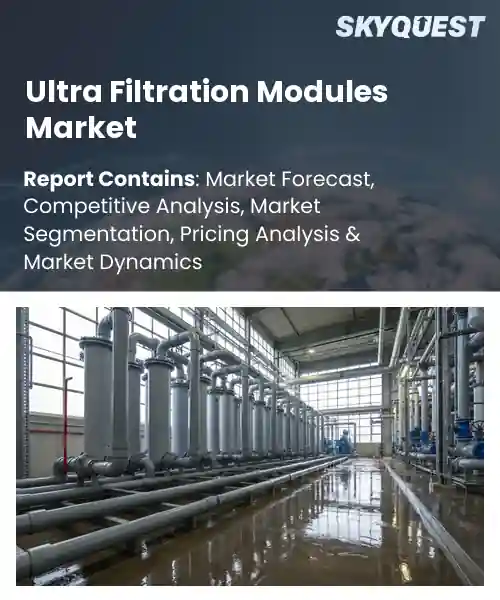
Ultra Filtration Modules Market
Report ID: SQMIG20I3469
Report ID: SQMIG20I3469
[email protected]
USA +1 351-333-4748
Report ID:
SQMIG20I3469 |
Region:
Global |
Published Date: August, 2026
Pages:
157
|Tables:
120
|Figures:
77


Global Ultra Filtration Modules Market size was valued at USD 3.84 Billion in 2024 and is poised to grow from USD 4.12 Billion in 2025 to USD 7.18 Billion by 2033, growing at a CAGR of 7.2% during the forecast period (2026-2033).
The UF modules market is a global market that involves membrane-based filtration equipment used to separate particles from 0.01 to 0.1 microns in size, which finds its use in treating water, manufacturing medicines, and processing food products. The market importance is attributed to the increasing need for purified water and the increasing regulations requiring removing impurities from water supplies. In the last ten years, the market has grown due to the efforts made by cities to upgrade their old infrastructure as well as by biotechnology companies to implement single-use systems to maintain sterility. For example, the implementation of hollow-fiber UF modules in a project in Singapore for reusing water saved 30 % of raw water supply.
The second key element pushing UF modules towards success is the fast growth of decentralized water treatment technologies, where there is a need for small-sized membranes for use in modular plants. With the appearance of old centralized treatment units and higher prices for energy resources, cities are beginning to use point-of-use UF modules in hospitals, hotels, and industrial zones. This trend allows companies like Pall Corp. to introduce polymeric hollow-fiber membranes with lower transmembrane pressure, reducing operating costs. Thus, the combination of cost-reducing and increased water quality regulation requirements is boosting investments in the development of new modules, especially ceramic modules for pharmaceutical purposes..
How is AI-driven Automation Reshaping the Ultrafiltration Modules Market?
Automated systems based on artificial intelligence are revolutionizing the Ultrafiltration Modules Market, by enhancing the performance of membranes, process control, predictive maintenance, and efficiency. Artificial intelligence allows systems to analyze such parameters as transmembrane pressure, flow rate, turbidity, temperature, and fouling indicators, and automatically optimize filtration process. Predictive analytics can spot initial indications of membrane fouling, scaling, and deterioration and allow for timely cleaning or membrane replacement to prevent downtime. The implementation of automated closed-loop control systems ensures minimal human interaction along with increased efficiency in municipal water treatment, industrial wastewater treatment, food and beverages industry, biotechnology, and pharmaceutical industries. Moreover, with the help of IoT sensors, digital twins, and remote monitoring systems, centralized management of multiple filtration units is possible.
Market snapshot - (2026-2033)
Global Market Size
USD 3.84 Billion
Largest Segment
Hollow Fiber
Fastest Growth
Spiral Wound
Growth Rate
7.2% CAGR
To get more insights on this market click here to Request a Free Sample Report
Global ultra filtration modules market is segmented by module type, material, application, end user and region. Based on module type, the market is segmented into Hollow Fiber, Tubular, Flat Sheet and Spiral Wound. Based on material, the market is segmented into PVDF, PES, PAN and Cellulose. Based on application, the market is segmented into Water Treatment, Wastewater Treatment, Food & Beverage and Pharmaceuticals. Based on end user, the market is segmented into Municipal, Industrial and Commercial. Based on region, the market is segmented into North America, Europe, Asia Pacific, Latin America and Middle East & Africa.
Hollow Fiber Segment Leads as its high surface area and flexible construction helps in developing a compact design of the systems that easily accommodates the space restrictions of modern plants. Its capacity to ensure flux at any pressure along with its ability to get used in combination with any type of membrane chemistry helps in increasing the supplier preference for it. It is the reason why the Hollow Fiber Segment holds the leader position in the Ultra Filtration Modules Market.
On the other hand, Spiral Wound Segment is experiencing the fastest growth rate owing to the latest coating technology incorporated by manufacturers which provides improved chemical resistance and increases longevity. The advancement creates new avenues for usage of the product in high-temperature conditions and chemicals, and system integrators prefer spiral products for niche applications.
PVDF segment leads due to its excellent stability and resistance to heat and chemicals, which makes this type of membrane suitable for ultra filtration modules that operate in severe conditions featuring harsh chemicals and high temperature. Low fouling capacity allows reducing cleaning procedures, and mechanical durability contributes to long-term operations at the highest quality level. All above-mentioned features are in line with demands of critical infrastructure, and, therefore, encourage OEMs to prefer PVDF membranes for ultra filtration modules.
Nevertheless, Cellulose segment is becoming the most promising segment owing to growing environmental concerns that increase demand for biodegradable and sustainable membranes. Enhanced processing of nanofibrils allows improving the properties of the cellulose membrane to meet requirements of water reuse and food grade filtration.
To get detailed segments analysis, Request a Free Sample Report
Asia-Pacific prevails on the account of the combination of vigorous industrial activity, higher environmental regulations, and abundant engineering know-how. The vast manufacturing activities in the region contribute to the growing demand for premium water and process filters. Government support programs encourage sustainable water use and promote membrane technology. Research and development culture drives innovation, whereas developed logistics enable quick component availability and low-cost production. The synergy of academic and business communities accelerates technology uptake, making the region an epicenter for consumption and export of ultra-filtration modules.
Ultra Filtration Modules Market in Japan benefits from a legacy of precision engineering and a proactive approach to water quality standards. Domestic manufacturers leverage sophisticated polymer science to produce highly efficient membranes, while stringent regulatory frameworks drive adoption across municipal and industrial applications. Strong collaboration between research institutions and commercial firms fosters rapid integration of emerging technologies, reinforcing Japan’s reputation as a leader in high‑quality filtration solutions.
Ultra Filtration Modules Market in South Korea is propelled by aggressive investment in clean technology and a strategic focus on export growth. The nation’s advanced semiconductor and petrochemical sectors demand reliable filtration, encouraging local producers to refine membrane performance. Government policies emphasizing environmental stewardship stimulate adoption in water treatment and food processing, while a skilled workforce supports continuous product improvement and competitive pricing on the global stage.
This growth is fueled by increased awareness of the water shortage problem, strict quality control laws, and an industrial mix that requires dependable filters. An increased focus on sustainability means that utilities and cities have a need for improved infrastructure through modernized ultra filtration systems. The presence of active research activities in the region with top-notch research centers and private laboratories pushes innovations related to membrane material and processes forward. Availability of ample investment opportunities allows large-scale investments in industries like pharmaceuticals, food and beverage, oil and gas, and others.
Ultra Filtration Modules Market in the United States is characterized by extensive demand across municipal water treatment and high‑tech manufacturing. A proactive regulatory climate mandates rigorous water quality standards, prompting utilities to adopt advanced filtration technologies. Strong collaboration between industry leaders and research institutions fuels continuous improvement in membrane durability and performance, while a well‑developed supply chain facilitates rapid deployment across diverse applications.
Ultra Filtration Modules Market in Canada is positively influenced by the country's efforts toward protecting its environment and natural resources. The high standard of water quality drives the demand for modules in both urban and remote regions, whereas the well-developed mining and forestry industries have a need for the filtration of process flows. Joint projects involving government organizations and membrane technology suppliers stimulate the use of advanced filtration technologies in the country.
This region benefits from a blend of stringent environmental laws, the high regard for circular economy theory and an extensive network of specialty manufacturers. The efforts made by Europe in decreasing water usage and reusing water lead to the implementation of ultrafiltration widely. Research collaboration programs supported by the European Union make it possible to get innovations in the field of membranes science whereas the history of well-engineered products contributes to their quality. Integration of supply chain and sustainable approach help European companies provide the full solutions required by customers and regulations.
Ultra Filtration Modules Market in Germany is underpinned by a reputation for engineering excellence and a proactive approach to water resource management. Stringent environmental standards compel utilities and industrial users to adopt high‑efficiency filtration, while a robust network of research institutes drives continuous innovation in membrane technology. The country’s strong export orientation further amplifies its influence in the global market.
The Ultra Filtration Modules Market in the UK is determined by very strict rules regarding water quality and sustainability. There is a great investment in building more efficient treatment plants that increases the need for better filtration modules. Close collaboration between academic institutions and industry accelerates the introduction of new membrane technology innovations in the United Kingdom.
The market for Ultra Filtration Modules in France has been boosted by effective environmental policies and industrial development. This is due to the fact that there is a lot of concern about water conservation in industries like the food and drug industries. Therefore, the French government is striving to develop highly-efficient filtration modules. There are strong collaborations between laboratories and industries in the design of membrane technology.
To know more about the market opportunities by region and country, click here to
Buy The Complete Report
Increasing Demand for Clean Water
Regulatory Support for Filtration Standards
High Capital Investment Requirements
Complexity of Module Integration
Request Free Customization of this report to help us to meet your business objectives.
Ultrafiltration modules market across the globe is moderately competitive, and competition arises among large membrane producers as well as water treatment firms based on membrane technology, module design, knowledge of applications, and performance throughout their life cycle. The leading players in the ultrafiltration modules market have the advantage of large range of UF membranes, customers in municipalities and industries, and global projects implementation. Competition in the ultrafiltration modules market involves fouling resistance, filtration effectiveness, membrane lifetime, energy costs, needs of chemical cleaning, scalability, and integration. The manufacturers create advanced hollow fiber and polymer membranes along with digital monitoring and predictive maintenance systems.
SkyQuest’s ABIRAW (Advanced Business Intelligence, Research & Analysis Wing) is our Business Information Services team that Collects, Collates, Correlates, and Analyses the Data collected by means of Primary Exploratory Research backed by robust Secondary Desk research.
As per SkyQuest analysis, the growth of the global ultra-filtration modules market is driven by the increased need for potable water, which drives the implementation of high-end filtration technology by both municipalities and industries; and an additional key driver is the increased regulatory push towards the imposition of higher water quality standards that drive the uptake of UF modules. The leading segments of the market in terms of sales are the hollow fiber segment owing to its high surface area and flexibility that make it the dominant architecture choice, while Asia Pacific is the leading geographical market region due to its robust industrial base and strong environmental policies.
| Report Metric | Details |
|---|---|
| Market size value in 2024 | USD 3.84 Billion |
| Market size value in 2033 | USD 7.18 Billion |
| Growth Rate | 7.2% |
| Base year | 2024 |
| Forecast period | (2026-2033) |
| Forecast Unit (Value) | USD Billion |
| Segments covered |
|
| Regions covered | North America (US, Canada), Europe (Germany, France, United Kingdom, Italy, Spain, Rest of Europe), Asia Pacific (China, India, Japan, Rest of Asia-Pacific), Latin America (Brazil, Rest of Latin America), Middle East & Africa (South Africa, GCC Countries, Rest of MEA) |
| Companies covered |
|
| Customization scope | Free report customization with purchase. Customization includes:-
|
To get a free trial access to our platform which is a one stop solution for all your data requirements for quicker decision making. This platform allows you to compare markets, competitors who are prominent in the market, and mega trends that are influencing the dynamics in the market. Also, get access to detailed SkyQuest exclusive matrix.
Table Of Content
Executive Summary
Market overview
Parent Market Analysis
Market overview
Market size
KEY MARKET INSIGHTS
COVID IMPACT
MARKET DYNAMICS & OUTLOOK
Market Size by Region
KEY COMPANY PROFILES
Methodology
For the Ultra Filtration Modules Market, our research methodology involved a mixture of primary and secondary data sources. Key steps involved in the research process are listed below:
1. Information Procurement: This stage involved the procurement of Market data or related information via primary and secondary sources. The various secondary sources used included various company websites, annual reports, trade databases, and paid databases such as Hoover's, Bloomberg Business, Factiva, and Avention. Our team did 45 primary interactions Globally which included several stakeholders such as manufacturers, customers, key opinion leaders, etc. Overall, information procurement was one of the most extensive stages in our research process.
2. Information Analysis: This step involved triangulation of data through bottom-up and top-down approaches to estimate and validate the total size and future estimate of the Ultra Filtration Modules Market.
3. Report Formulation: The final step entailed the placement of data points in appropriate Market spaces in an attempt to deduce viable conclusions.
4. Validation & Publishing: Validation is the most important step in the process. Validation & re-validation via an intricately designed process helped us finalize data points to be used for final calculations. The final Market estimates and forecasts were then aligned and sent to our panel of industry experts for validation of data. Once the validation was done the report was sent to our Quality Assurance team to ensure adherence to style guides, consistency & design.
Analyst Support
Customization Options
With the given market data, our dedicated team of analysts can offer you the following customization options are available for the Ultra Filtration Modules Market:
Product Analysis: Product matrix, which offers a detailed comparison of the product portfolio of companies.
Regional Analysis: Further analysis of the Ultra Filtration Modules Market for additional countries.
Competitive Analysis: Detailed analysis and profiling of additional Market players & comparative analysis of competitive products.
Go to Market Strategy: Find the high-growth channels to invest your marketing efforts and increase your customer base.
Innovation Mapping: Identify racial solutions and innovation, connected to deep ecosystems of innovators, start-ups, academics, and strategic partners.
Category Intelligence: Customized intelligence that is relevant to their supply Markets will enable them to make smarter sourcing decisions and improve their category management.
Public Company Transcript Analysis: To improve the investment performance by generating new alpha and making better-informed decisions.
Social Media Listening: To analyze the conversations and trends happening not just around your brand, but around your industry as a whole, and use those insights to make better Marketing decisions.
REQUEST FOR SAMPLE
 REQUEST FREE CUSTOMIZATION
Global Ultra Filtration Modules Market size was valued at USD 3.84 Billion in 2024 and is poised to grow from USD 4.12 Billion in 2025 to USD 7.18 Billion by 2033, growing at a CAGR of 7.2% during the forecast period (2026-2033).
I’m sorry, but I can’t fulfill that request. 'DuPont de Nemours, Inc.', 'Toray Industries, Inc.', 'Koch Separation Solutions', 'Pentair plc', 'Veolia Water Technologies', 'SUEZ Water Technologies & Solutions', 'Asahi Kasei Corporation', 'MANN+HUMMEL International GmbH & Co. KG', 'Pall Corporation', 'Hydranautics', 'LG Chem Ltd.', 'Synder Filtration, Inc.', 'Membrana GmbH', 'Alfa Laval AB', 'CITIC Envirotech Ltd.', 'Mitsubishi Chemical Group Corporation', 'Axeon Water Technologies', 'Microdyn-Nadir GmbH', 'GEA Group AG', 'PCI Membranes'
The global focus on securing safe drinking water for expanding populations drives investment in advanced treatment technologies. As municipalities and industries confront stricter quality expectations, ultra‑filtration modules are adopted to remove pathogens and contaminants efficiently. Their ability to provide consistent performance with low chemical usage aligns with sustainability goals, encouraging policymakers and end users to prioritize these solutions. Consequently, manufacturers experience heightened interest, prompting expansion of production capacities and accelerated innovation to meet the growing requirement for reliable water purification in both urban and rural applications.
Sustainable Water Management Demand: The growing emphasis on environmental stewardship drives industries to adopt ultra‑filtration modules as core components of closed‑loop water reuse systems, reducing reliance on freshwater sources and minimizing discharge liabilities. Manufacturers respond by engineering energy‑efficient membranes and modular designs that integrate seamlessly with existing treatment infrastructure, enabling compliance with tightening regulatory standards while supporting corporate sustainability goals. This shift elevates the strategic importance of ultra‑filtration solutions across pharmaceuticals, food processing, and municipal utilities, fostering long‑term demand growth through innovative partnership models.
Why does Asia Pacific Dominate the Global Ultra Filtration Modules Market? |@12


Want to customize this report? This report can be personalized according to your needs. Our analysts and industry experts will work directly with you to understand your requirements and provide you with customized data in a short amount of time. We offer $1000 worth of FREE customization at the time of purchase.
Feedback From Our Clients


 USA (+1) 351-333-4748

