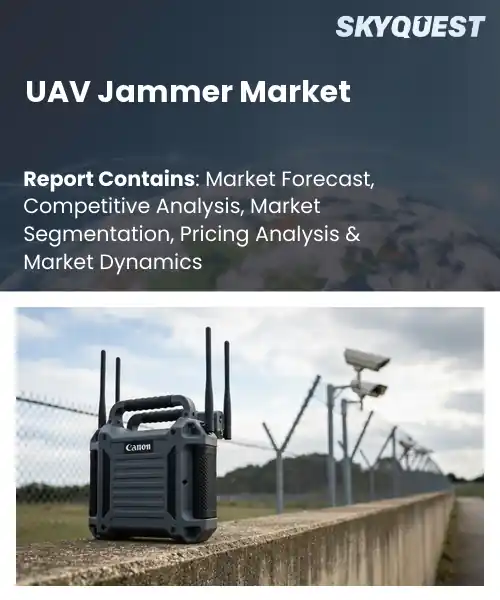
UAV Jammer Market
Report ID: SQMIG20A2769
Report ID: SQMIG20A2769
[email protected]
USA +1 351-333-4748
Report ID:
SQMIG20A2769 |
Region:
Global |
Published Date: July, 2026
Pages:
157
|Tables:
183
|Figures:
79


Global Uav Jammer Market size was valued at USD 1.2 Billion in 2024 and is poised to grow from USD 1.35 Billion in 2025 to USD 3.47 Billion by 2033, growing at a CAGR of 12.5% during the forecast period (2026-2033).
The UAV jammer market has been driven by the rapid proliferation of tactical drones as governments and enterprises are forced to protect critical infrastructure from unauthorized surveillance and intrusions. The market covers hardware and software that send out radio-frequency signals to jam control links, GPS navigation. The technology's importance grew after incidents in 2018 when small UAVs penetrated airport perimeters in Europe and attempted contraband smuggling into U.S. prisons. The early adopters showed the deterrent value of the product and manufacturers rapidly scaled up production and diversified the design widely. Global supply chains now support compact handheld units and sophisticated vehicle-mounted systems that have moved out of the niche military tool domain into mainstream critical protective assets. The global UAV jammer market is majorly driven by the tightening regulations across aviation and security sectors.
Stringent laws have made it mandatory for operators to adopt counter-measure solutions to remain compliant. Standards like the EU U-Space framework and the U.S. FAA remote-identification rule leave holes that can only be plugged by advanced jammers, especially at airports, energy facilities and large public events. That pressure pushes investment into software-defined devices that can disrupt across multiple frequencies and encourages partnerships with telecommunication companies for spectrum access. Thus, defense units use jammers to protect bases, and service leasing models generate revenues, turning policy mandates into commercial growth.
How is AI Influencing the UAV Jammer Market?
AI is transforming the UAV jammer market from static jamming devices to smart adaptive defenses. Now, machine-learning algorithms analyze hostile drone flight patterns and communication protocols in real time, allowing jammers to pick the most effective frequency and power level on the fly. This dynamically adaptive approach limits the scope for counter-measures and increases the operational envelope of ground-based and airborne systems. Vendors are embedding AI cores directly into hardware, creating self-optimising units that learn from each engagement, and get better over successive missions.
This makes a more agile ecosystem where operators can focus on strategy and let the technology handle the technical nuances of interference, creating a faster, more reliable and easier to integrate overall solution into existing security architectures. In June 2026, Lockheed Martin announced an AI-based adaptive jammer that can improve its interference patterns, increase its effectiveness and drive rapid market growth.
Market snapshot - (2026-2033)
Global Market Size
USD 1.2 Billion
Largest Segment
Fixed UAV Jammers
Fastest Growth
Handheld UAV Jammers
Growth Rate
12.5% CAGR
To get more insights on this market click here to Request a Free Sample Report
Global UAV jammer market is segmented by product type, jamming technique, application, range, end user, deployment and region. Based on product type, the market is segmented into Handheld UAV Jammers, Fixed UAV Jammers, Vehicle-Mounted UAV Jammers, Backpack UAV Jammers and Others. Based on jamming technique, the market is segmented into RF Jamming, GNSS/GPS Jamming, Multi-Band Jamming, Protocol-Based Jamming and Others. Based on application, the market is segmented into Military & Defense, Critical Infrastructure Protection, Border Security, VIP & Event Security and Others. Based on range, the market is segmented into Short Range, Medium Range, Long Range, Extended Range and Others. Based on end user, the market is segmented into Defense Forces, Homeland Security Agencies, Law Enforcement Agencies, Critical Infrastructure Operators and Others. Based on deployment, the market is segmented into Portable, Fixed Installation, Vehicle Mounted, Integrated Counter-UAS Systems and Others. Based on region, the market is segmented into North America, Europe, Asia Pacific, Latin America and Middle East & Africa.
The Handheld UAV Jammers segment is dominant because operators prefer mobility and rapid deployment in contested environments. The lightweight design allows individual soldiers or security personnel to deploy jamming immediately, responding to tactical threats from small drones suddenly appearing out of nowhere. This ease of use means less training overhead and the battery efficiency allows for longer missions without bulky support equipment. This means the focus is on handheld solutions, further reinforcing their leadership position across defense and law enforcement applications.
However, the Backpack UAV Jammers segment is witnessing the fastest growth momentum as forces are looking for flexible, man portable systems that combine the convenience of handheld devices with longer operational endurance. Enhanced battery modules and modular antenna arrays enable operators to move power jamming capability without vehicle support and provide procurement opportunities for expeditionary units and rapid response teams.
The RF Jamming segment leads due to the broadband approach to jamming control links of a wide range of commercial drone platforms. It can flood the radio spectrum with interference, neutralizing both legacy and newer UAVs without the need for precise targeting. The technology is mature, cost effective and easily integrated with existing counter UAS suites making it the preferred choice for militaries and critical infrastructure protectors looking for all weather interference capabilities.
Meanwhile, Multi Band Jamming segment is emerging as a high growth area as operators are faced with fleets of drones switching frequencies to avoid single band solutions. Software defined radio advances enable disruption of multiple spectra simultaneously, extending defensive reach without added hardware complexity. That capability is in line with the regulator’s mitigation focus and is driving adoption in defense and civilian security programs.
To get detailed segments analysis, Request a Free Sample Report
North America benefits from a deep integration of advanced defense research, a robust aerospace supply chain, and early adoption of counter‑UAV technologies by both public and private sectors. Extensive collaboration among defense contractors, technology firms, and academic institutions fuels continuous innovation, while regulatory frameworks support the deployment of interference solutions across critical infrastructure. Strong investment in cybersecurity and electronic warfare capabilities further reinforces market leadership, and the presence of major aviation hubs creates a concentrated demand for protective measures. Together these factors generate a fertile environment for product development, rapid prototyping, and scalable manufacturing, positioning North America at the forefront of the global UAV jammer landscape.
UAV Jammer Market development in the United States is driven by a sophisticated defense ecosystem that prioritizes electronic resilience and integrates counter‑UAV solutions into a wide range of security operations. Federal programs encourage research partnerships that accelerate technology transfer, while commercial aviation operators adopt interference tools to safeguard airspace. The regulatory landscape balances innovation with safety, enabling a broad spectrum of applications from critical infrastructure protection to event security, reinforcing the United States as a pivotal market for advanced jammer solutions.
UAV Jammer Market activity in Canada reflects a strategic emphasis on national security and the protection of expansive transport corridors. Government initiatives support the testing and certification of electronic countermeasure systems, fostering collaboration with domestic manufacturers and research institutions. The emphasis on safeguarding border regions and critical transport nodes creates a supportive environment for the deployment of jammer technologies, while commercial sectors such as resource extraction adopt these solutions to mitigate emerging aerial threats.
Europe’s expansion is propelled by a unified regulatory approach that encourages cross‑border cooperation on security standards and electronic defense measures. Strong defense budgets across the region, combined with a dense network of aerospace manufacturers, stimulate demand for sophisticated counter‑UAV capabilities. Collaborative research programs among leading universities and industry clusters accelerate technology refinement, while an increasing focus on protecting urban air mobility and high‑value infrastructure fuels market momentum. The strategic alignment of national security priorities with commercial applications, such as event safety and critical infrastructure protection, creates a robust ecosystem that underpins the rapid growth of the European UAV jammer market.
UAV Jammer Market presence in Germany is anchored by a leading defense industry and a sophisticated engineering talent pool that drives high‑performance electronic solutions. Government procurement policies prioritize cutting‑edge counter‑UAV systems for both military and civilian use, while strong partnerships with research institutes accelerate innovation cycles. The country’s emphasis on protecting industrial zones and transportation hubs further fuels adoption, positioning Germany as a central hub for advanced jammer technologies within Europe.
UAV Jammer Market progression in the United Kingdom is characterized by a dynamic blend of defense modernization and vibrant commercial adoption. Strategic initiatives focus on integrating electronic warfare capabilities into public safety frameworks, and a thriving start‑up ecosystem contributes novel approaches to interference technology. Collaborative testing ranges and regulatory support enable rapid deployment across sectors such as critical infrastructure, aviation, and large‑scale events, reinforcing the United Kingdom’s status as a fast‑moving market for UAV countermeasures.
UAV Jammer Market development in France benefits from a strong emphasis on aerospace excellence and a proactive security agenda. National defense programs encourage the integration of electronic countermeasure systems into broader security architectures, while collaboration with civilian research centers nurtures innovative solutions. The focus on protecting cultural landmarks and densely populated urban areas drives demand for agile jammer deployments, establishing France as an emerging contributor to the European market landscape.
Asia Pacific advances its position through a combination of rapid technology adoption, expanding defense capabilities, and growing awareness of aerial security risks across diverse economies. Nations in the region invest heavily in electronic warfare research, often leveraging strong manufacturing bases to produce cost‑effective yet sophisticated jammer solutions. The proliferation of commercial drone usage for logistics, agriculture, and media creates a parallel demand for protective measures, prompting both governmental and private entities to implement counter‑UAV strategies. Regional cooperation on standards and joint testing initiatives further harmonizes market development, enabling the Asia Pacific to emerge as a dynamic and influential player in the global UAV jammer arena.
UAV Jammer Market activity in Japan is shaped by a rigorous approach to public safety and a resilient industrial sector known for precision engineering. Governmental frameworks promote the integration of electronic countermeasures into urban airspace management, while partnerships with leading electronics firms drive the creation of highly reliable jammer devices. The emphasis on protecting densely populated metropolitan areas and critical infrastructure catalyzes sustained demand, positioning Japan as a key contributor to regional market growth.
UAV Jammer Market progress in South Korea reflects a strategic focus on advanced defense technologies and a thriving electronics manufacturing ecosystem. National security priorities trigger the adoption of sophisticated counter‑UAV systems across military and civilian domains, while close collaboration between research institutions and industry accelerates product innovation. The drive to secure emerging smart city initiatives and critical transport networks amplifies market momentum, reinforcing South Korea’s emerging role in the Asia Pacific UAV jammer landscape.
To know more about the market opportunities by region and country, click here to
Buy The Complete Report
Increasing Defense Spending
Advancements In Signal Processing
Regulatory Restrictions On Emissions
High Development Costs
Request Free Customization of this report to help us to meet your business objectives.
The UAV jammer market is shaped by intense rivalry among specialist defense firms that are accelerating product roll‑outs and geographic reach after securing sizable equity rounds; for example Dominion Dynamics closed a C$139 million Series A in June 2026 to fast‑track its jammer platform, while ARCYN Defense raised seed capital in the same month to expand its electronic‑countermeasure suite, prompting a wave of strategic hiring and joint testing with NATO partners. Companies such as DroneShield, D‑Fend Solutions and Epirus are also investing heavily in next‑generation RF‑jamming architectures and software‑defined payloads to differentiate their offerings.
SkyQuest’s ABIRAW (Advanced Business Intelligence, Research & Analysis Wing) is our Business Information Services team that Collects, Collates, Correlates, and Analyses the Data collected by means of Primary Exploratory Research backed by robust Secondary Desk research.
As per SkyQuest analysis, the global UAV jammer market is expanding rapidly, driven first by rising defense spending that pushes militaries and critical infrastructure owners to acquire electronic‑warfare tools, and second by breakthroughs in signal‑processing technology that make jammers more precise and reliable. The handheld UAV jammer segment leads the market because users value mobility and quick deployment, while North America dominates due to its strong defense ecosystem and early adoption. AI‑driven adaptive capabilities are also accelerating adoption as they enable jammers to auto‑adjust frequencies in real time, further widening appeal across both defense and commercial sectors. However, stringent regulatory limits on radio‑frequency emissions constrain broader civilian use and add certification costs, representing the main restraint on growth.
| Report Metric | Details |
|---|---|
| Market size value in 2024 | USD 1.2 Billion |
| Market size value in 2033 | USD 3.47 Billion |
| Growth Rate | 12.5% |
| Base year | 2024 |
| Forecast period | (2026-2033) |
| Forecast Unit (Value) | USD Billion |
| Segments covered |
|
| Regions covered | North America (US, Canada), Europe (Germany, France, United Kingdom, Italy, Spain, Rest of Europe), Asia Pacific (China, India, Japan, Rest of Asia-Pacific), Latin America (Brazil, Rest of Latin America), Middle East & Africa (South Africa, GCC Countries, Rest of MEA) |
| Companies covered |
|
| Customization scope | Free report customization with purchase. Customization includes:-
|
To get a free trial access to our platform which is a one stop solution for all your data requirements for quicker decision making. This platform allows you to compare markets, competitors who are prominent in the market, and mega trends that are influencing the dynamics in the market. Also, get access to detailed SkyQuest exclusive matrix.
Table Of Content
Executive Summary
Market overview
Parent Market Analysis
Market overview
Market size
KEY MARKET INSIGHTS
COVID IMPACT
MARKET DYNAMICS & OUTLOOK
Market Size by Region
KEY COMPANY PROFILES
Methodology
For the UAV Jammer Market, our research methodology involved a mixture of primary and secondary data sources. Key steps involved in the research process are listed below:
1. Information Procurement: This stage involved the procurement of Market data or related information via primary and secondary sources. The various secondary sources used included various company websites, annual reports, trade databases, and paid databases such as Hoover's, Bloomberg Business, Factiva, and Avention. Our team did 45 primary interactions Globally which included several stakeholders such as manufacturers, customers, key opinion leaders, etc. Overall, information procurement was one of the most extensive stages in our research process.
2. Information Analysis: This step involved triangulation of data through bottom-up and top-down approaches to estimate and validate the total size and future estimate of the UAV Jammer Market.
3. Report Formulation: The final step entailed the placement of data points in appropriate Market spaces in an attempt to deduce viable conclusions.
4. Validation & Publishing: Validation is the most important step in the process. Validation & re-validation via an intricately designed process helped us finalize data points to be used for final calculations. The final Market estimates and forecasts were then aligned and sent to our panel of industry experts for validation of data. Once the validation was done the report was sent to our Quality Assurance team to ensure adherence to style guides, consistency & design.
Analyst Support
Customization Options
With the given market data, our dedicated team of analysts can offer you the following customization options are available for the UAV Jammer Market:
Product Analysis: Product matrix, which offers a detailed comparison of the product portfolio of companies.
Regional Analysis: Further analysis of the UAV Jammer Market for additional countries.
Competitive Analysis: Detailed analysis and profiling of additional Market players & comparative analysis of competitive products.
Go to Market Strategy: Find the high-growth channels to invest your marketing efforts and increase your customer base.
Innovation Mapping: Identify racial solutions and innovation, connected to deep ecosystems of innovators, start-ups, academics, and strategic partners.
Category Intelligence: Customized intelligence that is relevant to their supply Markets will enable them to make smarter sourcing decisions and improve their category management.
Public Company Transcript Analysis: To improve the investment performance by generating new alpha and making better-informed decisions.
Social Media Listening: To analyze the conversations and trends happening not just around your brand, but around your industry as a whole, and use those insights to make better Marketing decisions.
REQUEST FOR SAMPLE
 REQUEST FREE CUSTOMIZATION
Global Uav Jammer Market size was valued at USD 1.2 Billion in 2024 and is poised to grow from USD 1.35 Billion in 2025 to USD 3.47 Billion by 2033, growing at a CAGR of 12.5% during the forecast period (2026-2033).
The UAV jammer market is shaped by intense rivalry among specialist defense firms that are accelerating product roll‑outs and geographic reach after securing sizable equity rounds; for example Dominion Dynamics closed a C$139 million Series A in June 2026 to fast‑track its jammer platform, while ARCYN Defense raised seed capital in the same month to expand its electronic‑countermeasure suite, prompting a wave of strategic hiring and joint testing with NATO partners. Companies such as DroneShield, D‑Fend Solutions and Epirus are also investing heavily in next‑generation RF‑jamming architectures and software‑defined payloads to differentiate their offerings. 'RTX Corporation', 'L3Harris Technologies, Inc.', 'Lockheed Martin Corporation', 'Northrop Grumman Corporation', 'BAE Systems plc', 'Thales S.A.', 'Leonardo S.p.A.', 'Rheinmetall AG', 'Rohde & Schwarz GmbH & Co. KG', 'HENSOLDT AG', 'Israel Aerospace Industries Ltd.', 'Elbit Systems Ltd.', 'SRC, Inc.', 'Droneshield Limited', 'Dedrone Holdings, Inc.', 'CerbAir SAS', 'MyDefence A/S', 'CP Technologies LLC', 'MCTECH RF Technologies Ltd.', 'Netline Communications Technologies Ltd.'
Growing defense budgets around the globe are prompting military forces to prioritize electronic warfare capabilities, and this creates a steady demand for UAV jammer solutions that can neutralize hostile drone threats, thereby enhancing operational security and mission success across diverse conflict environments, while also supporting modernization initiatives that integrate advanced counter‑UAV technologies into existing defense architectures, ultimately driving sustained market expansion and fostering innovation within the sector.
Ai-Driven Countermeasure Integration: Manufacturers are embedding advanced artificial intelligence algorithms into UAV jamming systems to enable real‑time threat detection and adaptive signal disruption. These smart jammers analyze flight patterns, frequency hopping, and environmental variables, automatically adjusting output to maintain efficacy against evolving drone technologies. This capability reduces operator workload, shortens response times, and enhances resilience in contested airspaces, making AI‑enabled jamming a preferred solution for critical infrastructure protection and military operations seeking next‑generation electronic warfare tools for modern defense strategies worldwide today.
Why does North America Dominate the Global UAV Jammer Market? |@12


Want to customize this report? This report can be personalized according to your needs. Our analysts and industry experts will work directly with you to understand your requirements and provide you with customized data in a short amount of time. We offer $1000 worth of FREE customization at the time of purchase.
Feedback From Our Clients


 USA (+1) 351-333-4748

