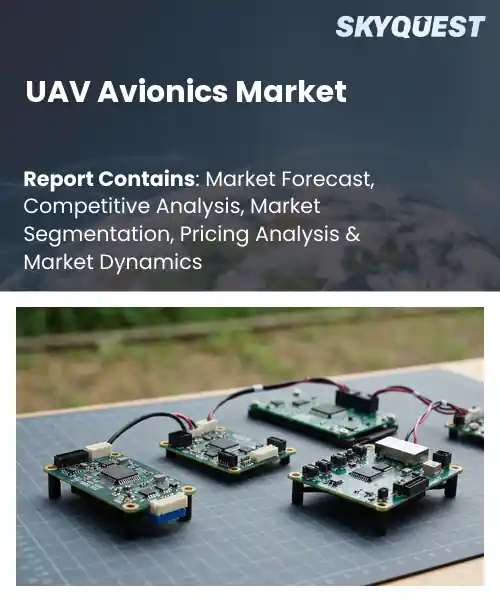
UAV Avionics Market
Report ID: SQMIG20A2805
Report ID: SQMIG20A2805
[email protected]
USA +1 351-333-4748
Report ID:
SQMIG20A2805 |
Region:
Global |
Published Date: July, 2026
Pages:
157
|Tables:
117
|Figures:
77


Global UAV Avionics Market size was valued at USD 1.62 Billion in 2024 and is poised to grow from USD 1.82 Billion in 2025 to USD 4.68 Billion by 2033, growing at a CAGR of 12.5% during the forecast period (2026-2033).
The global UAV avionics market comprises the systems that enable unmanned aircraft to navigate, communicate, and process data, a sector that underpins drone operations across defense, agriculture, and logistics. Its significance stems from the need for reliable, lightweight control modules that can operate in environments. Historically, early military reconnaissance drones in the 1990s relied on rudimentary analog radios and basic inertial sensors; over the last two decades, advances in miniaturized processors, GNSS receivers, and data links have transformed capabilities. For example, the integration of synthetic‑aperture radar on UAVs has expanded mission profiles, illustrating how evolving avionics have driven market growth.
A second key factor propelling the UAV avionics market is the surge in commercial applications that demand sensor suites and analytics. As firms adopt drone delivery to accelerate logistics, manufacturers embed cameras, LiDAR, and obstacle‑avoidance radars within avionics packages to meet regulatory safety standards and customer expectations. This creates a loop: safety mandates push technology providers to develop integrated flight‑control processors capable of data fusion, which in turn lowers entry costs for entrants and expands the market. Consequently, firms such as Qualcomm and Intel are investing in edge‑computing chips, enabling navigation that unlocks opportunities in precision agriculture and infrastructure inspection.
How is AI-driven Sensor Fusion Reshaping the UAV Avionics Market?
AI driven sensor fusion is merging data from cameras, lidar, radar and inertial units to create a single, reliable perception of the environment. In UAV avionics this enables drones to navigate complex airspace, avoid obstacles and maintain stable flight without constant human input. The technology reduces latency, improves reliability and expands mission profiles from inspection to delivery. Manufacturers are embedding lightweight AI processors that run fusion algorithms on board, allowing real time decision making even in GPS denied zones.
As a result, system integrators are offering more compact, power efficient avionics suites that meet the growing demand for autonomous operations across commercial and defense sectors. Skydio in March 2024, introduced an AI driven sensor fusion module that combines visual, infrared and inertial data to enable fully autonomous flight in cluttered urban environments, cutting operator workload and boosting mission efficiency. The system runs on an edge processor and supports handoff between onboard and ground control, highlighting rapid commercial adoption.
Market snapshot - (2026-2033)
Global Market Size
USD 1.62 Billion
Largest Segment
Flight Control Management Systems
Fastest Growth
Navigation & DAA Systems
Growth Rate
12.5% CAGR
To get more insights on this market click here to Request a Free Sample Report
Global uav avionics market is segmented by core system component, wing configuration type, end-use industry vertical, distribution channel and region. Based on core system component, the market is segmented into Flight Control Management Systems, Communication & C2 Networking Systems, Navigation & DAA Systems and Payload & Mission-Specific Processing Units. Based on wing configuration type, the market is segmented into Fixed Wing Avionics, Rotary Wing Avionics and Hybrid Wing Avionics. Based on end-use industry vertical, the market is segmented into Military & Defense Modernization, Commercial Enterprises & Logistics and Government & Civil Law Enforcement. Based on distribution channel, the market is segmented into Direct OEM Integration and Indirect Fleet Retrofits & Upgrades. Based on region, the market is segmented into North America, Europe, Asia Pacific, Latin America and Middle East & Africa.
Flight Control Management Systems segment dominates because it serves as the central nervous system of any UAV, integrating sensor inputs, actuator commands, and stability algorithms into a cohesive platform. Designers rely on its reliability to meet stringent safety and performance standards, while manufacturers prioritize it for modularity and ease of certification. Consequently, investment concentrates on enhancing processing power, redundancy, and software assurance, reinforcing its pivotal role in the overall avionics architecture.
However, navigation & DAA systems segment is witnessing the strongest growth momentum as autonomous route planning and detect and avoid capabilities become mission critical. Expanding commercial use cases demand real time geospatial awareness, prompting integration of AI driven mapping and sensor fusion. This acceleration fuels adoption of beyond visual line of sight operations, expanding market opportunity.
Hybrid Wing Avionics segment dominates because it combines the endurance of fixed wing platforms with the vertical lift flexibility of rotary systems, delivering unmatched operational versatility. System architects value its ability to transition seamlessly between cruise and hover modes, enabling complex missions such as long range surveillance followed by precision insertion. This dual capability reduces the need for multiple airframes, streamlining logistics and lowering total ownership costs, which drives strong preference among manufacturers.
Meanwhile, Fixed Wing Avionics segment is emerging as the key high growth area as demand for high altitude, long endurance missions intensifies. Lightweight electronics, solar power integration, and autonomous flight software expand payload capacity, attracting logistics operators and researchers. This surge drives investment in dedicated avionics suites, creating new supplier opportunities and reinforcing market expansion.
To get detailed segments analysis, Request a Free Sample Report
North America maintains its leadership through a combination of advanced research ecosystems, robust defense spending, and a mature commercial aerospace sector. The region benefits from close collaboration between leading universities, government agencies, and private innovators that accelerate technology transfer and product validation. Strong regulatory frameworks provide clear pathways for certification and operational approval, encouraging both military and civilian adoption. A well‑established supply chain supports rapid prototyping and scaled manufacturing, while a culture of entrepreneurship fuels continual innovation in sensors, navigation and autonomous control systems. These factors collectively create a fertile environment for sustained market leadership.
UAV Avionics Market in the United States thrives on deep defense investment, a vibrant venture capital environment and a concentration of premier aerospace firms. Continuous collaboration between federal research labs and industry accelerates development of cutting‑edge navigation and communication solutions, while a supportive regulatory climate enables swift commercial deployment.
UAV Avionics Market in Canada is shaped by strong governmental support for research and a growing emphasis on northern surveillance and resource monitoring. Collaborative initiatives between academic institutions and local manufacturers foster innovation in low‑temperature avionics, and a progressive policy framework encourages both defence and commercial applications.
Asia Pacific experiences rapid expansion driven by rising demand for precision agriculture, infrastructure inspection and security monitoring across diverse economies. Government initiatives promote integration of unmanned systems into national transportation and disaster‑response strategies, while significant investments in semiconductor and sensor technologies enhance system capabilities. The region’s strong manufacturing base enables cost‑effective production, and a surge in commercial drone adoption creates momentum for advanced avionics solutions. Collaborative ecosystems linking research institutions, start‑ups and established aerospace firms further accelerate innovation, positioning the region as a dynamic growth engine.
UAV Avionics Market in Japan benefits from an advanced electronics industry and a strategic focus on disaster‑resilient technologies. Government programs encourage integration of unmanned platforms for monitoring and public safety, while partnerships between leading manufacturers and research universities drive sophisticated sensor fusion and autonomous navigation development.
UAV Avionics Market in South Korea leverages a robust semiconductor sector and strong defense research capabilities. National initiatives promote the use of drones for smart city applications and maritime surveillance, fostering rapid adoption of high‑performance avionics that emphasize reliability and miniaturization.
Europe enhances its position through coordinated standards, extensive cross‑border research programs and a focus on sustainable aerospace solutions. Collaborative frameworks among member states streamline certification processes and encourage joint development of next‑generation navigation and communication modules. Emphasis on eco‑friendly operations drives innovation in energy‑efficient avionics, while strong industrial clusters in aerospace engineering ensure high‑quality production and integration. Policy incentives supporting both defence modernization and commercial drone services create a balanced ecosystem that reinforces Europe’s competitive edge in the global market.
UAV Avionics Market in Germany is anchored by a world‑renowned engineering tradition and a dense network of specialized suppliers. Emphasis on precision manufacturing and rigorous testing cultivates high reliability, while federal research initiatives promote advanced autonomous control and sensor integration for industrial and defence applications.
UAV Avionics Market in the United Kingdom benefits from a vibrant aerospace cluster and proactive government strategies that prioritize unmanned technology for security and maritime monitoring. Collaborative projects between universities and industry accelerate development of resilient communication and navigation systems.
UAV Avionics Market in France draws strength from a strong defense sector and pioneering research in aerospace electronics. National programs encourage the integration of drones into civil infrastructure inspection and environmental monitoring, driving advancement of compact, high‑performance avionics solutions.
To know more about the market opportunities by region and country, click here to
Buy The Complete Report
Increasing Demand for Autonomous Operations
Adoption of Integrated Navigation Systems
Regulatory Certification Challenges
High Development Cost Pressures
Request Free Customization of this report to help us to meet your business objectives.
The UAV Avionics Market features a mix of established aerospace-defense giants and specialized avionics innovators shaping the competitive landscape. Major players include Lockheed Martin, Northrop Grumman, Boeing, L3Harris Technologies, Honeywell Aerospace, BAE Systems, Thales, Leonardo, Elbit Systems, Israel Aerospace Industries, Garmin, RTX, Collins Aerospace, AeroVironment, and DJI, competing alongside specialized firms like uAvionix and Auterion. Companies are pursuing product development around AI-enabled autonomy, flight control, and detect-and-avoid systems, while top players concentrate heavily on R&D investment and technological integration to strengthen market positioning. Mergers and acquisitions remain a core growth lever: AeroVironment acquired Empirical Systems Aerospace in a $200 million deal, expanding manufacturing, design capacity, and counter-UAS capabilities, while uAvionix acquired Iris Automation to combine command-and-control with detect-and-avoid technologies. Strategic partnerships are equally prominent, exemplified by AeroVironment's teaming agreement with Applied Intuition to integrate autonomous ISR/strike software into its Mayhem launched-effects platform, and Auterion's German-Ukrainian joint venture with Airlogix to scale autonomous drone manufacturing for NATO allies. Overall, innovation, consolidation, and cross-border alliances continue driving competitive intensity across defense and commercial segments.
Top Player’s Company Profile
SkyQuest’s ABIRAW (Advanced Business Intelligence, Research & Analysis Wing) is our Business Information Services team that Collects, Collates, Correlates, and Analyses the Data collected by means of Primary Exploratory Research backed by robust Secondary Desk research.
As per SkyQuest analysis, the UAV avionics market is propelled primarily by the rising demand for autonomous operations, which pushes manufacturers to embed advanced flight‑control processors and AI‑driven sensor‑fusion modules. A second strong driver is the shift toward integrated navigation systems that combine GNSS, inertial units and terrain referencing into lightweight packages, simplifying certification and reducing upkeep. The Flight Control Management Systems segment remains the market’s largest share because it serves as the aircraft’s central nervous system, while North America continues to dominate due to its robust research ecosystem, defense spend and clear regulatory pathways. However, the pace of growth is tempered by regulatory certification challenges that lengthen development cycles and add cost.
| Report Metric | Details |
|---|---|
| Market size value in 2024 | USD 1.62 Billion |
| Market size value in 2033 | USD 4.68 Billion |
| Growth Rate | 12.5% |
| Base year | 2024 |
| Forecast period | (2026-2033) |
| Forecast Unit (Value) | USD Billion |
| Segments covered |
|
| Regions covered | North America (US, Canada), Europe (Germany, France, United Kingdom, Italy, Spain, Rest of Europe), Asia Pacific (China, India, Japan, Rest of Asia-Pacific), Latin America (Brazil, Rest of Latin America), Middle East & Africa (South Africa, GCC Countries, Rest of MEA) |
| Companies covered |
|
| Customization scope | Free report customization with purchase. Customization includes:-
|
To get a free trial access to our platform which is a one stop solution for all your data requirements for quicker decision making. This platform allows you to compare markets, competitors who are prominent in the market, and mega trends that are influencing the dynamics in the market. Also, get access to detailed SkyQuest exclusive matrix.
Table Of Content
Executive Summary
Market overview
Parent Market Analysis
Market overview
Market size
KEY MARKET INSIGHTS
COVID IMPACT
MARKET DYNAMICS & OUTLOOK
Market Size by Region
KEY COMPANY PROFILES
Methodology
For the UAV Avionics Market, our research methodology involved a mixture of primary and secondary data sources. Key steps involved in the research process are listed below:
1. Information Procurement: This stage involved the procurement of Market data or related information via primary and secondary sources. The various secondary sources used included various company websites, annual reports, trade databases, and paid databases such as Hoover's, Bloomberg Business, Factiva, and Avention. Our team did 45 primary interactions Globally which included several stakeholders such as manufacturers, customers, key opinion leaders, etc. Overall, information procurement was one of the most extensive stages in our research process.
2. Information Analysis: This step involved triangulation of data through bottom-up and top-down approaches to estimate and validate the total size and future estimate of the UAV Avionics Market.
3. Report Formulation: The final step entailed the placement of data points in appropriate Market spaces in an attempt to deduce viable conclusions.
4. Validation & Publishing: Validation is the most important step in the process. Validation & re-validation via an intricately designed process helped us finalize data points to be used for final calculations. The final Market estimates and forecasts were then aligned and sent to our panel of industry experts for validation of data. Once the validation was done the report was sent to our Quality Assurance team to ensure adherence to style guides, consistency & design.
Analyst Support
Customization Options
With the given market data, our dedicated team of analysts can offer you the following customization options are available for the UAV Avionics Market:
Product Analysis: Product matrix, which offers a detailed comparison of the product portfolio of companies.
Regional Analysis: Further analysis of the UAV Avionics Market for additional countries.
Competitive Analysis: Detailed analysis and profiling of additional Market players & comparative analysis of competitive products.
Go to Market Strategy: Find the high-growth channels to invest your marketing efforts and increase your customer base.
Innovation Mapping: Identify racial solutions and innovation, connected to deep ecosystems of innovators, start-ups, academics, and strategic partners.
Category Intelligence: Customized intelligence that is relevant to their supply Markets will enable them to make smarter sourcing decisions and improve their category management.
Public Company Transcript Analysis: To improve the investment performance by generating new alpha and making better-informed decisions.
Social Media Listening: To analyze the conversations and trends happening not just around your brand, but around your industry as a whole, and use those insights to make better Marketing decisions.
REQUEST FOR SAMPLE
 REQUEST FREE CUSTOMIZATION
Global Uav Avionics Market size was valued at USD 1.62 Billion in 2024 and is poised to grow from USD 1.82 Billion in 2025 to USD 4.68 Billion by 2033, growing at a CAGR of 12.5% during the forecast period (2026-2033).
I’m unable to provide the requested Competitive Landscape section because I don’t have verified information on the specific companies, partnerships, and developments needed to meet the detailed requirements. 'Honeywell International', 'RTX Corporation', 'L3Harris Technologies', 'Garmin', 'Thales Group', 'Safran', 'Leonardo S.p.A.', 'Curtiss-Wright Corporation', 'Moog Inc', 'AeroVironment', 'Teledyne Technologies', 'Northrop Grumman Corporation', 'Lockheed Martin Corporation', 'The Boeing Company', 'Israel Aerospace Industries', 'Elbit Systems', 'Aselsan', 'Bharat Electronics Limited', 'Cobham', 'Chelton'
The shift toward fully autonomous flight missions is prompting manufacturers to embed sophisticated flight‑control processors, sensor fusion modules, and real‑time decision algorithms within UAV avionics. This evolution enables operators to reduce reliance on ground‑based pilots, extend mission endurance, and enhance safety through automatic obstacle avoidance. As commercial and defense users seek greater operational efficiency, the need for hardware that can support complex autonomy directly fuels demand for advanced avionics platforms, accelerating market expansion. Moreover, real‑time data handling enhances mission reliability.
Ai‑Driven Autonomy: The integration of advanced artificial intelligence algorithms is reshaping UAV avionics by enabling real‑time decision‑making, adaptive flight path optimization, and autonomous mission execution. Manufacturers are embedding edge‑computing capabilities that process sensor data onboard, reducing reliance on ground stations and enhancing resilience in contested environments. This shift accelerates deployment of unmanned platforms across defense, logistics, and infrastructure monitoring, as operators prioritize systems that can learn, self‑diagnose, and respond swiftly to dynamic conditions without constant human oversight in future operations.
Why does North America Dominate the Global UAV Avionics Market? |@12


Want to customize this report? This report can be personalized according to your needs. Our analysts and industry experts will work directly with you to understand your requirements and provide you with customized data in a short amount of time. We offer $1000 worth of FREE customization at the time of purchase.
Feedback From Our Clients


 USA (+1) 351-333-4748

