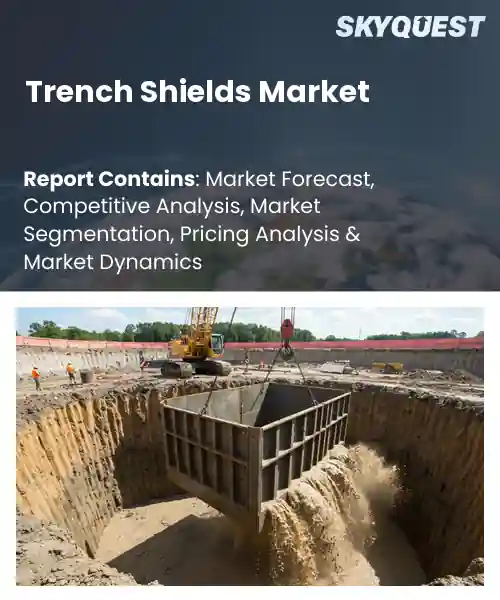
Trench Shields Market
Report ID: SQMIG20G2179
Report ID: SQMIG20G2179
[email protected]
USA +1 351-333-4748
Report ID:
SQMIG20G2179 |
Region:
Global |
Published Date: July, 2026
Pages:
157
|Tables:
172
|Figures:
79


Global Trench Shields Market size was valued at USD 487.3 Million in 2024 and is poised to grow from USD 513.61 Million in 2025 to USD 782.28 Million by 2033, growing at a CAGR of 5.4% during the forecast period (2026-2033).
Trench shields, also known as trench boxes, are engineered steel or aluminum structures that protect workers from cave‑in hazards during underground utility and construction excavations. Their market emerged as urbanization accelerated, demanding safer, faster subsurface work; the United States, Europe, and increasingly China have adopted stringent safety regulations that mandate protective equipment.
Regulatory pressure drives the trench shields market as governments tighten safety standards and impose penalties for non‑compliance. When authorities mandate protective equipment for excavations deeper than 0.6 meters, contractors must procure certified shields, increasing demand across residential, commercial, and infrastructure projects. In the United Kingdom, the Health and Safety Executive’s Excavation Regulation 2023 sparked a 15 percent rise in shield orders within twelve months, showing the direct link between policy and sales. At the same time, smart‑sensor integration load‑monitoring and tilt alerts creates premium product lines, allowing manufacturers to capture margins while improving safety on subway tunneling and pipeline refurbishment jobs.
How is AI-driven automation improving safety in the trench shields market?
AI driven automation is reshaping safety practices in the trench shields market by embedding sensors and machine learning into the equipment. Real time data on soil pressure, vibration and worker proximity is collected and analyzed to trigger instant alerts before a condition becomes hazardous. Predictive models learn from past incidents and suggest optimal shield placement, reducing the need for manual inspections. Remote monitoring lets supervisors oversee multiple sites from a central hub, limiting exposure of personnel to unstable trenches. The technology also supports training simulations that replicate dangerous scenarios without physical risk, creating a culture of proactive risk management.
National Trench Safety in April 2025, launched an AI driven monitoring platform that integrates with its trench shields to automatically detect ground movement and alert crews. This innovation shortens response times, boosts confidence in shield stability and drives broader adoption of advanced safety solutions across the industry.
Market snapshot - (2026-2033)
Global Market Size
USD 487.3 Million
Largest Segment
Aseptic Connectors
Fastest Growth
Aseptic Welders
Growth Rate
5.4% CAGR
To get more insights on this market click here to Request a Free Sample Report
The global trench shields market is segmented by product type, material, application, end user, distribution channel, and region. Based on product type, the market is segmented into Trench Boxes, Slide Rail Systems, and Hydraulic Trench Shields. Based on material, the market is segmented into Steel Trench Shields, Aluminum Trench Shields, and Others. Based on application, the market is segmented into Utility Installation, Pipeline Construction, Road and Highway Construction, Building Construction, Telecommunications, and Others. Based on end user, the market is segmented into Construction Contractors, Utility Companies, Municipal Authorities, Oil & Gas Companies, and Others. Based on distribution channel, the market is segmented into Direct Sales, Equipment Rental Companies, Distributors, and Others. Based on region, the market is segmented into North America, Europe, Asia Pacific, Latin America, and the Middle East & Africa.
Steel trench shields segment dominates with large global trench shields market share because of its exceptional load-bearing capacity, durability, and ability to withstand heavy soil pressure in deep excavations. These shields are widely used in large-scale infrastructure projects such as pipelines, highways, sewer systems, and utility installations where maximum worker protection is essential.
As per global trench shields market outlook, aluminum trench shields segment is expected to register the fastest growth due to its lightweight design, which simplifies transportation, reduces installation time, and lowers labor costs. Their increasing adoption in urban utility repairs, residential construction, and confined excavation sites is further supporting segment growth.
Why Does the Utility Installation Segment Dominate the Global Trench Shields Market?
Utility companies segment holds the largest market share as governments and utility providers continue investing in water distribution, wastewater systems, gas pipelines, underground power cables, and stormwater drainage networks. These projects require reliable trench protection to comply with worker safety regulations, ensuring consistent demand for trench shields.
The telecommunications segment is the fastest growing, fueled by rapid expansion of fiber broadband networks, 5G infrastructure deployment, and smart city initiatives that require extensive underground cable installation worldwide.
To get detailed segments analysis, Request a Free Sample Report
North America leads the trench shields market through a combination of stringent occupational safety standards, a mature construction ecosystem, and deep integration of advanced manufacturing capabilities. The United States and Canada benefit from well‑established supply chains that deliver high‑quality steel and composite materials at scale. Continuous investment in workforce training reinforces proper usage and maintenance of protective systems, while strong demand from infrastructure renewal projects sustains steady consumption. Innovation hubs foster the development of lighter, more modular shield designs that address site‑specific challenges, further cementing regional leadership. Collaborative industry associations also promote best practices, ensuring that safety solutions evolve in line with regulatory expectations. Additionally, extensive research partnerships between academia and equipment manufacturers accelerate the introduction of eco‑friendly shield materials, while lobbying efforts help harmonize cross‑border safety guidelines, reinforcing a cohesive market environment.
As per trench shields market regional outlook, United States is shaped by a highly regulated environment that emphasizes worker protection across large‑scale civil projects. Leading manufacturers leverage domestic steel production and advanced engineering expertise to supply customizable solutions. Engineering firms prioritize rapid deployment and ergonomic designs to meet tight project timelines, while safety consultants drive awareness of best practice standards. This ecosystem sustains strong demand for innovative shield technologies across diverse construction sectors.
As per trench shields market regional forecast, Canada benefits from a collaborative safety culture that integrates national occupational guidelines with regional construction practices. Domestic producers tap into abundant raw material resources to offer cost‑effective yet robust shield options. Project developers value the adaptability of modular systems for varied terrain, while provincial authorities support training initiatives that enhance proper installation techniques. This alignment of regulatory support and industry responsiveness fuels steady interest in protective trench solutions across the nation.
Europe experiences rapid expansion of the trench shields market due to harmonized safety directives, strong environmental commitments, and a resurgence of urban renewal initiatives. The regulatory framework across member states encourages adoption of advanced protective systems, while green construction agendas prioritize reusable and low‑impact materials. Collaboration between engineering institutes and equipment makers spurs continuous refinement of modular designs that cater to dense cityscapes and historic retrofit projects. Moreover, a skilled labor pool proficient in precision installation accelerates project timelines, and cross‑border trade agreements simplify component sourcing. This confluence of policy support, sustainability focus, and technical expertise positions Europe as a vibrant growth hub for trench shielding solutions. Industry clusters in central and northern regions also nurture joint ventures that blend digital monitoring tools with traditional shielding, enhancing safety outcomes and operational efficiency across the continent.
Germany is anchored by a robust engineering tradition that emphasizes precision and durability. Domestic manufacturers combine high‑grade steel expertise with innovative composite technologies to deliver highly resilient shield solutions. Major infrastructure programs prioritize safety upgrades, encouraging the deployment of modular systems that can be rapidly installed in varied ground conditions. Strong collaboration between research institutes and industry accelerates product evolution, reinforcing Germany position as a benchmark for quality in trench protection.
United Kingdom benefits from a proactive safety agenda that aligns closely with evolving construction practices. Leading firms integrate lightweight alloy constructions with ergonomic handling features, catering to fast‑paced project cycles common in urban development. Government incentives for retrofit of aging utilities stimulate demand for adaptable shielding solutions, while professional bodies disseminate best‑practice guidelines that raise awareness of trench safety. This dynamic environment fuels rapid adoption of next‑generation protective technologies.
France is emerging as construction firms embrace heightened risk mitigation standards. Local producers leverage access to high‑quality steel corridors to fabricate efficient shield units that suit a range of soil profiles. Emphasis on modularity allows contractors to adapt solutions quickly for mixed‑use developments and restoration of historic sites. Collaborative training programs supported by industry associations raise competency levels, gradually expanding the market footprint for trench protection technologies across the nation.
Asia Pacific is strengthening its position in the trench shields market through a combination of rapid urbanization, escalating infrastructure modernization, and a growing emphasis on occupational safety. Nations across the region are investing heavily in high‑rise construction and transportation corridors, creating a substantial need for reliable trench protection. Local manufacturers are scaling production capacities while adopting advanced fabrication methods that reduce weight and improve durability. Partnerships with global technology providers introduce smart monitoring features that enhance real‑time hazard detection. Additionally, regional regulatory bodies are tightening safety mandates, prompting developers to prioritize trench shielding as a core component of project planning. This convergence of market demand, technical innovation, and regulatory impetus propels Asia Pacific toward a more prominent role in the global landscape.
Japan is characterized by meticulous engineering standards and a cultural focus on worker welfare. Domestic producers combine advanced metallurgical processes with precision machining to create high‑performance shield systems suitable for regional varied geological conditions. Major infrastructure upgrades, particularly in seismic‑prone zones, drive demand for resilient and quickly deployable solutions. Collaborative initiatives between academia and industry foster the integration of sensor‑based monitoring, further enhancing safety outcomes on complex excavation projects.
South Korea benefits from a proactive construction sector that integrates advanced safety technologies into large‑scale development projects. Local manufacturers leverage strong steel production capabilities and adopt modular design principles to deliver flexible shielding solutions for rapid installation. Government safety campaigns emphasize the importance of trench protection, encouraging contractors to adopt state‑of‑the‑art systems. Ongoing collaboration with research institutes drives continuous improvement in material resilience and ergonomic handling, supporting broader market acceptance.
To know more about the market opportunities by region and country, click here to
Buy The Complete Report
Increasing Demand For Deep‑Sea Installations
Adoption of Advanced Composite Materials
High Initial Capital Expenditure
Regulatory Compliance And Certification
Request Free Customization of this report to help us to meet your business objectives.
The competitive landscape is shaped by aggressive M&A among leading construction equipment manufacturers, strategic partnerships between defense contractors and civil‑engineering firms to integrate ballistic‑grade composites, and rapid tech innovation such as AI‑driven design optimization of modular shield sections. Recent joint ventures between major earth‑moving OEMs and specialty material suppliers have accelerated product diversification, intensifying rivalry for large‑scale infrastructure contracts.
SkyQuest’s ABIRAW (Advanced Business Intelligence, Research & Analysis Wing) is our Business Information Services team that Collects, Collates, Correlates, and Analyses the Data collected by means of Primary Exploratory Research backed by robust Secondary Desk research.
As per SkyQuest analysis the global trench shields market growth driven primarily by increasing demand for deep‑sea installations that require robust protective solutions, while the high initial capital expenditure required for certified systems temper growth. North America leads the market due to strict safety standards and mature supply chains, and the aseptic connectors segment holds the largest share because of its essential role in sterile bioprocess environments. A second catalyst comes from the adoption of advanced composite materials which make shields lighter, stronger and corrosion‑resistant, further encouraging adoption across offshore and urban projects worldwide today. The global trench shields market trend is witnessing a shift toward lightweight, modular trench shield systems that improve worker safety while reducing installation time and transportation costs.
| Report Metric | Details |
|---|---|
| Market size value in 2024 | USD 487.3 Million |
| Market size value in 2033 | USD 782.28 Million |
| Growth Rate | 5.4% |
| Base year | 2024 |
| Forecast period | (2026-2033) |
| Forecast Unit (Value) | USD Million |
| Segments covered |
|
| Regions covered | North America (US, Canada), Europe (Germany, France, United Kingdom, Italy, Spain, Rest of Europe), Asia Pacific (China, India, Japan, Rest of Asia-Pacific), Latin America (Brazil, Rest of Latin America), Middle East & Africa (South Africa, GCC Countries, Rest of MEA) |
| Companies covered |
|
| Customization scope | Free report customization with purchase. Customization includes:-
|
To get a free trial access to our platform which is a one stop solution for all your data requirements for quicker decision making. This platform allows you to compare markets, competitors who are prominent in the market, and mega trends that are influencing the dynamics in the market. Also, get access to detailed SkyQuest exclusive matrix.
Table Of Content
Executive Summary
Market overview
Parent Market Analysis
Market overview
Market size
KEY MARKET INSIGHTS
COVID IMPACT
MARKET DYNAMICS & OUTLOOK
Market Size by Region
KEY COMPANY PROFILES
Methodology
For the Trench Shields Market, our research methodology involved a mixture of primary and secondary data sources. Key steps involved in the research process are listed below:
1. Information Procurement: This stage involved the procurement of Market data or related information via primary and secondary sources. The various secondary sources used included various company websites, annual reports, trade databases, and paid databases such as Hoover's, Bloomberg Business, Factiva, and Avention. Our team did 45 primary interactions Globally which included several stakeholders such as manufacturers, customers, key opinion leaders, etc. Overall, information procurement was one of the most extensive stages in our research process.
2. Information Analysis: This step involved triangulation of data through bottom-up and top-down approaches to estimate and validate the total size and future estimate of the Trench Shields Market.
3. Report Formulation: The final step entailed the placement of data points in appropriate Market spaces in an attempt to deduce viable conclusions.
4. Validation & Publishing: Validation is the most important step in the process. Validation & re-validation via an intricately designed process helped us finalize data points to be used for final calculations. The final Market estimates and forecasts were then aligned and sent to our panel of industry experts for validation of data. Once the validation was done the report was sent to our Quality Assurance team to ensure adherence to style guides, consistency & design.
Analyst Support
Customization Options
With the given market data, our dedicated team of analysts can offer you the following customization options are available for the Trench Shields Market:
Product Analysis: Product matrix, which offers a detailed comparison of the product portfolio of companies.
Regional Analysis: Further analysis of the Trench Shields Market for additional countries.
Competitive Analysis: Detailed analysis and profiling of additional Market players & comparative analysis of competitive products.
Go to Market Strategy: Find the high-growth channels to invest your marketing efforts and increase your customer base.
Innovation Mapping: Identify racial solutions and innovation, connected to deep ecosystems of innovators, start-ups, academics, and strategic partners.
Category Intelligence: Customized intelligence that is relevant to their supply Markets will enable them to make smarter sourcing decisions and improve their category management.
Public Company Transcript Analysis: To improve the investment performance by generating new alpha and making better-informed decisions.
Social Media Listening: To analyze the conversations and trends happening not just around your brand, but around your industry as a whole, and use those insights to make better Marketing decisions.
REQUEST FOR SAMPLE
 REQUEST FREE CUSTOMIZATION
Global Trench Shields Market size was valued at USD 487.3 Million in 2024 and is poised to grow from USD 513.61 Million in 2025 to USD 782.28 Million by 2033, growing at a CAGR of 5.4% during the forecast period (2026-2033).
The competitive landscape is shaped by aggressive M&A among leading construction equipment manufacturers, strategic partnerships between defense contractors and civil‑engineering firms to integrate ballistic‑grade composites, and rapid tech innovation such as AI‑driven design optimization of modular shield sections. Recent joint ventures between major earth‑moving OEMs and specialty material suppliers have accelerated product diversification, intensifying rivalry for large‑scale infrastructure contracts. 'Cytiva', 'Sartorius AG', 'Merck KGaA', 'Thermo Fisher Scientific Inc.', 'Saint-Gobain Life Sciences', 'Parker Hannifin Corporation', 'Colder Products Company', 'Genesis BPS LLC', 'Foxx Life Sciences', 'BioPharma Dynamics Ltd.', 'GEA Group AG', 'Watson-Marlow Fluid Technology Solutions', 'Ezi-Dock Systems Ltd.', 'TekniPlex Healthcare', 'Meissner Filtration Products, Inc.', 'Entegris, Inc.', 'Terumo BCT, Inc.', 'Single Use Support GmbH', 'Opta Group LLC', 'AdvantaPure'
Increasing demand for deep‑sea installations is driven by expanding offshore energy projects, including oil, gas, and renewable wind farms, which require robust trench protection solutions. These projects rely on trench shields to safeguard cables and pipelines against seabed disturbances, fostering consistent procurement cycles. As operators prioritize operational safety and long‑term reliability, they increasingly select high‑performance trench shields, prompting manufacturers to enhance product offerings and support services. This persistent requirement fuels market expansion by creating steady revenue streams and encouraging technological innovation.
Smart Sensor Integration: Manufacturers are embedding advanced sensor arrays within trench shields to continuously monitor stress, vibration, and environmental conditions. Real‑time data feeds enable predictive maintenance, reducing unexpected failures and extending service life. This connectivity also supports remote diagnostics and integration with broader construction site management platforms, fostering safer operations and cost efficiencies. As IoT adoption accelerates across heavy‑equipment sectors, the ability to leverage actionable insights from shield instrumentation is becoming a decisive differentiator for operators seeking higher reliability and profitability in projects.
Why does North America Dominate the Global Trench Shields Market? |@12


Want to customize this report? This report can be personalized according to your needs. Our analysts and industry experts will work directly with you to understand your requirements and provide you with customized data in a short amount of time. We offer $1000 worth of FREE customization at the time of purchase.
Feedback From Our Clients


 USA (+1) 351-333-4748

