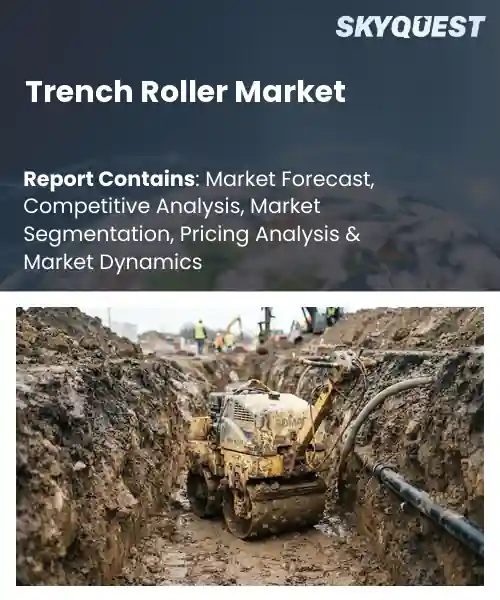
Trench Roller Market
Report ID: SQMIG20G2204
Report ID: SQMIG20G2204
[email protected]
USA +1 351-333-4748
Report ID:
SQMIG20G2204 |
Region:
Global |
Published Date: August, 2026
Pages:
157
|Tables:
117
|Figures:
77


Global Trench Roller Market size was valued at USD 624.3 Million in 2024 and is poised to grow from USD 670.5 Million in 2025 to USD 1186.95 Million by 2033, growing at a CAGR of 7.4% during the forecast period (2026-2033).
The global trench roller market encompasses compact vibratory rollers that compact narrow excavations such as utility trenches and drainage channels. Its significance stems from the need for high‑quality compaction in urban environments where space constraints limit traditional equipment. Historically, the market emerged in the late 1990s as manufacturers miniaturized roller technology to meet the growing demand for underground utilities in expanding cities. A 2005 European fiber‑optic rollout adopted trench rollers to reduce settlement risks, illustrating how the technology accelerated construction timelines while preserving surface integrity. This evolution highlights driver: the relentless push for efficiency and precision in congested infrastructure projects. Building on the identified driver, the main growth factor is the integration of technology and sustainability mandates. Cities are mandating reduced carbon footprints, prompting manufacturers to embed sensors that monitor compaction density in time, thus lowering fuel consumption and re‑work. For instance, a 2022 pilot in Singapore equipped trench rollers with IoT modules, resulting in a 15% cut in diesel use while guaranteeing compliance with local vibration limits. This efficiency translates into lower project costs, encouraging contractors to adopt the equipment for large‑scale utility installations. Consequently, demand expands across markets where urbanization heightens the need for compact, precise compaction solutions.
How is AI-driven automation influencing efficiency and adoption in the trench roller market?
AI driven automation is reshaping the trench roller market by embedding sensors, machine learning algorithms and autonomous controls into traditional equipment. These technologies enable real time adjustment of roller pressure, improve soil compaction consistency and lower fuel consumption. Operators benefit from reduced manual input and faster cycle times, which makes rental fleets more attractive to contractors seeking reliable performance. The market is experiencing heightened interest as urban construction projects demand higher productivity and tighter quality standards. Early adopters report smoother workflows and fewer re work incidents, reinforcing the value proposition of intelligent rollers and extending equipment lifespan while also lowering maintenance costsWacker Neuson February 2025, introduced an articulated RTD‑SC4 roller equipped with AI based load sensing that automatically adjusts compaction force, cuts cycle time and reduces operator fatigue, encouraging wider adoption among rental firms and contractors seeking higher efficiency and consistent results while also improving overall project timelines and profitability
Market snapshot - (2026-2033)
Global Market Size
USD 624.3 Million
Largest Segment
Surgical Treatment
Fastest Growth
Minimally Invasive Procedures
Growth Rate
7.4% CAGR
To get more insights on this market click here to Request a Free Sample Report
Global trench roller market is segmented by product type, operating weight, application, end user and region. Based on product type, the market is segmented into Walk-Behind Trench Rollers and Remote-Controlled Trench Rollers. Based on operating weight, the market is segmented into Light-Duty, Medium-Duty and Heavy-Duty. Based on application, the market is segmented into Trench Compaction, Road Construction, Utility Infrastructure and Other Construction Applications. Based on end user, the market is segmented into Construction Companies, Rental Companies and Government and Infrastructure Contractors. Based on region, the market is segmented into North America, Europe, Asia Pacific, Latin America and Middle East & Africa.
Walk-Behind Trench Rollers segment dominates because they combine simplicity with low acquisition cost, making them attractive for small to medium projects where operators value ease of use. Their manual control allows precise compaction in confined spaces, and the robust mechanical design reduces maintenance downtime. These attributes align with the prevalent demand for cost‑effective, reliable equipment, reinforcing their leading position in the trench roller market and supporting long‑term operational efficiency.
However, Remote-Controlled Trench Rollers segment emerges as the fastest growing area as automation gains traction in high‑volume construction sites. Advanced telemetry and safety features attract contractors seeking to reduce labor exposure and increase productivity. This innovation fuels new project specifications, expanding market opportunities and prompting manufacturers to accelerate development pipelines.
Trench Compaction segment dominates because it directly addresses the core purpose of trench rollers, delivering dense, uniform backfill essential for structural stability. Operators prioritize machines that ensure optimal soil consolidation, and this application drives consistent procurement across projects. Its fundamental role in preventing settlement and enhancing load‑bearing capacity sustains its leading status within the market. Moreover, regulatory guidelines often mandate specific compaction standards, reinforcing demand for dedicated equipment and solidifying its market prominence.
Meanwhile, Utility Infrastructure segment emerges as the fastest growing area as expanding broadband, renewable energy grids, and smart city projects increase trenching activities. The need for precise, repeatable compaction along long utility corridors drives adoption of specialized rollers. This surge creates new revenue streams and encourages manufacturers to tailor solutions, accelerating overall market expansion.
To get detailed segments analysis, Request a Free Sample Report
North America holds a clear leadership position in the global trench roller market thanks to a combination of mature infrastructure, high investment in underground utility networks, and strong engineering expertise. The region benefits from a well‑established construction ecosystem that continuously adopts advanced mechanized solutions to improve productivity and safety. Robust regulatory frameworks encourage the use of efficient trenching equipment, while a network of experienced manufacturers supplies customized tools aligned with local standards. Demand from high‑density urban centers drives frequent upgrades to aging pipe systems, reinforcing the need for reliable trench rollers. Additionally, collaborative research initiatives between industry and academic institutions accelerate innovation, ensuring that North American players remain at the forefront of technology adoption and product development.
Trench Roller Market in the United States is propelled by extensive municipal and private sector projects that prioritize rapid pipe installation and rehabilitation. The large geographic spread creates diverse soil conditions, prompting manufacturers to offer a wide range of machine configurations. Strong emphasis on safety standards drives adoption of ergonomically designed rollers, while a culture of continuous improvement supports the integration of digital monitoring systems that enhance operational efficiency.
Trench Roller Market in Canada benefits from government policies that encourage modernization of underground utilities across urban and remote regions. Emphasis on environmental stewardship leads to preference for low‑emission equipment, prompting manufacturers to integrate hybrid power options. Collaborative partnerships between equipment suppliers and local contractors facilitate tailored solutions for challenging terrain and seasonal weather constraints. This focus on sustainable performance and adaptability strengthens Canada’s role within the North American market.
Europe’s trench roller market is experiencing rapid expansion driven by a convergence of stringent infrastructure renewal mandates, heightened focus on urban resilience, and a strong push toward digitized construction practices. Governments across the continent are allocating significant resources to replace aging water and gas networks, prompting contractors to adopt mechanized trenching solutions that reduce installation time and minimize surface disruption. Environmental regulations encourage low‑emission machinery, while a collaborative ecosystem of research institutes and equipment manufacturers accelerates the introduction of smart, sensor‑enabled rollers. The demand for precision in densely populated cities fuels the development of compact, high‑efficiency models. Combined with a culture of continuous improvement and cross‑border trade, these forces position Europe as a dynamic hub for innovative trench roller technologies.
Trench Roller Market in Germany is anchored by a manufacturing base that delivers equipment tailored to underground projects. Rigorous safety standards and a tradition of engineering excellence compel suppliers to integrate automation and telematics. Utilities prioritize reliability and energy efficiency, encouraging adoption of rollers with low noise and emission profiles. Collaborative alliances between German firms and research laboratories foster product refinement, reinforcing the country’s leading position within the European landscape.
Trench Roller Market in the United Kingdom is experiencing growth as infrastructure projects prioritize installation methods. Strong regulatory incentives for minimizing surface disruption drive contractors toward mechanized rollers that enhance speed and safety. An ecosystem of tech startups and established equipment firms fuels integration of IoT connectivity, allowing performance tracking and maintenance. This combination of support and innovation positions the United Kingdom as the continent’s fastest‑growing market for trench rollers.
Trench Roller Market in France is emerging as developers seek compact solutions to upgrade aging utility corridors within areas. Focus on reducing carbon footprints encourages manufacturers to offer electric or hybrid rollers with noise output. Partnerships between French engineering schools and equipment providers promote modular designs that can be adapted to varied site conditions. This focus on sustainability and flexibility is raising France’s presence in the European trench roller landscape.
Asia Pacific is steadily strengthening its position in the trench roller market through a blend of rapid urbanization, aggressive infrastructure development, and a growing emphasis on technological integration. Nations across the region are investing heavily in modernizing water, gas, and telecommunications networks, which creates sustained demand for efficient trenching equipment. Local manufacturers are accelerating product innovation by incorporating electric drive systems and smart sensors to meet increasingly strict environmental and safety regulations. Collaborative ventures between regional engineering firms and global technology providers facilitate knowledge transfer and enable rapid adaptation to diverse geological conditions. The convergence of supportive policy frameworks, rising construction activity, and a focus on sustainable, high‑performance machinery positions Asia Pacific as a pivotal growth engine for the global trench roller industry.
Trench Roller Market in Japan is driven by a mature construction sector that values precision engineering and low‑emission technology. Stringent environmental legislation pushes manufacturers toward electric‑powered rollers with advanced noise‑reduction features. Close collaboration between Japanese equipment firms and research universities yields innovation in modular designs suited for urban environments. This commitment to sustainability and technical excellence reinforces Japan’s reputation as a leading contributor to the Asia Pacific trench roller landscape.
Trench Roller Market in South Korea benefits from governmental incentives aimed at modernizing utility networks and reducing construction timelines. Emphasis on productivity drives adoption of rollers equipped with telemetry and depth‑control systems. Domestic manufacturers collaborate with technology startups to integrate AI‑based monitoring that optimizes performance and minimizes downtime. This synergy of policy support and innovation positions South Korea as a accelerator of growth within the Asia Pacific trench roller sector.
To know more about the market opportunities by region and country, click here to
Buy The Complete Report
Rising Infrastructure Development
Adoption Of Automated Trench Systems
High Capital Expenditure Requirement
Stringent Environmental Regulations
Request Free Customization of this report to help us to meet your business objectives.
The competitive landscape is shaped by several established equipment manufacturers intensifying R&D collaborations and forming joint ventures with construction firms to embed sensor technology in trench rollers, while some players have pursued strategic acquisitions of niche automation startups to accelerate product differentiation and address rising demand for faster, precision trenching solutions.
Top Player’s Company Profile
Recent Developments
SkyQuest’s ABIRAW (Advanced Business Intelligence, Research & Analysis Wing) is our Business Information Services team that Collects, Collates, Correlates, and Analyses the Data collected by means of Primary Exploratory Research backed by robust Secondary Desk research. As per SkyQuest analysis, the global trench roller market is being propelled primarily by the integration of advanced sensors and AI‑driven automation that boost compaction efficiency and lower fuel use, while rising infrastructure development across urban centers adds a second strong driver by creating steady demand for compact, precise equipment. The walk‑behind trench roller segment remains dominant because of its low cost and ease of use, and North America leads the market thanks to mature utility networks and strong regulatory support. However, the high capital expenditure required for automated, low‑emission models acts as a restraint, slowing adoption among smaller contractors.
| Report Metric | Details |
|---|---|
| Market size value in 2024 | USD 624.3 Million |
| Market size value in 2033 | USD 1186.95 Million |
| Growth Rate | 7.4% |
| Base year | 2024 |
| Forecast period | (2026-2033) |
| Forecast Unit (Value) | USD Million |
| Segments covered |
|
| Regions covered | North America (US, Canada), Europe (Germany, France, United Kingdom, Italy, Spain, Rest of Europe), Asia Pacific (China, India, Japan, Rest of Asia-Pacific), Latin America (Brazil, Rest of Latin America), Middle East & Africa (South Africa, GCC Countries, Rest of MEA) |
| Companies covered |
|
| Customization scope | Free report customization with purchase. Customization includes:-
|
To get a free trial access to our platform which is a one stop solution for all your data requirements for quicker decision making. This platform allows you to compare markets, competitors who are prominent in the market, and mega trends that are influencing the dynamics in the market. Also, get access to detailed SkyQuest exclusive matrix.
Table Of Content
Executive Summary
Market overview
Parent Market Analysis
Market overview
Market size
KEY MARKET INSIGHTS
COVID IMPACT
MARKET DYNAMICS & OUTLOOK
Market Size by Region
KEY COMPANY PROFILES
Methodology
For the Trench Roller Market, our research methodology involved a mixture of primary and secondary data sources. Key steps involved in the research process are listed below:
1. Information Procurement: This stage involved the procurement of Market data or related information via primary and secondary sources. The various secondary sources used included various company websites, annual reports, trade databases, and paid databases such as Hoover's, Bloomberg Business, Factiva, and Avention. Our team did 45 primary interactions Globally which included several stakeholders such as manufacturers, customers, key opinion leaders, etc. Overall, information procurement was one of the most extensive stages in our research process.
2. Information Analysis: This step involved triangulation of data through bottom-up and top-down approaches to estimate and validate the total size and future estimate of the Trench Roller Market.
3. Report Formulation: The final step entailed the placement of data points in appropriate Market spaces in an attempt to deduce viable conclusions.
4. Validation & Publishing: Validation is the most important step in the process. Validation & re-validation via an intricately designed process helped us finalize data points to be used for final calculations. The final Market estimates and forecasts were then aligned and sent to our panel of industry experts for validation of data. Once the validation was done the report was sent to our Quality Assurance team to ensure adherence to style guides, consistency & design.
Analyst Support
Customization Options
With the given market data, our dedicated team of analysts can offer you the following customization options are available for the Trench Roller Market:
Product Analysis: Product matrix, which offers a detailed comparison of the product portfolio of companies.
Regional Analysis: Further analysis of the Trench Roller Market for additional countries.
Competitive Analysis: Detailed analysis and profiling of additional Market players & comparative analysis of competitive products.
Go to Market Strategy: Find the high-growth channels to invest your marketing efforts and increase your customer base.
Innovation Mapping: Identify racial solutions and innovation, connected to deep ecosystems of innovators, start-ups, academics, and strategic partners.
Category Intelligence: Customized intelligence that is relevant to their supply Markets will enable them to make smarter sourcing decisions and improve their category management.
Public Company Transcript Analysis: To improve the investment performance by generating new alpha and making better-informed decisions.
Social Media Listening: To analyze the conversations and trends happening not just around your brand, but around your industry as a whole, and use those insights to make better Marketing decisions.
REQUEST FOR SAMPLE
 REQUEST FREE CUSTOMIZATION


Want to customize this report? This report can be personalized according to your needs. Our analysts and industry experts will work directly with you to understand your requirements and provide you with customized data in a short amount of time. We offer $1000 worth of FREE customization at the time of purchase.
Feedback From Our Clients


 USA (+1) 351-333-4748

