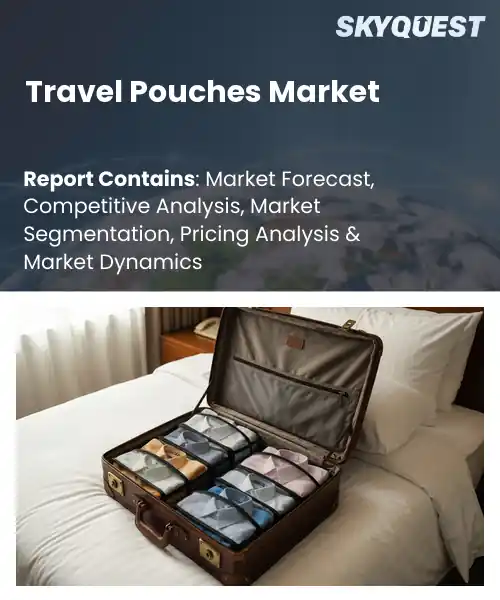
Travel Pouches Market
Report ID: SQMIG25K2164
Report ID: SQMIG25K2164
[email protected]
USA +1 351-333-4748
Report ID:
SQMIG25K2164 |
Region:
Global |
Published Date: March, 2026
Pages:
157
|Tables:
120
|Figures:
77


Global Travel Pouches Market size was valued at USD 1.6 Billion in 2024 and is poised to grow from USD 1.72 Billion in 2025 to USD 3.12 Billion by 2033, growing at a CAGR of 7.7% during the forecast period (2026-2033).
Key Takeaways : Market Trends & Insights
Growing global travel activity, increasing need for organized packing solutions, rising demand for lightweight and compact accessories, advancements in product design and materials, and expanding e-commerce distribution are driving sales of travel pouches.
Rising consumer spending has pushed travel pouch companies to invest in product differentiation through technology and sustainable materials Features like RFID blocking, anti-theft zip locks, and compressibility are being incorporated by travel pouch manufacturers to increase the usability and security of the bag. Simultaneously, the use of eco-friendly materials and fabrics is helping the brand position itself at a premium level, attract eco-conscious customers, and facilitate co-branding opportunities with retail outlets and hoteliers.
Moreover, there is an increased amount of travel taking place for both leisure and business purposes, which will be a key driving force behind future sales of travel pouches bags. Growing mobility among consumers worldwide, coupled with changing travel behavior and increasing preference for convenience and organization, is expected to primarily drive travel pouches market growth.
On the contrary, availability of low-cost alternatives, price sensitivity in emerging markets, limited product differentiation in lower-tier segments, and concerns regarding durability and quality are forecasted to slow down travel pouches market penetration through 2033.
How is IoT Improving Experience for Travel Pouch Users?
With the emergence of IoT technology, user experience for travelers using travel pouches has improved through the use of intelligent and interconnected pouches. Some of the major features include location sensing, smart alerts about inventory levels, built-in power supply capability, and increased security that helps prevent loss and makes packing much more convenient. At present, some of the technologies currently integrated by manufacturers are low-energy sensors, mobile connectivity, and smart compartments.
Market snapshot - 2026-2033
Global Market Size
USD 1.6 Billion
Largest Segment
Anti-Theft Travel Pouches
Fastest Growth
Compression Travel Pouches
Growth Rate
7.7% CAGR
To get more insights on this market click here to Request a Free Sample Report
Global travel pouches market is segmented by product type, material, application, distribution channel, and region. Based on product type, the market is segmented into Waterproof Travel Pouches, Anti-Theft Travel Pouches, Compression Travel Pouches, and Others. Based on material, the market is segmented into Leather, Fabric, Plastic, and Others. Based on application, the market is segmented into Personal Use, Business Use, and Others. Based on distribution channel, the market is segmented into Online Stores, Supermarkets/Hypermarkets, Specialty Stores, and Others. Based on region, the market is segmented into North America, Europe, Asia Pacific, Latin America, and Middle East & Africa.
The waterproof travel pouches segment is slated to lead the global travel pouches market revenue generation in the future. Consumers place high value on protecting luggage contents from liquids and unexpected exposure, which cements the dominance of this segment. This trend forces manufacturers to ensure that their products are built with longevity in mind and that they have a durable finish, leading retailers to feature these products and prompting brands to emphasize reliability through marketing.
However, anti-theft travel pouches are emerging as the most rapidly expanding segment as per this travel pouches industry analysis. Growing apprehensions about security along with the emergence of lockable fittings and RFID blocking technology facilitate a wider business horizon. The growing inclination of the frequent flyers towards the brand is driven by smart marketing, which paves the way for luxury branding and accessories.
The online stores segment is anticipated to account for the highest global travel pouches market share going forward. The broad product assortment, ease of accessibility through online searches, and direct selling model offered by e-commerce sites make sure that this segment maintains its dominant position against other sectors. The ability to make use of customer feedback, conduct marketing activities, and make inventory adjustments ensures that firms modify their products to create niche products.
Nevertheless, specialty stores show the highest growth potential due to their curated retail environment and personalization services that attract consumers interested in high-quality, practical travel bags. Cooperation with fashion designers, on-the-spot product demonstrations, and customization help increase sales and customer retention, thus offering room for high-end products.
To get detailed segments analysis, Request a Free Sample Report
Mature retail infrastructure, strong consumer affinity for travel accessories, and a concentration of influential brands are helping this region lead global sales of travel pouches. The presence of a developed distribution landscape is also helping bolster the dominance of North America going forward. Rising number of business and leisure travelers ensures continued market demand for functional and trend-relevant storage organizing products. Moreover, the coordinated efforts of manufacturers, designers and materials suppliers, help ensure access to long-lasting materials, modular storage compartment systems and integrated security measures that are in keeping with consumers' demanding expectations. Additionally, the use of sustainable sourcing programs and the design of efficient distribution networks reinforce North America as a leader in premiumization and long-term market share.
Presence of a diverse consumer base seeking high-performance, design-forward organizers shapes demand for travel pouches in the United States. Innovation in retail involves a combination of both experiential physical store front and online portal with curation to focus on features such as durability of materials used, modularity of the product segments, and safety considerations. Product development through collaboration among domestic designers and international producers is sped up, with marketing highlighting convenience and aesthetics.
Innovations in travel pouches will be influenced by consumer demand for functional yet minimalist and sustainable products in Canada. Manufacturers collaborate with design firms that translate global trends to fit the domestic setting. Brand communication is geared towards customers who factor in environmental concerns in their purchasing decisions. Manufacturers highlight their travel pouches using different marketing approaches, emphasizing easy transportation of light travel essentials while ensuring sustainability and durability.
Evolving consumer lifestyles, a travel-oriented culture, and consumers who are willing to spend on accessories which combine aesthetics with functionality present great potential for travel pouch manufacturers in Europe. Products that place a lot of importance on aesthetics, use ethical sources of raw materials, and can be used in various ways to appeal to European consumers. Brands, therefore, must use high-quality materials and multiple functionalities in their products to appeal to European consumers. Retail environments are supportive of European consumers discovering new products through strong omnichannel marketing strategies. The development of cross-border trade relationships between designers/manufacturers/logistics has enabled companies to respond quickly to regional fashion trends and sustainability expectations. The historical significance of established brands and regulatory clarity will also support the development of premium segments of the market and contribute positively to confidence among consumers and the development of premium marketplaces throughout Europe.
For Germany, there is an increasing demand for travel pouches that are engineered precisely and of high quality. It is vital to consider factors such as durability, compartmentalization, and security when purchasing them. Consumers prefer technologically sophisticated products, which can be seen as an avenue for premiumization. This fosters collaboration between the engineering and design departments for utility products. Local manufacturers focus on creating unique materials and production techniques.
Dynamic consumer appetite for trend-led, multifunctional organizers that blend urban style with travel practicality help influence sales of travel pouches in the United Kingdom. Partnerships between small design companies and retailing help respond fast to changing demands. Active design industry and flexible retailing contribute to quick updates and new feature integration. Companies pay much attention to compact size and modular design as well as stylish finishes to meet demands of fashion-aware consumers, whereas social media increases product recognition.
Emphasis on lifestyle-led designs that prioritize elegance, compactness, and artisanal touches are helping shape travel pouch demand in France. Consumers are attracted to designs that offer elegance and refinement in line with their travel needs for either leisure or business purposes. Small-scale designers and boutique brands focus on creating items that are handcrafted and carefully curated to ensure they suit the intended purpose and add value to the consumer experience.
Robust manufacturing scale, fast design iteration, and expanding domestic travel demand are helping boost sales of travel pouches across Asia Pacific going forward. Regional suppliers are also adapting global trends to fit their local markets, including the use of lightweight fabrication materials, compact storage systems, and multi-functional products. Mobile-first retail strategies combined with an expanding e-commerce platform will allow regional suppliers access to a wider variety of consumer demographics, while collaborative partnerships will allow cross-border development of product/technology and design. Design and innovation centers are proliferating throughout the region, increasing the efficiency of the entire product development cycle, resulting in faster introduction of sustainable materials and smart technologies that will appeal to technology-oriented consumers. Travel pouch companies are expected to focus on offering competitively priced products with better materials and designs to boost their sales potential across Asia Pacific.
Meticulous design, compact engineering, and premium finishes tailored to urban commuters are expected to influence the demand for travel pouches in Japan. Domestic brands and design houses strive to produce smaller-sized travel pouches that optimize packing, while specialty shops create unique and elegant lines of travel accessories. Customers look for ease of organization, new types of closure mechanisms, as well as materials that combine durability with luxurious feel.
The trend-conscious target market that favors aesthetically appealing, small-sized, well-designed organizers is instrumental in increasing the sale of travel pouches in South Korea. Korean manufacturers combine contemporary designs, efficient organizational skills, and lightweight material to design their products, while online stores and lifestyle retailers play a role in ensuring visibility for such products. Changing trends in fashion, together with the influence of social media, makes aesthetic products a necessity. This is because the aim is innovation and modern finishing, geared towards youth.
To know more about the market opportunities by region and country, click here to
Buy The Complete Report
Rising Leisure Travel Demand
The increasing inclination of consumers towards easy-to-use packaging has led to an increase in the demand for travel pouches due to the desire for convenience in accessing necessary items and better compartmentalization. Different kinds of travel pouches are produced using various materials and designs that make these travel pouches portable and convenient, thus encouraging consumers to purchase them. Due to their durability and style, travel pouches can also be positioned at a higher price level and can make great gifts, thus making them more attractive to customers of all ages.
Innovation In Materials And Design
Continuous innovations in terms of materials used and design enable the manufacturers to create unique products that distinguish themselves from others in terms of performance and appearance to appeal to different customers. Use of light and water-resistant materials as well as environment-friendly materials enables to add value to consumers who are concerned about durability and environmental issues. These types of innovations in design that increase organization, protection, and mobility will create loyalty among customers and thus enable higher pricing. This is expected to put pressure on retail stores to stock more variations.
Raw Material Price Volatility
Volatility and increases in the cost of materials limit the ability of companies to ensure consistent pricing and profitability, making some firms cut down on diversity or quality to control costs. It is tough for small businesses to include increased costs in their products without reducing their profit margins, which means that they will be more conservative with production and innovation. As the price level increases due to the rise in material costs, it is likely that consumers will postpone their plans for buying non-essential accessories, thus affecting the volume of sales.
Intense Market Fragmentation and Competition
Fragmentation levels and stiff competition between many brands and own-label products keep costs down and margins tight, leaving little room for innovation and marketing investment. Retailers are confronted with a wide variety of products, rendering it challenging for any brand to gain any market visibility and branding power without significant marketing efforts. Such a situation deters new entrants into the market from providing high-quality or unique products, compelling established brands to concentrate on minimizing costs rather than innovating to expand the global travel pouches market outlook.
Request Free Customization of this report to help us to meet your business objectives.
Travel pouch brands pursue material and design differentiation, strategic partnerships, and limited-edition collaborations to boost their sales potential. Focusing on integration of smart technologies and security-based designs is also emerging as a key opportunity as per this travel pouches market analysis. Here is a startup that is expected to influence the future sales trajectory for travel pouch brands.
MycoFutures: Founded in 2021, the primary aim of the company was to market textile materials made from mycelium for consumer accessories, minimize dependency on petroleum-based clothing, and demonstrate a sustainable manufacturing process for luggage products. The Canadian start-up in spring 2025, launched an exclusive mycelium travel bag in association with Sheertex, completed prepayment purchases, entered a manufacturing contract, and began talks with specialty stores for increased product availability.
SkyQuest’s ABIRAW (Advanced Business Intelligence, Research & Analysis Wing) is our Business Information Services team that Collects, Collates, Correlates, and Analyses the Data collected by means of Primary Exploratory Research backed by robust Secondary Desk research.
As per SkyQuest analysis, rising global travel activity and increasing demand for organized and multifunctional travel accessories are anticipated to drive the demand for travel pouches going forward. However, availability of low-cost alternatives, limited product differentiation in lower-tier segments, and concerns regarding durability are slated to slow down the adoption of travel pouches in the future. North America is slated to spearhead the demand for travel pouches owing to the high frequency of business and leisure travel, strong consumer spending on travel accessories, and well-established retail and e-commerce infrastructure. Integration of IoT-enabled features, expansion of RFID-protected and smart travel solutions, and increasing focus on sustainable materials are anticipated to be key trends driving the travel pouches market through 2033.
| Report Metric | Details |
|---|---|
| Market size value in 2024 | USD 1.6 Billion |
| Market size value in 2033 | USD 3.12 Billion |
| Growth Rate | 7.7% |
| Base year | 2024 |
| Forecast period | 2026-2033 |
| Forecast Unit (Value) | USD Billion |
| Segments covered |
|
| Regions covered | North America (US, Canada), Europe (Germany, France, United Kingdom, Italy, Spain, Rest of Europe), Asia Pacific (China, India, Japan, Rest of Asia-Pacific), Latin America (Brazil, Rest of Latin America), Middle East & Africa (South Africa, GCC Countries, Rest of MEA) |
| Companies covered |
|
| Customization scope | Free report customization with purchase. Customization includes:-
|
To get a free trial access to our platform which is a one stop solution for all your data requirements for quicker decision making. This platform allows you to compare markets, competitors who are prominent in the market, and mega trends that are influencing the dynamics in the market. Also, get access to detailed SkyQuest exclusive matrix.
Table Of Content
Executive Summary
Market overview
Parent Market Analysis
Market overview
Market size
KEY MARKET INSIGHTS
COVID IMPACT
MARKET DYNAMICS & OUTLOOK
Market Size by Region
KEY COMPANY PROFILES
Methodology
For the Travel Pouches Market, our research methodology involved a mixture of primary and secondary data sources. Key steps involved in the research process are listed below:
1. Information Procurement: This stage involved the procurement of Market data or related information via primary and secondary sources. The various secondary sources used included various company websites, annual reports, trade databases, and paid databases such as Hoover's, Bloomberg Business, Factiva, and Avention. Our team did 45 primary interactions Globally which included several stakeholders such as manufacturers, customers, key opinion leaders, etc. Overall, information procurement was one of the most extensive stages in our research process.
2. Information Analysis: This step involved triangulation of data through bottom-up and top-down approaches to estimate and validate the total size and future estimate of the Travel Pouches Market.
3. Report Formulation: The final step entailed the placement of data points in appropriate Market spaces in an attempt to deduce viable conclusions.
4. Validation & Publishing: Validation is the most important step in the process. Validation & re-validation via an intricately designed process helped us finalize data points to be used for final calculations. The final Market estimates and forecasts were then aligned and sent to our panel of industry experts for validation of data. Once the validation was done the report was sent to our Quality Assurance team to ensure adherence to style guides, consistency & design.
Analyst Support
Customization Options
With the given market data, our dedicated team of analysts can offer you the following customization options are available for the Travel Pouches Market:
Product Analysis: Product matrix, which offers a detailed comparison of the product portfolio of companies.
Regional Analysis: Further analysis of the Travel Pouches Market for additional countries.
Competitive Analysis: Detailed analysis and profiling of additional Market players & comparative analysis of competitive products.
Go to Market Strategy: Find the high-growth channels to invest your marketing efforts and increase your customer base.
Innovation Mapping: Identify racial solutions and innovation, connected to deep ecosystems of innovators, start-ups, academics, and strategic partners.
Category Intelligence: Customized intelligence that is relevant to their supply Markets will enable them to make smarter sourcing decisions and improve their category management.
Public Company Transcript Analysis: To improve the investment performance by generating new alpha and making better-informed decisions.
Social Media Listening: To analyze the conversations and trends happening not just around your brand, but around your industry as a whole, and use those insights to make better Marketing decisions.
REQUEST FOR SAMPLE
 REQUEST FREE CUSTOMIZATION
Global Travel Pouches Market size was valued at USD 1.6 Billion in 2024 and is poised to grow from USD 1.72 Billion in 2025 to USD 3.12 Billion by 2033, growing at a CAGR of 7.7% during the forecast period (2026-2033).
Competitive landscape in the global travel pouches market is intensifying as brands pursue material and design differentiation, strategic partnerships, and limited edition collaborations to capture direct to consumer and retail shelf share. Examples include Away’s designer travel pouch collaborations and airline amenity partnerships that repurpose kits into retail pouches. Startups drive material and production innovation, exemplified by MycoFutures’ mycelium pouch developed with Sheertex. 'Travelon', 'Eagle Creek', 'Bago', 'Osprey', 'Patagonia', 'AmazonBasics', 'Targus', 'Victorinox', 'eBags', 'REI Co-op', 'Sea to Summit', 'Lewis N. Clark', 'MATADOR', 'Mark & Graham', 'The North Face', 'Pacsafe', 'ZOMAKE', 'TravelWise', 'High Sierra', 'Thule'
Growing consumer preference for convenient and organized packing is driving demand for travel pouches as travelers seek easier access to essentials, improved compartmentalization, and streamlined luggage management. Manufacturers respond with varied sizes, materials, and functional features that enhance portability and user experience, which encourages purchase behavior. The perception of travel pouches as durable, stylish accessories also supports premium positioning and gifting appeal, broadening the customer base across age groups and travel types and reinforcing sustained market growth through repeat and referral purchases.
Sustainable Material Adoption: Manufacturers increasingly prioritize sustainable materials and circular design principles to meet growing consumer demand for responsible travel accessories. This shift drives investment in recycled textiles, biodegradable components and supply chain transparency while encouraging product longevity and repairability. Retailers emphasize sustainability credentials through storytelling and certifications, shaping purchasing decisions and differentiating offerings. Collaboration among designers, material innovators and third party certifiers accelerates adoption, reshaping product development priorities and positioning sustainability as a core value proposition across mainstream premium travel pouch categories.
The use of sustainable sourcing programs and the design of efficient distribution networks reinforce North America as a leader in premiumization and long-term market share.
The market faces challenges such as intense competition, availability of low-cost alternatives, and raw material price volatility, which can impact profitability and limit product innovation.
Online stores dominate the market due to their wide product variety, ease of access, and strong direct-to-consumer sales models.
The integration of IoT-enabled features such as location tracking, smart alerts, and connected compartments is enhancing convenience and security for users.


Want to customize this report? This report can be personalized according to your needs. Our analysts and industry experts will work directly with you to understand your requirements and provide you with customized data in a short amount of time. We offer $1000 worth of FREE customization at the time of purchase.
Feedback From Our Clients


 USA (+1) 351-333-4748

