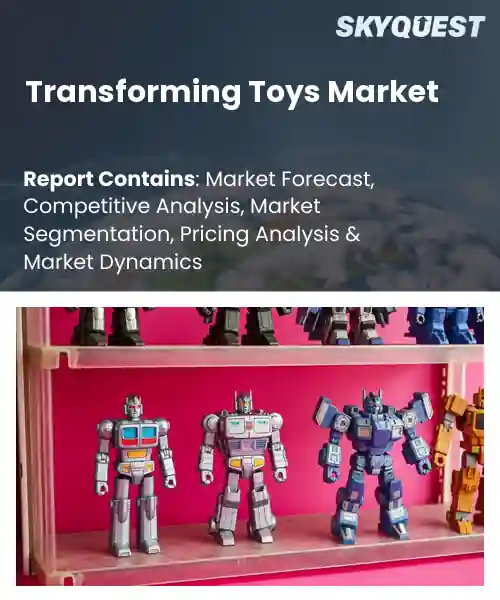
Transforming Toys Market
Report ID: SQMIG25J2348
Report ID: SQMIG25J2348
[email protected]
USA +1 351-333-4748
Report ID:
SQMIG25J2348 |
Region:
Global |
Published Date: August, 2026
Pages:
157
|Tables:
173
|Figures:
79


Global Transforming Toys Market size was valued at USD 2.40 Billion in 2024 and is poised to grow from USD 2.56 Billion in 2025 to USD 4.31 Billion by 2033, growing at a CAGR of 6.7% during the forecast period (2026-2033).
The transforming toys market trends encompasses interactive play systems that blend physical components with digital technology, enabling adaptive experiences that respond to a child’s actions. Its significance lies in reshaping childhood development while opening new revenue streams for manufacturers. Historically the sector emerged from simple electronic puzzles in the 1990s, progressed to motion‑sensing dolls in the early 2010s, and now thrives on AI‑driven platforms such as programmable robots and mixed‑reality kits. This evolution reflects rising consumer appetite for educational value and parental demand for screen‑time moderation, each milestone amplifying demand and prompting investment in research and development across global supply chains.
The principal catalyst accelerating global transforming toys market growth is the convergence of data analytics with modular hardware, which allows manufacturers to personalize play experiences in real time. When child interaction data feeds machine‑learning algorithms, toys adjust difficulty levels, fostering sustained engagement and measurable skill improvement. Companies such as LEGO® Education and Sphero have capitalized on this loop, launching kits that collect performance metrics and deliver cloud‑based lesson plans to schools, thereby unlocking institutional sales channels. Consequently, revenue expands not only through direct consumer purchases but also through subscription services, licensing agreements, and cross‑platform ecosystems that reward continual innovation for future educational ecosystems worldwide.
How are AI and IoT Reshaping the Transforming Toys Market?
AI and IoT are turning traditional transforming toys into interactive companions that learn, react and connect to digital ecosystems. AI brings voice recognition, emotion detection and adaptive storylines, while IoT adds sensors, Bluetooth links and cloud updates that let toys evolve over time. Manufacturers now embed micro processors that capture movement and environmental cues, enabling toys to change shape or behavior based on a child’s actions. This creates personalized play experiences that keep children engaged longer and open pathways for subscription content and cross platform games. The market therefore sees a shift from static collectibles to smart updatable products that blend physical and digital play.
Hasbro March 2024 introduced an AI enabled Transformers line that responds to voice commands and updates its transformation modes via a cloud service, illustrating how the technologies drive deeper engagement and recurring revenue through software upgrades.
Market snapshot - (2026-2033)
Global Market Size
USD 2.4 Billion
Largest Segment
Robot Transforming Toys
Fastest Growth
Character Transforming Toys
Growth Rate
6.7% CAGR
To get more insights on this market click here to Request a Free Sample Report
Global transforming toys market is segmented by product type, material, age group, distribution channel, licensing and region. Based on product type, the market is segmented into vehicle transforming toys, robot transforming toys, character transforming toys and others. Based on material, the market is segmented into plastic, metal and others. Based on age group, the market is segmented into 3–5 years, 6–8 years and above 8 years. Based on distribution channel, the market is segmented into toy stores, hypermarkets, online retail and others. Based on licensing, the market is segmented into licensed and non-licensed. Based on region, the market is segmented into North America, Europe, Asia Pacific, Latin America and Middle East & Africa.
Vehicle transforming toys segment dominates because it captures the imagination of children through dynamic play that combines familiar transportation motifs with the thrill of transformation. The tactile appeal of wheels, doors and moving parts encourages repeated interaction, while the iconic status of cars and trucks aligns with parental nostalgia, driving purchase decisions. This synergy of familiarity and novelty fuels sustained demand across retail channels, reinforcing its leadership in the transforming toys market.
However, robot transforming toys segment is witnessing the strongest growth momentum as advances in articulation and programmable features attract tech savvy families seeking interactive experiences. Integration of simple coding elements and expressive movements expands play value, prompting rapid adoption and opening new avenues for educational positioning, thereby accelerating market expansion.
Plastic segment dominates because it offers versatile molding capabilities that enable intricate transformation mechanisms while keeping costs low for both manufacturers and buyers. Its lightweight nature enhances portability, and the ability to produce vibrant colors aligns with children’s visual preferences. Additionally, modern formulations meet safety standards and allow for recyclable options, which reassure parents and broaden market acceptance, solidifying its leading position in the transforming toys market.
On the other hand, metal segment is emerging as the key high growth area as consumers seek premium tactile experiences and durability that mimic real machinery. Advances in safe alloy coatings and miniaturized moving parts enable sophisticated transformations, attracting collectors and older children. This appeal fuels expanding demand, creating opportunities for upscale product lines and reinforcing market expansion.
To get detailed segments analysis, Request a Free Sample Report
North America leads the global transforming toys market due to a combination of strong consumer demand, advanced manufacturing capabilities, and a highly developed retail ecosystem. The region benefits from a culture that embraces innovative play experiences and a robust infrastructure that supports rapid product development and distribution. Leading brands and technology firms collaborate closely with toy manufacturers, fostering continuous innovation in design, materials, and interactive features. Additionally, the presence of influential media and entertainment franchises drives cross‑platform storytelling that enhances the appeal of transforming toys. Consumer purchasing power and a preference for premium, safety‑tested products further reinforce market leadership, while extensive e‑commerce networks ensure wide accessibility across diverse demographic segments. Regulatory frameworks that prioritize child safety also encourage manufacturers to invest in higher quality standards, reinforcing consumer confidence. Moreover, strong intellectual property protection in the region supports the development of original concepts and licensed collaborations, further driving market dynamism.
Transforming toys market outlook in the United States thrives on a deep integration of entertainment media and cutting‑edge product design, creating a seamless link between popular franchises and interactive play. Consumer enthusiasm for immersive experiences fuels demand for high‑quality, technologically enhanced toys. Robust distribution channels, including both brick‑and‑mortar and digital platforms, ensure broad market reach, while a strong culture of innovation encourages continuous product refresh cycles that keep the segment vibrant.
Transforming toys market forecast in Canada benefits from a consumer base that values safety, educational content, and sustainable materials, prompting manufacturers to prioritize eco‑friendly designs and rigorous testing. Proximity to United States supply chains facilitates efficient logistics and product launches. Collaborative initiatives between local retailers and brands foster tailored offerings that reflect regional preferences, while a growing emphasis on digital engagement enhances the appeal of interactive transforming toys across age groups.
Asia Pacific is experiencing rapid expansion of the transforming toys market driven by a confluence of cultural enthusiasm for innovative play, rising disposable incomes, and a strong tradition of technology integration in consumer products. The region’s vibrant entertainment sectors, particularly in animation and gaming, provide a rich source of intellectual property that fuels demand for character‑based transforming toys. Manufacturers benefit from advanced manufacturing hubs that enable cost‑effective production while maintaining high quality standards. Growing digital connectivity and the proliferation of e‑commerce platforms accelerate market penetration, allowing brands to reach tech‑savvy youth across urban and emerging markets. Additionally, a heightened focus on educational and STEM‑aligned play experiences aligns with parental preferences, further propelling the sector’s momentum. Collaborative efforts between local designers and global toy makers also foster culturally resonant products that deepen consumer engagement.
Transforming toys market regional outlook in Japan is shaped by appreciation for intricate design and storytelling, where iconic anime and manga characters seamlessly transition into transforming toys. Consumers prioritize craftsmanship and innovative mechanisms, prompting manufacturers to invest heavily in precision engineering. Strong retail networks, combined with a e‑commerce landscape, ensure widespread availability. Collaborative ventures between local creators and international brands further enrich the product portfolio, catering to both traditional collectors and audiences.
Transforming toys market regional forecast in South Korea thrives on a culture that blends technology with pop‑culture phenomena, resulting in highly interactive and striking toys. The strong gaming and K‑pop entertainment sectors supply popular characters that are adapted into transforming formats. Consumers value integration of digital features, prompting manufacturers to embed components and reality experiences. Efficient supply chains and a tech‑savvy retail environment accelerate rapid product rollout and broad global market adoption.
Europe is strengthening its position in the transforming toys market through a blend of heritage craftsmanship, innovative design, and a strong emphasis on sustainability. The region’s deep-rooted toy‑making traditions provide a foundation for high‑quality, safety‑focused products that resonate with discerning consumers. Collaborative ecosystems linking designers, engineers, and cultural institutions foster the creation of sophisticated, story‑driven toys that integrate emerging technologies such as interactive electronics and augmented reality. Growing consumer awareness of environmental impact drives manufacturers to adopt eco‑friendly materials and circular‑economy practices, enhancing brand appeal. Robust retail networks, combined with a mature e‑commerce infrastructure, ensure broad distribution across diverse markets. Additionally, supportive regulatory frameworks and intellectual‑property protections encourage investment in original concepts and licensed collaborations, further solidifying Europe’s competitive edge in the global landscape.
Transforming toys market analysis in Germany leverages a reputation for engineering precision and durable design, delivering toys that combine robust mechanics with sophisticated aesthetics. Consumers appreciate the emphasis on safety standards and environmentally responsible production, prompting manufacturers to integrate recyclable materials. Strong collaborations between automotive and toy sectors inspire innovative transformation mechanisms, while a retail network ensures widespread availability. Digital integration, including interactive apps, further enhances the play experience for children.
Transforming toys market penetration in the United Kingdom benefits from a creative industry that fuels imaginative play concepts and storytelling. Consumers value craftsmanship and the integration of educational elements, encouraging manufacturers to embed learning outcomes within transforming designs. Strong retail partnerships and an online marketplace facilitate product diffusion. Growing interest in sustainability drives the adoption of recycled plastics and circular‑economy initiatives, while collaborations with media franchises amplify visibility and consumer engagement.
Transforming toys industry in France is driven by a tradition of design and a focus on cultural relevance, resulting in toys that blend aesthetic appeal with functionality. Consumers appreciate the integration of fashion and storytelling, prompting manufacturers to collaborate with designers and entertainment studios. A retail landscape and e‑commerce platforms ensure market coverage. Environmental consciousness leads to the use of biodegradable materials and circular‑production models, enhancing brand perception among families.
To know more about the market opportunities by region and country, click here to
Buy The Complete Report
Growing Demand For Interactive Play
Adopting Sustainable Materials In Toys
Regulatory Compliance Challenges
High Production Costs For Advanced Features
Request Free Customization of this report to help us to meet your business objectives.
The global transforming toys market is highly competitive, with established toy manufacturers, collectible brands, entertainment companies, and emerging specialty players competing through character licensing, product innovation, transforming mechanisms, collectibility, digital integration, and franchise-based consumer engagement. Major participants include Hasbro, Mattel, Bandai Namco, Takara Tomy, Spin Master, LEGO Group, Jazwares, Playmates Toys, MGA Entertainment, Super7, Threezero, Blokees, Flame Toys, ZURU, McFarlane Toys, Good Smile Company, Kotobukiya, and Funko. Hasbro maintains a strong position through its Transformers franchise and broad entertainment portfolio, while Takara Tomy and Bandai Namco leverage established Japanese character and collectible franchises. Mattel and Spin Master compete through extensive global toy portfolios and licensed entertainment properties, whereas LEGO differentiates through construction-based play and increasingly sophisticated physical-digital experiences.
Emerging and specialist brands such as Blokees, Flame Toys, Threezero, and Super7 strengthen competition in the collectible and premium transforming-toy segments. Competitive differentiation is increasingly centered on transformation complexity, design quality, durability, character licensing, collectible appeal, age-specific functionality, and integration of digital or interactive features. Companies are also expanding through new entertainment partnerships, franchise extensions, direct-to-consumer channels, and limited-edition products to strengthen consumer engagement and capture demand across both children's and adult collectible markets.
Top Player’s Company Profile
Recent Developments in the Transforming Toys Market
SkyQuest’s ABIRAW (Advanced Business Intelligence, Research & Analysis Wing) is our Business Information Services team that Collects, Collates, Correlates, and Analyses the Data collected by means of Primary Exploratory Research backed by robust Secondary Desk research. As per SkyQuest analysis the global transforming toys market is driven primarily by the rising demand for interactive play that blends physical toys with AI and IoT features, which creates personalized experiences and recurring revenue. A secondary driver is the industry’s shift toward sustainable materials such as recycled plastics, appealing to environmentally‑conscious parents and supporting premium pricing. The vehicle‑transforming segment remains the dominant share because its familiar transportation themes and tactile transformation mechanics resonate strongly with children and nostalgic adults. North America leads the market thanks to strong consumer purchasing power, advanced manufacturing, and a mature retail ecosystem, while high production costs for advanced electronics act as a notable restraint.
| Report Metric | Details |
|---|---|
| Market size value in 2024 | USD 2.4 Billion |
| Market size value in 2033 | USD 4.31 Billion |
| Growth Rate | 6.7% |
| Base year | 2024 |
| Forecast period | (2026-2033) |
| Forecast Unit (Value) | USD Billion |
| Segments covered |
|
| Regions covered | North America (US, Canada), Europe (Germany, France, United Kingdom, Italy, Spain, Rest of Europe), Asia Pacific (China, India, Japan, Rest of Asia-Pacific), Latin America (Brazil, Rest of Latin America), Middle East & Africa (South Africa, GCC Countries, Rest of MEA) |
| Companies covered |
|
| Customization scope | Free report customization with purchase. Customization includes:-
|
To get a free trial access to our platform which is a one stop solution for all your data requirements for quicker decision making. This platform allows you to compare markets, competitors who are prominent in the market, and mega trends that are influencing the dynamics in the market. Also, get access to detailed SkyQuest exclusive matrix.
Table Of Content
Executive Summary
Market overview
Parent Market Analysis
Market overview
Market size
KEY MARKET INSIGHTS
COVID IMPACT
MARKET DYNAMICS & OUTLOOK
Market Size by Region
KEY COMPANY PROFILES
Methodology
For the Transforming Toys Market, our research methodology involved a mixture of primary and secondary data sources. Key steps involved in the research process are listed below:
1. Information Procurement: This stage involved the procurement of Market data or related information via primary and secondary sources. The various secondary sources used included various company websites, annual reports, trade databases, and paid databases such as Hoover's, Bloomberg Business, Factiva, and Avention. Our team did 45 primary interactions Globally which included several stakeholders such as manufacturers, customers, key opinion leaders, etc. Overall, information procurement was one of the most extensive stages in our research process.
2. Information Analysis: This step involved triangulation of data through bottom-up and top-down approaches to estimate and validate the total size and future estimate of the Transforming Toys Market.
3. Report Formulation: The final step entailed the placement of data points in appropriate Market spaces in an attempt to deduce viable conclusions.
4. Validation & Publishing: Validation is the most important step in the process. Validation & re-validation via an intricately designed process helped us finalize data points to be used for final calculations. The final Market estimates and forecasts were then aligned and sent to our panel of industry experts for validation of data. Once the validation was done the report was sent to our Quality Assurance team to ensure adherence to style guides, consistency & design.
Analyst Support
Customization Options
With the given market data, our dedicated team of analysts can offer you the following customization options are available for the Transforming Toys Market:
Product Analysis: Product matrix, which offers a detailed comparison of the product portfolio of companies.
Regional Analysis: Further analysis of the Transforming Toys Market for additional countries.
Competitive Analysis: Detailed analysis and profiling of additional Market players & comparative analysis of competitive products.
Go to Market Strategy: Find the high-growth channels to invest your marketing efforts and increase your customer base.
Innovation Mapping: Identify racial solutions and innovation, connected to deep ecosystems of innovators, start-ups, academics, and strategic partners.
Category Intelligence: Customized intelligence that is relevant to their supply Markets will enable them to make smarter sourcing decisions and improve their category management.
Public Company Transcript Analysis: To improve the investment performance by generating new alpha and making better-informed decisions.
Social Media Listening: To analyze the conversations and trends happening not just around your brand, but around your industry as a whole, and use those insights to make better Marketing decisions.
REQUEST FOR SAMPLE
 REQUEST FREE CUSTOMIZATION
Global Transforming Toys Market size was valued at USD 2.4 Billion in 2024 and is poised to grow from USD 2.56 Billion in 2025 to USD 4.31 Billion by 2033, growing at a CAGR of 6.7% during the forecast period (2026-2033).
The competitive landscape of the global transforming toys market is shaped by intense rivalry among established manufacturers and emerging innovators, with market drivers such as rapid technology integration and consumer demand for interactive experiences intensifying competition; recent strategic moves include Hasbro’s acquisition of Entertainment One in 2023 to expand its digital content pipeline, Mattel’s partnership with Nickelodeon to co‑develop smart play experiences, and LEGO’s investment in augmented‑reality platforms to enhance physical‑digital hybrid play, underscoring a focus on M&A, strategic alliances, and tech‑driven product innovation. 'Hasbro, Inc.', 'Mattel, Inc.', 'Bandai Namco Holdings Inc.', 'Takara Tomy Co., Ltd.', 'Spin Master Corp.', 'LEGO Group', 'Jazwares, LLC', 'Playmates Toys Ltd.', 'MGA Entertainment, Inc.', 'Super7', 'Threezero', 'Blokees', 'Flame Toys', 'Robo Alive (ZURU)', 'ZURU Group', 'Tomy Company, Ltd.', 'McFarlane Toys', 'Good Smile Company', 'Kotobukiya Co., Ltd.', 'Funko, Inc.'
Consumers are increasingly seeking toys that blend physical interaction with digital feedback, encouraging deeper engagement and learning. This preference fuels manufacturers to integrate sensors, connectivity, and adaptive software, which transforms simple play into immersive experiences. By delivering personalized content and real‑time responsiveness, such toys enhance perceived value, prompting parents to invest more heavily in innovative products. Retailers also increase shelf visibility, amplifying consumer exposure.
Ai‑Driven Interactive Play: Manufacturers are embedding generative AI engines into toys to enable real‑time dialogue, adaptive storylines, and personalized learning experiences. These smart companions interpret child speech, adjust difficulty, and suggest new activities, creating a seamless blend of entertainment and education. The shift enhances brand loyalty as children form lasting emotional bonds with responsive characters, while parents appreciate the developmental value. As AI algorithms become more efficient, the cost barrier lowers, prompting broader adoption across mass‑market product lines for global retailers worldwide today.
Why does North America Dominate the Global Transforming Toys Market? |@12


Want to customize this report? This report can be personalized according to your needs. Our analysts and industry experts will work directly with you to understand your requirements and provide you with customized data in a short amount of time. We offer $1000 worth of FREE customization at the time of purchase.
Feedback From Our Clients


 USA (+1) 351-333-4748

