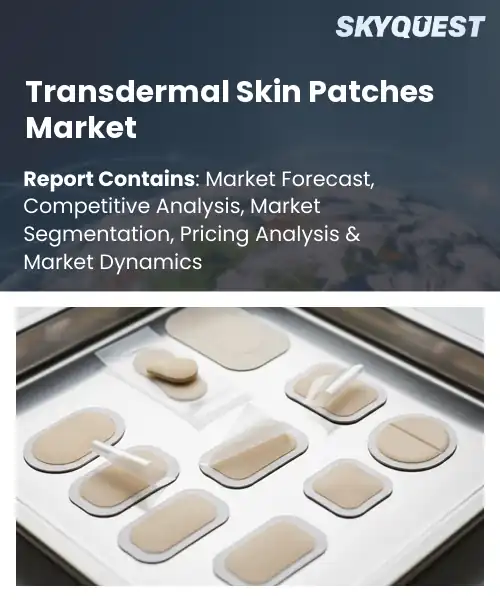
Transdermal Skin Patches Market
Report ID: SQMIG35I3101
Report ID: SQMIG35I3101
[email protected]
USA +1 351-333-4748
Report ID:
SQMIG35I3101 |
Region:
Global |
Published Date: July, 2026
Pages:
157
|Tables:
176
|Figures:
79


Global Transdermal Skin Patches Market size was valued at USD 8.87 Billion in 2024 and is poised to grow from USD 9.38 Billion in 2025 to USD 14.74 Billion by 2033, growing at a CAGR of 5.8% during the forecast period (2026-2033).
The global transdermal skin patches market includes pharmaceutical and cosmetic products that deliver active ingredients through the skin into systemic circulation. The significance is due to its ability to ensure accurate dosing, enhance compliance with therapy, and mitigate adverse gastrointestinal effects associated with traditional oral medications. The emergence of the patch technology can be traced back to the 70s when patches for nicotine addiction were introduced, which was afterwards advanced to analgesics and various drugs in general. Innovations in the form of new delivery systems have resulted in more sophisticated patch designs, which are supported by favorable regulatory conditions. Consequently, the industry has finally become a considerable force in the healthcare market because of a proliferation in chronic disease cases and the rise of consumer demand for non-invasive formulation.
One key factor accelerating market expansion is the rising prevalence of chronic conditions that require drug exposure, such as diabetes, pain syndromes, and hormone deficiencies. Clinicians strive to lower dosing frequency, so transdermal patches reduce clinic visits and adherence costs, prompting insurer reimbursement incentives. Real‑world adoption illustrates this effect: insulin‑mimetic patches in European trials cut hypoglycemia episodes by 30 % versus injections, while fentanyl patches dominate cancer pain control in North America. These results spur investment in advanced adhesives and polymer matrices, enabling manufacturers to launch combination patches that deliver multiple agents, opening revenue streams and reinforcing the market’s upward trajectory.
How is AI Enhancing Drug Delivery Efficiency in the Transdermal Skin Patch Market?
AI has changed the development of transdermal drug delivery system by applying data driven approaches, instantaneous monitoring process and flexible manufacturing system. Machine learning can help predict skin permeability and design the best drug-polymer combination, which will significantly decrease the number of trials needed to find a proper patch. Using the technology of AI in imaging promotes accurate placement of microneedles, which increases the level of absorption but reduces irritation. The techniques of predictive analytics allow to make adjustments to the coating process in order to keep drug amount in any batch constant and diminish any divergence between product batches. The use of smart patches will help to deliver data about therapy compliance to the cloud where the algorithms will be able to fit dosing regimens for particular patients.
In June 2026, Sempulse expanded its AI-powered Life Analytics AI platform, enhancing predictive health monitoring through wearable skin-mounted sensor patches. The upgraded system improves real-time analysis of patient vital signs, enabling earlier clinical intervention and demonstrating how AI-integrated skin patch technologies are advancing remote patient monitoring and personalized healthcare solutions.
Market snapshot - (2026-2033)
Global Market Size
USD 8.87 Billion
Largest Segment
Drug Delivery Patches
Fastest Growth
Others
Growth Rate
5.8% CAGR
To get more insights on this market click here to Request a Free Sample Report
Global transdermal skin patches market is segmented by product type, technology, application, end user, distribution channel, patient group and region. Based on product type, the market is segmented into drug delivery patches, pain relief patches, nicotine patches and others. Based on technology, the market is segmented into matrix patches, reservoir patches, drug-in-adhesive patches and others. Based on application, the market is segmented into pain management, hormone therapy, smoking cessation and others. Based on end user, the market is segmented into hospitals, homecare, specialty clinics and others. Based on distribution channel, the market is segmented into hospital pharmacies, retail pharmacies, online pharmacies and others. Based on patient group, the market is segmented into adult patients, pediatric patients and geriatric patients. Based on region, the market is segmented into North America, Europe, Asia Pacific, Latin America and Middle East & Africa.
Drug delivery patches segment dominates because they provide a versatile platform for systemic medication administration, enabling precise dosing, reduced gastrointestinal side‑effects, and improved patient compliance. This innovation meets the expectations of medical practitioners with respect to non-invasive solutions and leads to its extensive implementation in chronic disease management, cardiac therapy as well as hormonal drug delivery. Manufacturers are therefore inclined to invest heavily in R&D and industrialization of these products in order to ensure their position in the market and achieve further growth of the transdermal delivery patches industry in the foreseeable future.
However, nicotine patches segment experiences rapid growth because smoking cessation initiatives and heightened consumer awareness drive demand for discreet and convenient nicotine delivery. Innovative adhesive technologies improve skin tolerance, while regulatory support for over‑the‑counter access expands market penetration. This momentum fuels broader product pipelines, unlocking new revenue streams for manufacturers.
Matrix patches segment leads because they integrate the drug uniformly within a polymeric matrix, providing sustained release without complex manufacturing steps. By simplifying production, the end-to-end process can increase scalability, reduce costs, and ensure consistent product quality in line with the raise requirements of the OEMs in order to achieve optimal delivery systems according to the distribution networks of the adhesive patches producers. Hence, the patches are seen as advantageous in terms of the accessibility and attractiveness of the methods of pain and hormone therapies that drive the evolution and the realization of new solutions in formulation improvement and compliance with necessary regulations worldwide and beyond.
Meanwhile, drug-in-adhesive patches segment is witnessing growth because adhesive matrices enable drug loading and thinner designs, expanding application possibilities. Their ability to combine delivery and adhesion eliminates layers, simplifying manufacturing and reducing skin irritation. Rising demand for discreet wearable therapeutics fuels product pipeline development, positioning these patches as a growth engine.
To get detailed segments analysis, Request a Free Sample Report
North America leads due to advanced healthcare infrastructure, strong regulatory framework that accelerates product approvals, and robust R&D ecosystems centered around major pharmaceutical hubs. The cooperation between academic institutions and industry pushes forward the new ways of patch formulation aimed at chronic illnesses. High market acceptance of the self-administered therapies as well as the wide coverage from the insurance companies enable to increase the market share. The established production capacity is able to guarantee the provision of high-quality products in the most effective manner taking into account the efficiency of supply chain. The presence of investments from venture capital firms and big international companies continues to foster the development of the pipeline, allowing the region to remain a leader in the transdermal technologies. Innovation incubators accelerate the process of implementation of novel adhesive technologies and the collaboration with European centers enables to strengthen knowledge transfer.
United States Transdermal Skin Patches Market
Transdermal skin patches market in United States benefits from a mature ecosystem of pharmaceutical innovators and a network of clinical research organizations. Strong intellectual property protections encourage investment in adhesive chemistries and drug reservoirs. Broad reimbursement policies across insurers enable widespread patient access, while consumer preference for convenient needle‑free delivery fuels demand across therapeutic categories. Continued collaboration between biotech startups and established manufacturers sustains pipeline vitality and market expansion.
Canada Transdermal Skin Patches Market
Transdermal skin patches market in Canada leverages a healthcare framework that integrates provincial reimbursement programs with national regulatory alignment. The care element is critical in the popularity of simple application patches for chronic pain and hormone therapy. Research facilities dealing with polymer science have made contributions to patch bonding and drug delivery improvements. Joint ventures between domestic biotechs and multinationals have paid dividends thereby enriching the local offering while maintaining traction in the market.
Europe’s rapid expansion stems from a confluence of progressive regulatory pathways, strong clinical research networks, and heightened focus on patient convenience within integrated healthcare systems. The standardization of regulations in member countries makes the process of product approval easier which improves on the efficiency of launching international products. Solid financial support for translation research helps pes facilitate partnerships between biomedical institutions, biotech startups, and pharmaceutical companies to create advanced adhesive techniques and new methods of drug delivery. The growing public awareness about needle-free procedures and reimbursement systems pro bono treatments will result in greater penetration of noninjections therapies into the market. Moreover, ecological consciousness promotes the constructive development of eco-sustainable manufacturing materials which fits into the trend of developing patches. All health operators understand the importance of applying of such innovations in combination with traditional treatments to improve compliance and decrease the burden on the infusion system.
Germany Transdermal Skin Patches Market
Transdermal skin patches market in Germany is propelled by a strong engineering tradition and clinical trial infrastructure that accelerates technology validation. Close collaboration between pharmaceutical giants and specialized polymer research institutes yields high‑performance adhesive systems. Reimbursement schemes that reward innovative, patient‑friendly solutions encourage early adoption across cardiovascular and hormonal therapy segments. Government incentives for sustainability further stimulate development of biodegradable patch materials, reinforcing Germany’s position as a dominant European hub.
United Kingdom Transdermal Skin Patches Market
Transdermal skin patches market in United Kingdom experiences growth driven by a regulatory environment that offers accelerated pathways for delivery systems. The healthcare integration supported by NHS networks and biotechnology firms contributes to clinical practices and data acquiring. Investment in the healthcare integration makes it possible to follow up the adherence to the treatment and thus improves the therapy effectiveness. The research centres, which develop new materials for bio-compatible adhesives, attract partners and have made the UK one of the most progressive figures in the field of medicine and health.
France Transdermal Skin Patches Market
Transdermal skin patches market in France is emerging as manufacturers capitalize on reimbursement policies and a preference for treatments. Initiatives between university laboratories and biotech firms drive exploration of polymer matrices that improve skin permeability. Adoption by dermatology and pain‑management clinics creates proof points for broader therapeutic applications. Green manufacturing incentives by governments push ahead to drive developments in respect of recyclable patch substrates, putting France within in the pipeline of centers for innovative transdermal technologies.
The Asia Pacific region is strengthening its position through a blend of expanding healthcare access, rising acceptance of non‑invasive drug delivery, and targeted governmental support for innovative medical technologies. Moreover, national health policies that drive cost-effective therapies support the development of patches for the management of chronic illness and the reduction of dependency on injections. Similarly, booming biotech hubs need to focus on the development of new adhesive platforms and smaller drug reservoirs while working together with global pharmaceutical firms to transfer their technology. Consumers show greater preference for products that are easy to use and administer. Furthermore, investments into modern manufacturing capabilities and infrastructure will result in effective production of high-quality products and proper commercialization of transdermal delivery systems. Regulatory agencies across the region are harmonizing guidelines to facilitate cross‑border clinical studies, enhancing the speed at which products reach multiple markets. Growing intellectual property frameworks also provide confidence for investors seeking long‑term returns in patch technology.
Japan Transdermal Skin Patches Market
Transdermal skin patches market in Japan benefits from a community that prioritizes therapeutics and patient adherence. Strong collaboration between leading pharmaceutical companies and research universities drives advancement of micro‑structured adhesive technologies. Government insurance plans providing subsidy related to delivery modes contribute towards the growing adoption rates in healthcare implementations. There is a growing interest in terms of sustainable and biocompatible materials, which is consistent with national strategies.
South Korea Transdermal Skin Patches Market
Transdermal skin patches market in South Korea is propelled by a sector and incentives that prioritize drug delivery platforms. Close ties between academic research institutes and pharmaceutical manufacturers accelerate development of adhesive matrices and patch technologies with sensors. Reimbursement policies with a focus on home therapies promote use of such therapies for chronic disease management. Plus, investment in manufacturing enables further investigation into recyclable materials, making South Korea a leader in transdermal patches.
To know more about the market opportunities by region and country, click here to
Buy The Complete Report
Increasing Acceptance Of Transdermal Therapy
Advancements In Patch Manufacturing Technology
Stringent Regulatory Approval Pathways
Limited Skin Permeability For Certain Drugs
Request Free Customization of this report to help us to meet your business objectives.
The transdermal skin patches market is shaped by intense competition among established pharmaceutical firms and emerging innovators, driving accelerated product pipelines and strategic collaborations. Organizations are taking merger actions to achieve greater portfolio widths, as observed in various recent consolidation actions. Furthermore, partnerships with biotechnology companies facilitate the speedy introduction of new drug candidates in patches. There are numerous technological advancements in areas such as advanced polymer matrices and micro-needling systems that allow firms investing in research and development and partnerships in other fields to be ahead of others.
Top Player’s Company Profile
Recent Developments
SkyQuest’s ABIRAW (Advanced Business Intelligence, Research & Analysis Wing) is our Business Information Services team that Collects, Collates, Correlates, and Analyses the Data collected by means of Primary Exploratory Research backed by robust Secondary Desk research.
As per SkyQuest analysis the global transdermal skin patches industry is driven first by the rising acceptance of transdermal therapy which boosts patient adherence and encourages insurers to reimburse patch treatments; a second strong driver is rapid advances in manufacturing technology that enable precise drug release, thinner designs and faster scale‑up, widening therapeutic options. The drug delivery patches segment leads the market because it offers versatile systemic dosing and minimal side effects, while North America dominates thanks to its advanced healthcare infrastructure and robust R&D ecosystem. However, stringent regulatory approval pathways remain a restraint that can delay product launches and increase costs.
| Report Metric | Details |
|---|---|
| Market size value in 2024 | USD 8.87 Billion |
| Market size value in 2033 | USD 14.74 Billion |
| Growth Rate | 5.8% |
| Base year | 2024 |
| Forecast period | (2026-2033) |
| Forecast Unit (Value) | USD Billion |
| Segments covered |
|
| Regions covered | North America (US, Canada), Europe (Germany, France, United Kingdom, Italy, Spain, Rest of Europe), Asia Pacific (China, India, Japan, Rest of Asia-Pacific), Latin America (Brazil, Rest of Latin America), Middle East & Africa (South Africa, GCC Countries, Rest of MEA) |
| Companies covered |
|
| Customization scope | Free report customization with purchase. Customization includes:-
|
To get a free trial access to our platform which is a one stop solution for all your data requirements for quicker decision making. This platform allows you to compare markets, competitors who are prominent in the market, and mega trends that are influencing the dynamics in the market. Also, get access to detailed SkyQuest exclusive matrix.
Table Of Content
Executive Summary
Market overview
Parent Market Analysis
Market overview
Market size
KEY MARKET INSIGHTS
COVID IMPACT
MARKET DYNAMICS & OUTLOOK
Market Size by Region
KEY COMPANY PROFILES
Methodology
For the Transdermal Skin Patches Market, our research methodology involved a mixture of primary and secondary data sources. Key steps involved in the research process are listed below:
1. Information Procurement: This stage involved the procurement of Market data or related information via primary and secondary sources. The various secondary sources used included various company websites, annual reports, trade databases, and paid databases such as Hoover's, Bloomberg Business, Factiva, and Avention. Our team did 45 primary interactions Globally which included several stakeholders such as manufacturers, customers, key opinion leaders, etc. Overall, information procurement was one of the most extensive stages in our research process.
2. Information Analysis: This step involved triangulation of data through bottom-up and top-down approaches to estimate and validate the total size and future estimate of the Transdermal Skin Patches Market.
3. Report Formulation: The final step entailed the placement of data points in appropriate Market spaces in an attempt to deduce viable conclusions.
4. Validation & Publishing: Validation is the most important step in the process. Validation & re-validation via an intricately designed process helped us finalize data points to be used for final calculations. The final Market estimates and forecasts were then aligned and sent to our panel of industry experts for validation of data. Once the validation was done the report was sent to our Quality Assurance team to ensure adherence to style guides, consistency & design.
Analyst Support
Customization Options
With the given market data, our dedicated team of analysts can offer you the following customization options are available for the Transdermal Skin Patches Market:
Product Analysis: Product matrix, which offers a detailed comparison of the product portfolio of companies.
Regional Analysis: Further analysis of the Transdermal Skin Patches Market for additional countries.
Competitive Analysis: Detailed analysis and profiling of additional Market players & comparative analysis of competitive products.
Go to Market Strategy: Find the high-growth channels to invest your marketing efforts and increase your customer base.
Innovation Mapping: Identify racial solutions and innovation, connected to deep ecosystems of innovators, start-ups, academics, and strategic partners.
Category Intelligence: Customized intelligence that is relevant to their supply Markets will enable them to make smarter sourcing decisions and improve their category management.
Public Company Transcript Analysis: To improve the investment performance by generating new alpha and making better-informed decisions.
Social Media Listening: To analyze the conversations and trends happening not just around your brand, but around your industry as a whole, and use those insights to make better Marketing decisions.
REQUEST FOR SAMPLE
 REQUEST FREE CUSTOMIZATION
Global Transdermal Skin Patches Market size was valued at USD 8.87 Billion in 2024 and is poised to grow from USD 9.38 Billion in 2025 to USD 14.74 Billion by 2033, growing at a CAGR of 5.8% during the forecast period (2026-2033).
The transdermal skin patches market is shaped by intense competition among established pharmaceutical firms and emerging innovators, driving accelerated product pipelines and strategic collaborations. Companies are pursuing mergers to broaden portfolio breadth, such as recent consolidation moves highlighted in industry analyses, while partnerships with biotech firms enable rapid integration of novel drug candidates into patch formats. Technological innovation is evident in the adoption of advanced polymer matrices and micro‑needling delivery systems, positioning firms that invest in R&D and cross‑sector alliances ahead of peers. 'Johnson & Johnson', 'Novartis AG', 'Teva Pharmaceutical Industries Ltd.', 'Mylan N.V.', 'Hisamitsu Pharmaceutical Co., Inc.', 'Luye Pharma Group Ltd.', 'Viatris Inc.', 'Teikoku Pharma USA, Inc.', 'Nitto Denko Corporation', 'LTS Lohmann Therapie-Systeme AG', 'Tapemark Company', 'Corium, Inc.', 'Kindeva Drug Delivery L.P.', 'Mylan Technologies Inc.', 'Perrigo Company plc', 'Pfizer Inc.', 'Sanofi S.A.', 'Bayer AG', 'Zydus Lifesciences Limited', 'Luye Pharma AG'
Patients and clinicians are embracing transdermal patches because they provide continuous drug delivery, reduce dosing frequency, and minimize invasive procedures, which together improve adherence and quality of life. This acceptance encourages pharmaceutical companies to prioritize patch formulations, leading to broader product pipelines and heightened market visibility. The perception of enhanced safety and convenience also fuels word‑of‑mouth promotion, further expanding the user base across chronic and acute therapeutic areas, thereby driving overall market growth. Additionally, insurers are more willing to reimburse due to perceived cost efficiency.
Personalized Therapeutics Expansion: Manufacturers are shifting toward skin patches that can be tailored to individual genetic profiles, disease severity, and lifestyle factors. Advances in microfabrication and bioinformatics enable precise dosing and controlled release, allowing clinicians to prescribe patches that match patient-specific pharmacokinetic requirements. This personalization reduces adverse events, improves adherence, and opens new revenue streams as healthcare systems prioritize outcomes‑based reimbursement models, driving broader acceptance of customized transdermal platforms across chronic pain, hormone replacement, and neurological disorder therapies in the global market today.
Why does North America Dominate the Global Transdermal Skin Patches Market? |@12


Want to customize this report? This report can be personalized according to your needs. Our analysts and industry experts will work directly with you to understand your requirements and provide you with customized data in a short amount of time. We offer $1000 worth of FREE customization at the time of purchase.
Feedback From Our Clients


 USA (+1) 351-333-4748

