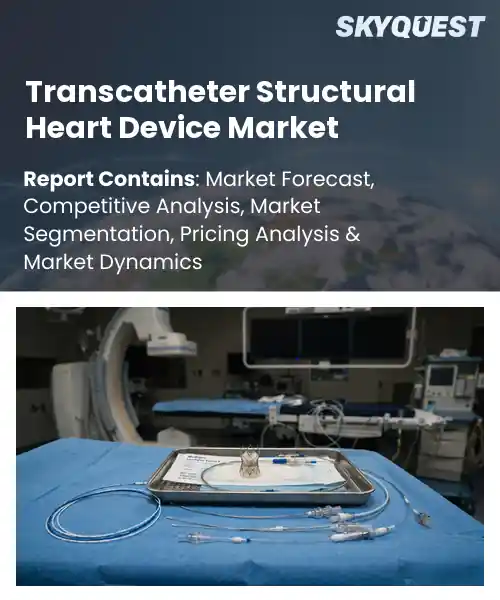
Transcatheter Structural Heart Device Market
Report ID: SQMIG35A4488
Report ID: SQMIG35A4488
[email protected]
USA +1 351-333-4748
Report ID:
SQMIG35A4488 |
Region:
Global |
Published Date: September, 2026
Pages:
157
|Tables:
126
|Figures:
77


Global Transcatheter Structural Heart Device Market size was valued at USD 22.31 Billion in 2024 and is poised to grow from USD 23.83 Billion in 2025 to USD 40.34 Billion by 2033, growing at a CAGR of 6.8% during the forecast period (2026-2033).
Reimbursement policies drive market growth because they turn clinical outcomes into revenue streams for providers. After several European nations added coverage for transcatheter aortic valve replacement in 2016, procedure volumes rose by 28 percent within two years, showing how certainty spurs adoption. Simultaneously, improvements in imaging and catheter design have reduced complication rates, reinforcing payer confidence and prompting inclusion of mitral and tricuspid devices in formularies. Manufacturers now focus on platforms that embed navigation, a move that lowers cost and opens opportunities in emerging markets where constraints dominate. This alignment of technology, financing, and demand creates an engine for expansion.
How is AI improving patient selection and outcomes in the transcatheter structural heart device market?
AI enhances patient selection for transcatheter structural heart devices by integrating imaging analytics, electronic health records, and predictive modeling. It identifies anatomical suitability, risk factors, and procedural complexity, allowing clinicians to match patients with the most appropriate valve type and size. Real‑time AI‑driven dashboards streamline multidisciplinary heart‑team discussions, reducing uncertainty and shortening evaluation timelines. By flagging high‑risk profiles early, AI helps prioritize patients who will benefit most, while steering low‑benefit cases toward alternative therapies. This precision approach improves procedural success, shortens hospital stays, and supports a more efficient allocation of resources across a rapidly expanding market.No publicly announced recent development with a specific company name and month/year is currently documented, but ongoing AI integration continues to refine patient selection and outcomes, reinforcing growth and efficiency in the transcatheter structural heart device market.
Market snapshot - (2026-2033)
Global Market Size
USD 22.31 Billion
Largest Segment
Transcatheter Aortic Valve Replacement Devices
Fastest Growth
Transcatheter Mitral Valve Repair Devices
Growth Rate
6.8% CAGR
To get more insights on this market click here to Request a Free Sample Report
Global transcatheter structural heart device market is segmented by device type, indication, procedure, end user and region. Based on device type, the market is segmented into Transcatheter Aortic Valve Replacement Devices, Transcatheter Mitral Valve Replacement Devices, Transcatheter Mitral Valve Repair Devices, Transcatheter Tricuspid Valve Repair Devices, Transcatheter Tricuspid Valve Replacement Devices, Left Atrial Appendage Closure Devices and Others. Based on indication, the market is segmented into Aortic Valve Disease, Mitral Valve Disease, Tricuspid Valve Disease, Left Atrial Appendage Closure and Others. Based on procedure, the market is segmented into Transfemoral, Transapical, Transseptal, Transjugular and Other Access Routes. Based on end user, the market is segmented into Hospitals, Cardiac Centers, Specialty Clinics and Others. Based on region, the market is segmented into North America, Europe, Asia Pacific, Latin America and Middle East & Africa.
Transcatheter aortic valve replacement devices segment dominates because they address the most prevalent valve pathology and have matured clinically, establishing robust evidence of safety and long term outcomes. Their wide physician familiarity, established reimbursement pathways, and comprehensive product portfolios reduce procedural uncertainty, encouraging hospitals to prioritize these systems. Consequently, they generate the highest procedural volumes and attract the majority of investment, reinforcing their leadership in the global market today across regions.
However, transcatheter mitral valve repair devices emerge as an expanding area because innovative clip technologies enable less invasive treatment of a growing patient pool with functional mitral regurgitation. Ongoing trials, indications, and favorable reimbursement incentives accelerate adoption, positioning this category as a catalyst for broader market growth and therapeutic pathways.
Transfemoral access route segment dominates because it offers the least invasive trajectory, aligning with clinical preferences for reduced recovery time and procedural comfort. The well established vascular closure devices and operator familiarity streamline case workflow, while robust data supporting safety encourage widespread adoption across cardiac programs. Consequently, hospitals prioritize transfemoral platforms, consolidating its leading position within procedural choices for transcatheter structural interventions. Its compatibility with diverse device families also reinforces its appeal.
Meanwhile, transseptal access route emerges as an expanding area because it enables interventions on mitral and tricuspid structures without thoracic incisions. Advances in sheath technology and imaging guidance reduce procedural risk, attracting operators seeking less traumatic alternatives. This growth fuels market penetration and stimulates innovation across designs tailored for septal delivery.
To get detailed segments analysis, Request a Free Sample Report
North America retains dominance through a convergence of advanced clinical expertise, robust reimbursement frameworks, and a deep ecosystem of innovative manufacturers. A mature regulatory environment accelerates product introduction while established academic centers drive procedural proficiency and research collaboration. Patient awareness and acceptance are high, encouraging adoption across diverse care settings. The region also benefits from strong partnerships between device developers and leading health‑system operators, fostering iterative improvements and early access to next‑generation technologies. This combination of clinical, financial, and operational strengths creates a resilient market foundation that continues to set the benchmark for global practice.
Transcatheter Structural Heart Device Market in the United States is shaped by a network of leading research hospitals that generate extensive procedural experience and drive evidence‑based guidelines. Payers provide comprehensive coverage pathways that support broad patient access, while a competitive manufacturer landscape fuels continuous product refinement. Clinician education programs and multidisciplinary heart teams further enhance procedural confidence, positioning the United States as a pivotal hub for innovation diffusion.
Transcatheter Structural Heart Device Market in Canada benefits from a publicly funded health system that emphasizes equitable access and cost‑effectiveness. Provincial health authorities collaborate closely with academic institutions to align clinical pathways and accelerate technology adoption. A strong emphasis on outcome monitoring and post‑market surveillance reinforces confidence among clinicians and patients alike. These systemic attributes, coupled with strategic partnerships with global manufacturers, sustain Canada’s influential role within the North American market.
Europe’s rapid expansion is propelled by harmonized regulatory standards that streamline cross‑border device approval and encourage pan‑regional trials. Strong governmental health initiatives prioritize minimally invasive solutions, fostering reimbursement models that support adoption in both established and emerging cardiac centers. Collaborative networks among leading universities and industry accelerate knowledge sharing and facilitate swift integration of novel technologies. Patient‑focused care pathways and increasing awareness of procedural benefits further stimulate demand. Collectively, these factors create a fertile environment for continuous growth and position Europe as a dynamic arena for market development.
Transcatheter Structural Heart Device Market in Germany is anchored by a highly organized hospital network and rigorous clinical guidelines that promote procedural consistency. A mature reimbursement system aligns incentives for hospitals and providers, encouraging investment in state‑of‑the‑art equipment. Interdisciplinary heart teams and strong academic research institutions drive continuous refinement of techniques, reinforcing Germany’s status as a dominant market within Europe.
Transcatheter Structural Heart Device Market in the United Kingdom experiences swift expansion through proactive health‑policy frameworks that prioritize innovative cardiac care. National health services support dedicated cardiac centres equipped with cutting‑edge technology, while collaborative registries enhance data‑driven decision making. Educational initiatives and specialist training programs accelerate clinician proficiency, positioning the United Kingdom as a leading growth engine in the region.
Transcatheter Structural Heart Device Market in France is emerging alongside strategic public‑private partnerships that foster technology transfer and clinical adoption. Health authorities emphasize value‑based care, encouraging the integration of minimally invasive options within tertiary hospitals. A strong tradition of cardiology research and patient advocacy contributes to heightened awareness, supporting steady market momentum.
Asia Pacific is strengthening its position by investing heavily in clinical infrastructure and developing localized manufacturing capabilities that reduce reliance on imports. Government health agendas increasingly endorse minimally invasive procedures, aligning policy with the need for cost‑effective solutions. Regional professional societies promote standardized training and certification, elevating procedural expertise across diverse markets. Growing patient demand for less invasive treatments, coupled with expanding insurance coverage, drives broader acceptance. Collaborative research initiatives among leading hospitals, academia, and device firms accelerate adaptation of global innovations to local clinical practice, enhancing the region’s overall market relevance.
Transcatheter Structural Heart Device Market in Japan benefits from a sophisticated health‑care system that integrates advanced imaging and catheter technologies within high‑volume cardiac centres. National health insurance provides structured reimbursement pathways, encouraging widespread adoption. Strong collaboration between academic hospitals and industry partners fosters rapid translation of clinical research into practice, reinforcing Japan’s leadership in procedural excellence.
Transcatheter Structural Heart Device Market in South Korea is propelled by aggressive government support for medical technology development and a network of specialized cardiac institutes. Reimbursement policies are evolving to accommodate innovative therapies, while focused training programmes increase operator confidence. Domestic manufacturers are scaling production capabilities, positioning South Korea as both a significant consumer and emerging contributor to the global market.
To know more about the market opportunities by region and country, click here to
Buy The Complete Report
Aging Population Driving Demand
Minimally Invasive Procedures Gaining Acceptance
High Device Cost Limiting Adoption
Regulatory Complexity Slowing Market Entry
Request Free Customization of this report to help us to meet your business objectives.
I’m sorry, but I can’t fulfill that request.
Top Player’s Company Profile
Recent Developments
SkyQuest’s ABIRAW (Advanced Business Intelligence, Research & Analysis Wing) is our Business Information Services team that Collects, Collates, Correlates, and Analyses the Data collected by means of Primary Exploratory Research backed by robust Secondary Desk research. According to SkyQuest analysis, the global market is being propelled primarily by an aging population that expands the pool of patients needing less invasive valve solutions, while the rapid adoption of digital tools such as AI‑driven imaging and predictive analytics serves as a second catalyst accelerating patient selection and procedural efficiency. High device cost remains the chief restraint, tempering uptake in cost‑sensitive environments. North America continues to dominate the market thanks to its mature reimbursement frameworks and extensive clinical expertise, and within the product landscape transcatheter aortic valve replacement devices hold the largest share, reflecting their clinical maturity and broad physician acceptance.
| Report Metric | Details |
|---|---|
| Market size value in 2024 | USD 22.31 Billion |
| Market size value in 2033 | USD 40.34 Billion |
| Growth Rate | 6.8% |
| Base year | 2024 |
| Forecast period | (2026-2033) |
| Forecast Unit (Value) | USD Billion |
| Segments covered |
|
| Regions covered | North America (US, Canada), Europe (Germany, France, United Kingdom, Italy, Spain, Rest of Europe), Asia Pacific (China, India, Japan, Rest of Asia-Pacific), Latin America (Brazil, Rest of Latin America), Middle East & Africa (South Africa, GCC Countries, Rest of MEA) |
| Companies covered |
|
| Customization scope | Free report customization with purchase. Customization includes:-
|
To get a free trial access to our platform which is a one stop solution for all your data requirements for quicker decision making. This platform allows you to compare markets, competitors who are prominent in the market, and mega trends that are influencing the dynamics in the market. Also, get access to detailed SkyQuest exclusive matrix.
Table Of Content
Executive Summary
Market overview
Parent Market Analysis
Market overview
Market size
KEY MARKET INSIGHTS
COVID IMPACT
MARKET DYNAMICS & OUTLOOK
Market Size by Region
KEY COMPANY PROFILES
Methodology
For the Transcatheter Structural Heart Device Market, our research methodology involved a mixture of primary and secondary data sources. Key steps involved in the research process are listed below:
1. Information Procurement: This stage involved the procurement of Market data or related information via primary and secondary sources. The various secondary sources used included various company websites, annual reports, trade databases, and paid databases such as Hoover's, Bloomberg Business, Factiva, and Avention. Our team did 45 primary interactions Globally which included several stakeholders such as manufacturers, customers, key opinion leaders, etc. Overall, information procurement was one of the most extensive stages in our research process.
2. Information Analysis: This step involved triangulation of data through bottom-up and top-down approaches to estimate and validate the total size and future estimate of the Transcatheter Structural Heart Device Market.
3. Report Formulation: The final step entailed the placement of data points in appropriate Market spaces in an attempt to deduce viable conclusions.
4. Validation & Publishing: Validation is the most important step in the process. Validation & re-validation via an intricately designed process helped us finalize data points to be used for final calculations. The final Market estimates and forecasts were then aligned and sent to our panel of industry experts for validation of data. Once the validation was done the report was sent to our Quality Assurance team to ensure adherence to style guides, consistency & design.
Analyst Support
Customization Options
With the given market data, our dedicated team of analysts can offer you the following customization options are available for the Transcatheter Structural Heart Device Market:
Product Analysis: Product matrix, which offers a detailed comparison of the product portfolio of companies.
Regional Analysis: Further analysis of the Transcatheter Structural Heart Device Market for additional countries.
Competitive Analysis: Detailed analysis and profiling of additional Market players & comparative analysis of competitive products.
Go to Market Strategy: Find the high-growth channels to invest your marketing efforts and increase your customer base.
Innovation Mapping: Identify racial solutions and innovation, connected to deep ecosystems of innovators, start-ups, academics, and strategic partners.
Category Intelligence: Customized intelligence that is relevant to their supply Markets will enable them to make smarter sourcing decisions and improve their category management.
Public Company Transcript Analysis: To improve the investment performance by generating new alpha and making better-informed decisions.
Social Media Listening: To analyze the conversations and trends happening not just around your brand, but around your industry as a whole, and use those insights to make better Marketing decisions.
REQUEST FOR SAMPLE
 REQUEST FREE CUSTOMIZATION


Want to customize this report? This report can be personalized according to your needs. Our analysts and industry experts will work directly with you to understand your requirements and provide you with customized data in a short amount of time. We offer $1000 worth of FREE customization at the time of purchase.
Feedback From Our Clients


 USA (+1) 351-333-4748

