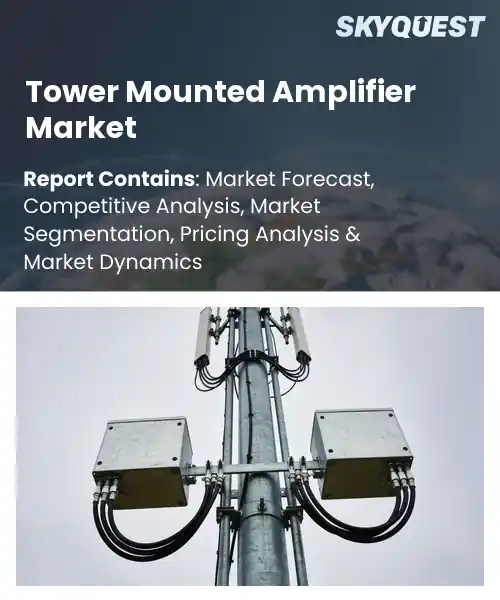
Tower Mounted Amplifier Market
Report ID: SQMIG45H2236
Report ID: SQMIG45H2236
[email protected]
USA +1 351-333-4748
Report ID:
SQMIG45H2236 |
Region:
Global |
Published Date: July, 2026
Pages:
157
|Tables:
171
|Figures:
79


Global Tower Mounted Amplifier Market size was valued at USD 1.35 Billion in 2024 and is poised to grow from USD 1.46 Billion in 2025 to USD 2.74 Billion by 2033, growing at a CAGR of 8.2% during the forecast period (2026-2033).
The tower mounted amplifier industry provides devices that boost uplink signals for cellular base stations, mitigating loss from long feeder cables. Its relevance comes from the densification of mobile networks, where operators add small cells and antenna systems to satisfy 5G capacity needs.
For example, a European operator retrofitted towers with TMAs, achieving a 15 % rise in uplink throughput without additional spectrum. This shift shows how the market has become a critical enabler of wireless performance globally today. Regulatory pressure to improve efficiency now drives the catalyst for the global TMA market, as operators aim to cut power use while preserving service quality. By mounting amplification near the antenna, TMAs reduce feeder loss, lowering electricity costs and carbon footprints for network owners. This incentive has prompted vendors to launch intelligent TMAs with monitoring and adaptive gain control, allowing performance tuning. A North American carrier deployed such TMAs at 1,200 sites, achieving a 12 % drop in site power draw and smoother handovers for users. These results show how sustainability goals and cost savings combine, creating demand for feature‑rich amplifiers.
How is AI-driven automation influencing the tower mounted amplifier market?
AI driven automation is reshaping the tower mounted amplifier (TMA) landscape by enabling real time signal optimization, predictive maintenance, and streamlined network planning. Machine learning algorithms analyze traffic patterns and environmental factors, allowing amplifiers to self adjust gain and reduce interference without manual intervention. This intelligence shortens deployment cycles and lowers operational costs, making it easier for operators to expand coverage as 5G and industrial IoT demand intensify. Vendors are embedding AI modules directly into hardware, creating smart amplifiers that can diagnose faults and trigger remote repairs. The result is a more resilient infrastructure that can adapt to fluctuating demand while preserving service quality.
CommScope in June 2025, introduced an AI enabled TMA that automatically calibrates gain based on live network data, boosting efficiency and supporting rapid network densification. The system’s self learning capability reduces field visits and accelerates rollout, illustrating how automation fuels market growth.
Market snapshot - (2026-2033)
Global Market Size
USD 1.35 Billion
Largest Segment
Single-Band Tower Mounted Amplifiers
Fastest Growth
Multi-Band Tower Mounted Amplifiers
Growth Rate
8.2% CAGR
To get more insights on this market click here to Request a Free Sample Report
Global tower mounted amplifier market is segmented by type, technology, application, frequency band, end user, installation type and region. Based on type, the market is segmented into Single-Band Tower Mounted Amplifiers, Dual-Band Tower Mounted Amplifiers and Multi-Band Tower Mounted Amplifiers. Based on technology, the market is segmented into 4G/LTE Tower Mounted Amplifiers, 5G Tower Mounted Amplifiers and Multi-Standard Amplifiers. Based on application, the market is segmented into Mobile Network Coverage Enhancement, Signal Quality Improvement, Network Capacity Expansion and Others. Based on frequency band, the market is segmented into Low Band, Mid Band and High Band. Based on end user, the market is segmented into Mobile Network Operators, Telecom Infrastructure Providers and Private Network Operators. Based on installation type, the market is segmented into New Deployments and Network Upgrades & Retrofits. Based on region, the market is segmented into North America, Europe, Asia Pacific, Latin America and Middle East & Africa.
5G tower mounted amplifiers segment dominates with large tower mounted amplifier market share because they directly address the exponential data demand and ultra low latency requirements of modern networks, prompting operators to prioritize front haul signal reinforcement. Their ability to amplify higher frequency carriers while preserving signal integrity aligns with the rollout of dense small cell deployments, making them indispensable for delivering seamless user experiences. Consequently, manufacturers focus R&D on power efficiency and heat management, reinforcing this segment’s leadership.
As per tower mounted amplifier market outlook, multi standard amplifiers are witnessing the strongest growth momentum because they provide operators with a flexible platform that supports both legacy 4g LTE and emerging 5g bands, reducing inventory complexity. This adaptability drives rapid adoption across upgrade projects, propelling market expansion and creating new opportunities for integrated hardware solutions.
As per tower mounted amplifier market regional forecast, mobile network coverage enhancement segment stands out because it directly tackles coverage gaps in rural and suburban zones, where signal attenuation often limits subscriber experience. By boosting received power at the handset, these amplifiers enable operators to extend footprint without extensive new site construction, delivering cost effective service improvements. This practical benefit solidifies its prominence within the tower mounted amplifier market and supports regulatory objectives for universal connectivity, reinforcing its strategic importance.
Conversely, network capacity expansion is emerging as the key growth area because operators are densifying networks to meet soaring data traffic, and amplified signals enable more users per cell without degradation. This pressure to increase throughput drives adoption of high gain amplifiers, accelerating market momentum and prompting vendors to innovate toward compact, high efficiency designs that unlock capacity gains.
To get detailed segments analysis, Request a Free Sample Report
North America benefits from a mature telecommunications infrastructure where operators continuously upgrade networks to meet high consumer expectations for mobile data quality. The region hosts a concentration of leading equipment manufacturers and research institutions that drive innovation in low‑noise amplifier design and integration with emerging network architectures. Strong investment appetite from service providers, coupled with supportive regulatory frameworks that encourage spectrum efficiency, fuels demand for tower‑mounted solutions. The presence of large urban centers with dense cellular deployments further intensifies the need for signal enhancement technologies, positioning the United States and Canada as pivotal contributors to market leadership.
As per tower mounted amplifier market regional outlook, United States is propelled by extensive deployment of advanced wireless standards across metropolitan and suburban areas. Operators prioritize network densification to support high‑capacity services, and tower‑mounted amplifiers are essential for preserving signal integrity in challenging environments. Collaboration between major carrier groups and technology suppliers accelerates the rollout of sophisticated amplification modules that integrate seamlessly with existing tower assets.
As per tower mounted amplifier industry analysis, Canada reflects a strategic focus on expanding coverage in remote and northern regions where terrain challenges signal propagation. Telecommunications firms emphasize resilience and energy efficiency in equipment selection, leading to adoption of amplifiers designed for harsh climatic conditions. Partnerships with local research centers foster the development of tailored solutions that address the unique topographical and regulatory landscape of the Canadian market.
The Asia Pacific region experiences rapid urbanization and a surge in mobile data consumption, prompting operators to densify networks and upgrade legacy sites. Government initiatives promoting broadband penetration and the rollout of next‑generation wireless standards create a fertile environment for tower‑mounted amplifier adoption. Competitive market dynamics encourage providers to enhance coverage and capacity while controlling operational expenditures, making low‑loss amplification solutions attractive. Additionally, a strong manufacturing base in the region supports local sourcing of high‑performance components, reducing lead times and fostering agile deployment across diverse market segments.
As per tower mounted amplifier market regional forecast, Japan is driven by dense urban environments where high‑rise structures impede signal reach. Operators focus on maintaining seamless connectivity for a tech‑savvy population, leading to widespread integration of amplifiers that boost signal strength without compromising latency. Domestic technology firms contribute innovative designs that align with stringent quality standards, reinforcing confidence in tower‑mounted solutions across the nation.
South Korea is underpinned by a highly saturated mobile network that seeks to sustain exceptional data speeds and reliability. The country’s early adoption of advanced wireless technologies compels operators to reinforce tower infrastructure with amplification devices that mitigate interference and extend coverage. Collaboration between leading telecom providers and equipment manufacturers accelerates the deployment of compact, energy‑efficient amplifiers tailored to the dense metropolitan topology.
Europe leverages its commitment to digital transformation and cross‑border harmonization of spectrum to solidify its role in the tower‑mounted amplifier ecosystem. Policy frameworks encouraging sustainable network expansion and the transition to energy‑conscious operations motivate operators to integrate amplifiers that improve signal quality while reducing power consumption. Collaborative research initiatives across the continent drive the creation of next‑generation amplification technologies that address both urban density and rural outreach challenges. The region’s emphasis on standardization and interoperability ensures that tower‑mounted solutions can be deployed efficiently across diverse regulatory environments, reinforcing Europe’s strategic foothold in the market.
Germany benefits from a robust telecommunications landscape that prioritizes high‑quality coverage in both industrial corridors and historic city centers. Operators invest in amplification hardware that supports seamless integration with emerging network architectures, emphasizing reliability and low maintenance. Strong engineering expertise within the country contributes to the development of precision‑engineered amplifiers that meet rigorous performance criteria.
United Kingdom reflects a focus on expanding coverage in densely populated urban zones and remote rural areas alike. Service providers adopt amplification solutions that enhance signal penetration in complex building environments, aligning with consumer demand for uninterrupted connectivity. Collaborative ventures between telecom operators and local manufacturers foster the introduction of adaptable amplifier designs suited to the nation’s varied topography.
France is shaped by a strategic emphasis on improving network resilience across metropolitan and peripheral regions. Telecommunications firms prioritize amplifiers that deliver consistent performance while adhering to environmental standards. Engagement with European research networks supports the development of innovative amplification technologies that cater to the specific challenges of French terrain and urban density.
To know more about the market opportunities by region and country, click here to
Buy The Complete Report
Rising Demand for Cellular Coverage
Adoption of 5G Small Cells
High Installation Cost Concerns
Regulatory Approval Delays
Request Free Customization of this report to help us to meet your business objectives.
The competitive landscape of the global tower mounted amplifier industry is shaped by a handful of established players such as CommScope Inc., Amphenol Corporation, Kathrein SE, Filtronic plc, Comba Telecom Systems Holdings Ltd., and Westell, which are intensifying rivalry through targeted product innovation, strategic partnerships with telecom operators, and selective acquisitions to broaden their TMA portfolios. These actions are driven by the need to meet increasing demand for high‑performance signal amplification in expanding mobile and broadband networks, prompting firms to accelerate development cycles and leverage collaborative ecosystems for faster market penetration.
In August 2025, CommScope announced it has entered into a definitive agreement to sell its Connectivity and Cable Solutions (CCS) segment to Amphenol for approximately $10.5 billion in cash, with closing expected within the first half of 2026.
In August 2025, Kathrein Broadcast, the German antenna specialist, announced the sale of its U.S. division to American Amplifier Technologies (AAT), a California-based provider of broadcast and electrical products. AAT acquired 100% of the shares in Kathrein Broadcast USA and will continue operating the company under the same name.
SkyQuest’s ABIRAW (Advanced Business Intelligence, Research & Analysis Wing) is our Business Information Services team that Collects, Collates, Correlates, and Analyses the Data collected by means of Primary Exploratory Research backed by robust Secondary Desk research.
As per SkyQuest analysis, the tower mounted amplifier market growth is being propelled primarily by the rising demand for cellular coverage as operators expand footprints to meet surging data traffic, while the high installation cost remains a notable restraint that can slow adoption. North America continues to lead the market due to its mature infrastructure and strong innovation ecosystem, and the 5G tower‑mounted amplifier segment is the clear front‑runner, reflecting operators’ need for high‑frequency signal reinforcement. A second strong driver is the integration of edge‑computing nodes which calls for reliable front‑haul amplification, further spurring demand for smart, low‑power amplifiers. Additionally, AI‑enabled monitoring is helping operators reduce maintenance costs and improve energy efficiency, making the technology more attractive. The global tower mounted amplifier market trend driven by the rapid expansion of 4G and 5G mobile networks, increasing mobile data traffic, and the need to enhance wireless network coverage and signal quality.
| Report Metric | Details |
|---|---|
| Market size value in 2024 | USD 1.35 Billion |
| Market size value in 2033 | USD 2.74 Billion |
| Growth Rate | 8.2% |
| Base year | 2024 |
| Forecast period | (2026-2033) |
| Forecast Unit (Value) | USD Billion |
| Segments covered |
|
| Regions covered | North America (US, Canada), Europe (Germany, France, United Kingdom, Italy, Spain, Rest of Europe), Asia Pacific (China, India, Japan, Rest of Asia-Pacific), Latin America (Brazil, Rest of Latin America), Middle East & Africa (South Africa, GCC Countries, Rest of MEA) |
| Companies covered |
|
| Customization scope | Free report customization with purchase. Customization includes:-
|
To get a free trial access to our platform which is a one stop solution for all your data requirements for quicker decision making. This platform allows you to compare markets, competitors who are prominent in the market, and mega trends that are influencing the dynamics in the market. Also, get access to detailed SkyQuest exclusive matrix.
Table Of Content
Executive Summary
Market overview
Parent Market Analysis
Market overview
Market size
KEY MARKET INSIGHTS
COVID IMPACT
MARKET DYNAMICS & OUTLOOK
Market Size by Region
KEY COMPANY PROFILES
Methodology
For the Tower Mounted Amplifier Market, our research methodology involved a mixture of primary and secondary data sources. Key steps involved in the research process are listed below:
1. Information Procurement: This stage involved the procurement of Market data or related information via primary and secondary sources. The various secondary sources used included various company websites, annual reports, trade databases, and paid databases such as Hoover's, Bloomberg Business, Factiva, and Avention. Our team did 45 primary interactions Globally which included several stakeholders such as manufacturers, customers, key opinion leaders, etc. Overall, information procurement was one of the most extensive stages in our research process.
2. Information Analysis: This step involved triangulation of data through bottom-up and top-down approaches to estimate and validate the total size and future estimate of the Tower Mounted Amplifier Market.
3. Report Formulation: The final step entailed the placement of data points in appropriate Market spaces in an attempt to deduce viable conclusions.
4. Validation & Publishing: Validation is the most important step in the process. Validation & re-validation via an intricately designed process helped us finalize data points to be used for final calculations. The final Market estimates and forecasts were then aligned and sent to our panel of industry experts for validation of data. Once the validation was done the report was sent to our Quality Assurance team to ensure adherence to style guides, consistency & design.
Analyst Support
Customization Options
With the given market data, our dedicated team of analysts can offer you the following customization options are available for the Tower Mounted Amplifier Market:
Product Analysis: Product matrix, which offers a detailed comparison of the product portfolio of companies.
Regional Analysis: Further analysis of the Tower Mounted Amplifier Market for additional countries.
Competitive Analysis: Detailed analysis and profiling of additional Market players & comparative analysis of competitive products.
Go to Market Strategy: Find the high-growth channels to invest your marketing efforts and increase your customer base.
Innovation Mapping: Identify racial solutions and innovation, connected to deep ecosystems of innovators, start-ups, academics, and strategic partners.
Category Intelligence: Customized intelligence that is relevant to their supply Markets will enable them to make smarter sourcing decisions and improve their category management.
Public Company Transcript Analysis: To improve the investment performance by generating new alpha and making better-informed decisions.
Social Media Listening: To analyze the conversations and trends happening not just around your brand, but around your industry as a whole, and use those insights to make better Marketing decisions.
REQUEST FOR SAMPLE
 REQUEST FREE CUSTOMIZATION
Global Tower Mounted Amplifier Market size was valued at USD 1.35 Billion in 2024 and is poised to grow from USD 1.46 Billion in 2025 to USD 2.74 Billion by 2033, growing at a CAGR of 8.2% during the forecast period (2026-2033).
The competitive landscape of the global Tower Mounted Amplifier market is shaped by a handful of established players such as CommScope Inc., Amphenol Corporation, Kathrein SE, Filtronic plc, Comba Telecom Systems Holdings Ltd., and Westell, which are intensifying rivalry through targeted product innovation, strategic partnerships with telecom operators, and selective acquisitions to broaden their TMA portfolios. These actions are driven by the need to meet increasing demand for high‑performance signal amplification in expanding mobile and broadband networks, prompting firms to accelerate development cycles and leverage collaborative ecosystems for faster market penetration. 'CommScope Holding Company, Inc.', 'Amphenol Corporation', 'Rosenberger Hochfrequenztechnik GmbH & Co. KG', 'Kathrein SE', 'Radio Frequency Systems GmbH', 'TE Connectivity Ltd.', 'Kaelus Pty Ltd.', 'Comba Telecom Systems Holdings Ltd.', 'Procom A/S', 'Microlab, Inc.', 'Bird Technologies', 'RFI Technology Solutions', 'Tongyu Communication Inc.', 'Ace Technologies Corporation', 'Allgon AB', 'Cobham Wireless Ltd.', 'Pasternack Enterprises, Inc.', 'Times Microwave Systems', 'Wisi Communications GmbH & Co. KG', 'HUBER+SUHNER AG'
Telecom operators are expanding network footprints to meet increasing data traffic, prompting installations of tower‑mounted amplifiers that enhance signal strength and reduce transmission loss. By improving coverage in densely populated and remote areas, these amplifiers enable providers to deliver consistent service quality, fostering customer satisfaction and loyalty. Consequently, operators view such equipment as essential infrastructure, encouraging investment and deployment initiatives that directly drive market expansion for tower‑mounted amplifier solutions through strategic partnerships and ongoing technology upgrades that align with evolving regulatory standards and user expectations.
Rising Demand For 5G Small Cells: Telecom operators worldwide are densifying networks to meet 5G performance targets, driving the deployment of small‑cell sites on lamp posts, rooftops, and utility poles. Tower‑mounted amplifiers are becoming essential to boost signal strength in these constrained locations, enabling consistent coverage and capacity without costly macro‑cell upgrades. Vendors are integrating compact, low‑power amplifiers that harmonize with smart‑city infrastructure, creating a new revenue stream for equipment suppliers and expanding the addressable market for TMA solutions across emerging urban and suburban regions globally.
Why does North America Dominate the Global Tower Mounted Amplifier Market? |@12


Want to customize this report? This report can be personalized according to your needs. Our analysts and industry experts will work directly with you to understand your requirements and provide you with customized data in a short amount of time. We offer $1000 worth of FREE customization at the time of purchase.
Feedback From Our Clients


 USA (+1) 351-333-4748

