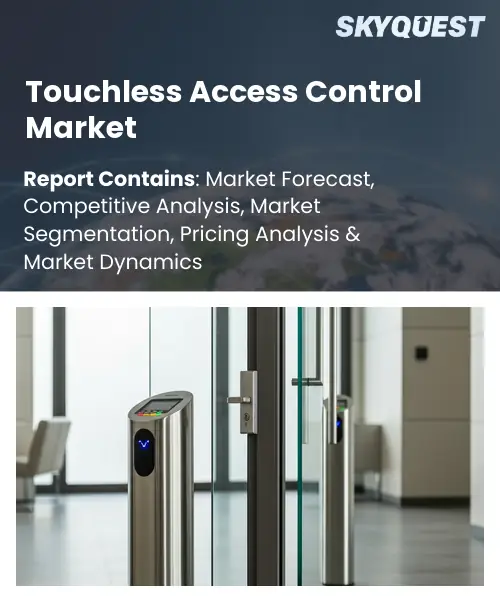
Touchless Access Control Market
Report ID: SQMIG45J2817
Report ID: SQMIG45J2817
[email protected]
USA +1 351-333-4748
Report ID:
SQMIG45J2817 |
Region:
Global |
Published Date: August, 2026
Pages:
157
|Tables:
147
|Figures:
78


Global Touchless Access Control Market size was valued at USD 2.86 Billion in 2024 and is poised to grow from USD 3.09 Billion in 2025 to USD 5.82 Billion by 2033, growing at a CAGR of 8.2% during the forecast period (2026-2033).
The touchless access control system, which is based on the use of biometric and RFID technologies that authenticate a user without any physical interaction, is currently an integral component of contemporary security systems. The main factor that drives the market is increased awareness about hygiene due to the coronavirus pandemic during which companies tried to reduce shared points of contact, such as key pad readers. Over the last ten years, the market developed from simple proximity card systems to advanced facial recognition and palm-vein scanners capable of processing thousands of transactions per minute. Hospitals, airports, and corporate campuses that adopt such technology provide examples of its importance since it allows reducing the risk of infections while sustaining the same flow of people. The key element that drives growth at the international level is the combination of smart-building systems with IoT.
As companies embrace digitalization of their buildings, information gathered from facial recognition or Bluetooth beacon devices could lead to adaptive lighting, heating and ventilation controls, and occupancy analysis, leading to energy savings and improved user experience. For instance, one office building in Singapore employs cloud-based access controls in verifying individuals and setting up workstation configurations, resulting in a reduction of onboarding times by 40 percent. The combination not only drives demand for modular hardware but also creates opportunities for recurring revenues through subscription-based analytics services.
How is AI-driven Facial Recognition Reshaping the Global Touchless Access Control Market?
Facial recognition powered by AI technology is changing the landscape of access control systems as it brings together high accuracy biometric data processing along with real-time decisions. This method of verification relies on capturing unique facial features and processing them using deep learning models in order to verify identity in real-time without any physical interaction. Scalability makes it possible to easily deploy facial recognition systems in multiple access points in order to speed up the process of entering offices, hospitals, and other facilities, and eliminate the necessity of carrying around keypads or badges. The use of edge computing devices which ensure that no personal information is shared ensures fast performance and addresses all privacy issues related to AI-powered access control technology.
Market snapshot - (2026-2033)
Global Market Size
USD 2.86 Billion
Largest Segment
Facial Recognition
Fastest Growth
Wave Sensors
Growth Rate
8.2% CAGR
To get more insights on this market click here to Request a Free Sample Report
Global touchless access control market is segmented by technology, component, end user, deployment, application and region. Based on technology, the market is segmented into Facial Recognition, Mobile Credentials, NFC, RFID, Bluetooth and Wave Sensors. Based on component, the market is segmented into Hardware, Software and Services. Based on end user, the market is segmented into Commercial, Healthcare, Government and Industrial. Based on deployment, the market is segmented into Cloud-Based and On-Premises. Based on application, the market is segmented into Building Access, Attendance Management and Visitor Management. Based on region, the market is segmented into North America, Europe, Asia Pacific, Latin America and Middle East & Africa.
The facial recognition segment has an edge over others due to its unique feature of providing a seamless way of authentication that is not only very safe but also works on the principles of improved hygiene practices and AI integration. It helps in achieving quick authentication without requiring the individual to have direct contact points, which helps in meeting the needs of both safety as well as faster processing.
The mobile credentials segment, however, seems to be growing the fastest as the smartphone has become such a common device, which is capable of storing encrypted access tokens. The convenience factor provided by this segment encourages people to use their smartphone instead of getting additional cards.
Software segment leads because it orchestrates the complex algorithms, data analytics, and user interfaces that enable seamless touchless authentication. Robust firmware and cloud enabled platforms provide real time updates, threat detection, and integration with enterprise identity systems, ensuring adaptability to evolving security standards. The ability to deliver scalable, customizable solutions without extensive hardware changes makes software the cornerstone for organizations seeking agile, future proof access control across diverse sectors today and beyond.
On the other hand, the services segment has become the focal point for high-growth opportunities due to increasing needs of managed deployment and maintenance support among others as organizations seek to overcome the hurdles in the regulatory environment. The customized packages help cut operational costs and quicken the process of value creation, hence outsourcing the relevant knowledge. The increased demand creates an entire ecosystem of service providers.
To get detailed segments analysis, Request a Free Sample Report
North America dominates the Touchless Access Control Market, owing to a combination of sophisticated infrastructure of technology, security needs, and procurement procedures. Businesses in both the USA and Canada favor entry processes with minimal physical interaction, leading to an extensive use of biometric and RFID systems. Synergies of technology companies and real estate developers help to incorporate touchless technology rapidly into both new construction projects and existing buildings. Regulatory environment mandates rigorous data protection and high levels of access control, thus adding to the trust in touchless solutions. Besides, an innovative environment with strong venture capital support ensures constant improvement of products, which keeps organizations in North America ahead in terms of secure touchless access.
Touchless Access Control Market in the United States is propelled by large‑scale commercial and governmental projects that demand high‑security, contact‑free entry solutions. Leading technology firms collaborate with architecture firms to embed biometric scanners and cloud‑managed credentials into office towers, campuses, and public venues. Consumer expectations for hygienic environments, amplified by recent health concerns, drive rapid deployment across retail and hospitality sectors, reinforcing a fast‑moving adoption cycle.
The Touchless Access Control Market in Canada thrives on the backdrop of public safety being the top priority and building codes that promote the use of touchless access control technology. Cooperation between government agencies and technology suppliers drives its adoption in hospitals, educational institutes, and transit centers. The market is additionally spurred by the rising demand for sustainable options, motivating companies to implement products that minimize wear and tear, cut down energy usage, and improve overall user experience in the country.
Europe experiences rapid expansion of the Touchless Access Control Market as a result of coordinated regulatory initiatives, widespread smart‑city programs, and heightened awareness of health and security concerns. The European Union’s emphasis on data protection and interoperable standards creates a trusted environment for biometric and credential‑based solutions. National governments invest heavily in modernizing public infrastructure, prompting adoption in transportation, government buildings, and large‑scale events. Industry clusters in Germany, the United Kingdom, and France spearhead innovation, delivering integrated platforms that combine access control with building‑management systems. This collaborative ecosystem, combined with strong consumer demand for frictionless experiences, positions Europe as a dynamic growth engine for touchless security technologies.
German Touchless Access Control Systems Market thrives thanks to the presence of a well-developed manufacturing industry and excellent engineering, which encourages usage of highly accurate biometric and RFID technologies. Industrial establishments, automobile manufacturing sites, and educational campuses use touchless entry systems in order to comply with safety standards and optimize labor management. Digitalization efforts supported by the government lead to the integration of touchless access control in new and old buildings, ensuring compliance with strict data privacy laws.
Touchless Access Control Market in the United Kingdom is experiencing the fastest growth across Europe, fueled by aggressive digital‑infrastructure programs and a proactive regulatory environment. Financial institutions, education providers, and large commercial estates adopt contact‑free authentication to enhance security and user convenience. The UK’s emphasis on resilience and pandemic preparedness accelerates rollout in public transport hubs and government facilities. Collaborative research initiatives between universities and technology firms further accelerate innovation, driving rapid market expansion.
France Touchless Access Control Market is one of the new markets coming up as an active market through initiatives by the government for the development of smart cities and sustainable buildings. This market is being adopted in retail stores, museums, and public utilities where touchless entry is implemented in order to ensure safety and efficiency of operations. The French regulatory system promotes security of data and also encourages interoperability thus providing a fertile ground for companies within the market.
Asia Pacific is consolidating its role in the Touchless Access Control Market owing to the presence of rapid urbanization, smart infrastructure development backed by governments, and the culture of hygienic and technologically advanced approach. Countries like Japan and South Korea spend large sums of money on next generation biometric devices, which are integrated with the Internet of Things technologies and cloud-based management system, to create a security solution ecosystem. With its robust manufacturing sector, Asia Pacific has the capacity to manufacture the sensors and hardware needed, thereby lowering dependence on imports and minimizing time-to-market. Increased demand in transport, hospitality sectors, and dense housing developments leads to wider adoption of touchless access control solutions.
The Touchless Access Control Market in Japan is aided by the presence of an advanced technological framework and the social emphasis on cleanliness, leading to the early adoption of touch-free access control systems. Corporate offices, airports, and hotel chains utilize high-end biometric sensors and mobile credentials systems in order to increase security and convenience. Policies for promoting smart cities ensure that access control systems integrate seamlessly into urban infrastructure. The robustness of the domestic manufacturing industry of components guarantees that Japan stays ahead of the curve.
Market for Touchless Access Control System in South Korea is driven by an evolving ICT sector coupled with the government’s policies, which favor implementation of smart buildings. Organizations such as banks, universities, and large-scale shopping complexes have utilized seamless authentication technology in enhancing security and efficiency. Technical capabilities in semiconductors and sensors make it possible to manufacture high-quality, small-sized devices that work well in touchless access control systems. Collaboration between new and old players has enhanced growth of this market segment.
To know more about the market opportunities by region and country, click here to
Buy The Complete Report
Growing Demand for Contactless Entry
Adoption of Biometric Technologies
High Installation Cost Barriers
Privacy Concerns Over Data
Request Free Customization of this report to help us to meet your business objectives.
The intense competition between the established and new players in the touchless access control industry is a key driver behind the innovation. Large corporations, including ASSA ABLOY, which recently acquired HID Global, and Johnson Controls, collaborating with Microsoft Azure on their AI-powered security solutions, have been speeding up the development of their products.
SkyQuest’s ABIRAW (Advanced Business Intelligence, Research & Analysis Wing) is our Business Information Services team that Collects, Collates, Correlates, and Analyses the Data collected by means of Primary Exploratory Research backed by robust Secondary Desk research.
As per SkyQuest analysis, the global market of touchless access control technology is mainly driven by the rising preference for contactless access, due to which businesses aim to minimize the spread of pathogens and build up the confidence of their occupants. Another driving factor is the fast adoption of biometric technologies such as artificial intelligence-based facial recognition. The facial recognition segment represents the largest market share because of its increasing popularity in the commercial, healthcare, and governmental sectors. North America continues to dominate the global market owing to its highly developed infrastructure, stringent regulatory policies, and investments in smart buildings.
| Report Metric | Details |
|---|---|
| Market size value in 2024 | USD 2.86 Billion |
| Market size value in 2033 | USD 5.82 Billion |
| Growth Rate | 8.2% |
| Base year | 2024 |
| Forecast period | (2026-2033) |
| Forecast Unit (Value) | USD Billion |
| Segments covered |
|
| Regions covered | North America (US, Canada), Europe (Germany, France, United Kingdom, Italy, Spain, Rest of Europe), Asia Pacific (China, India, Japan, Rest of Asia-Pacific), Latin America (Brazil, Rest of Latin America), Middle East & Africa (South Africa, GCC Countries, Rest of MEA) |
| Companies covered |
|
| Customization scope | Free report customization with purchase. Customization includes:-
|
To get a free trial access to our platform which is a one stop solution for all your data requirements for quicker decision making. This platform allows you to compare markets, competitors who are prominent in the market, and mega trends that are influencing the dynamics in the market. Also, get access to detailed SkyQuest exclusive matrix.
Table Of Content
Executive Summary
Market overview
Parent Market Analysis
Market overview
Market size
KEY MARKET INSIGHTS
COVID IMPACT
MARKET DYNAMICS & OUTLOOK
Market Size by Region
KEY COMPANY PROFILES
Methodology
For the Touchless Access Control Market, our research methodology involved a mixture of primary and secondary data sources. Key steps involved in the research process are listed below:
1. Information Procurement: This stage involved the procurement of Market data or related information via primary and secondary sources. The various secondary sources used included various company websites, annual reports, trade databases, and paid databases such as Hoover's, Bloomberg Business, Factiva, and Avention. Our team did 45 primary interactions Globally which included several stakeholders such as manufacturers, customers, key opinion leaders, etc. Overall, information procurement was one of the most extensive stages in our research process.
2. Information Analysis: This step involved triangulation of data through bottom-up and top-down approaches to estimate and validate the total size and future estimate of the Touchless Access Control Market.
3. Report Formulation: The final step entailed the placement of data points in appropriate Market spaces in an attempt to deduce viable conclusions.
4. Validation & Publishing: Validation is the most important step in the process. Validation & re-validation via an intricately designed process helped us finalize data points to be used for final calculations. The final Market estimates and forecasts were then aligned and sent to our panel of industry experts for validation of data. Once the validation was done the report was sent to our Quality Assurance team to ensure adherence to style guides, consistency & design.
Analyst Support
Customization Options
With the given market data, our dedicated team of analysts can offer you the following customization options are available for the Touchless Access Control Market:
Product Analysis: Product matrix, which offers a detailed comparison of the product portfolio of companies.
Regional Analysis: Further analysis of the Touchless Access Control Market for additional countries.
Competitive Analysis: Detailed analysis and profiling of additional Market players & comparative analysis of competitive products.
Go to Market Strategy: Find the high-growth channels to invest your marketing efforts and increase your customer base.
Innovation Mapping: Identify racial solutions and innovation, connected to deep ecosystems of innovators, start-ups, academics, and strategic partners.
Category Intelligence: Customized intelligence that is relevant to their supply Markets will enable them to make smarter sourcing decisions and improve their category management.
Public Company Transcript Analysis: To improve the investment performance by generating new alpha and making better-informed decisions.
Social Media Listening: To analyze the conversations and trends happening not just around your brand, but around your industry as a whole, and use those insights to make better Marketing decisions.
REQUEST FOR SAMPLE
 REQUEST FREE CUSTOMIZATION
Global Touchless Access Control Market size was valued at USD 2.86 Billion in 2024 and is poised to grow from USD 3.09 Billion in 2025 to USD 5.82 Billion by 2033, growing at a CAGR of 8.2% during the forecast period (2026-2033).
Intense rivalry among incumbents and agile newcomers drives rapid innovation in the global touchless access control market. Major players such as ASSA ABLOY, which completed the HID Global acquisition, and Johnson Controls, partnering with Microsoft Azure for AI‑enabled security, are accelerating product roadmaps. Competitive pressure fuels M&A activity, strategic alliances, and the rollout of biometric and cloud‑based solutions. 'ASSA ABLOY AB', 'Allegion plc', 'Dormakaba Holding AG', 'Johnson Controls International plc', 'Honeywell International Inc.', 'Siemens AG', 'Bosch Security Systems', 'HID Global Corporation', 'SALTO Systems S.L.', 'Axis Communications AB', 'Suprema Inc.', 'Nedap N.V.', 'Genetec Inc.', 'Identiv, Inc.', 'LenelS2', 'Paxton Access Ltd.', 'Gallagher Group Limited', 'Brivo Inc.', 'Avigilon Corporation', 'ZKTeco Co., Ltd.'
The increasing emphasis on health safety in public and private spaces motivates organizations to eliminate physical touchpoints. By implementing touchless access solutions, facilities reduce pathogen transmission risk, enhancing occupant confidence and compliance with hygiene protocols. This shift aligns with broader societal expectations for safer environments, prompting building managers and security professionals to prioritize contactless technologies. Consequently, demand accelerates as stakeholders seek systems that support seamless, sanitary entry while maintaining robust security standards, driving market expansion across multiple sectors globally, continuously.
Contactless Biometrics Adoption: Enterprises are increasingly preferring facial and iris recognition solutions that eliminate physical touch, driven by heightened hygiene expectations and the desire for seamless user experiences. Vendors are integrating advanced AI algorithms to improve accuracy under varied lighting conditions, while simplifying enrollment processes. This shift reduces friction at entry points, supports remote management, and aligns with broader digital transformation initiatives, positioning touchless access as a strategic differentiator for organizations seeking resilient, future‑ready security infrastructures that meet evolving compliance and safety standards.
Why does North America Dominate the Global Touchless Access Control Market? |@12


Want to customize this report? This report can be personalized according to your needs. Our analysts and industry experts will work directly with you to understand your requirements and provide you with customized data in a short amount of time. We offer $1000 worth of FREE customization at the time of purchase.
Feedback From Our Clients


 USA (+1) 351-333-4748

