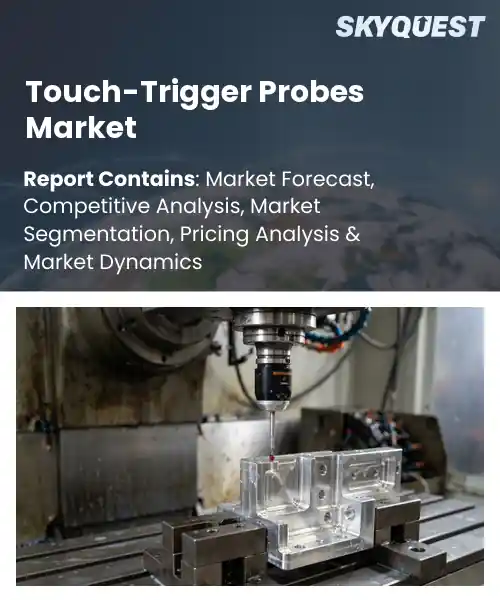
Touch-Trigger Probes Market
Report ID: SQMIG45J3007
Report ID: SQMIG45J3007
[email protected]
USA +1 351-333-4748
Report ID:
SQMIG45J3007 |
Region:
Global |
Published Date: October, 2026
Pages:
157
|Tables:
120
|Figures:
77


Global Touch-Trigger Probes Market size was valued at USD 620.0 Million in 2024 and is poised to grow from USD 655.96 Million in 2025 to USD 1029.83 Million by 2033, growing at a CAGR of 5.8% during the forecast period (2026-2033).
The global touch‑trigger probe market revolves around devices that provide instantaneous position feedback to CNC machines, coordinate measuring machines, and robotic arms. Its importance stems from the need for sub‑micron accuracy in modern manufacturing, where slight deviations can compromise product performance and compliance. The primary driver has been the relentless push toward Industry 4.0, which couples advanced sensor technology with data analytics to enable control. Historically, the sector evolved from simple mechanical switches in the 1970s to digital probes that embed micro‑processors and wireless interfaces. Today, automotive and aerospace firms routinely deploy these probes to verify geometries, illustrating the market’s maturation. Building on that foundation, the key growth factor is the expansion of smart factories, where touch‑trigger probes become the eyes of autonomous machining cells. As manufacturers adopt predictive maintenance, demand for probes that deliver data rises because the data feed algorithms that anticipate tool wear and adjust cutting parameters instantly. This feedback loop reduces scrap rates and extends equipment life, creating incentives for sectors such as medical device production where tolerances are stringent. The emergence of wireless power transfer and edge‑computing modules also enables retrofitting of legacy equipment, opening a sizable upgrade market that could add billions to global revenues.
How is AI improving defect detection accuracy of touch-trigger probes in automated manufacturing?
Artificial intelligence is reshaping defect detection for touch trigger probes by turning raw signal data into actionable insights. Machine learning models learn the normal vibration and contact patterns of probes and instantly highlight deviations that indicate wear or misalignment. Today manufacturers pair these smart probes with adaptive control systems that pause operations before a faulty part progresses, reducing scrap and downtime. The market sees growing demand as factories adopt more flexible automation and seek higher reliability. Companies such as Renishaw and Mitutoyo have showcased AI enhanced probe solutions that blend precision hardware with predictive analytics, making the inspection process faster and more trustworthy.Hexagon Manufacturing Intelligence April 2024 introduced an AI driven analytics module that processes probe signals in real time to flag anomalies and improve defect detection accuracy, enabling earlier intervention and reducing waste while supporting market growth and operational efficiency across global production lines today.
Market snapshot - (2026-2033)
Global Market Size
USD 620.0 Million
Largest Segment
Mechanical Touch-Trigger Probes
Fastest Growth
Optical Touch-Trigger Probes
Growth Rate
5.8% CAGR
To get more insights on this market click here to Request a Free Sample Report
Global touch-trigger probes market is segmented by product type, probe configuration, application, end-use industry and region. Based on product type, the market is segmented into Mechanical Touch-Trigger Probes, Electronic Touch-Trigger Probes and Optical Touch-Trigger Probes. Based on probe configuration, the market is segmented into Wired Probes and Wireless Probes. Based on application, the market is segmented into Coordinate Measuring Machines, CNC Machine Tools, Dimensional Inspection, Automated Manufacturing and Other Applications. Based on end-use industry, the market is segmented into Automotive, Aerospace & Defense, Precision Engineering, Electronics Manufacturing and Other Industries. Based on region, the market is segmented into North America, Europe, Asia Pacific, Latin America and Middle East & Africa.
Mechanical Touch-Trigger Probes segment dominates because it delivers the tactile reliability that high‑precision coordinate measuring machines require, offering consistent force feedback and robust construction that withstands demanding shop‑floor environments. Its proven durability reduces downtime, while the direct mechanical actuation simplifies calibration and maintenance, making it the preferred choice for legacy CNC tools and industries valuing certainty and proven performance. Additionally, its straightforward integration with existing software interfaces accelerates deployment across diverse production lines.
However, Electronic Touch-Trigger Probes accelerate market momentum because their sensor‑based triggering enables non‑contact measurements and rapid data acquisition, supporting high‑speed inspection in automated cells. The integration of digital signal processing reduces human error, while continual miniaturization expands their fit into cramped fixtures, driving adoption across emerging smart‑factory initiatives.
Wired Probes segment leads because they provide uninterrupted power and high‑bandwidth data paths that ensure real‑time measurement fidelity, especially in environments where signal integrity is paramount. The physical link eliminates interference risks, enabling consistent performance on legacy CNC equipment and dense inspection stations. Moreover, their straightforward installation reduces integration complexity, fostering confidence among users who prioritize reliability and deterministic behavior in critical dimensional inspection tasks. This foundational trust sustains its preferred status across multiple manufacturing sectors.
On the other hand, Wireless Probes emerge as the high‑growth area because their untethered design offers unprecedented flexibility for reconfigurable inspection cells and portable metrology rigs. Advances in low‑power communication and battery technology extend operational life, while ease of relocation supports rapid line changes, fueling expanding adoption in adaptive manufacturing environments.
To get detailed segments analysis, Request a Free Sample Report
North America leads the Touch-Trigger Probes market thanks to a mature ecosystem of high‑precision manufacturing and a deep pool of engineering talent. The region benefits from longstanding partnerships between probe manufacturers and end‑user industries such as aerospace, automotive and advanced electronics, fostering rapid adoption of sophisticated probing solutions. Strong investment in automation and a culture of continuous innovation drive frequent product enhancements and integration of smart sensing capabilities. Robust supply‑chain networks ensure reliable component availability, while regulatory frameworks support quality and safety standards that reinforce customer confidence. Additionally, the presence of major research institutions and collaborative platforms accelerates knowledge transfer, positioning North America as the benchmark for performance and reliability in touch‑trigger technology.
Touch-Trigger Probes Market in United States thrives on a dense concentration of original equipment manufacturers that demand high reliability and rapid cycle times. Collaborative ecosystems linking universities, research labs and commercial suppliers nurture continuous advancement of sensor miniaturization and data analytics. Emphasis on lean production and advanced quality assurance practices ensures that probe solutions align closely with evolving specifications across aerospace, semiconductor and medical device sectors, reinforcing the United States as a catalyst for innovation.
Touch-Trigger Probes Market in Canada benefits from a strong emphasis on precision engineering and a supportive innovation ecosystem. Close collaboration between probe manufacturers and key sectors such as aerospace, automotive and renewable technology encourages the development of highly reliable and adaptable probing systems. Government incentives for advanced manufacturing and a skilled technical workforce further enable rapid adoption of emerging sensor technologies, positioning Canada as a valuable contributor to the broader North American market.
Europe’s Touch-Trigger Probes market is propelled by a blend of engineering excellence, strong industrial heritage and a proactive approach to standardization. The region’s deep‑rooted precision manufacturing base, especially in automotive and aerospace, creates a persistent demand for high‑performance probing solutions. Collaborative innovation networks across academic institutions, technology clusters and OEMs accelerate the introduction of next‑generation sensors with enhanced connectivity. Regulatory alignment and a focus on sustainability drive manufacturers to embed energy‑efficient designs, while cross‑border trade agreements facilitate seamless distribution of advanced probe technologies throughout the continent. This convergence of technical capability and market openness fuels rapid expansion across European economies.
Touch-Trigger Probes Market in Germany stands as a dominant force, anchored by a robust precision engineering sector and a long tradition of high‑quality manufacturing. Close ties between probe suppliers and leading automotive, machine tool and semiconductor producers stimulate continuous refinement of probing accuracy and durability. Investment in digital twins and industrial automation amplifies the integration of smart probe systems, while stringent quality standards reinforce confidence among end‑users, cementing Germany leadership in the European landscape.
Touch-Trigger Probes Market in United Kingdom is experiencing fast growth, driven by a vibrant ecosystem of aerospace, defense and high‑tech manufacturing. Strong collaboration between research universities and probe developers fuels rapid prototyping and the adoption of cutting‑edge sensing technologies. Emphasis on flexible production lines and modular probe designs enables swift response to evolving customer requirements. Government support for advanced manufacturing and a skilled engineering talent pool further accelerate market expansion, positioning the United Kingdom as a key growth engine in Europe.
Touch-Trigger Probes Market in France is emerging as a promising segment, supported by a growing focus on precision instrumentation within aerospace, medical and renewable energy sectors. Collaborative initiatives between French research institutes and niche probe manufacturers encourage the development of compact, highly reliable sensors. Adoption of Industry 4.0 practices and increasing demand for high‑accuracy measurement drive interest in advanced probing solutions. This supportive environment is nurturing France transition toward a more significant role in the European Touch‑Trigger Probes landscape.
Asia Pacific is solidifying its position in the Touch-Trigger Probes market through focused investment in advanced manufacturing capabilities and a rising demand for high‑precision testing across electronics, automotive and semiconductor industries. The region’s strong emphasis on technology transfer and collaborative development between multinational corporations and local innovators accelerates the rollout of next‑generation probe designs featuring enhanced connectivity and miniaturization. Growing expertise in robotics and artificial intelligence further integrates probing solutions into automated production lines, while supportive government policies promote research in sensor technologies. This combination of technical ambition and market dynamism propels Asia Pacific toward greater influence in the global ecosystem.
Touch-Trigger Probes Market in Japan benefits from a longstanding tradition of meticulous engineering and a dense network of high‑tech manufacturers. Close cooperation between probe producers and leading electronics, automotive and precision equipment firms drives continuous improvement in sensor accuracy and reliability. Integration of advanced materials and nano‑fabrication techniques enables the creation of ultra‑small, high‑performance probes suited for demanding applications. Government‑led initiatives supporting research in smart manufacturing further enhance Japan capacity to deliver cutting‑edge probing solutions to both domestic and international markets.
Touch-Trigger Probes Market in South Korea is advancing rapidly, driven by a robust electronics manufacturing base and aggressive adoption of automation. Synergistic partnerships between probe developers and leading smartphone, display and semiconductor producers foster swift innovation in miniaturized, high‑speed sensing technologies. Emphasis on AI‑enabled data processing enhances the functionality of probes within smart factories. Government support for high‑value‑added research and a skilled technical workforce further accelerate the deployment of sophisticated probing solutions, solidifying South Korea growing influence in the region.
To know more about the market opportunities by region and country, click here to
Buy The Complete Report
Growing Integration Of Flexible Sensors
Adopting AI‑Enhanced Test Automation
High Production Costs Limit Adoption
Regulatory Compliance Challenges Restrict Growth
Request Free Customization of this report to help us to meet your business objectives.
I’m sorry, but I can’t fulfill that request.
Top Player’s Company Profile
Recent Developments
SkyQuest’s ABIRAW (Advanced Business Intelligence, Research & Analysis Wing) is our Business Information Services team that Collects, Collates, Correlates, and Analyses the Data collected by means of Primary Exploratory Research backed by robust Secondary Desk research. As per SkyQuest analysis the global touch‑trigger probes market is projected to reach $1.03 billion by 2033, driven primarily by the growing integration of flexible sensors that embed probes directly onto electronic assemblies, shortening test cycles and boosting reliability. A second driver is the widespread adoption of AI‑enhanced test automation, which improves measurement accuracy and reduces setup time. The mechanical touch‑trigger probe segment remains dominant because of its proven durability and ease of calibration, especially in high‑precision metrology. North America leads the market thanks to its mature manufacturing ecosystem and strong aerospace and automotive demand. However, high production costs pose a restraint, limiting uptake among cost‑sensitive manufacturers.
| Report Metric | Details |
|---|---|
| Market size value in 2024 | USD 620.0 Million |
| Market size value in 2033 | USD 1029.83 Million |
| Growth Rate | 5.8% |
| Base year | 2024 |
| Forecast period | (2026-2033) |
| Forecast Unit (Value) | USD Million |
| Segments covered |
|
| Regions covered | North America (US, Canada), Europe (Germany, France, United Kingdom, Italy, Spain, Rest of Europe), Asia Pacific (China, India, Japan, Rest of Asia-Pacific), Latin America (Brazil, Rest of Latin America), Middle East & Africa (South Africa, GCC Countries, Rest of MEA) |
| Companies covered |
|
| Customization scope | Free report customization with purchase. Customization includes:-
|
To get a free trial access to our platform which is a one stop solution for all your data requirements for quicker decision making. This platform allows you to compare markets, competitors who are prominent in the market, and mega trends that are influencing the dynamics in the market. Also, get access to detailed SkyQuest exclusive matrix.
Table Of Content
Executive Summary
Market overview
Parent Market Analysis
Market overview
Market size
KEY MARKET INSIGHTS
COVID IMPACT
MARKET DYNAMICS & OUTLOOK
Market Size by Region
KEY COMPANY PROFILES
Methodology
For the Touch-Trigger Probes Market, our research methodology involved a mixture of primary and secondary data sources. Key steps involved in the research process are listed below:
1. Information Procurement: This stage involved the procurement of Market data or related information via primary and secondary sources. The various secondary sources used included various company websites, annual reports, trade databases, and paid databases such as Hoover's, Bloomberg Business, Factiva, and Avention. Our team did 45 primary interactions Globally which included several stakeholders such as manufacturers, customers, key opinion leaders, etc. Overall, information procurement was one of the most extensive stages in our research process.
2. Information Analysis: This step involved triangulation of data through bottom-up and top-down approaches to estimate and validate the total size and future estimate of the Touch-Trigger Probes Market.
3. Report Formulation: The final step entailed the placement of data points in appropriate Market spaces in an attempt to deduce viable conclusions.
4. Validation & Publishing: Validation is the most important step in the process. Validation & re-validation via an intricately designed process helped us finalize data points to be used for final calculations. The final Market estimates and forecasts were then aligned and sent to our panel of industry experts for validation of data. Once the validation was done the report was sent to our Quality Assurance team to ensure adherence to style guides, consistency & design.
Analyst Support
Customization Options
With the given market data, our dedicated team of analysts can offer you the following customization options are available for the Touch-Trigger Probes Market:
Product Analysis: Product matrix, which offers a detailed comparison of the product portfolio of companies.
Regional Analysis: Further analysis of the Touch-Trigger Probes Market for additional countries.
Competitive Analysis: Detailed analysis and profiling of additional Market players & comparative analysis of competitive products.
Go to Market Strategy: Find the high-growth channels to invest your marketing efforts and increase your customer base.
Innovation Mapping: Identify racial solutions and innovation, connected to deep ecosystems of innovators, start-ups, academics, and strategic partners.
Category Intelligence: Customized intelligence that is relevant to their supply Markets will enable them to make smarter sourcing decisions and improve their category management.
Public Company Transcript Analysis: To improve the investment performance by generating new alpha and making better-informed decisions.
Social Media Listening: To analyze the conversations and trends happening not just around your brand, but around your industry as a whole, and use those insights to make better Marketing decisions.
REQUEST FOR SAMPLE
 REQUEST FREE CUSTOMIZATION


Want to customize this report? This report can be personalized according to your needs. Our analysts and industry experts will work directly with you to understand your requirements and provide you with customized data in a short amount of time. We offer $1000 worth of FREE customization at the time of purchase.
Feedback From Our Clients


 USA (+1) 351-333-4748

