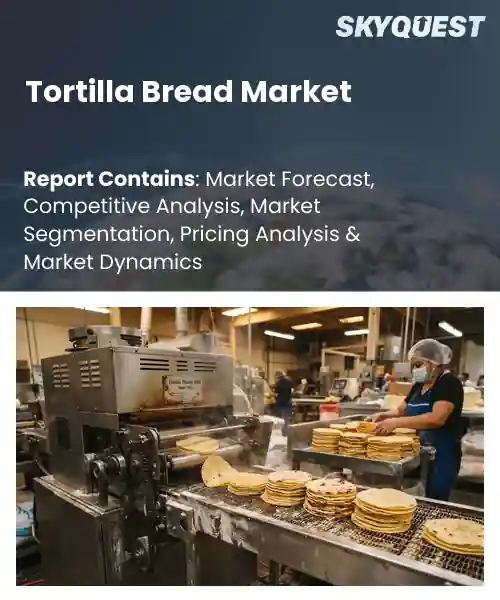
Tortilla Bread Market
Report ID: SQMIG30I3274
Report ID: SQMIG30I3274
[email protected]
USA +1 351-333-4748
Report ID:
SQMIG30I3274 |
Region:
Global |
Published Date: September, 2026
Pages:
157
|Tables:
121
|Figures:
77


Global Tortilla Bread Market size was valued at USD 48.5 Billion in 2024 and is poised to grow from USD 51.07 Billion in 2025 to USD 77.2 Billion by 2033, growing at a CAGR of 5.3% during the forecast period (2026-2033).
The global tortilla bread market comprises flat, unleavened breads made from corn or wheat, used in tacos, burritos, and wraps. Its significance stems from the product’s role as a staple in Latin American diets and its adoption in mainstream fast‑food and retail channels worldwide. The primary driver of market expansion is rising consumer preference for convenient, protein‑rich, low‑fat meals that can be prepared quickly at home or in restaurants. Over the past decade, the proliferation of Mexican‑style eateries in North America, combined with the launch of tortilla kits by producers, has turned a regional specialty into a recognized food platform. Building on that consumer shift, the second key factor reshaping the tortilla bread market is supply‑chain innovation that reduces cost and enhances product diversity. Advanced processing technologies now enable manufacturers to blend corn, wheat, and grains such as quinoa or chickpea flour, creating protein or gluten‑free variants that meet dietary demands. As retailers stock these differentiated products, food‑service operators can introduce menu items like vegan burritos or protein‑boosted tacos at competitive prices, which in turn drives volume sales and encourages brand loyalty. Consequently, investment in production lines and partnerships with grocery chains is unlocking growth corridors across North America, Europe, and markets.
How is AI-driven automation influencing production efficiency in the tortilla bread market?
AI driven automation is reshaping how tortilla producers manage dough handling, baking and packaging. Machine vision systems monitor dough consistency while predictive algorithms adjust mixing speed to maintain texture. Robotic arms transfer sheets to ovens with precise timing, reducing waste and downtime. Real time data analytics allow operators to anticipate maintenance needs before breakdowns occur. The result is a smoother flow from raw ingredients to finished product, enabling plants to meet rising consumer demand without expanding floor space. Brands that adopt these tools report faster changeovers and more consistent flavor, which strengthens their position in a competitive market.Bimbo Bakeries USA March 2024, introduced an AI powered line that synchronizes dough mixing and baking, cutting changeover time and boosting output while preserving quality. This innovation demonstrates how intelligent automation can lift efficiency and support growth across the tortilla bread market globally for producers seeking to scale and profitability.
Market snapshot - (2026-2033)
Global Market Size
USD 48.5 Billion
Largest Segment
Corn Tortillas
Fastest Growth
Specialty Tortillas
Growth Rate
5.3% CAGR
To get more insights on this market click here to Request a Free Sample Report
Global tortilla bread market is segmented by product type, product form, application, distribution channel and region. Based on product type, the market is segmented into Corn Tortillas, Flour Tortillas, Whole Wheat Tortillas, Multigrain Tortillas and Specialty Tortillas. Based on product form, the market is segmented into Fresh Tortillas, Frozen Tortillas and Shelf-Stable Tortillas. Based on application, the market is segmented into Household Consumption, Foodservice and Food Manufacturing. Based on distribution channel, the market is segmented into Supermarkets & Hypermarkets, Convenience Stores, Specialty Stores, Online Retail and Foodservice Distributors. Based on region, the market is segmented into North America, Europe, Asia Pacific, Latin America and Middle East & Africa.
Fresh Tortillas segment dominates because consumers value immediate flavor, texture, and aroma that only freshly prepared products can deliver. This preference drives retailers to allocate prime shelf space and encourages manufacturers to prioritize rapid production cycles. The convenience of ready to eat options aligns with busy household routines, reinforcing repeat purchases. Consequently, freshness becomes a core competitive advantage that shapes brand positioning and supply chain investment decisions for future growth.
However, Frozen Tortillas segment is witnessing the strongest growth momentum because advances in flash freezing preserve quality while extending shelf life, enabling broader distribution beyond traditional grocery aisles. This convenience appeals to time pressed shoppers and food service operators seeking inventory flexibility, thus opening new channels and expanding market reach for consumers.
Online Retail segment dominates because digital platforms provide unmatched convenience, allowing shoppers to compare brands, access niche varieties, and schedule home delivery with ease. The algorithmic recommendation engines amplify product discovery, while subscription models foster loyalty. Seamless payment integration reduces friction, encouraging frequent purchases. As consumers increasingly prioritize contactless shopping experiences, ecommerce becomes the primary gateway for both everyday and specialty tortilla offerings, shaping overall market dynamics.
Meanwhile, Specialty Stores segment emerges as the key high growth area because curated assortments attract culinary enthusiasts seeking authentic or artisanal tortilla options. Store owners emphasize storytelling and local sourcing, which resonates with discerning buyers. This niche focus drives premium pricing power and stimulates experimentation, encouraging manufacturers to launch innovative flavors and formulations. Consequently, specialty retail expands market depth and creates new opportunities for differentiated product lines.
To get detailed segments analysis, Request a Free Sample Report
North America benefits from a deep cultural integration of tortilla‑based foods, bolstered by a large and diverse consumer base that values convenience and flavor. The region enjoys extensive retail networks, from supermarket chains to specialty outlets, which ensure broad product accessibility. Continuous innovation in ingredient blends and health‑focused formulations aligns with evolving dietary preferences. Strong supply‑chain efficiencies, abundant grain production, and a concentration of established manufacturers create cost advantages. Additionally, robust marketing investments and collaborations with foodservice operators reinforce brand visibility and drive repeat consumption, cementing the region’s leadership in the global market.
Tortilla Bread Market in the United States thrives on a blend of traditional Mexican influences and modern American snacking habits, fostering constant demand across both household and out‑of‑home channels. Extensive distribution partnerships enable placement in a wide array of retail formats, while consumer awareness of gluten‑free and high‑fiber options fuels product diversification. Leading manufacturers leverage advanced processing technologies to maintain consistent quality, supporting strong brand loyalty and encouraging frequent trial of new flavors and formats.
Tortilla Bread Market in Canada is propelled by growing multicultural culinary adoption and a rising appetite for convenient, handheld meals. Retail corridors feature a steady presence of both domestic producers and imported brands, enhancing consumer choice. Health‑conscious trends encourage the introduction of whole‑grain and reduced‑sodium variants, resonating with Canadian shoppers. Collaborative efforts between foodservice operators and manufacturers expand menu applications, reinforcing the product’s relevance across breakfast, lunch, and snack occasions.
Europe’s expansion is driven by an increasingly adventurous palate that embraces global culinary experiences, positioning tortilla‑based products as versatile ingredients for fusion dishes. Retail environments across the continent have broadened shelf space for both traditional and premium offerings, supported by strong private‑label initiatives. Health trends stimulate the launch of whole‑grain and high‑protein formulations, while sustainability concerns encourage the use of locally sourced grains. Collaborative partnerships between foodservice chains and manufacturers introduce tortilla‑centric menu items, reinforcing consumer trial and acceptance. Regulatory alignment and trade facilitation further simplify cross‑border distribution, accelerating market penetration throughout the region.
Tortilla Bread Market in Germany benefits from a robust snack culture that values quick, flavorful options, leading to widespread adoption in urban appetites. Established bakery networks and modern retail chains ensure nationwide product visibility, while consumer interest in clean‑label ingredients drives the development of organic and whole‑grain variants. Collaborative innovation between manufacturers and gastronomy venues introduces tortilla‑based menu concepts, reinforcing its role as a staple for both home cooking and take‑away dining.
Tortilla Bread Market in the United Kingdom experiences rapid growth as consumers seek convenient, globally inspired meals that fit busy lifestyles. Strong presence in convenience stores and online grocery platforms enhances accessibility, while rising demand for plant‑based and high‑protein options fuels product diversification. Foodservice establishments increasingly incorporate tortillas into fast‑casual concepts, amplifying exposure. Marketing initiatives that highlight heritage and culinary flexibility resonate with British shoppers, accelerating trial and repeat purchase cycles.
Tortilla Bread Market in France is emerging as a niche yet expanding segment, driven by curiosity for international flavors and a growing preference for versatile base products. Artisan bakeries and specialty retailers experiment with regional grain blends, aligning with French sensibilities toward premium ingredients. Health‑oriented consumers gravitate toward low‑fat and fiber‑rich options, prompting manufacturers to adapt formulations. Collaborative culinary events and pop‑up experiences introduce tortillas to a broader audience, fostering gradual market acceptance.
Asia Pacific is strengthening its position through a convergence of rising urbanization, evolving food cultures, and increasing openness to international cuisines. Consumer desire for quick, portable meals aligns with the functional attributes of tortillas, prompting manufacturers to tailor products with local taste profiles and ingredient preferences. Expansion of modern retail formats, including hypermarkets and e‑commerce platforms, enhances product reach, while strategic partnerships with restaurant chains embed tortillas into fusion menus. Emphasis on health‑forward formulations, such as fiber‑rich and reduced‑sugar options, resonates with a health‑aware demographic. Collaborative research and development efforts focus on adapting processing techniques to regional grain varieties, reinforcing supply chain resilience and supporting sustained market growth.
Tortilla Bread Market in Japan adapts to a sophisticated palate that appreciates texture and subtle flavor, prompting manufacturers to develop lighter, crispier variants suited to Japanese cuisine. Integration into convenience store offerings and bento‑box concepts provides on‑the‑go convenience, while collaborations with local chefs create sushi‑style wraps that blend tradition with novelty. Focus on clean‑label ingredients and portion control aligns with health trends, encouraging broader consumer acceptance across age groups.
Tortilla Bread Market in South Korea leverages the country’s dynamic fast‑casual sector, where innovative street‑food concepts incorporate tortillas into Korean‑style fillings. Retail expansion through mega‑stores and online channels increases product visibility, while flavor experiments that infuse local spices and sauces cater to regional taste preferences. Health‑centric initiatives promote whole‑grain and fortified options, resonating with a market attentive to nutritional value and lifestyle balance.
To know more about the market opportunities by region and country, click here to
Buy The Complete Report
Increasing Health Awareness
Expansion Of Ethnic Cuisine
Rising Raw Material Costs
Regulatory Labeling Requirements
Request Free Customization of this report to help us to meet your business objectives.
I’m sorry, but I can’t fulfill that request.
Top Player’s Company Profile
Recent Developments
SkyQuest’s ABIRAW (Advanced Business Intelligence, Research & Analysis Wing) is our Business Information Services team that Collects, Collates, Correlates, and Analyses the Data collected by means of Primary Exploratory Research backed by robust Secondary Desk research. As per SkyQuest analysis the global tortilla bread market is being propelled primarily by increasing health awareness that pushes manufacturers toward whole‑grain, high‑fiber and reduced‑sodium varieties, while the expansion of ethnic cuisine, especially Mexican‑style dishes, serves as a second driver accelerating both household and food‑service demand. Rising raw material costs act as a restraint by squeezing margins and potentially limiting price‑sensitive purchases. North America remains the dominating region thanks to its deep cultural integration of tortilla‑based foods, extensive retail networks and strong supply‑chain efficiency. Within the product landscape the fresh tortillas segment leads the market because consumers prize immediate flavor, texture and aroma, reinforcing brand positioning and supply‑chain investment.
| Report Metric | Details |
|---|---|
| Market size value in 2024 | USD 48.5 Billion |
| Market size value in 2033 | USD 77.2 Billion |
| Growth Rate | 5.3% |
| Base year | 2024 |
| Forecast period | (2026-2033) |
| Forecast Unit (Value) | USD Billion |
| Segments covered |
|
| Regions covered | North America (US, Canada), Europe (Germany, France, United Kingdom, Italy, Spain, Rest of Europe), Asia Pacific (China, India, Japan, Rest of Asia-Pacific), Latin America (Brazil, Rest of Latin America), Middle East & Africa (South Africa, GCC Countries, Rest of MEA) |
| Companies covered |
|
| Customization scope | Free report customization with purchase. Customization includes:-
|
To get a free trial access to our platform which is a one stop solution for all your data requirements for quicker decision making. This platform allows you to compare markets, competitors who are prominent in the market, and mega trends that are influencing the dynamics in the market. Also, get access to detailed SkyQuest exclusive matrix.
Table Of Content
Executive Summary
Market overview
Parent Market Analysis
Market overview
Market size
KEY MARKET INSIGHTS
COVID IMPACT
MARKET DYNAMICS & OUTLOOK
Market Size by Region
KEY COMPANY PROFILES
Methodology
For the Tortilla Bread Market, our research methodology involved a mixture of primary and secondary data sources. Key steps involved in the research process are listed below:
1. Information Procurement: This stage involved the procurement of Market data or related information via primary and secondary sources. The various secondary sources used included various company websites, annual reports, trade databases, and paid databases such as Hoover's, Bloomberg Business, Factiva, and Avention. Our team did 45 primary interactions Globally which included several stakeholders such as manufacturers, customers, key opinion leaders, etc. Overall, information procurement was one of the most extensive stages in our research process.
2. Information Analysis: This step involved triangulation of data through bottom-up and top-down approaches to estimate and validate the total size and future estimate of the Tortilla Bread Market.
3. Report Formulation: The final step entailed the placement of data points in appropriate Market spaces in an attempt to deduce viable conclusions.
4. Validation & Publishing: Validation is the most important step in the process. Validation & re-validation via an intricately designed process helped us finalize data points to be used for final calculations. The final Market estimates and forecasts were then aligned and sent to our panel of industry experts for validation of data. Once the validation was done the report was sent to our Quality Assurance team to ensure adherence to style guides, consistency & design.
Analyst Support
Customization Options
With the given market data, our dedicated team of analysts can offer you the following customization options are available for the Tortilla Bread Market:
Product Analysis: Product matrix, which offers a detailed comparison of the product portfolio of companies.
Regional Analysis: Further analysis of the Tortilla Bread Market for additional countries.
Competitive Analysis: Detailed analysis and profiling of additional Market players & comparative analysis of competitive products.
Go to Market Strategy: Find the high-growth channels to invest your marketing efforts and increase your customer base.
Innovation Mapping: Identify racial solutions and innovation, connected to deep ecosystems of innovators, start-ups, academics, and strategic partners.
Category Intelligence: Customized intelligence that is relevant to their supply Markets will enable them to make smarter sourcing decisions and improve their category management.
Public Company Transcript Analysis: To improve the investment performance by generating new alpha and making better-informed decisions.
Social Media Listening: To analyze the conversations and trends happening not just around your brand, but around your industry as a whole, and use those insights to make better Marketing decisions.
REQUEST FOR SAMPLE
 REQUEST FREE CUSTOMIZATION


Want to customize this report? This report can be personalized according to your needs. Our analysts and industry experts will work directly with you to understand your requirements and provide you with customized data in a short amount of time. We offer $1000 worth of FREE customization at the time of purchase.
Feedback From Our Clients


 USA (+1) 351-333-4748

