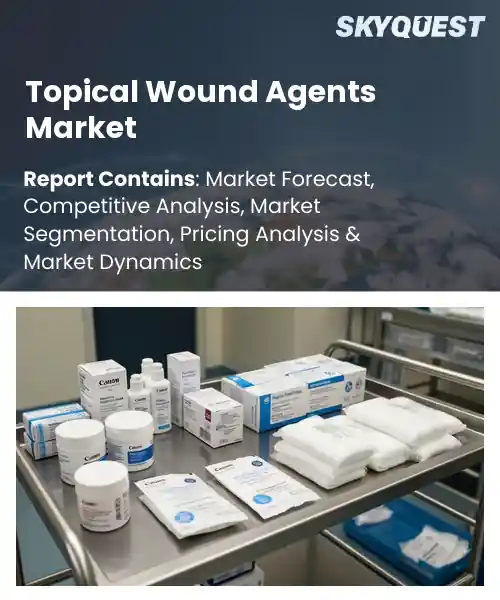
Topical Wound Agents Market
Report ID: SQMIG35I2762
Report ID: SQMIG35I2762
[email protected]
USA +1 351-333-4748
Report ID:
SQMIG35I2762 |
Region:
Global |
Published Date: June, 2026
Pages:
157
|Tables:
92
|Figures:
76


Global Topical Wound Agents Market size was valued at USD 1.6 Billion in 2024 and is poised to grow from USD 1.73 Billion in 2025 to USD 3.31 Billion by 2033, growing at a CAGR of 8.4% during the forecast period (2026-2033).
The topical agents industry is a market where the products are applied directly onto a wound or incision to stop infection and promote healing through tissue regeneration. The use of effective local therapy diminishes systemic antibiotic consumption, and significantly reduces the cost of overall patient care. The primary driving force for this segment of the market is the increasing number of patients with chronic and surgical wounds. The global market for topical agents will continue to expand as populations age, diabetes and obesity rates increase, and the number of complex procedures increase, resulting in a continued increased demand for targeted therapies. Historically the topical agents market has evolved from simple antiseptics and dressings to more advanced bioactive, cellular, and bioengineering products; examples of these include silver-based creams, hydrocolloid dressings, medicinal honey, and recombinant growth factor formulations.
A major contributor to the global expansion of the topical agents market has been advances in technology that have improved the formulation and delivery systems of topical agent products. Increased product bioactivity and targeted release translate into improved clinical efficacy, which contributes to higher reimbursement and subsequently greater adoption in both the acute and community settings. An example of this is the use of silver nanoparticle dressings to reduce the bioburden of burns and surgical sites which result in shorter lengths of stay and lower downstream costs. Another example is the use of growth factor gels for the closure of chronic diabetic foot ulcers which will decrease the number of amputations and long-term disabilities. When manufacturers prove cost effectiveness in trials and hospitals adopt evidence based protocols, investment rises toward next generation agents and expanding regional access follows while adoption scales.
How is AI Enhancing Clinical Outcomes In The Topical Wound Agents Market?
Artificial intelligence is driving better clinical results in the area of topical wound agents by making assessments of wounds more objective and aiding in the selection of therapy options based on the biology of the wound. The main features of this enhanced clinical approach are automated imaging, predictive analytics, as well as integrated care pathways that provide guidance to clinicians on making selections regarding topical antibiotics and dressings. The direction of the market for topical wound agents is moving toward the use of digital wound management platforms that provide standardized methods for measuring wounds, identifying the progression of healing, and providing the earliest identification of infection risk. These enhancements provide lower variability in clinical care, increase the speed with which clinicians make clinical choices, and allow for the establishment of more consistent responses to treatment.
Examples of this innovation are systems that convert image evaluations of the wound into actionable recommendations, simulation tools that assist in coordinating care between providers, and the ability to use a single set of documents to coordinate care for all disciplines involved in a single episode of care. In March 2026, Swift Medical received FDA clearance to utilize their portable spectral imaging system, in conjunction with their AI platform, in order to identify the presence of bacterial load on wounds earlier. Because of this capability, physicians can select targeted topical agents, leading to improved patient outcomes, and help to further the adoption of data and analytics driven clinical practice within both home health and ambulatory settings.
Market snapshot - (2026-2033)
Global Market Size
USD 1.6 Billion
Largest Segment
Antiseptics
Fastest Growth
Others
Growth Rate
8.4% CAGR
To get more insights on this market click here to Request a Free Sample Report
Global topical wound agents market is segmented by product, form, end-user and region. Based on product, the market is segmented into Antiseptics, Antibiotics, Anesthetics and Others. Based on form, the market is segmented into Creams and Ointments, Gels, Sprays and Solutions and Others. Based on end-user, the market is segmented into Hospitals and Clinics, Home Care Settings and Others. Based on region, the market is segmented into North America, Europe, Asia Pacific, Latin America and Middle East & Africa.
As per topical wound agents market analysis, due to the wide range of bacterial control that they offer, as well as their ability to be used as part of a complete care solution (i.e. both prior to surgery as actually during surgery), antiseptics account for the majority of the antimicrobial/antiseptic market segment. Additionally, when antiseptics are used in a variety of forms (e.g. sprays, gels, creams, liquids), they usually have low manufacturing costs and are relatively easily regulated, thus resulting in routine use by clinicians. This creates a continuing demand from those (acute and chronic) who require an expeditious means to reduce bioburden and avoid any complications associated with poor wound closure.
As per topical wound agents market forecast, with the growth of specific therapies targeting various pathogens associated with antibiotic resistant infections (e.g. Streptococcus, Staphylococcus), as well as further advancement in the area of sustained or prolonged, localized delivery systems of antibiotics (e.g. microencapsulation, nano drug delivery), the fastest growing segment within the wound care market will be the antibiotic segment. There has also been a significant push from clinicians for effective means of treating biofilms in their patients that have either been or will be subjected to surgical procedures. This includes various novel topical combinations that will assist with the successful management of biofilms or complex chronic wounds.
The creams and ointments dominate the market, as these products provide patients with occlusive barriers and emollients that support moist healing and epithelial growth. All wound types, both acute and chronic, have these formulations as first-line therapy. Not only do these formulations have a wide range of active ingredients and a simple manufacturing process to create large product lines, but the familiarity of healthcare providers and patients with creams and ointments usually leads to them being prescribed multiple times and used in outpatient settings where topical protection is a primary intervention.
As per topical wound agents market outlook, Gels are now expanding the fastest in terms of type of formulation, as hydrogel structures aid in providing a moist environment for wound healing, deliver bioactive compounds more effectively, and are far more comfortable for patients than conventional dressings. Advances in polymer technology combined with the addition of antimicrobial agents or growth factors will dramatically speed up the clinical adoption of hydrogel products as well as encourage innovation in product development, leading to new therapeutic uses and commercial opportunities within the field of wound care.
To get detailed segments analysis, Request a Free Sample Report
The North American topical wound care agents market is at the top due to both its superior clinical infrastructure and the existence of established reimbursement systems. North America has an extremely large number of manufacturers and researchers in the field, giving it an additional advantage over other regions. As clinicians have a high level of awareness regarding new therapy options for treating wounds, North American hospitals have established purchasing processes that prioritize proven therapy-based treatments. The strong partnership between manufacturers and academic institutions has accelerated the development of new products and their subsequent validation through clinical trials. In addition, by supporting the use of agents that produce measurable benefits in the real world, providers and integrated delivery networks provide a platform for the adoption of new products. As a result, there are very strong distribution networks and a favorable regulatory environment for medical products, which ultimately enables the rapid scaling of new formulations throughout both acute and community-based care.
The Topical Wound Agents Industry in the U.S. is supported by an established ecosystem consisting of specialized wound care facilities, high-top technology hospitals, and active clinical research, all of which have resulted in rapid adoption of innovative products and services. Both large manufacturers and agile medical technology companies benefit from strong commercial capabilities. Integrated care organizations and specialty clinics seek those therapies that will reduce complexity of care while improving healing outcomes. In addition, payer engagement and generating real world evidence will influence decisions on purchasing methodologies; and the multidisciplinary care model allows wider utilization of the agents across care settings.
The Topical Wound Agents Industry in Canada is affected by a publicly funded health care system that is primarily focused on evidence-based requirements for procurement and cost-effectiveness. The method of adopting new topical wound agents across all provinces in Canada is determined by provincial health care authorities through provincial formularies, which utilize a centrally coordinated decision making process and alignment of clinical guidelines. Most provinces in Canada have smaller populations than larger markets, which has resulted in selective uptake of products with clear clinical benefits. Co-operation between academic hospitals and industry supports local evaluation of products and clinicians are focused on solutions which will produce measurable benefits to patients and efficiencies within the health care system.
Europe is experiencing rapid expansion in the topical wound agents market due to harmonized regulatory frameworks, strong life science clusters, and increasing emphasis on integrated care pathways for chronic wounds. National health systems and payers are shifting toward value based procurement, encouraging adoption of agents that demonstrate improved clinical outcomes and care efficiency. Cross border collaboration among research institutions and industry accelerates product development and knowledge sharing, while specialty wound centers and community care programs drive demand for accessible, easy to use formulations. Local manufacturing capabilities and targeted innovation in dressings and bioactive agents further strengthen Europe position in the global market.
Topical Wound Agents Market in Germany is anchored by a robust manufacturing base, well developed hospital networks, and a high density of specialized wound care facilities that together sustain leadership in the region. Clinical evaluation and guideline driven adoption support uptake of advanced agents, while strong relationships between industry and clinician opinion leaders facilitate rapid diffusion of innovation. Reimbursement structures that value demonstrable clinical benefit encourage investment in technologies that improve healing trajectories and reduce downstream care needs.
Topical Wound Agents Market in the United Kingdom is driven by structured procurement processes within the national health system and a growing focus on innovation pathways that accelerate access for promising therapies. Community and primary care programs emphasize early intervention and continuity of wound management, creating demand for user friendly topical agents. Partnerships between academic centers and industry support locally relevant evidence generation, while clinician networks and specialist nurses play a central role in evaluating and championing new formulations across care settings.
Topical Wound Agents Market in France is emerging through targeted adoption within specialized clinics and university hospitals that test clinical and economic value of new agents. National and regional health authorities emphasize rigorous assessment of therapeutic benefit and cost effectiveness, which shapes procurement and clinical guideline recommendations. Local manufacturers and research institutes collaborate to adapt global innovations to local care pathways, while clinicians increasingly adopt evidence based topical solutions that align with broader objectives for improving patient outcomes and managing healthcare resources.
Asia Pacific is strengthening its role in the topical wound agents market through a mix of regulatory modernization, investment in local manufacturing, and expansion of advanced healthcare delivery across both public and private sectors. Increasing clinical research capacity and partnerships with global firms enable technology transfer and localized product development. Growth of specialized wound care clinics, greater access to high quality hospital services, and rising focus on chronic disease management all support higher demand for topical agents. Government initiatives to improve healthcare infrastructure and export oriented strategies from regional manufacturers further accelerate the region integration into global wound care supply chains.
Topical Wound Agents Market in Japan benefits from stringent clinical standards, a sophisticated regulatory framework for medical innovations, and a strong domestic industry that prioritizes product quality and incremental improvement. Hospitals and specialized clinics are receptive to proven therapies that align with clinical guidelines, and collaboration between manufacturers and academic centers supports robust clinical evaluation. Emphasis on patient safety and long term outcomes encourages adoption of topical agents that demonstrate consistent performance in diverse care settings.
Topical Wound Agents Market in South Korea is characterized by rapid commercialization capabilities, a dynamic biotech and medtech ecosystem, and proactive regulatory processes that facilitate market entry for innovative agents. Strong ties between industry, research institutions, and clinical centers drive swift clinical validation and scale up. Digital health integration and export orientation complement domestic growth, while clinicians and procurement bodies focus on products that offer clinical differentiation and operational efficiencies across acute and community wound care services.
To know more about the market opportunities by region and country, click here to
Buy The Complete Report
Rising Chronic Wound Incidence
Technological Advancements In Formulations
Regulatory Approval Complexity
High Treatment Cost Burden
Request Free Customization of this report to help us to meet your business objectives.
Competitive landscape in the global topical wound agents market is shaped by consolidation and technology differentiation, with strategic M&A such as Coloplast’s acquisition of Kerecis, corporate spin-outs and licensing from incumbents, and partnerships with defense and academic groups accelerating clinical development and market entry; innovation in delivery platforms and targeted topical chemistries is prompting firms to pursue exclusive licenses, distribution tie-ups and targeted commercialization in post-acute channels.
SkyQuest’s ABIRAW (Advanced Business Intelligence, Research & Analysis Wing) is our Business Information Services team that Collects, Collates, Correlates, and Analyses the Data collected by means of Primary Exploratory Research backed by robust Secondary Desk research.
As per SkyQuest analysis, the global topical wound agents market is being propelled primarily by the rising prevalence of chronic and surgical wounds, which increases demand for effective local therapies. A significant restraint is regulatory approval complexity that slows market entry and adds development costs. North America remains the dominating region due to advanced clinical infrastructure, established reimbursement and concentrated R&D. The dominating segment is antiseptics, valued for broad-spectrum, low-cost and routine use across care settings. A second driver is technological advancements in formulation and delivery, including bioactive and controlled-release systems that improve efficacy and support adoption across hospitals and home care.
| Report Metric | Details |
|---|---|
| Market size value in 2024 | USD 1.6 Billion |
| Market size value in 2033 | USD 3.31 Billion |
| Growth Rate | 8.4% |
| Base year | 2024 |
| Forecast period | (2026-2033) |
| Forecast Unit (Value) | USD Billion |
| Segments covered |
|
| Regions covered | North America (US, Canada), Europe (Germany, France, United Kingdom, Italy, Spain, Rest of Europe), Asia Pacific (China, India, Japan, Rest of Asia-Pacific), Latin America (Brazil, Rest of Latin America), Middle East & Africa (South Africa, GCC Countries, Rest of MEA) |
| Companies covered |
|
| Customization scope | Free report customization with purchase. Customization includes:-
|
To get a free trial access to our platform which is a one stop solution for all your data requirements for quicker decision making. This platform allows you to compare markets, competitors who are prominent in the market, and mega trends that are influencing the dynamics in the market. Also, get access to detailed SkyQuest exclusive matrix.
Table Of Content
Executive Summary
Market overview
Parent Market Analysis
Market overview
Market size
KEY MARKET INSIGHTS
COVID IMPACT
MARKET DYNAMICS & OUTLOOK
Market Size by Region
KEY COMPANY PROFILES
Methodology
For the Topical Wound Agents Market, our research methodology involved a mixture of primary and secondary data sources. Key steps involved in the research process are listed below:
1. Information Procurement: This stage involved the procurement of Market data or related information via primary and secondary sources. The various secondary sources used included various company websites, annual reports, trade databases, and paid databases such as Hoover's, Bloomberg Business, Factiva, and Avention. Our team did 45 primary interactions Globally which included several stakeholders such as manufacturers, customers, key opinion leaders, etc. Overall, information procurement was one of the most extensive stages in our research process.
2. Information Analysis: This step involved triangulation of data through bottom-up and top-down approaches to estimate and validate the total size and future estimate of the Topical Wound Agents Market.
3. Report Formulation: The final step entailed the placement of data points in appropriate Market spaces in an attempt to deduce viable conclusions.
4. Validation & Publishing: Validation is the most important step in the process. Validation & re-validation via an intricately designed process helped us finalize data points to be used for final calculations. The final Market estimates and forecasts were then aligned and sent to our panel of industry experts for validation of data. Once the validation was done the report was sent to our Quality Assurance team to ensure adherence to style guides, consistency & design.
Analyst Support
Customization Options
With the given market data, our dedicated team of analysts can offer you the following customization options are available for the Topical Wound Agents Market:
Product Analysis: Product matrix, which offers a detailed comparison of the product portfolio of companies.
Regional Analysis: Further analysis of the Topical Wound Agents Market for additional countries.
Competitive Analysis: Detailed analysis and profiling of additional Market players & comparative analysis of competitive products.
Go to Market Strategy: Find the high-growth channels to invest your marketing efforts and increase your customer base.
Innovation Mapping: Identify racial solutions and innovation, connected to deep ecosystems of innovators, start-ups, academics, and strategic partners.
Category Intelligence: Customized intelligence that is relevant to their supply Markets will enable them to make smarter sourcing decisions and improve their category management.
Public Company Transcript Analysis: To improve the investment performance by generating new alpha and making better-informed decisions.
Social Media Listening: To analyze the conversations and trends happening not just around your brand, but around your industry as a whole, and use those insights to make better Marketing decisions.
REQUEST FOR SAMPLE
 REQUEST FREE CUSTOMIZATION
Global Topical Wound Agents Market size was valued at USD 1.6 Billion in 2024 and is poised to grow from USD 1.73 Billion in 2025 to USD 3.31 Billion by 2033, growing at a CAGR of 8.4% during the forecast period (2026-2033).
Competitive landscape in the global topical wound agents market is shaped by consolidation and technology differentiation, with strategic M&A such as Coloplast’s acquisition of Kerecis, corporate spin-outs and licensing from incumbents, and partnerships with defense and academic groups accelerating clinical development and market entry; innovation in delivery platforms and targeted topical chemistries is prompting firms to pursue exclusive licenses, distribution tie-ups and targeted commercialization in post-acute channels. '3M Company', 'Smith & Nephew', 'Convatec Group', 'Coloplast A/S', 'Mölnlycke Health Care', 'B. Braun SE', 'Cardinal Health', 'Johnson & Johnson', 'Paul Hartmann AG', 'Essity', 'Integra LifeSciences', 'Mylan', 'Teva Pharmaceutical', 'Pfizer', 'Organogenesis Holdings', 'Medline Industries', 'Viatris', 'Mizuho OSI', 'Derma Sciences', 'Silverlon'
Growing prevalence of chronic wounds increases demand for advanced topical agents because healthcare providers and patients seek effective options to manage prolonged healing and reduce complications. Clinicians prefer formulations that support tissue repair, control bioburden, and provide moist wound environments, driving procurement and adoption. As care pathways emphasize outpatient and community-based management, topical products become integral to treatment regimens, prompting manufacturers to invest in development and distribution. Confidence in clinical utility and perceived patient benefit further encourages use and incorporation into standard wound care practices.
Advanced Bioactive Topical Agents: Advanced bioactive topical agents are gaining preference as formulators integrate antimicrobial, anti-inflammatory and regenerative components into single products to improve clinical outcomes. These multifaceted formulations enable targeted delivery, prolonged activity and compatibility with varied wound types, supporting broader adoption across care settings. Collaboration between specialty manufacturers and biotech innovators accelerates pipeline differentiation, while emphasis on patient comfort and ease of application enhances adherence in outpatient and home care. Sustainable sourcing of biopolymers further strengthens market positioning and wider stakeholder acceptance.
Why does North America Dominate the Global Topical Wound Agents Market? |@12


Want to customize this report? This report can be personalized according to your needs. Our analysts and industry experts will work directly with you to understand your requirements and provide you with customized data in a short amount of time. We offer $1000 worth of FREE customization at the time of purchase.
Feedback From Our Clients


 USA (+1) 351-333-4748

