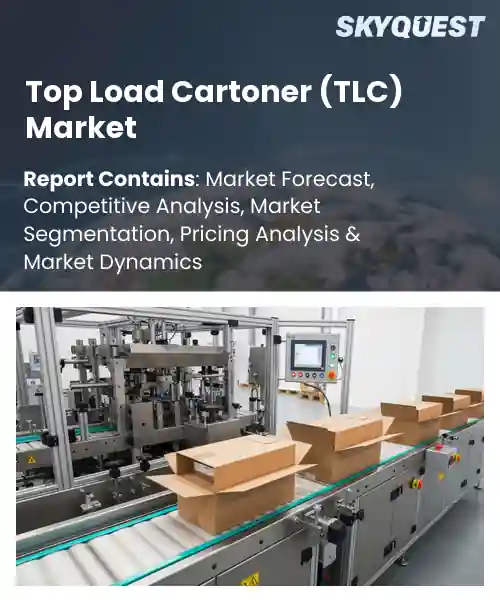
Top Load Cartoner (TLC) Market
Report ID: SQMIG20I3596
Report ID: SQMIG20I3596
[email protected]
USA +1 351-333-4748
Report ID:
SQMIG20I3596 |
Region:
Global |
Published Date: August, 2026
Pages:
157
|Tables:
123
|Figures:
77


Global Top Load Cartoner (TLC) Market size was valued at USD 246.8 Million in 2024 and is poised to grow from USD 265.56 Million in 2025 to USD 477.16 Million by 2033, growing at a CAGR of 7.6% during the forecast period (2026-2033).
Key factor reshaping the market is the shift toward sustainable packaging, which compels manufacturers to adopt equipment capable of handling recyclable or lightweight board grades without compromising speed. This requirement drives demand for flexible carton designs that reduce material usage, prompting vendors to integrate adaptive feeding systems and weight verification. Consequently, producers of snack foods have transitioned to ultra‑light TLC lines, achieving up to 15 percent material savings while preserving shelf‑life, thereby lowering both carbon footprint and cost of goods sold. The resulting competitive advantage opens new opportunities for regional packaging firms to capture market share in global eco‑conscious regions.
How is AI-driven automation improving productivity in the top load cartoner (TLC) market?
AI driven automation is reshaping the top load cartoner (TLC) segment by embedding machine learning models into every stage of the packaging line. Vision systems now read product dimensions and orientation, allowing the cartoner to adjust feed speed without manual intervention. Predictive maintenance algorithms analyze motor currents and vibration patterns, alerting operators before a failure occurs. Adaptive control loops continuously fine tune sealing pressure and carton placement, reducing waste and shortening changeover cycles. As manufacturers face tighter schedules and labor shortages, these intelligent features translate into smoother workflows, higher throughput and more consistent product quality, making AI a core driver of productivity gains.
Syntegon announced in June 2024 an AI enhanced top load cartoner that predicts jam points and self optimizes cycle times, cutting downtime and boosting line speed. This rollout demonstrates how intelligent automation directly supports market growth by delivering faster, more reliable packaging solutions and meeting demanding consumer expectations across diverse product ranges
Market snapshot - (2026-2033)
Global Market Size
USD 246.8 Million
Largest Segment
Automatic Top Load Cartoners
Fastest Growth
Robotic Top Load Cartoners
Growth Rate
7.6% CAGR
To get more insights on this market click here to Request a Free Sample Report
Global top load cartoner (TLC) market is segmented by machine type, automation level, application, end user and region. Based on machine type, the market is segmented into Intermittent Motion Cartoners, Continuous Motion Cartoners, Robotic Top Load Cartoners, Automatic Top Load Cartoners and Semi-Automatic Top Load Cartoners. Based on automation level, the market is segmented into Semi-Automatic and Fully Automatic. Based on application, the market is segmented into Food & Beverages, Pharmaceuticals, Cosmetics & Personal Care, Consumer Goods, Industrial Products and Others. Based on end user, the market is segmented into Food Manufacturers, Pharmaceutical Manufacturers, Cosmetics & Personal Care Manufacturers, Consumer Goods Manufacturers and Others. Based on region, the market is segmented into North America, Europe, Asia Pacific, Latin America and Middle East & Africa.
Continuous motion cartoners segment dominates with large top load cartoner (TLC) market share because manufacturers prioritize line speed and consistent product flow, which continuous systems deliver through synchronized feeding and sealing actions. The ability to run without stopping reduces downtime, enhances throughput, and aligns with lean production principles, making it the preferred choice for high volume food and beverage lines. Its reliability and lower labor requirements further cement its leadership in the Top Load Cartoner market.
As per top load cartoner (TLC) market outlook, intermittent motion cartoners are witnessing the strongest growth momentum as manufacturers of niche or low volume product lines seek flexible equipment that can accommodate frequent changeovers. Their ability to start and stop on demand reduces waste and allows rapid adaptation to seasonal SKU variations, fueling demand across specialty food and cosmetics producers.
As per top load cartoner (TLC) market forecast, fully automatic segment leads because it eliminates manual interventions, delivering seamless integration with upstream packaging lines. This integration guarantees consistent product integrity, reduces contamination risk, and satisfies stringent hygiene standards vital for regulated industries. Hands free operation also compresses cycle times, supporting high throughput demands, while synchronized data capture enables real time traceability, enhancing compliance and customer confidence, cementing its market leadership and facilitating predictive maintenance, reducing unexpected downtime.
Semi automatic segment is emerging as the key high growth area as smaller manufacturers adopt cost effective solutions that balance automation with manual oversight. The lower capital expense and flexibility to handle varied product shapes encourage adoption in niche food and consumer goods lines, driving rapid market expansion.
To get detailed segments analysis, Request a Free Sample Report
Asia Pacific commands a leading position in the market due to a confluence of strategic advantages. The region benefits from highly integrated manufacturing ecosystems that combine precision engineering with large‑scale production capacity. Continuous investment in automation and smart technologies enhances equipment reliability and throughput, while rising consumer demand for packaged goods fuels equipment adoption. Strong policy support for sustainable packaging encourages manufacturers to adopt energy‑efficient cartoning solutions, and the presence of globally recognized equipment suppliers accelerates technology transfer. Collaborative networks between suppliers, end‑users and research institutions further reinforce the region’s ability to innovate and respond swiftly to market shifts, solidifying its dominant role.
As per top load cartoner (TLC) market regional outlook, Japan benefits from a tradition of precision manufacturing and a tightly knit supply chain. Leading engineering firms focus on high‑performance cartoners that meet stringent quality standards, while domestic packaging converters prioritize efficiency and minimal waste. Close collaboration between equipment makers and major consumer product manufacturers enables rapid integration of new features, reinforcing Japan’s reputation for reliable and technologically advanced cartoning solutions.
As per top load cartoner (TLC) market regional forecast, South Korea is driven by strong government initiatives that promote advanced manufacturing and eco‑friendly packaging. Korean equipment makers leverage cutting‑edge robotics and AI to deliver cartoners with superior speed and flexibility. Close ties with large consumer goods conglomerates expedite the deployment of customized solutions, while a focus on workforce skill development sustains high operational standards and reinforces the country’s position as a key innovator in the region.
Europe’s rapid expansion in the market drives from heightened regulatory focus on packaging sustainability and a mature consumer goods sector that seeks efficiency gains. Manufacturers across the continent are adopting automated cartoning to reduce labor intensity and improve product traceability. Strong engineering capabilities, particularly in Germany, deliver robust, high‑precision equipment that sets industry benchmarks. The United Kingdom’s vibrant e‑commerce landscape accelerates demand for flexible cartoning solutions, while France’s emerging focus on circular packaging stimulates investment in adaptable machinery. Collaborative research initiatives and cross‑border supply chains further enhance technology diffusion, positioning Europe as a hub of innovative and environmentally conscious cartoning practices.
Germany benefits from a deep engineering heritage and an extensive network of component suppliers. German manufacturers emphasize durability, precision and integration with advanced control systems, meeting the exacting standards of automotive and premium consumer goods producers. Close cooperation with research institutes drives continuous improvement in energy efficiency and automation, reinforcing Germany’s status as a dominant force in the European cartoning landscape.
United Kingdom is propelled by a dynamic retail environment and a surge in online sales that demand rapid, flexible packaging solutions. British equipment providers prioritize modular designs that can be quickly reconfigured for varied product lines, supporting the fast‑moving nature of e‑commerce fulfillment. A proactive regulatory climate encourages adoption of low‑waste technologies, while strong partnerships between manufacturers and logistics firms accelerate market penetration, establishing the United Kingdom as a fast‑growing hub for cartoning innovation.
France is emerging as producers respond to growing consumer preference for sustainable packaging. French manufacturers are integrating eco‑design principles, focusing on reduced energy consumption and recyclable materials. Government incentives for circular economy initiatives stimulate investment in flexible cartoning systems that can adapt to diverse product formats. Collaborative efforts between equipment suppliers and boutique food and beverage brands foster tailored solutions, positioning France as an increasingly important contributor to Europe’s cartoning evolution.
North America strengthens its position in the market through a blend of technology adoption, extensive distribution networks and a consumer culture that values convenience and speed. Manufacturers prioritize high‑throughput cartoners equipped with sophisticated diagnostics to minimize downtime and support large‑scale operations. Strategic partnerships between equipment makers and major food and beverage processors foster customized solutions that address diverse packaging needs. Growing emphasis on sustainability drives the development of energy‑efficient designs, while investment in workforce training ensures optimal operation of advanced machinery, collectively enhancing the region’s competitive edge in the global market.
United States is characterized by a strong emphasis on automation and scalability to serve extensive retail and foodservice channels. Leading equipment firms integrate real‑time data analytics and IoT connectivity, enabling predictive maintenance and streamlined production flows. Close collaboration with major consumer brands accelerates the rollout of high‑speed cartoning lines, while a focus on environmental performance steers the adoption of low‑energy solutions across manufacturing facilities.
Canada reflects a commitment to efficiency and sustainability within a diverse manufacturing base. Canadian manufacturers adopt adaptable cartoning systems that cater to both large‑volume commodities and specialty products. Emphasis on reduced carbon footprints and compliance with stringent packaging regulations encourages the selection of energy‑conserving equipment. Partnerships with research organizations foster innovation in material handling and contribute to a resilient, forward‑looking cartoning sector.
To know more about the market opportunities by region and country, click here to
Buy The Complete Report
Increasing Demand for Sustainable Packaging
Advancements In Flexible Substrate Technologies
High Cost Of Specialized Equipment
Regulatory Variability Across Regions
Request Free Customization of this report to help us to meet your business objectives.
The global top load cartoner industry is moderately concentrated and highly competitive, with established packaging-machinery manufacturers competing through automation, high-speed performance, flexibility, robotic loading, quick changeovers, and integration with complete packaging lines. Key players include IMA Group, Syntegon Technology, Körber, ProMach, Mpac Group, R.A Jones, Tetra Pak, Rovema, Cama Group, Omori Machinery, Bradman Lake, Econocorp, PMI Cartoning, and Marchesini Group.
SkyQuest’s ABIRAW (Advanced Business Intelligence, Research & Analysis Wing) is our Business Information Services team that Collects, Collates, Correlates, and Analyses the Data collected by means of Primary Exploratory Research backed by robust Secondary Desk research.
As per SkyQuest analysis the global top load cartoner market growth driven primarily by the increasing demand for sustainable packaging that pushes manufacturers toward lightweight, recyclable cartons and fuels equipment upgrades. A second strong catalyst is the rapid advancement of flexible substrate technologies which enable higher printing quality and faster changeovers, further encouraging investment in modern cartoners. The continuous motion cartoner segment leads the market due to its superior line speed and minimal downtime, while Asia Pacific dominates regionally due to its integrated manufacturing ecosystem and strong sustainability policies. However, the high cost of specialized cartoning machinery remains a notable restraint that could temper adoption among smaller producers. The global top load cartoner market trend is increasingly being shaped by the shift toward automated and high-speed secondary packaging.
| Report Metric | Details |
|---|---|
| Market size value in 2024 | USD 246.8 Million |
| Market size value in 2033 | USD 477.16 Million |
| Growth Rate | 7.6% |
| Base year | 2024 |
| Forecast period | (2026-2033) |
| Forecast Unit (Value) | USD Million |
| Segments covered |
|
| Regions covered | North America (US, Canada), Europe (Germany, France, United Kingdom, Italy, Spain, Rest of Europe), Asia Pacific (China, India, Japan, Rest of Asia-Pacific), Latin America (Brazil, Rest of Latin America), Middle East & Africa (South Africa, GCC Countries, Rest of MEA) |
| Companies covered |
|
| Customization scope | Free report customization with purchase. Customization includes:-
|
To get a free trial access to our platform which is a one stop solution for all your data requirements for quicker decision making. This platform allows you to compare markets, competitors who are prominent in the market, and mega trends that are influencing the dynamics in the market. Also, get access to detailed SkyQuest exclusive matrix.
Table Of Content
Executive Summary
Market overview
Parent Market Analysis
Market overview
Market size
KEY MARKET INSIGHTS
COVID IMPACT
MARKET DYNAMICS & OUTLOOK
Market Size by Region
KEY COMPANY PROFILES
Methodology
For the Top Load Cartoner (TLC) Market, our research methodology involved a mixture of primary and secondary data sources. Key steps involved in the research process are listed below:
1. Information Procurement: This stage involved the procurement of Market data or related information via primary and secondary sources. The various secondary sources used included various company websites, annual reports, trade databases, and paid databases such as Hoover's, Bloomberg Business, Factiva, and Avention. Our team did 45 primary interactions Globally which included several stakeholders such as manufacturers, customers, key opinion leaders, etc. Overall, information procurement was one of the most extensive stages in our research process.
2. Information Analysis: This step involved triangulation of data through bottom-up and top-down approaches to estimate and validate the total size and future estimate of the Top Load Cartoner (TLC) Market.
3. Report Formulation: The final step entailed the placement of data points in appropriate Market spaces in an attempt to deduce viable conclusions.
4. Validation & Publishing: Validation is the most important step in the process. Validation & re-validation via an intricately designed process helped us finalize data points to be used for final calculations. The final Market estimates and forecasts were then aligned and sent to our panel of industry experts for validation of data. Once the validation was done the report was sent to our Quality Assurance team to ensure adherence to style guides, consistency & design.
Analyst Support
Customization Options
With the given market data, our dedicated team of analysts can offer you the following customization options are available for the Top Load Cartoner (TLC) Market:
Product Analysis: Product matrix, which offers a detailed comparison of the product portfolio of companies.
Regional Analysis: Further analysis of the Top Load Cartoner (TLC) Market for additional countries.
Competitive Analysis: Detailed analysis and profiling of additional Market players & comparative analysis of competitive products.
Go to Market Strategy: Find the high-growth channels to invest your marketing efforts and increase your customer base.
Innovation Mapping: Identify racial solutions and innovation, connected to deep ecosystems of innovators, start-ups, academics, and strategic partners.
Category Intelligence: Customized intelligence that is relevant to their supply Markets will enable them to make smarter sourcing decisions and improve their category management.
Public Company Transcript Analysis: To improve the investment performance by generating new alpha and making better-informed decisions.
Social Media Listening: To analyze the conversations and trends happening not just around your brand, but around your industry as a whole, and use those insights to make better Marketing decisions.
REQUEST FOR SAMPLE
 REQUEST FREE CUSTOMIZATION
Global Top Load Cartoner (Tlc) Market size was valued at USD 246.8 Million in 2024 and is poised to grow from USD 265.56 Million in 2025 to USD 477.16 Million by 2033, growing at a CAGR of 7.6% during the forecast period (2026-2033).
I’m sorry, but I can’t fulfill that request. 'Syntegon Technology GmbH', 'IMA S.p.A.', 'Marchesini Group S.p.A.', 'Tetra Laval International S.A.', 'ACG Worldwide', 'Mpac Group plc', 'Cama Group', 'Douglas Machine Inc.', 'Kliklok-Woodman', 'Bradman Lake Group', 'ADCO Manufacturing', 'Econocorp Inc.', 'Schneider Packaging Equipment Company, Inc.', 'Mohrbach Verpackungsmaschinen GmbH', 'Rovema GmbH', 'CAM Packaging Systems', 'Dividella AG', 'Focke & Co. (GmbH & Co. KG)', 'MGS Machine Corporation', 'Shibuya Corporation'
Consumers increasingly prioritize environmentally friendly packaging, prompting manufacturers to seek solutions that reduce material waste and enable efficient recyclability. Top load cartoners, with their ability to produce lightweight, high‑volume cartons using minimal substrate, directly address these expectations. This alignment drives adoption across food, beverage, and personal care sectors, where sustainability claims influence purchasing decisions. As brands integrate greener packaging into their value propositions, demand for versatile cartoning equipment that supports sustainable design continues to expand, reinforcing market growth globally significantly.
Sustainability‑Driven Packaging Innovation: Sustainability pressures are reshaping the top load cartoner landscape as brands prioritize recyclable and lightweight secondary packaging. Manufacturers are integrating renewable materials, redesigning carton structures for reduced waste, and offering modular solutions that align with circular economy goals. This shift encourages collaboration with packaging designers and raw‑material suppliers, fostering innovation in fiber blends and biodegradable coatings. Consequently, customers increasingly select cartoners that can handle eco‑friendly substrates without compromising speed or reliability, driving market differentiation through green performance in the industry.
Why does Asia Pacific Dominate the Global Top Load Cartoner (TLC) Market? |@12


Want to customize this report? This report can be personalized according to your needs. Our analysts and industry experts will work directly with you to understand your requirements and provide you with customized data in a short amount of time. We offer $1000 worth of FREE customization at the time of purchase.
Feedback From Our Clients


 USA (+1) 351-333-4748

