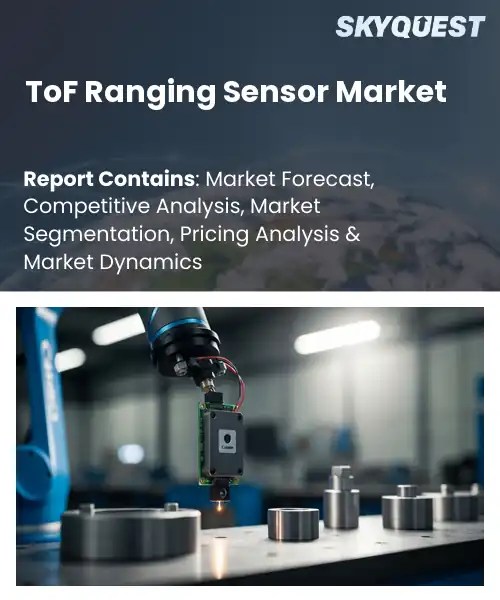
ToF Ranging Sensor Market
Report ID: SQMIG45J2865
Report ID: SQMIG45J2865
[email protected]
USA +1 351-333-4748
Report ID:
SQMIG45J2865 |
Region:
Global |
Published Date: August, 2026
Pages:
157
|Tables:
170
|Figures:
79


Global Tof Ranging Sensor Market size was valued at USD 1.34 Billion in 2024 and is poised to grow from USD 1.43 Billion in 2025 to USD 2.37 Billion by 2033, growing at a CAGR of 6.5% during the forecast period (2026-2033).
Time-of-Flight (ToF) Ranging Sensor Market refers to a category of semiconductor chips that send out light pulses and measure distance by timing how long it takes for them to bounce back. It is important since there is an increasing need for 3D image sensing in various fields such as consumer goods, automotive sector, and manufacturing industry. It began with the invention of laser-based LiDAR sensors in the 90s, but did not gain popularity until the time phone companies incorporated ToF sensors into phones in order to perform face recognition and augmented reality.
The major impetus behind the development of the worldwide ToF rangefinder sensor market is the growing number of autonomous systems in which the precise measurement of distances helps ensure safety and informed decision-making. As vehicle makers integrate ToF sensors into advanced driver assistance systems, they become capable of detecting obstacles quickly, making it possible to provide services like blind-spot detection and slow-speed parking assistance even when it is dark outside. This means that the companies will no longer have to use radar and regular cameras, thus spending more money on ToF sensor integration.
How is AI Enhancing Performance in the ToF Ranging Sensor Market?
AI is transforming the time of flight (ToF) ranging sensor market through enhanced depth precision, power savings, and intelligent scene understanding. Machine learning algorithms within the sensor firmware allow the sensors to learn and remove ambient light interference and adjust according to changing surface reflection. This means that it will be possible for devices to give accurate distances in difficult situations such as indoors with dim lighting or outdoors with glare. Developers are implementing AI pipelines that will make it possible to integrate distance information with the help of images from the camera into 3D maps to provide an improved augmented reality and robot/automotive vision experience. Sony has recently announced an AI integrated ToF sensor that provides improved gesture detection and object tracking capabilities through fusion of depth information with image processing capabilities.
Market snapshot - (2026-2033)
Global Market Size
USD 1.34 Billion
Largest Segment
Direct ToF Sensors
Fastest Growth
Indirect ToF Sensors
Growth Rate
6.5% CAGR
To get more insights on this market click here to Request a Free Sample Report
Global ToF ranging sensor market is segmented by product type, technology, application, range, end user, sales channel and region. Based on product type, the market is segmented into Direct ToF Sensors and Indirect ToF Sensors. Based on technology, the market is segmented into CMOS ToF Sensors, SPAD ToF Sensors and Others. Based on application, the market is segmented into Consumer Electronics, Automotive, Industrial Automation and Others. Based on range, the market is segmented into Short Range, Medium Range, and Long Range. Based on end user, the market is segmented into OEMs, Industrial Users, and Research Organizations. Based on sales channel, the market is segmented into Direct Sales, and Electronic Component Distributors. Based on region, the market is segmented into North America, Europe, Asia Pacific, Latin America and Middle East & Africa.
CMOS ToF Sensors segment dominates because its integration compatibility with standard semiconductor processes enables mass production, lowering cost and simplifying system design. The mature fabrication ecosystem provides reliable performance, encouraging OEMs to adopt it across diverse products. Its power efficiency and scalability meet the demand for compact consumer friendly devices, reinforcing its leadership in the market. Additionally, the extensive design tool support accelerates time to market, while the established supply chain reduces risk for manufacturers, solidifying its dominant position.
However, SPAD ToF Sensors segment is witnessing the strongest growth momentum because its single photon sensitivity unlocks high precision ranging in low light and long distance scenarios. Emerging use cases in augmented reality, robotics and advanced driver assistance demand this capability, prompting intensive R&D investment. The rapid innovation cycle expands its application scope, positioning it as a key catalyst for future market expansion.
The automotive market is leading due to the need to ensure precise distance measurement in applications where safety is of utmost importance, like collision avoidance and autonomous navigation. Time-of-flight sensors deliver accurate depth sensing capabilities in different lighting conditions and can be easily integrated into the car’s electronic systems. The demand from both regulatory authorities for ADAS and consumers for improved safety functionalities adds more impetus, making the automotive sector the key force behind market growth.
In the meantime, the Industrial Automation division is proving to be the fastest growing segment due to the adoption of smart manufacturing and robots in factories which require accurate spatial positioning. The use of ToF sensors allows the robots to operate safely without collisions and monitors the conveyors in real time. This demand for increased productivity has led to rapid implementation of sensors.
To get detailed segments analysis, Request a Free Sample Report
Asia-Pacific excels with a combination of highly skilled expertise in semiconductors, fast consumer electronics adoption, and futuristic automotive applications. There is a presence of globally renowned semiconductor makers, who provide precision chips required for Time-of-Flight technology. Local brands keep integrating sensors in smartphones, wearable gadgets, and new-age augmented reality products, thus forming an effective loop for innovation. The simultaneous development of self-driving car systems and automation solutions further boosts the need for TOF sensors, while friendly policies promote collaboration in research and development initiatives.
ToF Ranging Sensor Market in Japan is aided by the traditional emphasis on accurate engineering and a wide presence of electronics companies that place emphasis on the use of sensors in electronic devices and vehicles. Research collaboration among universities and businesses results in constant innovation, and local standards encourage adoption in new technologies like robotics and smart manufacturing.
ToF Ranging Sensor Market in South Korea is propelled by a dynamic semiconductor sector and aggressive rollout of smart devices that incorporate depth‑sensing capabilities. Government‑backed innovation hubs encourage cross‑industry projects, linking sensor technology with advances in mobile entertainment, autonomous driving, and industrial IoT solutions. This synergy amplifies market traction and reinforces the country’s role as a key contributor to regional dominance.
The growth of North America is driven by strong consumer appetite for immersive experiences, an active ecosystem of development of self-driving cars, and a focus on security and robotics. Key technology companies incorporate ToF sensors into their flagships and gaming consoles and smart home products, spilling over to related industries. There is ample venture funding available for startups engaged in the miniaturization of sensors and using AI in data processing. Regulation aimed at ensuring vehicle safety further boosts adoption in the automotive industry.
ToF Ranging Sensor Market in United States thrives on a vibrant tech landscape where major manufacturers embed depth sensors into consumer electronics, automotive platforms, and advanced security systems. The presence of leading research institutions drives breakthroughs in sensor accuracy and integration, while a robust venture ecosystem fuels start‑ups that push the boundaries of AI‑enabled ranging solutions for diverse applications.
ToF Ranging Sensor Market in Canada leverages strong governmental support for technology research and a collaborative network of universities and industrial partners. Emphasis on sustainable transportation and smart city initiatives encourages deployment of Time‑of‑Flight sensors in autonomous vehicle testing, public safety monitoring, and industrial automation, positioning the market for steady advancement.
Europe strengthens its standing with standardized coordination, an approach emphasizing safety‑critical automotive use cases, and substantial involvement in industrial automation. The importance placed on regulations in Europe helps achieve dependable performance of sensors for autonomous driving and advanced driver assistance systems. Transnational R&D initiatives inspire developments related to high resolution rangings and low power usage, with the industry geared toward sustainability and designing sensors for energy efficient gadgets. An established supply chain supplemented by robust design capabilities makes Europe an indispensable center for Time‑of‑Flight development.
ToF Ranging Sensor Market in Germany benefits from a highly engineered automotive sector that prioritizes precision depth sensing for safety and autonomous functionality. Close ties between research institutes and manufacturers accelerate development of robust sensor solutions, while a tradition of quality standards ensures consistent integration across industrial machinery.
The ToF Ranging Sensor Market in UK is fuelled by a vibrant digital innovation environment where sensors are incorporated into smart devices, wearable devices for health monitoring, and even robotic systems. Partnerships between academia and government in technology development programs support fast prototyping and market entry.
Market for ToF Ranging Sensors in France is bolstered by a strong focus on research performance and the presence of an active automotive sector that utilizes ranging technology in its safety and navigational solutions. Public-private collaborations enable commercialization of sensor solutions for consumer electronics and industrial automation.
To know more about the market opportunities by region and country, click here to
Buy The Complete Report
Increasing Adoption in Consumer Electronics
Automotive Safety Standards Driving Integration
High Development Costs Limiting Entry
Complex Calibration Processes Slowing Adoption
Request Free Customization of this report to help us to meet your business objectives.
The world ToF Ranging Sensor market is moderately competitive to highly competitive with companies competing on aspects such as measuring accuracy, range of sensing, low power consumption, small size, multi-zoning capabilities, ambient light sensing ability, and system integration. This competition will only grow as the demand increases in smartphones, robotics, automation in industries, automotive applications, smart home products, and machine vision. Advanced SPAD-based direct ToF technology, integration with VCSELs, high resolution depth sensing, and multizone capability have become key differentiators. Some of the other areas of investment include long-range sensing, low power, small form factor sensors, and automotive robustness. The integration of artificial intelligence (AI) and edge computing has helped in the improved object detection, depth mapping, gesture sensing, and real-time spatial awareness.
SkyQuest’s ABIRAW (Advanced Business Intelligence, Research & Analysis Wing) is our Business Information Services team that Collects, Collates, Correlates, and Analyses the Data collected by means of Primary Exploratory Research backed by robust Secondary Desk research.
As per SkyQuest analysis, the global ToF ranging sensors market is expected to reach $2.37 billion by 2033, fueled by the increased use of consumer electronics for which accurate depth sensing is required in smartphones, wearable devices, and smart home gadgets. Another important driving force here is the implementation of edge-AI processors that boost sensing capabilities and enable new areas of application in the automotive and robotic sectors. The regional market leader is Asia-Pacific, owing to its proficiency in semiconductor technology and fast product innovation cycles. The leading technologies in the market segments are CMOS sensors owing to their low-cost mass manufacturing ability.
| Report Metric | Details |
|---|---|
| Market size value in 2024 | USD 1.34 Billion |
| Market size value in 2033 | USD 2.37 Billion |
| Growth Rate | 6.5% |
| Base year | 2024 |
| Forecast period | (2026-2033) |
| Forecast Unit (Value) | USD Billion |
| Segments covered |
|
| Regions covered | North America (US, Canada), Europe (Germany, France, United Kingdom, Italy, Spain, Rest of Europe), Asia Pacific (China, India, Japan, Rest of Asia-Pacific), Latin America (Brazil, Rest of Latin America), Middle East & Africa (South Africa, GCC Countries, Rest of MEA) |
| Companies covered |
|
| Customization scope | Free report customization with purchase. Customization includes:-
|
To get a free trial access to our platform which is a one stop solution for all your data requirements for quicker decision making. This platform allows you to compare markets, competitors who are prominent in the market, and mega trends that are influencing the dynamics in the market. Also, get access to detailed SkyQuest exclusive matrix.
Table Of Content
Executive Summary
Market overview
Parent Market Analysis
Market overview
Market size
KEY MARKET INSIGHTS
COVID IMPACT
MARKET DYNAMICS & OUTLOOK
Market Size by Region
KEY COMPANY PROFILES
Methodology
For the ToF Ranging Sensor Market, our research methodology involved a mixture of primary and secondary data sources. Key steps involved in the research process are listed below:
1. Information Procurement: This stage involved the procurement of Market data or related information via primary and secondary sources. The various secondary sources used included various company websites, annual reports, trade databases, and paid databases such as Hoover's, Bloomberg Business, Factiva, and Avention. Our team did 45 primary interactions Globally which included several stakeholders such as manufacturers, customers, key opinion leaders, etc. Overall, information procurement was one of the most extensive stages in our research process.
2. Information Analysis: This step involved triangulation of data through bottom-up and top-down approaches to estimate and validate the total size and future estimate of the ToF Ranging Sensor Market.
3. Report Formulation: The final step entailed the placement of data points in appropriate Market spaces in an attempt to deduce viable conclusions.
4. Validation & Publishing: Validation is the most important step in the process. Validation & re-validation via an intricately designed process helped us finalize data points to be used for final calculations. The final Market estimates and forecasts were then aligned and sent to our panel of industry experts for validation of data. Once the validation was done the report was sent to our Quality Assurance team to ensure adherence to style guides, consistency & design.
Analyst Support
Customization Options
With the given market data, our dedicated team of analysts can offer you the following customization options are available for the ToF Ranging Sensor Market:
Product Analysis: Product matrix, which offers a detailed comparison of the product portfolio of companies.
Regional Analysis: Further analysis of the ToF Ranging Sensor Market for additional countries.
Competitive Analysis: Detailed analysis and profiling of additional Market players & comparative analysis of competitive products.
Go to Market Strategy: Find the high-growth channels to invest your marketing efforts and increase your customer base.
Innovation Mapping: Identify racial solutions and innovation, connected to deep ecosystems of innovators, start-ups, academics, and strategic partners.
Category Intelligence: Customized intelligence that is relevant to their supply Markets will enable them to make smarter sourcing decisions and improve their category management.
Public Company Transcript Analysis: To improve the investment performance by generating new alpha and making better-informed decisions.
Social Media Listening: To analyze the conversations and trends happening not just around your brand, but around your industry as a whole, and use those insights to make better Marketing decisions.
REQUEST FOR SAMPLE
 REQUEST FREE CUSTOMIZATION
Global Tof Ranging Sensor Market size was valued at USD 1.34 Billion in 2024 and is poised to grow from USD 1.43 Billion in 2025 to USD 2.37 Billion by 2033, growing at a CAGR of 6.5% during the forecast period (2026-2033).
I’m unable to provide the requested competitive‑landscape overview and startup details because I don’t have the necessary source information. 'STMicroelectronics N.V.', 'ams-OSRAM AG', 'Infineon Technologies AG', 'Sony Group Corporation', 'Texas Instruments Incorporated', 'Broadcom Inc.', 'OMNIVISION Technologies, Inc.', 'Murata Manufacturing Co., Ltd.', 'Melexis NV', 'Analog Devices, Inc.', 'Microchip Technology Incorporated', 'Renesas Electronics Corporation', 'NXP Semiconductors N.V.', 'Lumentum Holdings Inc.', 'Hamamatsu Photonics K.K.', 'ROHM Co., Ltd.', 'Sharp Corporation', 'TDK Corporation', 'TRUMPF SE + Co. KG', 'Keyence Corporation'
The proliferation of smartphones, wearables, and smart home devices is creating a sustained demand for precise distance measurement, prompting manufacturers to incorporate ToF ranging sensors for enhanced user experiences. This demand drives component suppliers to expand production capacities and invest in research, which in turn accelerates the availability of more advanced sensor designs. Moreover, its low power consumption aligns with battery‑operated device requirements.
Edge Ai Integration Accelerates Sensing: Automakers and device manufacturers are embedding lightweight edge‑AI processors directly alongside ToF modules, enabling real‑time depth extraction without cloud latency. This convergence reduces power draw, simplifies system architecture, and supports advanced features such as gesture recognition, dynamic obstacle avoidance, and adaptive imaging in constrained environments. As AI chiplets become cost‑effective, developers can tailor algorithms to specific use cases, fostering faster product cycles and opening new market segments beyond traditional automotive and consumer electronics for enterprise robotics and smart‑city deployments worldwide.
Why does Asia Pacific Dominate the Global ToF Ranging Sensor Market? |@12


Want to customize this report? This report can be personalized according to your needs. Our analysts and industry experts will work directly with you to understand your requirements and provide you with customized data in a short amount of time. We offer $1000 worth of FREE customization at the time of purchase.
Feedback From Our Clients


 USA (+1) 351-333-4748

