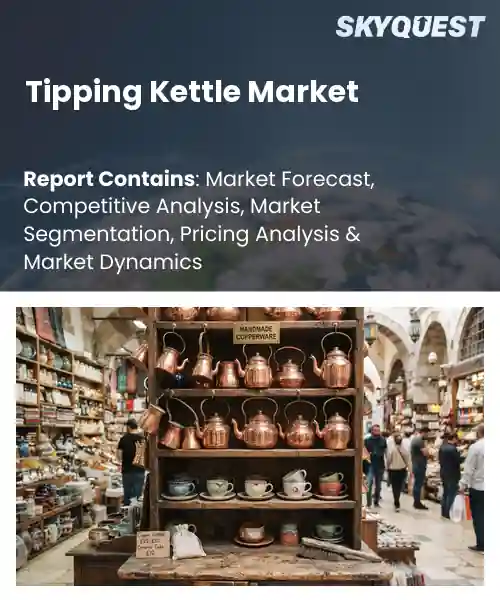
Tipping Kettle Market
Report ID: SQMIG25H2182
Report ID: SQMIG25H2182
[email protected]
USA +1 351-333-4748
Report ID:
SQMIG25H2182 |
Region:
Global |
Published Date: August, 2026
Pages:
157
|Tables:
175
|Figures:
79


Global Tipping Kettle Market size was valued at USD 284.7 Million in 2024 and is poised to grow from USD 299.5 Million in 2025 to USD 449.3 Million by 2033, growing at a CAGR of 5.2% during the forecast period (2026-2033).
The global tipping kettle market comprises automated kettles that tilt to pour water, primarily used in commercial hospitality, healthcare, and office environments. Its importance stems from the need for hands‑free operation, hygiene compliance, and energy efficiency, which together drive adoption across high‑traffic venues. Historically, the market emerged in the early 2000s when manufacturers introduced sensor‑based tilt mechanisms to replace manual pour pots. Over the past decade, rapid urbanization and rising demand for contact‑less solutions have accelerated deployment, illustrated by large hotel chains retrofitting lobby cafés with tipping kettles. Consequently, the sector has evolved from niche equipment to a mainstream amenity. Energy conservation regulations represent the pivotal factor shaping the next phase of the tipping kettle market, because they compel operators to adopt devices that minimize standby loss and control heating cycles. Manufacturers respond by integrating IoT thermostats and algorithms that shut down the element when usage patterns indicate inactivity, thereby reducing utility bills for large cafeterias. This capability unlocks opportunities in corporate campuses where monitoring can synchronize units, leading to significant carbon‑footprint reductions documented in a case study of a bank’s headquarters. As cost‑savings become quantifiable, procurement decisions increasingly favor smart tipping kettles, expanding market penetration beyond traditional hospitality venues.
How is IoT integration influencing efficiency in the tipping kettle market?
IoT integration is reshaping the tipping kettle market by embedding sensors that monitor temperature, usage patterns and water levels in real time. These data streams enable automatic adjustments that keep kettles at optimal heat while preventing over‑boiling, which conserves energy and extends equipment life. Remote dashboards let operators track performance across multiple locations, allowing swift response to anomalies before they cause downtime. Predictive analytics use historical usage to schedule maintenance only when needed, reducing unnecessary service visits. The seamless link between kettles and inventory systems also streamlines refill processes, cutting labor and minimizing waste. Together these capabilities create a more responsive, efficient ecosystem that supports higher throughput without sacrificing quality.In June 2023, a leading kettle manufacturer launched an IoT‑enabled tipping kettle that syncs with inventory platforms, reducing refill cycles and cutting energy waste, thereby boosting operational efficiency and supporting market growth.
Market snapshot - (2026-2033)
Global Market Size
USD 284.7 Million
Largest Segment
Manual Tipping Kettles
Fastest Growth
Electric Tipping Kettles
Growth Rate
5.2% CAGR
To get more insights on this market click here to Request a Free Sample Report
Global tipping kettle market is segmented by product type, capacity, application, end user, heating source, sales channel and region. Based on product type, the market is segmented into Manual Tipping Kettles, Electric Tipping Kettles, Steam-Jacketed Tipping Kettles and Others. Based on capacity, the market is segmented into Up to 100 Liters, 101–300 Liters and Above 300 Liters. Based on application, the market is segmented into Food Processing, Commercial Kitchens, Institutional Catering and Others. Based on end user, the market is segmented into Food Manufacturers, Hotels & Restaurants, Institutional Kitchens and Others. Based on heating source, the market is segmented into Electric, Steam, Gas and Others. Based on sales channel, the market is segmented into Direct Sales, Foodservice Equipment Distributors and Others. Based on region, the market is segmented into North America, Europe, Asia Pacific, Latin America and Middle East & Africa.
Manual tipping kettles segment dominates because they align with the cost sensitive preferences of many food processors and institutional kitchens that prioritize simplicity and low maintenance. Their mechanical operation eliminates reliance on complex electrical or steam systems, reducing installation hurdles and downtime. This reliability fosters trust among operators who need consistent batch processing, and the lower upfront investment encourages broader adoption across small and medium scale operations throughout the market industry and supply chain.
However, electric tipping kettles are witnessing the strongest growth momentum because advances in energy efficient heating elements and smart controls are expanding their appeal in high volume commercial kitchens. These innovations enable precise temperature management and faster turnaround, attracting operators seeking productivity gains, and they are driving new equipment investments that broaden market reach.
Up to 100 liters segment dominates because it meets the volume requirements of most food processing lines and institutional catering operations that handle moderate batch sizes. The compact footprint fits within space constrained production floors, while the lower thermal mass reduces heating time, delivering quicker cycles. These attributes lower operational costs and simplify workflow integration, prompting widespread selection across diverse users seeking efficient, scalable solutions throughout the industry lifecycle and long term value creation today.
Meanwhile, above 300 liters is emerging as the key high growth area because large scale manufacturers are scaling production to meet rising demand for bulk food items. The increased capacity enables continuous operation with fewer changeovers, enhancing efficiency, and manufacturers are investing in these bigger units to future proof their lines, stimulating market expansion.
To get detailed segments analysis, Request a Free Sample Report
Europe dominates the global Tipping Kettle Market because of a mature hospitality sector, strong emphasis on premium coffee experiences, and well‑established distribution networks. Consumers in the region value high‑quality brewing equipment, driving retailers and specialty coffee chains to adopt advanced kettle designs. Engineering expertise and a tradition of precision manufacturing in key countries support continuous product innovation, while sustainability concerns encourage the development of energy‑efficient models. Collaborative relationships between equipment manufacturers, coffee roasters, and barista training institutions create a feedback loop that refines kettle performance. Moreover, regulatory frameworks that prioritize safety and environmental standards reinforce market confidence, encouraging both domestic and international players to focus their efforts on Europe as a benchmark for product excellence. The region’s focus on artisanal coffee culture also fuels demand for precise temperature control, reinforcing the appeal of tipping kettles among discerning baristas.
Germany Tipping Kettle Market
Tipping Kettle Market in Germany benefits from an appreciation for culinary artistry and a specialty coffee culture. French consumers seek kettles that combine aesthetic elegance with precise temperature regulation, prompting manufacturers to focus on design refinement. Partnerships with boutique cafés and culinary schools foster knowledge exchange, enhancing the functionality of pour‑over techniques. Sustainability concerns encourage the adoption of low‑energy models, reinforcing France’s position as a hub for refined brewing experiences.
United Kingdom Tipping Kettle Market
Tipping Kettle Market in the United Kingdom is shaped by a café scene and a tradition of tea and coffee craftsmanship. Retailers prioritize kettles that deliver consistent temperature control, aligning with consumer expectations for brews. Collaborative innovation between local manufacturers and barista schools drives the integration of ergonomic designs and precise pour mechanisms. Environmental awareness pushes the market toward energy‑efficient models, reinforcing the United Kingdom reputation for quality brewing equipment.
France Tipping Kettle Market
Tipping Kettle Market in France benefits from an appreciation for culinary artistry and a specialty coffee culture. French consumers seek kettles that combine aesthetic elegance with precise temperature regulation, prompting manufacturers to focus on design refinement. Partnerships with boutique cafés and culinary schools foster knowledge exchange, enhancing the functionality of pour‑over techniques. Sustainability concerns encourage the adoption of low‑energy models, reinforcing France’s position as a hub for refined brewing experiences.
The rapid expansion of the Tipping Kettle Market in North America is propelled by a convergence of consumer enthusiasm for specialty coffee, a thriving chain of independent cafés, and a culture that celebrates artisanal brewing techniques. Retailers respond to demand for equipment that offers precise temperature control and consistent pour performance, essential for high‑quality espresso and pour‑over preparations. Collaboration between kettle manufacturers and barista training institutes accelerates product innovation, while sustainability narratives push the adoption of energy‑efficient designs. The presence of influential coffee influencers and media platforms amplifies awareness, encouraging both home enthusiasts and professional operators to upgrade their brewing tools. Additionally, robust distribution channels and a competitive landscape foster rapid product rollout, reinforcing North America’s position as a dynamic growth engine for tipping kettle technology.
United States Tipping Kettle Market
Tipping Kettle Market in the United States thrives on a coffee ecosystem that ranges from large‑scale chains to third‑wave cafés. Consumers prioritize kettles that deliver precise temperature stability, supporting the popularity of pour‑over and cold‑brew methods. Manufacturers partner with specialty coffee roasters to fine‑tune kettle performance, while sustainability initiatives drive the development of low‑energy models. This blend of innovation, consumer education, and market scale sustains demand across the United States.
Canada Tipping Kettle Market
Tipping Kettle Market in Canada is influenced by an emphasis on sustainability and an appreciation for coffee experiences. Canadian consumers seek kettles that combine efficiency with precise temperature control, aligning with values and the demand for consistent brew quality. Partnerships between local roasters and equipment manufacturers foster tailored solutions that address taste preferences. Initiatives by barista schools reinforce the importance of pour techniques, driving adoption of tipping kettles in Canada.
Asia Pacific is strengthening its position in the Tipping Kettle Market through a blend of technological innovation, rising specialty coffee consumption, and a cultural shift toward premium brewing experiences. Manufacturers in the region leverage advanced engineering capabilities to produce kettles with refined temperature precision and ergonomic designs that cater to both professional baristas and discerning home users. Growing coffee education programs and competitive café ecosystems in key economies stimulate demand for equipment that supports consistent pour‑over and espresso extraction. Sustainability agendas encourage the development of low‑energy models, while collaborations with local roasters accelerate product customization for regional taste profiles. This dynamic environment positions Asia Pacific as an emerging hub for next‑generation tipping kettle solutions.
Japan Tipping Kettle Market
Tipping Kettle Market in Japan is driven by an approach to coffee preparation and an appreciation for design aesthetics. Japanese consumers value kettles that deliver precise temperature control. Local manufacturers use quality materials and minimalist design, matching preferences for elegance. Partnerships with specialty coffee shops and barista training institutes give feedback that improves kettle performance. The focus on sustainability encourages adoption of models, reinforcing Japan’s reputation for refined brewing technology.
South Korea Tipping Kettle Market
Tipping Kettle Market in South Korea is shaped by a coffee culture that embraces drinks and equipment. Korean consumers prioritize kettles with rapid heating and temperature stability for pour‑over and cold‑brew beverages. Domestic manufacturers integrate smart features and sleek aesthetics, matching preferences. Collaboration with roasters and barista academies drives customization to suit flavor profiles. Environmental awareness encourages interest in energy‑saving designs, reinforcing South Korea’s role in the tipping kettle landscape.
To know more about the market opportunities by region and country, click here to
Buy The Complete Report
Increasing Home Brewing Enthusiasm
Growing Demand For Energy Efficiency
Higher Production Costs Limit Adoption
Regulatory Standards Delay Market Entry
Request Free Customization of this report to help us to meet your business objectives.
In the global tipping kettle market, incumbents have accelerated growth through strategic M&A—such as a 2025 acquisition of a smart‑temperature sensor firm by a leading kettle manufacturer—while forging partnerships with smart‑home ecosystems to embed IoT capabilities, and investing in proprietary heating technology to differentiate product lines.
Top Player’s Company Profile
Recent Developments
SkyQuest’s ABIRAW (Advanced Business Intelligence, Research & Analysis Wing) is our Business Information Services team that Collects, Collates, Correlates, and Analyses the Data collected by means of Primary Exploratory Research backed by robust Secondary Desk research. As per SkyQuest analysis, the global tipping kettle market is propelled primarily by the surge in home‑brewing enthusiasm, which fuels demand for precise, user‑friendly kettles, while the growing emphasis on energy efficiency serves as a second catalyst, encouraging manufacturers to embed smart heating and IoT controls. Europe emerges as the dominant region, benefitting from a mature hospitality sector and strong sustainability standards, and the manual tipping kettle segment leads the market thanks to its low cost and reliability for small‑scale operations. However, higher production costs associated with advanced materials and smart features act as a restraint, tempering broader adoption until price pressures ease.
| Report Metric | Details |
|---|---|
| Market size value in 2024 | USD 284.7 Million |
| Market size value in 2033 | USD 449.3 Million |
| Growth Rate | 5.2% |
| Base year | 2024 |
| Forecast period | (2026-2033) |
| Forecast Unit (Value) | USD Million |
| Segments covered |
|
| Regions covered | North America (US, Canada), Europe (Germany, France, United Kingdom, Italy, Spain, Rest of Europe), Asia Pacific (China, India, Japan, Rest of Asia-Pacific), Latin America (Brazil, Rest of Latin America), Middle East & Africa (South Africa, GCC Countries, Rest of MEA) |
| Companies covered |
|
| Customization scope | Free report customization with purchase. Customization includes:-
|
To get a free trial access to our platform which is a one stop solution for all your data requirements for quicker decision making. This platform allows you to compare markets, competitors who are prominent in the market, and mega trends that are influencing the dynamics in the market. Also, get access to detailed SkyQuest exclusive matrix.
Table Of Content
Executive Summary
Market overview
Parent Market Analysis
Market overview
Market size
KEY MARKET INSIGHTS
COVID IMPACT
MARKET DYNAMICS & OUTLOOK
Market Size by Region
KEY COMPANY PROFILES
Methodology
For the Tipping Kettle Market, our research methodology involved a mixture of primary and secondary data sources. Key steps involved in the research process are listed below:
1. Information Procurement: This stage involved the procurement of Market data or related information via primary and secondary sources. The various secondary sources used included various company websites, annual reports, trade databases, and paid databases such as Hoover's, Bloomberg Business, Factiva, and Avention. Our team did 45 primary interactions Globally which included several stakeholders such as manufacturers, customers, key opinion leaders, etc. Overall, information procurement was one of the most extensive stages in our research process.
2. Information Analysis: This step involved triangulation of data through bottom-up and top-down approaches to estimate and validate the total size and future estimate of the Tipping Kettle Market.
3. Report Formulation: The final step entailed the placement of data points in appropriate Market spaces in an attempt to deduce viable conclusions.
4. Validation & Publishing: Validation is the most important step in the process. Validation & re-validation via an intricately designed process helped us finalize data points to be used for final calculations. The final Market estimates and forecasts were then aligned and sent to our panel of industry experts for validation of data. Once the validation was done the report was sent to our Quality Assurance team to ensure adherence to style guides, consistency & design.
Analyst Support
Customization Options
With the given market data, our dedicated team of analysts can offer you the following customization options are available for the Tipping Kettle Market:
Product Analysis: Product matrix, which offers a detailed comparison of the product portfolio of companies.
Regional Analysis: Further analysis of the Tipping Kettle Market for additional countries.
Competitive Analysis: Detailed analysis and profiling of additional Market players & comparative analysis of competitive products.
Go to Market Strategy: Find the high-growth channels to invest your marketing efforts and increase your customer base.
Innovation Mapping: Identify racial solutions and innovation, connected to deep ecosystems of innovators, start-ups, academics, and strategic partners.
Category Intelligence: Customized intelligence that is relevant to their supply Markets will enable them to make smarter sourcing decisions and improve their category management.
Public Company Transcript Analysis: To improve the investment performance by generating new alpha and making better-informed decisions.
Social Media Listening: To analyze the conversations and trends happening not just around your brand, but around your industry as a whole, and use those insights to make better Marketing decisions.
REQUEST FOR SAMPLE
 REQUEST FREE CUSTOMIZATION


Want to customize this report? This report can be personalized according to your needs. Our analysts and industry experts will work directly with you to understand your requirements and provide you with customized data in a short amount of time. We offer $1000 worth of FREE customization at the time of purchase.
Feedback From Our Clients


 USA (+1) 351-333-4748

