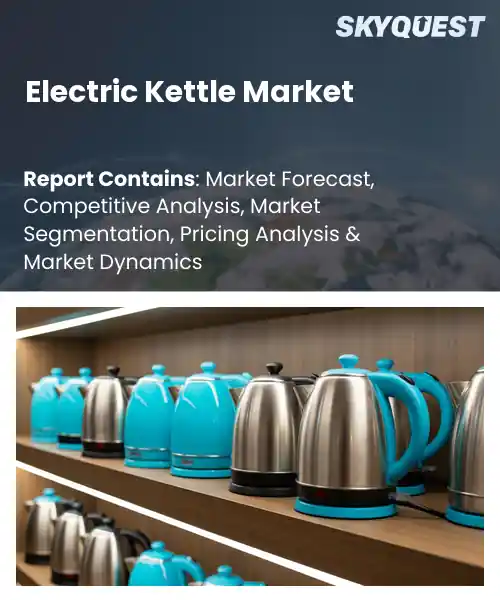
Electric Kettle Market
Report ID: SQMIG30K2098
Report ID: SQMIG30K2098
[email protected]
USA +1 351-333-4748
Report ID:
SQMIG30K2098 |
Region:
Global |
Published Date: June, 2026
Pages:
157
|Tables:
169
|Figures:
79


Global Electric Kettle Market size was valued at USD 2.1 Billion in 2024 and is poised to grow from USD 2.23 Billion in 2025 to USD 3.55 Billion by 2033, growing at a CAGR of 6.0% during the forecast period (2026-2033).
Electric kettle market centers on small electric appliances designed to rapidly boil water for domestic and commercial use, and its primary driver has been rising urbanization coupled with growing consumer demand for convenience and energy efficiency. The market matters because shifting lifestyles increase reliance on quick hot-water solutions in kitchens, offices, and hospitality settings, transforming kettles from luxury gadgets into everyday necessities. Over time product development moved from simple resistive elements to rapid-boil technologies, automatic shutoff, and smart connectivity, illustrated by brands introducing stainless-steel rapid-boil models and Wi-Fi-enabled units that integrate with home assistants, reshaping purchase criteria and aftermarket services.Advances in energy-efficient heating elements represent a key factor driving global market expansion because reduced boil times and lower electricity consumption directly lower operating costs for consumers and businesses, prompting higher replacement and adoption rates. For example, cafes and co-working spaces adopt rapid-boil stainless steel kettles to increase service speed, which in turn raises bulk procurement by institutional buyers and incentivizes manufacturers to scale production and innovate pricing. Similarly, smart features that allow remote control and scheduling create opportunities in subscription services and data-driven maintenance, so manufacturers can offer extended warranties and after-sales platforms that deepen customer loyalty, margin growth.
How is IoT expanding the smart electric kettle market?
IoT is transforming the smart electric kettle market by adding connectivity remote control and data driven features. Key aspects include app based scheduling precise temperature presets voice assistant integration and over the air updates that refine performance. The current market is shifting from simple thermostatic kettles to connected appliances that offer personalized brewing routines energy aware modes and remote monitoring. This is making kettles more appealing to specialty tea and coffee drinkers and to smart home adopters. Brands are responding with models that emphasize user experience and software led differentiation to stand out in a crowded market.Breville May 2026, launched the Smart Kettle Luxe with built in Wi Fi and voice assistant compatibility demonstrating how IoT enabled app control cloud based updates personalized brewing profiles and smart home integration boost convenience extend product longevity and improve energy efficiency.
Market snapshot - (2026-2033)
Global Market Size
USD 2.1 Billion
Largest Segment
Standard Electric Kettles
Fastest Growth
Multi-functional Kettles
Growth Rate
6.0% CAGR
To get more insights on this market click here to Request a Free Sample Report
Global electric kettle market is segmented by product type, material, capacity, application, distribution channel, end-user and region. Based on product type, the market is segmented into Standard Electric Kettles, Gooseneck Kettles, Travel / Portable Kettles and Multi-functional Kettles. Based on material, the market is segmented into Stainless Steel, Plastic and Glass. Based on capacity, the market is segmented into Below 1 Liter, 1–1.5 Liters and Above 1.5 Liters. Based on application, the market is segmented into Residential and Commercial. Based on distribution channel, the market is segmented into Online and Offline. Based on end-user, the market is segmented into Individual Consumers and Commercial Users. Based on region, the market is segmented into North America, Europe, Asia Pacific, Latin America and Middle East & Africa.
Standard Electric Kettles segment dominates because these models meet broad consumer needs with straightforward functionality, accessible pricing, and compatibility with daily routines, making them the default purchase for many households and basic commercial settings. Widespread retail presence and established manufacturing scale lower costs and ensure dependable supply, while simple controls and reliable heating performance reinforce consumer confidence and fuel steady replacement and replenishment demand across channels.
However, gooseneck kettles are emerging as the most rapidly expanding product type, driven by specialty coffee and tea brewing demand for precision pouring and refined temperature management. Design-forward aesthetics, premium branding, and enthusiast communities accelerate adoption among specialty consumers and boutique hospitality operators, creating high-margin opportunities and encouraging complementary accessories and service-driven offerings that expand overall market potential.
Stainless Steel segment leads because its material properties align with consumer priorities for durability, perceived safety, and a premium finish, enabling manufacturers to position products at higher value points. Corrosion resistance and thermal stability support longer appliance life and consistent performance, reducing after-sales issues and enhancing brand reputation. These advantages steer product development toward stainless platforms, encouraging integration of advanced features and stronger retail support across diverse sales channels.
However, Glass is witnessing the strongest growth momentum because visible boiling action and sleek aesthetics resonate with design focused buyers and premium kitchen trends. Advances in heat resistant glass and incorporation of lighting or smart controls are fueling niche premium launches, driving new mid and high end product opportunities and stimulating cross category innovation that elevates overall market value.
To get detailed segments analysis, Request a Free Sample Report
Asia Pacific dominates the global electric kettle market because of a convergence of consumer behavior, manufacturing capability and design innovation. High household adoption of convenient boiling appliances, strong cultural preference for hot beverages, and urban living patterns support steady demand. Well-established manufacturing bases enable rapid product development and cost-effective supply chains, while regional brands emphasize energy efficiency, rapid heating technologies and compact form factors tailored to dense living environments. Distribution networks spanning traditional retail, modern trade and expanding e-commerce channels ensure wide market penetration. Collaboration between component suppliers and appliance manufacturers accelerates feature integration such as temperature control and safety functions. Regulatory frameworks that encourage energy performance and consumer safety further reinforce market leadership and continuous product refinement. Design trends prioritize compact multi-functionality to suit varied consumer lifestyles. After-sales ecosystems improve brand trust and repeat purchases.
Electric Kettle Market Japan focuses on premium build quality, refined aesthetics and advanced temperature control tailored to discerning consumers. Local manufacturers emphasize silent operation, durable materials and compact styling for urban dwellings. Product differentiation arises through precise heating profiles, user intuitive interfaces and premium finishes that align with kitchen design trends. Strong aftermarket support and established retail partnerships ensure visibility, while focused innovation continues to elevate value among loyal shoppers.
Electric Kettle Market South Korea prioritizes smart connectivity, sleek design and rapid heating solutions that resonate with tech oriented consumers. Domestic brands focus on integration with home ecosystems, intuitive controls and stylish finishes suited to modern kitchens. Competitive component suppliers support product iterations and feature updates. Strong emphasis on quality assurance, user convenience and brand marketing drives premium positioning in urban retail channels and growing appeal in regional export markets.
Rapid expansion of the electric kettle market in Europe is driven by shifting consumer preferences toward convenience, energy mindful appliances and refined kitchen aesthetics. Consumers increasingly value precise temperature control and multifunctionality that support tea and specialty beverage rituals, while sustainability considerations elevate demand for energy efficient designs. Robust retail ecosystems combining established brick and mortar outlets with sophisticated online channels facilitate product discovery and comparison. Local manufacturers and international brands respond with regionally adapted features, premium finishes and enhanced safety standards that align with stringent regulatory expectations. Seasonal purchasing patterns and lifestyle trends in urban centers further amplify market activity. Cross border distribution and focused marketing strategies amplify brand reach, supporting a dynamic competitive landscape centered on innovation and consumer experience.
Electric Kettle Market Germany emphasizes engineering led reliability, energy conscious performance and adherence to rigorous safety standards that influence product selection. Domestic and international brands focus on durable components, clear user interfaces and long term serviceability favored by pragmatic consumers. Retail channels prioritize demonstrated quality and certified compliance, while professional endorsements and specialized appliance retailers support premium buying behaviors. Brand reputation and practical innovation remain central to ongoing market leadership.
Electric Kettle Market United Kingdom is characterized by dynamic consumer experimentation with specialty beverages, premium design preferences and strong online retail engagement. Brands introduce modular temperature control, artisanal finishes and targeted marketing to capture discerning buyers. Pop up retail, social influence and targeted promotions accelerate adoption of innovative features. Emphasis on sustainability, compact form factors and user experiences resonates with urban households and supports expansion across mainstream and niche channels.
Electric Kettle Market France shows emerging demand driven by appreciation for refined culinary habits, specialty tea culture and design appliances that complement contemporary kitchens. Brands introduce elegant finishes, compact footprints and user friendly controls to appeal to style conscious buyers. Retailtainment, culinary influencers and boutique channels support discovery of premium offerings. Emphasis on sustainable materials and discreet functionality positions products for uptake across modern urban households and lifestyle led segments.
North America is strengthening its position in the electric kettle market through a combination of product adaptation, channel evolution and consumer education. Manufacturers and brands prioritize safety features, easy maintenance and versatility to meet broad household expectations. Emphasis on energy efficiency tied to consumer awareness campaigns and retailer support is enhancing product consideration. Innovation highlights include integration with smart home platforms, modular designs and finishes that align with diverse kitchen décors. Expanding specialty retail, targeted online campaigns and growing acceptance of premium accessories stimulate category visibility. Collaboration between appliance makers and distributors improves aftermarket services and warranty offerings, helping to build trust among first time buyers and seasoned consumers and reinforcing regional competitiveness. Localized product assortments and co branding with beverage companies deepen category relevance. Greater investment in post purchase support and extended retail presence strengthens consumer confidence.
Electric Kettle Market United States reflects diverse consumer segments including appliance enthusiasts seeking smart functionality and premium styling. Retail variety includes mass market, specialty kitchen stores and robust e-commerce platforms enabling product discovery and comparison. Brands focus on smart integrations, versatile temperature settings and clear safety messaging to meet varied expectations. Service networks, warranties and targeted marketing around beverages and cooking rituals broadly encourage adoption across urban and suburban households.
Electric Kettle Market Canada is shaped by consumer focus on energy efficiency, compact designs and reliable safety features suitable for smaller kitchens. Brands emphasize low energy consumption, easy maintenance and subdued styling that aligns with Canadian kitchen trends. Growth is supported by strong retail partnerships, regional distributors and focused online merchandising. Emphasis on sustainable materials and clear product information helps consumers make informed appliance choices and nurtures steady category development.
To know more about the market opportunities by region and country, click here to
Buy The Complete Report
Smart Appliance Adoption Accelerates Demand
E Commerce Expansion Improves Access
Consumer Safety and Perception Issues
Supply Chain Complexity Limits Availability
Request Free Customization of this report to help us to meet your business objectives.
Competition in the global electric kettle market is intensifying as incumbents defend share through brand consolidation and channel partnerships while challengers push connectivity and UX improvements; key drivers tied to competition include rapid IoT feature rollouts and retailer alliances. Real strategic moves are visible: Groupe SEB’s multi-brand consolidation, BRU AG securing Innosuisse and retail ties, and WeeKett shipping WiFi and voice-enabled kettles—something that elevates connectivity requirements.
Top Player’s Company Profile
Recent Developments
SkyQuest’s ABIRAW (Advanced Business Intelligence, Research & Analysis Wing) is our Business Information Services team that Collects, Collates, Correlates, and Analyses the Data collected by means of Primary Exploratory Research backed by robust Secondary Desk research. As per SkyQuest analysis, the global electric kettle market is propelled by advances in energy-efficient heating elements as a key driver, while a second driver is the rapid expansion of e-commerce improving access and product discovery for consumers. A restraint is ongoing consumer safety and perception issues related to standards and occasional malfunctions that can slow replacement cycles. Asia Pacific dominates the market thanks to high household adoption, strong manufacturing bases and wide distribution networks, and standard electric kettles remain the dominating segment due to their broad functionality, affordability and retail availability. These dynamics are guiding manufacturers toward connected features, durable materials and channel diversification.
| Report Metric | Details |
|---|---|
| Market size value in 2024 | USD 2.1 Billion |
| Market size value in 2033 | USD 3.55 Billion |
| Growth Rate | 6.0% |
| Base year | 2024 |
| Forecast period | (2026-2033) |
| Forecast Unit (Value) | USD Billion |
| Segments covered |
|
| Regions covered | North America (US, Canada), Europe (Germany, France, United Kingdom, Italy, Spain, Rest of Europe), Asia Pacific (China, India, Japan, Rest of Asia-Pacific), Latin America (Brazil, Rest of Latin America), Middle East & Africa (South Africa, GCC Countries, Rest of MEA) |
| Companies covered |
|
| Customization scope | Free report customization with purchase. Customization includes:-
|
To get a free trial access to our platform which is a one stop solution for all your data requirements for quicker decision making. This platform allows you to compare markets, competitors who are prominent in the market, and mega trends that are influencing the dynamics in the market. Also, get access to detailed SkyQuest exclusive matrix.
Table Of Content
Executive Summary
Market overview
Parent Market Analysis
Market overview
Market size
KEY MARKET INSIGHTS
COVID IMPACT
MARKET DYNAMICS & OUTLOOK
Market Size by Region
KEY COMPANY PROFILES
Methodology
For the Electric Kettle Market, our research methodology involved a mixture of primary and secondary data sources. Key steps involved in the research process are listed below:
1. Information Procurement: This stage involved the procurement of Market data or related information via primary and secondary sources. The various secondary sources used included various company websites, annual reports, trade databases, and paid databases such as Hoover's, Bloomberg Business, Factiva, and Avention. Our team did 45 primary interactions Globally which included several stakeholders such as manufacturers, customers, key opinion leaders, etc. Overall, information procurement was one of the most extensive stages in our research process.
2. Information Analysis: This step involved triangulation of data through bottom-up and top-down approaches to estimate and validate the total size and future estimate of the Electric Kettle Market.
3. Report Formulation: The final step entailed the placement of data points in appropriate Market spaces in an attempt to deduce viable conclusions.
4. Validation & Publishing: Validation is the most important step in the process. Validation & re-validation via an intricately designed process helped us finalize data points to be used for final calculations. The final Market estimates and forecasts were then aligned and sent to our panel of industry experts for validation of data. Once the validation was done the report was sent to our Quality Assurance team to ensure adherence to style guides, consistency & design.
Analyst Support
Customization Options
With the given market data, our dedicated team of analysts can offer you the following customization options are available for the Electric Kettle Market:
Product Analysis: Product matrix, which offers a detailed comparison of the product portfolio of companies.
Regional Analysis: Further analysis of the Electric Kettle Market for additional countries.
Competitive Analysis: Detailed analysis and profiling of additional Market players & comparative analysis of competitive products.
Go to Market Strategy: Find the high-growth channels to invest your marketing efforts and increase your customer base.
Innovation Mapping: Identify racial solutions and innovation, connected to deep ecosystems of innovators, start-ups, academics, and strategic partners.
Category Intelligence: Customized intelligence that is relevant to their supply Markets will enable them to make smarter sourcing decisions and improve their category management.
Public Company Transcript Analysis: To improve the investment performance by generating new alpha and making better-informed decisions.
Social Media Listening: To analyze the conversations and trends happening not just around your brand, but around your industry as a whole, and use those insights to make better Marketing decisions.
REQUEST FOR SAMPLE
 REQUEST FREE CUSTOMIZATION


Want to customize this report? This report can be personalized according to your needs. Our analysts and industry experts will work directly with you to understand your requirements and provide you with customized data in a short amount of time. We offer $1000 worth of FREE customization at the time of purchase.
Feedback From Our Clients


 USA (+1) 351-333-4748

