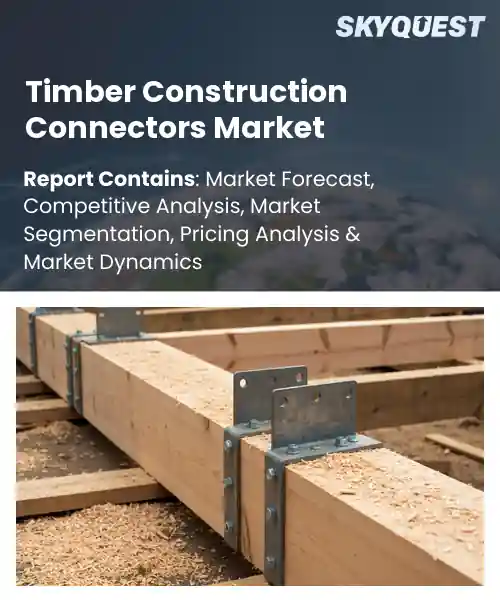
Timber Construction Connectors Market
Report ID: SQMIG20C2208
Report ID: SQMIG20C2208
[email protected]
USA +1 351-333-4748
Report ID:
SQMIG20C2208 |
Region:
Global |
Published Date: May, 2026
Pages:
157
|Tables:
179
|Figures:
79


Global Timber Construction Connectors Market size was valued at USD 1.4 Billion in 2024 and is poised to grow from USD 1.59 Billion in 2025 to USD 4.38 Billion by 2033, growing at a CAGR of 13.5% during the forecast period (2026-2033).
The timber construction connectors market is currently experiencing growth partially as a result of the global trend towards sustainable building methods that have risen engineered wood from a niche product to one widely used. The timber construction connectors market supplies a variety of products (such as metal plates, brackets, splines and fasteners) used to connect glue-laminated (glulam) beams, cross-laminated timbers (CLT) and prefabricated timber products together in both residential and commercial projects. The reason for the importance of this connector market is that timber provides significant CO2 sequestration benefits as well as a more efficient method of constructing buildings compared to steel and concrete due to the speed at which timber can be assembled on site; therefore, many architects and developers are now specifying glulam or CLT as the main material for mid-rise buildings.
Historically, timber construction connectors have evolved from simple nail systems to more sophisticated engineered connector systems via innovation by manufacturers to adapt to the new building codes related to timber, structural safety and fire safety. Two primary factors that are shaping the global timberConstruction Connectors market are the occurrence of regulatory harmonization and performance-driven innovation as both updated building codes and the development of new timber construction projects require high-capacity connectors that are designed to meet building code requirements and be certified for their use.
As codes have started to recognize engineered timber as an acceptable material for constructing taller buildings, subsequently manufacturers have produced certified, pre-tested new products that can be incorporated into engineered timber projects and provide designers with predictable load paths when using engineered timber. For example, as designers specify engineered timber for projects such as multi-family dwellings, schools and office towers, they will be able to do so with confidence using either a pre-tested metal plate, concealed joint or seismic-rated fastener. This cause-effect loop expands opportunities for prefabrication, reduces on-site labor costs and accelerates project schedules, which in turn attracts developers seeking sustainability and speed, opening markets in urban infill, modular housing and infrastructure applications.
How is AI Improving Design Optimization In The Timber Construction Connectors Market?
The Timber Construction Connectors market is transforming, due to the integration of generative design, structural simulation and data driven decision-making. Designers are now benefiting from faster iterations and being able to provide builders with more complete specifications since AI has enabled designers to identify compliance risk while creating new variations of connectors. Furthermore, the combination of AI with connector selection significantly reduces material waste through compressed lead time from the designer's concept to the shop drawings. Examples of this include: generative algorithms that develop new shapes for connectors; and automated approvals that convert structural requirements for connectors into manufacturable products.
Because of the integration of AI, the Timber Construction Connectors market is evolving to respond to broader movements around mass timber and prefabrication in the timber construction market. The introduction of new mass timber connectors by Simpson Strong-Tie in January 2026 demonstrates the overall digital revolution happening in this industry, as well as allowing for faster specification of connectors and fewer instances of rework when utilizing AI powered design and catalog search tools, thus allowing designers to make decisions more quickly and improving project delivery timelines.
Market snapshot - (2026-2033)
Global Market Size
USD 1.4 Billion
Largest Segment
Joist Hangers
Fastest Growth
Holdowns & Tension Connectors
Growth Rate
13.5% CAGR
To get more insights on this market click here to Request a Free Sample Report
Global timber construction connectors market is segmented by product type, material type, application, connector type, end user, distribution channel and region. Based on product type, the market is segmented into Joist Hangers, Angle Brackets, Beam Connectors, Post Bases, Holdowns & Tension Connectors and Others. Based on material type, the market is segmented into Steel Connectors, Stainless Steel Connectors, Galvanized Connectors and Others. Based on application, the market is segmented into Residential Construction, Commercial Construction, Industrial Construction and Infrastructure Projects. Based on connector type, the market is segmented into Structural Connectors, Framing Connectors, Shear Connectors and Fastening Systems. Based on end user, the market is segmented into Construction Companies, Contractors & Carpenters, Infrastructure Developers and DIY Consumers. Based on distribution channel, the market is segmented into Direct Sales, Distributors & Dealers, Home Improvement Stores and Online Sales. Based on region, the market is segmented into North America, Europe, Asia Pacific, Latin America and Middle East & Africa.
As per timber construction connectors market analysis, Joist Hangars are the most widely used segment of the overall Building Connections Market. Given that these devices allow for the standardized/approved/load bearing connections necessary to build floor and ceiling systems, the demand for them has been so high that it is now the most commonly specified connection by engineers and used by contractors. Their ability to provide predictable performance allows designers and inspectors to successfully perform their jobs. Because they come in a variety of load capacities and finishes, the amount of customization that would normally have to be done at the job site is greatly reduced. This means less labor for contractors and no uncertainty in procurement; therefore, manufacturers must concentrate on producing the highest quality products and delivering them reliably to maintain their position as the leader in the market.
As per timber construction connectors market forecast, the use of Angle Brackets is increasing rapidly due to the demand for retrofitted solutions and modular timber assemblies needing to connect at 90 degree angles. In addition, new adjustable and corrosion-proof designs are providing contractors installation options that allow them to connect materials quickly and add value to their projects. This also creates new opportunities for procurement and driving increased usage in renovation and prefabrication activities.
The Distributors and Dealers segment clearly takes the lead in supplying the market because distributors have sufficient inventory depth, are experienced in providing the technical assistance customers require, and can deliver to construction sites in a timely manner. These three areas correlate with meeting the varied needs of timber construction projects and are therefore the primary source of how contractors procure the products they need. Distributors support their contractor customers by bundling value added services such as providing specifications, custom ordering, and providing flexible payment terms which help mitigate risk to the contractor and ease supply chain coordination. This ease of doing business encourages frequent use of distributors by contractors and infrastructure developers and creates a stable revenue source for manufacturers.
As per timber construction connectors market outlook, Online sales growth continues to be the fastest growing segment in the market due to the increase in small contractor and DIY customers using digital catalogs to order their products easily. The availability of product information and product compatibility tools reduces friction when making purchasing decisions and the use of scalable fulfillment and direct-to-user delivery channels creates new demand segments for retailers and manufacturers to serve.
To get detailed segments analysis, Request a Free Sample Report
As per timber construction connectors market regional analysis, by integrating a mix of advanced manufacturing capacity, rigorous building codes that support engineered timber use, and mature networks of suppliers that promote innovations in the industry; Europe leads the way in the timber connectors for construction market. This long history of specialized expertise in precision metal and timber joinery allows for rapid development of high-performance connector systems. The collaboration between trade associations, research institutions, and various organizations facilitates the exchange of information and knowledge amongst all stakeholders. The combination of high demand in cities for sustainable building and city re-development, coupled with a pre-existing network of distribution throughout neighboring countries, reduces logistical barriers to using engineered timber solutions. The regulatory framework surrounding the market continues to require environmentally friendly and sustainable products, which benefits manufacturers in Europe who have successfully gone through a certification process and comply with the requirements of quality assurance. As a result, both the ability and willingness to create a diverse line of products geared toward engineered timber solutions has allowed European manufacturers to dominate their respective markets. Access to skilled labor and a long-standing tradition of fine craftsmanship using wood will help develop high-quality and custom-designed products. In addition, European manufacturers are located close to specialized component suppliers, reducing the time it takes to bring products to market.
Germany's timber construction connectors market is driven by a growing timber industry and an increasing number of advanced metal fabrication capabilities that result in greater connector solution diversity. To meet the structural timber application needs of the industry, manufacturers have placed an emphasis on testing and ensuring compliance with specific high-level building codes. Research studies have also fostered innovative product development through partnerships between researchers and timber construction manufacturers. Robust established export channels coupled with an adequate skilled labour population assist with scalability. The emphasis on sustainable and durable products further establishes German timber construction connector manufacturers as reliable partners for engineered timber projects throughout the domestic and European market.
In the UK, the timber construction connectors market growth use combined with changes to building regulations has resulted in increased demand from the market for certified timber construction connector systems designed for a variety of projects. Manufacturers are producing either standard connector products or developing adaptive connector products designed to work with modular timber assemblies. Continuous product improvement is supported by partnerships formed between research facilities and timber connector manufacturers. The extensive established distribution networks used by manufacturers in combination with a highly skilled contractor base provide for prompt and professional installation of timber connectors. Building on the strong reputation for sustainability and performance of UK timber connection products will serve to further strengthen the reputation of UK timber connectors among their customers in the domestic marketplace.
Timber Construction Connectors Market in France a tradition in timber construction combined with rising interest in engineered timber promotes connector innovation. French manufacturers emphasize design integration and aesthetic compatibility while ensuring compliance with national building norms for diverse urban and rural projects. Partnerships between engineering firms and metal fabricators enable bespoke connector development, and focus on lifecycle performance and sustainability encourages use by architects and contractors.
As per timber construction connectors market regional outlook, the market is growing rapidly throughout North America due to several factors. First is the rise of engineered wood systems; second is the investment in prefabrication and modular construction; and third is the increased focus on resilient and low carbon building practices. There is a strong structure of innovative suppliers, independent testing labs, and construction contractors that enable rapid product validation and market entry. In addition, creating mass timber will generate demand for appropriate connectors needed for large scale construction projects. Local producers use advanced production methods and work closely with designers to develop connector solutions for seismic, wind, and transfer loads, thereby furthering overall market growth in regions with different climates and regulations. Additionally, supportive policy environments, targeted incentives for green building practices, and investments in labor and supply chain capacity, will continue to drive growth within regional markets.
Timber Construction Connectors Market in USA is driven by the adoption of mass timber and modular construction techniques continues to drive the creation of innovative high-performance connectors; however, these connectors must also comply with many different types of building codes from region to region. There is an increasing need for connection systems and materials that can meet governmental regulatory requirements as well as the requirements set forth by architectural firms, engineering firms and research facilities. The enhancement of the supply chain for connection systems has helped create a network of contractors with expertise in both prefabrication and assembly on job sites. Designers have identified the necessity of using certified connection systems to achieve resilient and sustainable structures when working on regional timber projects in diverse climatic urban locales.
Timber Construction Connectors Market in Canada is driven by the demand for adaptable connection systems has been directly influenced by Canadian forest management practices, and the continued use of engineered wood. As a result, the emphasis on the performance of connection systems in cold climates and the compatibility of those connection systems to prefabrication techniques has become the primary area of focus for manufacturers. Collaboration with provincial governments and technical institutes assists manufacturers with developing and testing connection systems while ensuring compliance with applicable codes and standards. Long-established timber supply chain and fabrication capabilities have created the ability for manufacturers to scale their operations for future demand. The ability to provide environmentally-friendly connection systems and to specify certified connection systems has become a major driving force behind architects, engineers, and contractors desire for sustainable timber materials.
Asia Pacific is strengthening its role in the timber construction connectors market through targeted investment in manufacturing capability, standards harmonization efforts, and increased adoption of engineered timber in commercial and residential projects. Regional manufacturers are enhancing precision fabrication and coating technologies to meet durability and performance demands in diverse climates. Growing collaboration between designers, construction firms, and certification bodies accelerates acceptance of certified connector systems. Governments and private investors are promoting sustainable building practices and supply chain integration, while local production reduces lead times and supports customization. Intensified research and development, workforce training programs, and cross border trade partnerships further enhance product quality and expedite market adoption by major developers. Together these dynamics foster a more competitive regional offering that complements established exporters and addresses unique market needs across urbanizing economies.
Timber Construction Connectors Market in Japan is driven by engineering expertise and precision manufacturing underpin development of quality connector systems designed for seismic resilience and durability. Japanese firms prioritize rigorous testing, protective coatings, and integration with modular timber construction. Collaboration with research institutions and architects supports uptake in urban redevelopment and compact housing. Emphasis on sustainability and material efficiency, together with local production capacity, strengthens competitiveness in domestic and nearby regional markets and exports.
Timber Construction Connectors Market in South Korea is driven by manufacturing strength and adoption of advanced construction methods increase demand for durable, precision connectors for dense urban projects. Korean producers emphasize corrosion resistant finishes, efficient assembly, and integration with prefabricated timber modules. Cooperation with architects and construction firms enables tailored solutions for commercial and residential developments. Focus on innovation, export orientation, and sustainability alignment advances South Korea role in broader regional connector supply chains.
To know more about the market opportunities by region and country, click here to
Buy The Complete Report
Sustainability Preference In Construction
The heightened preference for eco-friendly and low carbon construction materials has redirected the design and purchase process away from steel and concrete structures and towards timber construction, thereby necessitating an increase in the amount of connectors supplied to facilitate safe and efficient timber connection. The emphasis that architects and developers are placing on using materials and systems which provide positive environmental impacts is driving the specification of engineered connectors that support tall timber and mass timber applications. This desire for verifiable sustainability is stimulating product development and supplier involvement as manufacturers extend their connector offerings and provide value-added services to accommodate changing performance and certification requirements, thus facilitating further growth of the marketplace.
Advances In Connector Technology
Limited Standardization Across Regions
Manufacturers and specifiers encounter challenges in obtaining approvals and penetrating the market due to inconsistent standards and different building codes by jurisdiction. With different certification regimes or various regions calling for connectivity devices to function based on their geographical location, there are longer development cycles, increased costs associated with testing and documenting devices, which leads to fewer reasons for pursuing new markets. Local architects and builders would prefer to use tried and true systems to reduce compliance risk, thereby inhibiting the growth of global product launches, thereby impacting the speed of adoption of new connector solutions into the marketplace.
Supply Chain Material Constraints
Request Free Customization of this report to help us to meet your business objectives.
Competitive landscape is driven by rapid CLT and prefabrication adoption that forces suppliers to differentiate through partnerships, product innovation, and consolidation; firms pursue acquisitions and platform partnerships to secure supply chains. Examples include Simpson Strong-Tie expanding CLT connector ranges, Rothoblaas launching a WOODY connector for prefabrication, and marketplace consolidation moves such as MaterialsXchange joining forces with a B2B platform.
SkyQuest’s ABIRAW (Advanced Business Intelligence, Research & Analysis Wing) is our Business Information Services team that Collects, Collates, Correlates, and Analyses the Data collected by means of Primary Exploratory Research backed by robust Secondary Desk research.
As per SkyQuest analysis, a key driver is the global shift toward sustainable building practices that favor engineered timber and boost demand for certified connectors, while a second driver is continuous advances in connector technology that improve performance, prefabrication and ease of installation. A notable restraint is fragmented standards and limited harmonization across regions, which complicates approvals and slows market expansion. Europe remains the dominating region due to mature manufacturing, stringent codes and strong industry networks. Joist hangers are the dominating segment because their standardized, predictable load performance makes them the default choice for floor and ceiling systems across residential and commercial projects.
| Report Metric | Details |
|---|---|
| Market size value in 2024 | USD 1.4 Billion |
| Market size value in 2033 | USD 4.38 Billion |
| Growth Rate | 13.5% |
| Base year | 2024 |
| Forecast period | (2026-2033) |
| Forecast Unit (Value) | USD Billion |
| Segments covered |
|
| Regions covered | North America (US, Canada), Europe (Germany, France, United Kingdom, Italy, Spain, Rest of Europe), Asia Pacific (China, India, Japan, Rest of Asia-Pacific), Latin America (Brazil, Rest of Latin America), Middle East & Africa (South Africa, GCC Countries, Rest of MEA) |
| Companies covered |
|
| Customization scope | Free report customization with purchase. Customization includes:-
|
To get a free trial access to our platform which is a one stop solution for all your data requirements for quicker decision making. This platform allows you to compare markets, competitors who are prominent in the market, and mega trends that are influencing the dynamics in the market. Also, get access to detailed SkyQuest exclusive matrix.
Table Of Content
Executive Summary
Market overview
Parent Market Analysis
Market overview
Market size
KEY MARKET INSIGHTS
COVID IMPACT
MARKET DYNAMICS & OUTLOOK
Market Size by Region
KEY COMPANY PROFILES
Methodology
For the Timber Construction Connectors Market, our research methodology involved a mixture of primary and secondary data sources. Key steps involved in the research process are listed below:
1. Information Procurement: This stage involved the procurement of Market data or related information via primary and secondary sources. The various secondary sources used included various company websites, annual reports, trade databases, and paid databases such as Hoover's, Bloomberg Business, Factiva, and Avention. Our team did 45 primary interactions Globally which included several stakeholders such as manufacturers, customers, key opinion leaders, etc. Overall, information procurement was one of the most extensive stages in our research process.
2. Information Analysis: This step involved triangulation of data through bottom-up and top-down approaches to estimate and validate the total size and future estimate of the Timber Construction Connectors Market.
3. Report Formulation: The final step entailed the placement of data points in appropriate Market spaces in an attempt to deduce viable conclusions.
4. Validation & Publishing: Validation is the most important step in the process. Validation & re-validation via an intricately designed process helped us finalize data points to be used for final calculations. The final Market estimates and forecasts were then aligned and sent to our panel of industry experts for validation of data. Once the validation was done the report was sent to our Quality Assurance team to ensure adherence to style guides, consistency & design.
Analyst Support
Customization Options
With the given market data, our dedicated team of analysts can offer you the following customization options are available for the Timber Construction Connectors Market:
Product Analysis: Product matrix, which offers a detailed comparison of the product portfolio of companies.
Regional Analysis: Further analysis of the Timber Construction Connectors Market for additional countries.
Competitive Analysis: Detailed analysis and profiling of additional Market players & comparative analysis of competitive products.
Go to Market Strategy: Find the high-growth channels to invest your marketing efforts and increase your customer base.
Innovation Mapping: Identify racial solutions and innovation, connected to deep ecosystems of innovators, start-ups, academics, and strategic partners.
Category Intelligence: Customized intelligence that is relevant to their supply Markets will enable them to make smarter sourcing decisions and improve their category management.
Public Company Transcript Analysis: To improve the investment performance by generating new alpha and making better-informed decisions.
Social Media Listening: To analyze the conversations and trends happening not just around your brand, but around your industry as a whole, and use those insights to make better Marketing decisions.
REQUEST FOR SAMPLE
 REQUEST FREE CUSTOMIZATION
Global Timber Construction Connectors Market size was valued at USD 1.4 Billion in 2024 and is poised to grow from USD 1.59 Billion in 2025 to USD 4.38 Billion by 2033, growing at a CAGR of 13.5% during the forecast period (2026-2033).
Competitive landscape is driven by rapid CLT and prefabrication adoption that forces suppliers to differentiate through partnerships, product innovation, and consolidation; firms pursue acquisitions and platform partnerships to secure supply chains. Examples include Simpson Strong-Tie expanding CLT connector ranges, Rothoblaas launching a WOODY connector for prefabrication, and marketplace consolidation moves such as MaterialsXchange joining forces with a B2B platform. 'Simpson Strong-Tie', 'MiTek Industries', 'Würth Group', 'Fastenal', 'Rothoblaas', 'Sherpa Connector Systems', 'Knapp Connectors', 'Pryda', 'ITW Construction Products', 'BMF Connectors', 'SFS Group', 'Pitzl Metallbau', 'Eurotec', 'Sihga', 'Altenloh Brinck & Co.', 'Paslode', 'BPC Fixings', 'Camo Fasteners', 'MTC Solutions', 'TimberLOK'
Growing preference for sustainable, low carbon building solutions has shifted design and procurement toward timber structures, increasing demand for connectors that enable safe, efficient timber assembly. Architects and developers prioritize materials and systems that demonstrate environmental benefits, prompting product specification of engineered connectors that facilitate tall timber and mass timber applications. This desire for verifiable sustainability accelerates innovation and supplier engagement, as manufacturers expand connector portfolios and support services to meet evolving performance and certification expectations, thereby underpinning market expansion.
𝗦𝗺𝗮𝗿𝘁 𝗕𝘂𝗶𝗹𝗱𝗶𝗻𝗴 𝗜𝗻𝘁𝗲𝗴𝗿𝗮𝘁𝗶𝗼𝗻: Timber connectors are increasingly designed to support modular, sensor-enabled assemblies and seamless interoperability with building systems. Connectors that accommodate embedded wiring, adjustable tolerances, and repeatable alignment streamline prefabrication and onsite fit-out while enabling data capture for lifecycle management and digital twins. This trend encourages closer collaboration between connector manufacturers, architects, and systems integrators, driving product differentiation through compatibility, ease of retrofitting, and reduced labor intensity, and positioning connectors as a strategic component in smart timber construction ecosystems.
Why does Europe Dominate the Global Timber Construction Connectors Market? |@12


Want to customize this report? This report can be personalized according to your needs. Our analysts and industry experts will work directly with you to understand your requirements and provide you with customized data in a short amount of time. We offer $1000 worth of FREE customization at the time of purchase.
Feedback From Our Clients


 USA (+1) 351-333-4748

