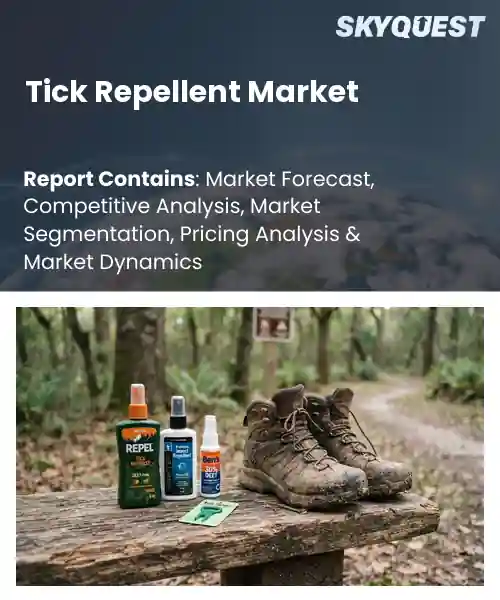
Tick Repellent Market
Report ID: SQMIG30L2560
Report ID: SQMIG30L2560
[email protected]
USA +1 351-333-4748
Report ID:
SQMIG30L2560 |
Region:
Global |
Published Date: August, 2026
Pages:
157
|Tables:
155
|Figures:
78


Global Tick Repellent Market size was valued at USD 1.24 Billion in 2024 and is poised to grow from USD 1.34 Billion in 2025 to USD 2.46 Billion by 2033, growing at a CAGR of 7.9% during the forecast period (2026-2033).
Regulatory scrutiny of pesticide residues now globally acts as a pivotal growth catalyst, because tighter limits force manufacturers to adopt safer active ingredients such as synthetic pyrethroids and plant‑derived oils. When the European Union lowered permissible concentrations in 2018, firms shifted R&D toward micro‑encapsulation that releases repellent gradually, satisfying compliance while extending efficacy. This technical shift opened premium outdoor apparel channels, where brands like Patagonia embed EPA‑registered repellents in hiking jackets, creating a significant new revenue stream. Consequently, the blend of regulation and innovation rapidly expands market share and attracts niche players targeting health‑conscious consumers across global markets significantly today.
What role does AI play in developing next‑gen tick repellent products?
AI accelerates the design of next gen tick repellents by analyzing chemical libraries, predicting efficacy, and modeling skin absorption. Machine learning models sift through thousands of candidate molecules, highlighting those with optimal volatility and low toxicity. Coupled with data from field trials, AI refines formulations faster than traditional lab testing. This speeds time to market and reduces R&D costs, aligning with growing consumer demand for safer, natural based repellents. Companies also use AI to personalize products for different climates and activity profiles, enhancing user experience. As the tick repellent market expands, AI enabled discovery becomes a key differentiator for innovators.In September 2022, a leading tick repellent company launched an AI driven formulation platform that integrates field data and predictive modeling, cutting development time and enabling rapid rollout of new active ingredients, thereby boosting market expansion and meeting consumer demand for innovative protection worldwide.
Market snapshot - (2026-2033)
Global Market Size
USD 1.24 Billion
Largest Segment
Chemical Tick Repellents
Fastest Growth
Tick Repellent Wearables
Growth Rate
7.9% CAGR
To get more insights on this market click here to Request a Free Sample Report
Global tick repellent market is segmented by product type, form, application, distribution channel, end user and region. Based on product type, the market is segmented into Chemical Tick Repellents, Natural Tick Repellents, Plant-Based Tick Repellents, Tick Repellent Sprays, Tick Repellent Creams & Lotions, Tick Repellent Wearables and Others. Based on form, the market is segmented into Sprays, Creams & Lotions, Powders, Wipes, Collars & Wearables and Others. Based on application, the market is segmented into Human Use, Animal Use and Others. Based on distribution channel, the market is segmented into Veterinary Clinics & Pharmacies, Supermarkets & Hypermarkets, Specialty Stores, Online Retail and Others. Based on end user, the market is segmented into Household Consumers, Pet Owners, Farmers & Livestock Owners, Veterinary & Animal Care Providers and Others. Based on region, the market is segmented into North America, Europe, Asia Pacific, Latin America and Middle East & Africa.
Chemical Tick Repellents segment dominates because manufacturers leverage proven efficacy and broad‑spectrum activity that meets consumer expectations for immediate protection against ticks. These formulations benefit from extensive research, regulatory acceptance, and established global supply chains, enabling consistent shelf life and reliable performance across varied climates. Consequently, retailers prioritize these products, and continuous consumer trust in their safety profile reinforces market leadership and sustains demand across human and animal applications throughout the market.
On the other hand, Natural Tick Repellents segment emerges as the most rapidly expanding area in the Tick Repellent Market. Growing consumer preference for eco‑friendly and skin‑gentle solutions, coupled with advances in botanical extraction, fuels demand, prompting new product launches that diversify portfolios and open distribution opportunities, accelerating market growth.
Online Retail segment dominates because e‑commerce platforms provide unmatched convenience, extensive product assortments, and direct access to detailed ingredient information that appeals to both casual consumers and dedicated pet owners. The digital environment enables rapid onboarding of new brands, personalized recommendations, and seamless price comparison, driving higher purchase frequency. This channel also benefits from targeted advertising and data analytics that refine marketing, reinforcing its leading position across the tick repellent landscape.
Meanwhile, Veterinary Clinics & Pharmazines segment is witnessing the strongest growth momentum in the Tick Repellent Market. Veterinarians increasingly recommend formulations for animal health, and the trust associated with clinical advice spurs adoption of specialized products. This credibility, with rising pet health awareness, expands market reach and creates premium opportunities.
To get detailed segments analysis, Request a Free Sample Report
North America leads the global tick repellent market due to a confluence of consumer behavior, regulatory support, and industry innovation. A strong culture of outdoor activities creates persistent demand for effective protection solutions. Well‑established retail networks and e‑commerce platforms ensure wide product availability across urban and rural areas. Stringent safety standards and proactive public health campaigns reinforce consumer confidence in product efficacy. Moreover, extensive research institutions and biotech firms drive continuous formulation improvements, positioning the region at the forefront of product development and market penetration. Collaboration between governmental health agencies and private manufacturers fosters rapid adoption of emerging technologies, while a growing emphasis on environmentally friendly active ingredients aligns with broader sustainability goals. The region’s capacity to scale production quickly in response to seasonal demand spikes further consolidates its leadership position.
Tick Repellent Market in United States benefits from a highly informed consumer base that prioritizes personal safety during extensive outdoor recreation. Retail chains, specialty outdoor stores, and online platforms provide diverse product choices, encouraging brand competition and innovation. Strong collaboration between federal health agencies and industry accelerates the introduction of advanced formulations, while public awareness campaigns reinforce proper usage. This ecosystem sustains robust demand and supports continuous product refinement today.
Tick Repellent Market in Canada reflects a strong public health focus combined with a vibrant outdoor lifestyle that drives consistent product uptake. Provincial health authorities work closely with manufacturers to ensure compliance with safety guidelines, while retailers emphasize natural and hypoallergenic options favored by health‑conscious consumers. Educational initiatives in schools and community centers raise awareness of tick‑borne diseases, reinforcing demand for reliable protection solutions across the nation and market growth.
Europe experiences rapid expansion of the tick repellent market as consumer awareness of vector‑borne health risks intensifies across diverse climatic zones. Harmonized regulatory frameworks across the European Union facilitate swift product approvals, encouraging manufacturers to launch innovative formulations that meet stringent safety and environmental criteria. A strong tradition of outdoor recreation, ranging from hiking in alpine regions to countryside leisure, sustains steady demand for reliable protection. Growing preference for natural active ingredients aligns with broader sustainability agendas, prompting brands to invest in eco‑friendly research. Cross‑border tourism and eco‑adventure travel expose more people to tick habitats, prompting retailers to broaden distribution through online and specialty outdoor outlets. This blend of regulatory support, consumer education and lifestyle trends solidifies Europe as a dynamic growth hub for tick repellents.
Tick Repellent Market in Germany is anchored by safety standards and an emphasis on scientific validation. Consumers favor products backed by clinical research, prompting manufacturers to prioritize efficacy data in their offerings. Retail distribution spans large pharmacy chains, outdoor specialty stores, and digital platforms, ensuring broad accessibility. Collaborative initiatives between federal health agencies and research institutes drive innovation, while public education campaigns reinforce preventive habits across urban and rural populations.
Tick Repellent Market in United Kingdom is propelled by a surge in outdoor leisure activities and heightened awareness of tick‑borne illnesses. Retailers respond with an expanding portfolio of natural and synthetic options, catering to diverse consumer preferences. Government health bodies collaborate with industry to disseminate guidance on effective usage, reinforcing confidence in product performance. Marketing and e‑commerce channels accelerate product reach, while education programs amplify preventive messaging throughout the country.
Tick Repellent Market in France is emerging as consumer interest in personal health protection grows alongside expanding outdoor tourism. Retail shelves increasingly feature products that combine efficacy with natural ingredients, appealing to environmentally conscious shoppers. Public health agencies partner with local distributors to provide educational resources on tick prevention, fostering greater market acceptance. E‑commerce platforms enable niche brands to reach specialized segments, gradually broadening the market footprint within the country.
Asia Pacific is strengthening its position in the tick repellent market through a combination of expanding outdoor recreation, heightened disease awareness, and rapid product innovation. Growing middle‑class populations in urban centers are embracing nature‑based leisure, creating sustained demand for effective protection solutions. Regional regulatory bodies are streamlining approval pathways while emphasizing safety and environmental stewardship, encouraging manufacturers to develop advanced formulations that meet local preferences. Investment in research collaborations between universities and biotech firms accelerates the discovery of novel active ingredients, often derived from indigenous plant sources. Digital commerce platforms and mobile health applications further amplify product accessibility and consumer education, positioning the region as an emerging hub of both demand and technological advancement. Additionally, government health initiatives promote community outreach programs that teach preventive measures, reinforcing the market’s credibility. The convergence of cultural affinity for natural remedies and manufacturing capabilities differentiates the Asia Pacific offering on the global stage.
Tick Repellent Market in Japan benefits from a strong culture of preventive health and an outdoor tourism sector. Consumers prioritize validated products, prompting manufacturers to focus on rigorous efficacy testing and safety compliance. Retail distribution includes major pharmacy chains, specialty outdoor stores, and an e‑commerce ecosystem that ensures nationwide reach. Collaborative research initiatives between academic institutions and industry drive the development of innovative, low‑toxicity formulations tailored to local environmental conditions.
Tick Repellent Market in South Korea is driven by participation in hiking and camping, coupled with heightened public awareness of vector‑borne diseases. The market favors products that combine efficacy with formulations, encouraging manufacturers to integrate natural extracts alongside synthetic actives. Distribution channels span pharmacy networks, outdoor specialty retailers, and growing online marketplaces, providing access. Government health campaigns collaborate with industry to disseminate guidelines, reinforcing consumer confidence and expanding market penetration.
To know more about the market opportunities by region and country, click here to
Buy The Complete Report
Increasing Outdoor Recreation
Growing Awareness Of Tick Diseases
Regulatory Approval Challenges
High Product Cost and Affordability Issues
Request Free Customization of this report to help us to meet your business objectives.
The global tick repellent market is dominated by legacy pharmaceutical and agrochemical giants such as Merck, Boehringer Ingelheim, Zoetis and Bayer, each pursuing aggressive M&A, strategic partnerships and technology‑driven product innovation to capture growing demand for safer, more effective repellents; recent collaborations and acquisitions are reshaping the competitive landscape and accelerating entry of novel active ingredients.
Top Player’s Company Profile
Recent Developments
SkyQuest’s ABIRAW (Advanced Business Intelligence, Research & Analysis Wing) is our Business Information Services team that Collects, Collates, Correlates, and Analyses the Data collected by means of Primary Exploratory Research backed by robust Secondary Desk research. As per SkyQuest analysis the global tick repellent market is projected to rise to $2.46 billion by 2033, driven primarily by increasing outdoor recreation that pushes consumers to seek reliable protection and further accelerated by growing awareness of tick‑borne diseases which fuels demand across human and animal applications. The chemical tick repellents segment leads the market thanks to its proven efficacy and broad shelf life, while North America remains the dominant region supported by strong outdoor culture and robust distribution networks. However, stringent regulatory approval processes pose a significant restraint, slowing the launch of innovative formulations and raising entry barriers for new players.
| Report Metric | Details |
|---|---|
| Market size value in 2024 | USD 1.24 Billion |
| Market size value in 2033 | USD 2.46 Billion |
| Growth Rate | 7.9% |
| Base year | 2024 |
| Forecast period | (2026-2033) |
| Forecast Unit (Value) | USD Billion |
| Segments covered |
|
| Regions covered | North America (US, Canada), Europe (Germany, France, United Kingdom, Italy, Spain, Rest of Europe), Asia Pacific (China, India, Japan, Rest of Asia-Pacific), Latin America (Brazil, Rest of Latin America), Middle East & Africa (South Africa, GCC Countries, Rest of MEA) |
| Companies covered |
|
| Customization scope | Free report customization with purchase. Customization includes:-
|
To get a free trial access to our platform which is a one stop solution for all your data requirements for quicker decision making. This platform allows you to compare markets, competitors who are prominent in the market, and mega trends that are influencing the dynamics in the market. Also, get access to detailed SkyQuest exclusive matrix.
Table Of Content
Executive Summary
Market overview
Parent Market Analysis
Market overview
Market size
KEY MARKET INSIGHTS
COVID IMPACT
MARKET DYNAMICS & OUTLOOK
Market Size by Region
KEY COMPANY PROFILES
Methodology
For the Tick Repellent Market, our research methodology involved a mixture of primary and secondary data sources. Key steps involved in the research process are listed below:
1. Information Procurement: This stage involved the procurement of Market data or related information via primary and secondary sources. The various secondary sources used included various company websites, annual reports, trade databases, and paid databases such as Hoover's, Bloomberg Business, Factiva, and Avention. Our team did 45 primary interactions Globally which included several stakeholders such as manufacturers, customers, key opinion leaders, etc. Overall, information procurement was one of the most extensive stages in our research process.
2. Information Analysis: This step involved triangulation of data through bottom-up and top-down approaches to estimate and validate the total size and future estimate of the Tick Repellent Market.
3. Report Formulation: The final step entailed the placement of data points in appropriate Market spaces in an attempt to deduce viable conclusions.
4. Validation & Publishing: Validation is the most important step in the process. Validation & re-validation via an intricately designed process helped us finalize data points to be used for final calculations. The final Market estimates and forecasts were then aligned and sent to our panel of industry experts for validation of data. Once the validation was done the report was sent to our Quality Assurance team to ensure adherence to style guides, consistency & design.
Analyst Support
Customization Options
With the given market data, our dedicated team of analysts can offer you the following customization options are available for the Tick Repellent Market:
Product Analysis: Product matrix, which offers a detailed comparison of the product portfolio of companies.
Regional Analysis: Further analysis of the Tick Repellent Market for additional countries.
Competitive Analysis: Detailed analysis and profiling of additional Market players & comparative analysis of competitive products.
Go to Market Strategy: Find the high-growth channels to invest your marketing efforts and increase your customer base.
Innovation Mapping: Identify racial solutions and innovation, connected to deep ecosystems of innovators, start-ups, academics, and strategic partners.
Category Intelligence: Customized intelligence that is relevant to their supply Markets will enable them to make smarter sourcing decisions and improve their category management.
Public Company Transcript Analysis: To improve the investment performance by generating new alpha and making better-informed decisions.
Social Media Listening: To analyze the conversations and trends happening not just around your brand, but around your industry as a whole, and use those insights to make better Marketing decisions.
REQUEST FOR SAMPLE
 REQUEST FREE CUSTOMIZATION


Want to customize this report? This report can be personalized according to your needs. Our analysts and industry experts will work directly with you to understand your requirements and provide you with customized data in a short amount of time. We offer $1000 worth of FREE customization at the time of purchase.
Feedback From Our Clients


 USA (+1) 351-333-4748

