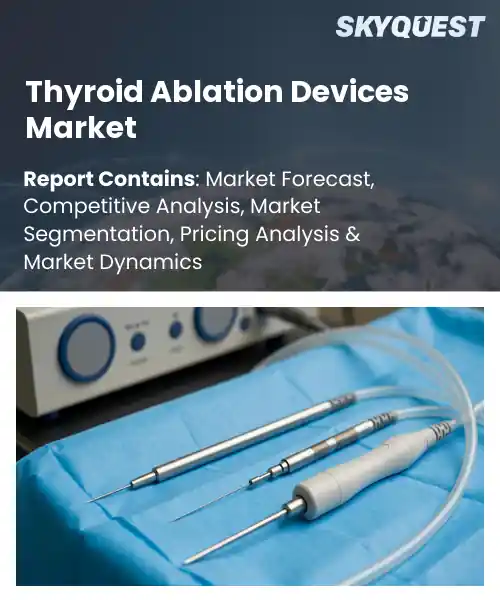
Thyroid Ablation Devices Market
Report ID: SQMIG35A4194
Report ID: SQMIG35A4194
[email protected]
USA +1 351-333-4748
Report ID:
SQMIG35A4194 |
Region:
Global |
Published Date: July, 2026
Pages:
157
|Tables:
176
|Figures:
79


Global Thyroid Ablation Devices Market size was valued at USD 423.3 Million in 2024 and is poised to grow from USD 460.97 Million in 2025 to USD 911.8 Million by 2033, growing at a CAGR of 8.9% during the forecast period (2026-2033).
The global thyroid ablation devices market is primarily driven by the increasing prevalence of thyroid nodules and differentiated thyroid cancers that have increased the demand for invasive treatment alternatives. Surgery has been the traditional mainstay for the management of thyroid disease, but increasing patient preference for surgery and morbidity has changed clinical pathways. Advances in radiofrequency, laser and focused ultrasound technologies now facilitate energy delivery while preserving tissue and therapeutic efficacy. In Europe, the introduction of microwave ablation systems in 2016 showed outcomes comparable to lobectomy with recovery. Thus, the market has moved from niche surgical adjuncts to a therapeutic segment, reflective of clinical need and maturity.
The trend toward outpatient ablation suggests growth opportunities, as current reimbursement models favor procedures that reduce hospital stay and complications. Increased insurance coverage for benign nodules is also bringing radiofrequency and laser ablation into the mainstream, allowing clinics to expand services without large capital outlay and promoting adoption in tertiary and community practices. A 2022 study from Korea found that using microwave ablation instead of total thyroidectomy for low-risk cancers lowered the cost of treatment by 30 %, leading to its endorsement by policymakers. This cost advantage, along with increased physician confidence, results in market expansion and encourages manufacturers to develop smaller devices and AI targeting, thereby expanding the patient pool.
How is AI-driven Automation Improving Procedural Outcomes In The Thyroid Ablation Devices Market?
AI-enabled automation is transforming thyroid ablation with real-time imaging analysis, precise energy delivery, and adaptive feedback loops that reduce operator variability. Machine-learning algorithms continuously interpret the ultrasound or CT data, automatically adjusting power settings to match tissue characteristics and maintain optimal temperature zones. This leads to better defined lesion margins, less repeat procedures and less operating time. Decision-support dashboards, which highlight critical anatomical landmarks and predict optimal probe placement, improve the workflow for clinicians, making it more intuitive for experienced surgeons and newer practitioners alike.
The advent of these intelligent controls is accelerating the adoption of minimally invasive therapies for thyroids, positioning the market for growth as hospitals seek greater efficiency and better patient outcomes. In June 2024, Boston Scientific launched an AI-enabled microwave ablation system, demonstrating the role of automated energy modulation to improve lesion uniformity and reduce procedure time, thus helping in market penetration.
Market snapshot - (2026-2033)
Global Market Size
USD 423.3 Million
Largest Segment
Radiofrequency Ablation Devices
Fastest Growth
High-Intensity Focused Ultrasound (HIFU) Devices
Growth Rate
8.9% CAGR
To get more insights on this market click here to Request a Free Sample Report
Global thyroid ablation devices market is segmented by product type, application, technology, end user, component, procedure type and region. Based on product type, the market is segmented into Radiofrequency Ablation Devices, Microwave Ablation Devices, Laser Ablation Devices, High-Intensity Focused Ultrasound (HIFU) Devices, Cryoablation Devices and Others. Based on application, the market is segmented into Benign Thyroid Nodules, Thyroid Cancer, Recurrent Thyroid Lesions and Hyperthyroidism. Based on technology, the market is segmented into Thermal Ablation, Non-Thermal Ablation and Ultrasound-Guided Ablation. Based on end user, the market is segmented into Hospitals, Specialty Clinics, Ambulatory Surgical Centers and Cancer Treatment Centers. Based on component, the market is segmented into Ablation Systems, Electrodes & Probes, Monitoring & Imaging Systems and Accessories & Consumables. Based on procedure type, the market is segmented into Minimally Invasive Procedures and Image-Guided Procedures. Based on region, the market is segmented into North America, Europe, Asia Pacific, Latin America and Middle East & Africa.
The Radiofrequency Ablation Devices segment holds a dominant position due to the proven efficacy, precise energy delivery and compatibility with existing ultrasound guidance systems, which are preferred by clinicians. “It removes some of the variability from procedures and provides surgeons and patients confidence in the technology’s ability to achieve consistent tissue coagulation.” Physicians are familiar with RF platforms, which reduces barriers to training, and the large body of evidence supports insurance reimbursement. All these factors combined, strengthen its dominance in the thyroid ablation devices market.
But the Microwave Ablation Devices segment has the highest growth rate because of its higher intratumoral temperatures which shorten procedure times and make it more suitable for larger nodules. The growth of the market is due to the increase in clinical trial indications for innovative generator designs that enhance safety and the use of such devices by interventional radiologists in search of fast alternatives.
Benign Thyroid Nodules segment holds the largest share due to the increasing prevalence of asymptomatic nodules, prompting clinicians to find minimally invasive alternatives to surgery. Ablation technologies can do just that and are a good fit with the patient’s increasing desire for gland-sparing and scar-sparing procedures. Reimbursement structures often support outpatient treatment of benign conditions, and incentivize providers to use these devices. Thus, the number of procedures and related device utilization is still strong in the market.
On the other hand, the Recurrent Thyroid Lesions segment is also emerging as a key high growth area, as repeat interventions require precise tissue preserving options. Image guided delivery advances improve targeting of scarred tissue and evidence supports efficacy in reducing recurrence rates. This opens up clinical pathways and gives providers incentives to buy specialized probes and drives the diversification and expansion of the market.
To get detailed segments analysis, Request a Free Sample Report
North America’s leadership is built on a mature clinical ecosystem that combines vast experience with cutting edge research. The United States has a number of leading academic centers and a culture of early adoption of minimally invasive technologies that support rapid adoption of thyroid ablation solutions. Robust reimbursement systems and clear regulatory pathways speed the entry of products and encourage ongoing innovation. Canada participates in this ecosystem through a public health care system that stresses evidence-based adoption and provides a stable market for sophisticated devices. High patient awareness, supportive policy frameworks and strong physician expertise together create a synergistic landscape that sustains North America’s dominance in the market.
Thyroid Ablation Devices Market in United States has a widespread network of high-volume endocrine surgery centers looking for less invasive options. Industry and leading medical school research collaborations accelerate device refinement and good insurance coverage encourages more clinical adoption. Driven by patient preference for outpatient procedures and an active regulatory environment that allows fast-tracking of new technologies, the United States is poised to be a key location for market growth.
The universal health framework in Canada that emphasizes cost-effective, evidence-based interventions is supporting the thyroid ablation devices market in Canada. Provincial health authorities collaborate closely with clinical societies to develop consensus guidelines, enabling gradual integration of ablation technologies. Strong emphasis on patient safety and long term outcomes instills confidence in clinicians and the academic partnerships drive localised training programmes. This integrated strategy supports a steady demand pipeline and establishes Canada as a powerful player in the regional arena.
Europe’s expansion is propelled by a convergence of clinical enthusiasm, harmonized regulatory standards, and growing emphasis on outpatient care across member states. Germany leads with a dense concentration of specialized thyroid centers that champion innovative treatments, while the United Kingdom’s agile health technology assessment processes accelerate market entry for emerging devices. France’s focus on personalized medicine and reimbursement reforms encourages broader clinical acceptance. Collaborative networks among European research institutions facilitate shared data, enhancing confidence in safety and efficacy. Together, these factors generate a fertile environment where clinicians and payers alike are receptive to minimally invasive thyroid solutions, fueling a rapid uplift in market activity throughout the continent.
Thyroid Ablation Devices Market in Germany benefits from a robust network of tertiary hospitals that prioritize minimally invasive endocrine procedures. Strong engineering partnerships and a tradition of clinical research accelerate device optimization. Reimbursement frameworks that reward value‑based care support adoption, while national guidelines increasingly recommend ablation as a first‑line option for select patients. This combination of clinical rigor and supportive policy sustains Germany’s leading position within Europe.
Thyroid Ablation Devices Market in United Kingdom is energized by a proactive health technology assessment system that fast‑tracks innovative therapies. Academic medical centers champion clinical trials that validate efficacy, creating a compelling evidence base for clinicians. Payers are receptive to cost‑saving outpatient solutions, encouraging swift incorporation into treatment pathways. Growing patient awareness of minimally invasive options further boosts demand, establishing the United Kingdom as a dynamic catalyst for market expansion.
Thyroid Ablation Devices Market in France is emerging through a strategic focus on personalized therapeutic approaches and evolving reimbursement incentives. Leading endocrinology societies endorse minimally invasive techniques, while regional health agencies support pilot programs that generate real‑world evidence. Collaborative ties with device manufacturers facilitate tailored training for physicians. This nurturing environment fosters incremental adoption and positions France as an influential emerging market within the European context.
Asia Pacific is advancing its market stature by leveraging rapid healthcare modernization and a growing preference for minimally invasive procedures across its economies. Japan’s established clinical expertise and strong regulatory support encourage early adoption of sophisticated ablation tools, while South Korea’s vibrant medical device sector drives both domestic use and export‑oriented innovation. Rising middle‑class populations are increasingly seeking high‑quality, outpatient care, prompting health systems to integrate efficient thyroid solutions. Cross‑border collaborations among research institutes and manufacturers accelerate knowledge transfer, and governmental initiatives that streamline approval pathways further enhance market accessibility. These synergistic forces collectively elevate Asia Pacific’s role as a rising hub for thyroid ablation technology.
Thyroid Ablation Devices Market in Japan is characterized by a sophisticated clinical landscape that embraces high‑precision minimally invasive technologies. Strong governmental endorsement of advanced medical devices ensures streamlined regulatory pathways, while leading university hospitals conduct pivotal studies that validate clinical benefits. Health insurers are receptive to cost‑effective outpatient treatments, promoting broader acceptance. Continuous professional development programs equip surgeons with specialized skills, reinforcing Japan’s reputation as a leading adopter and innovator in the field.
Thyroid Ablation Devices Market in South Korea thrives on a dynamic medical device ecosystem that blends rapid innovation with aggressive market entry strategies. Government policies that expedite device approval encourage swift clinical rollout, while prominent hospitals actively incorporate ablation techniques into standard practice. Robust private insurance coverage supports patient access, and focused training initiatives enhance procedural proficiency. This environment fosters a strong domestic demand base and positions South Korea as a pivotal contributor to the region’s expanding market landscape.
To know more about the market opportunities by region and country, click here to
Buy The Complete Report
Increasing Adoption of Minimally Invasive Techniques
Advancements In Imaging Guidance Technologies
High Initial Capital Investment Requirements
Stringent Regulatory Approval Processes
Request Free Customization of this report to help us to meet your business objectives.
The thyroid ablation devices market is shaped by intense competition among established manufacturers, with recent M&A activity such as Medtronic’s acquisition of a niche radiofrequency technology firm and Boston Scientific’s strategic partnership with a European imaging company to integrate real‑time guidance into ablation platforms. These moves intensify pressure on pricing and accelerate the rollout of next‑generation energy delivery systems, driving firms to differentiate through proprietary thermal control algorithms and combined diagnostic‑therapeutic solutions.
SkyQuest’s ABIRAW (Advanced Business Intelligence, Research & Analysis Wing) is our Business Information Services team that Collects, Collates, Correlates, and Analyses the Data collected by means of Primary Exploratory Research backed by robust Secondary Desk research.
As per SkyQuest analysis, the global thyroid ablation devices market is being propelled primarily by the increasing adoption of minimally invasive techniques, which reduce patient trauma and shorten hospital stays, driving demand across hospitals and specialty clinics. A second strong catalyst is the rapid advancement of imaging guidance technologies that improve targeting accuracy and procedural safety, encouraging clinicians to favor ablation over surgery. High initial capital investment requirements, however, remain a notable restraint, limiting uptake in smaller facilities and emerging economies. North America continues to dominate the market due to its mature clinical ecosystem and supportive reimbursement structures, while radiofrequency ablation devices hold the leading share among product types.
| Report Metric | Details |
|---|---|
| Market size value in 2024 | USD 423.3 Million |
| Market size value in 2033 | USD 911.8 Million |
| Growth Rate | 8.9% |
| Base year | 2024 |
| Forecast period | (2026-2033) |
| Forecast Unit (Value) | USD Million |
| Segments covered |
|
| Regions covered | North America (US, Canada), Europe (Germany, France, United Kingdom, Italy, Spain, Rest of Europe), Asia Pacific (China, India, Japan, Rest of Asia-Pacific), Latin America (Brazil, Rest of Latin America), Middle East & Africa (South Africa, GCC Countries, Rest of MEA) |
| Companies covered |
|
| Customization scope | Free report customization with purchase. Customization includes:-
|
To get a free trial access to our platform which is a one stop solution for all your data requirements for quicker decision making. This platform allows you to compare markets, competitors who are prominent in the market, and mega trends that are influencing the dynamics in the market. Also, get access to detailed SkyQuest exclusive matrix.
Table Of Content
Executive Summary
Market overview
Parent Market Analysis
Market overview
Market size
KEY MARKET INSIGHTS
COVID IMPACT
MARKET DYNAMICS & OUTLOOK
Market Size by Region
KEY COMPANY PROFILES
Methodology
For the Thyroid Ablation Devices Market, our research methodology involved a mixture of primary and secondary data sources. Key steps involved in the research process are listed below:
1. Information Procurement: This stage involved the procurement of Market data or related information via primary and secondary sources. The various secondary sources used included various company websites, annual reports, trade databases, and paid databases such as Hoover's, Bloomberg Business, Factiva, and Avention. Our team did 45 primary interactions Globally which included several stakeholders such as manufacturers, customers, key opinion leaders, etc. Overall, information procurement was one of the most extensive stages in our research process.
2. Information Analysis: This step involved triangulation of data through bottom-up and top-down approaches to estimate and validate the total size and future estimate of the Thyroid Ablation Devices Market.
3. Report Formulation: The final step entailed the placement of data points in appropriate Market spaces in an attempt to deduce viable conclusions.
4. Validation & Publishing: Validation is the most important step in the process. Validation & re-validation via an intricately designed process helped us finalize data points to be used for final calculations. The final Market estimates and forecasts were then aligned and sent to our panel of industry experts for validation of data. Once the validation was done the report was sent to our Quality Assurance team to ensure adherence to style guides, consistency & design.
Analyst Support
Customization Options
With the given market data, our dedicated team of analysts can offer you the following customization options are available for the Thyroid Ablation Devices Market:
Product Analysis: Product matrix, which offers a detailed comparison of the product portfolio of companies.
Regional Analysis: Further analysis of the Thyroid Ablation Devices Market for additional countries.
Competitive Analysis: Detailed analysis and profiling of additional Market players & comparative analysis of competitive products.
Go to Market Strategy: Find the high-growth channels to invest your marketing efforts and increase your customer base.
Innovation Mapping: Identify racial solutions and innovation, connected to deep ecosystems of innovators, start-ups, academics, and strategic partners.
Category Intelligence: Customized intelligence that is relevant to their supply Markets will enable them to make smarter sourcing decisions and improve their category management.
Public Company Transcript Analysis: To improve the investment performance by generating new alpha and making better-informed decisions.
Social Media Listening: To analyze the conversations and trends happening not just around your brand, but around your industry as a whole, and use those insights to make better Marketing decisions.
REQUEST FOR SAMPLE
 REQUEST FREE CUSTOMIZATION
Global Thyroid Ablation Devices Market size was valued at USD 423.3 Million in 2024 and is poised to grow from USD 460.97 Million in 2025 to USD 911.8 Million by 2033, growing at a CAGR of 8.9% during the forecast period (2026-2033).
The thyroid ablation devices market is shaped by intense competition among established manufacturers, with recent M&A activity such as Medtronic’s acquisition of a niche radiofrequency technology firm and Boston Scientific’s strategic partnership with a European imaging company to integrate real‑time guidance into ablation platforms. These moves intensify pressure on pricing and accelerate the rollout of next‑generation energy delivery systems, driving firms to differentiate through proprietary thermal control algorithms and combined diagnostic‑therapeutic solutions. 'Medtronic', 'Boston Scientific', 'Johnson & Johnson', 'Olympus Corporation', 'STARmed', 'HS Hospital Service', 'Trod Medical', 'Mermaid Medical', 'Esaote', 'AngioDynamics', 'EDAP TMS', 'SonaCare Medical', 'Profound Medical', 'Biolitec', 'Stryker', 'GE HealthCare', 'RF Medical', 'Creo Medical', 'Somatex Medical Technologies', 'BVM Medical'
Clinicians are increasingly adopting minimally invasive thyroid ablation techniques because they offer reduced procedural trauma, shorter hospital stays, and faster patient recovery. This shift away from conventional surgery enhances patient comfort and aligns with healthcare providers’ goals of optimizing resource utilization. As more physicians become familiar with radiofrequency, microwave, and laser ablation, referral patterns gradually favor these alternatives, expanding the patient base eligible for treatment. Consequently, demand for dedicated ablation devices rises, reinforcing market expansion and encouraging manufacturers to broaden product portfolios.
Minimally Invasive Preference Surge: The thyroid ablation market is experiencing a pronounced shift toward minimally invasive procedures, driven by patient demand for reduced postoperative pain, shorter hospital stays, and quicker return to normal activities. Clinicians are increasingly adopting radiofrequency and laser ablation technologies that can be performed on an outpatient basis, reinforcing the appeal of these modalities over conventional surgery. This preference is prompting manufacturers to prioritize device designs that enhance ease of use, procedural safety, and patient comfort, thereby expanding market adoption across diverse healthcare settings.
Why does North America Dominate the Global Thyroid Ablation Devices Market? |@12


Want to customize this report? This report can be personalized according to your needs. Our analysts and industry experts will work directly with you to understand your requirements and provide you with customized data in a short amount of time. We offer $1000 worth of FREE customization at the time of purchase.
Feedback From Our Clients


 USA (+1) 351-333-4748

