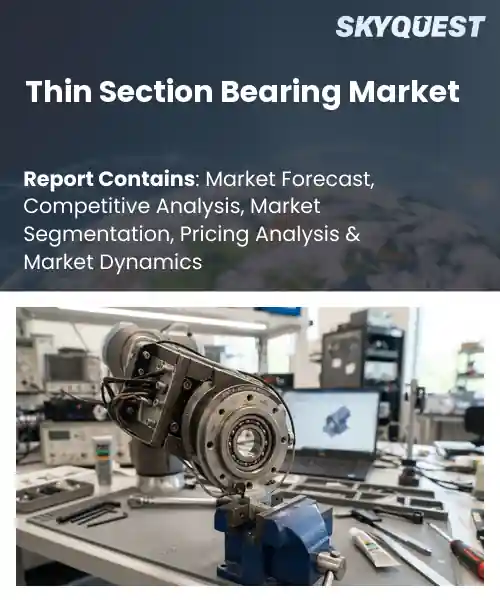
Thin Section Bearing Market
Report ID: SQMIG20I4012
Report ID: SQMIG20I4012
[email protected]
USA +1 351-333-4748
Report ID:
SQMIG20I4012 |
Region:
Global |
Published Date: September, 2026
Pages:
157
|Tables:
152
|Figures:
78


Global Thin Section Bearing Market size was valued at USD 3.6 Billion in 2024 and is poised to grow from USD 3.83 Billion in 2025 to USD 6.24 Billion by 2033, growing at a CAGR of 6.3% during the forecast period (2026-2033).
Thin‑section bearings, designed to deliver load capacity within a minimal axial profile, have become essential in sectors where space and weight constraints dominate design decisions. Their importance stems from the ability to sustain rotational motion while reducing assembly mass, a requirement that has accelerated adoption in aerospace turbine engines, electric‑vehicle drivetrains, and medical imaging devices. Historically, the market emerged in the late 1990s as manufacturers replaced conventional full‑width bearings with slimmer alternatives to meet stricter fuel‑efficiency standards. Over the past decade, advances in ceramic and hybrid material technologies have expanded performance envelopes, prompting manufacturers to integrate thin‑section solutions across platforms. The surge in electric‑propulsion and high‑speed machining drives the wave of growth for the thin‑section bearing market, because these applications demand components that combine low friction with reduced inertia. As electric aircraft and drones scale up power output, designers replace traditional bearings with thin‑section ceramic hybrids to lower rotational mass, thereby extending range and improving efficiency. Simultaneously, the rise of additive manufacturing enables bearing geometries that fit within housings, unlocking new opportunities in robotics and precision medical tools. Consequently, suppliers that invest in coating processes and supply chain integration are positioned to capture expanding demand and mitigate significant cost pressures.
How is AI influencing the thin section bearing market performance?
AI is reshaping the thin section bearing market by embedding predictive analytics, optimizing design cycles, and enhancing quality control. Manufacturers now feed sensor data from production lines into machine‑learning models that flag deviations before they become defects, reducing scrap and shortening time‑to‑market. Design engineers use generative AI to explore material combinations and geometry variations faster than traditional simulation, accelerating innovation while maintaining reliability standards. Supply chains benefit from AI‑driven demand forecasting, aligning inventory with fluctuating industrial needs and minimizing stockouts. Together, these capabilities create a more responsive ecosystem, driving higher throughput and cost efficiency across the sector.In March 2024, a leading bearing manufacturer announced an AI‑driven predictive maintenance platform, improving equipment uptime and supporting market growth through smarter operational insight.
Market snapshot - (2026-2033)
Global Market Size
USD 3.6 Billion
Largest Segment
Ball Bearings
Fastest Growth
Cross-Roller Bearings
Growth Rate
6.3% CAGR
To get more insights on this market click here to Request a Free Sample Report
Global thin section bearing market is segmented by bearing type, configuration, load type, application, end user and region. Based on bearing type, the market is segmented into Ball Bearings, Roller Bearings, Four-Point Contact Bearings, Cross-Roller Bearings and Others. Based on configuration, the market is segmented into Open Bearings, Sealed Bearings, Flanged Bearings and Split Bearings. Based on load type, the market is segmented into Radial, Axial and Combined Radial and Axial. Based on application, the market is segmented into Robotics, Aerospace, Medical Equipment, Semiconductor Equipment, Machine Tools and Others. Based on end user, the market is segmented into Industrial, Aerospace and Defense, Healthcare, Electronics and Others. Based on region, the market is segmented into North America, Europe, Asia Pacific, Latin America and Middle East & Africa.
Ball Bearings segment dominates because their geometry offers high precision and low friction, which are essential for the ultra thin profiles demanded by modern equipment. The simple design facilitates easy integration into compact assemblies, reducing overall system weight while maintaining reliability. Their adaptability to a wide range of speeds and load conditions further entrenches them as the go to choice for manufacturers seeking cost effective, high performance solutions in this market today across sectors.
Meanwhile, Four-Point Contact Bearings see the fastest growth because they merge radial and axial load capacity within an ultra thin design. New high speed spindles and precision drives demand this dual capability without added thickness, prompting rapid adoption. Their tighter tolerance support fuels product builds, expanding market reach and creating fresh opportunities.
Robotics segment dominates because the push for lighter, more agile automation platforms requires bearings that fit within extremely limited spaces while delivering high precision and repeatability. Thin section bearings reduce arm inertia, enabling faster response times, and their minimal profile aligns with compact joint designs. They also tolerate the high cyclical loads typical of robotic motion, making them indispensable for manufacturers aiming to enhance productivity and achieve tighter tolerances across varied industries.
Conversely, Semiconductor Equipment is witnessing the strongest growth as wafer handling and lithography tools demand ever smaller bearing profiles to meet ultra high precision alignment. The relentless miniaturization of circuitry pushes equipment designers to adopt thin section bearings that sustain cleanroom standards while tolerating high speeds. This creates expanding opportunities and fuels market acceleration.
To get detailed segments analysis, Request a Free Sample Report
North America commands leadership in the Thin Section Bearing Market through a confluence of mature industrial ecosystems, deep engineering expertise, and sustained investment in advanced manufacturing. The United States provides a hub of aerospace, automotive, and energy sectors that prize high‑precision components, while Canada contributes strong metallurgical research and a supportive supply chain. Collaborative networks between OEMs, research institutions, and component suppliers accelerate product innovation and adoption of next‑generation bearing designs. Robust regulatory frameworks promote quality standards and reliability, reinforcing customer confidence. The region’s ability to integrate digital manufacturing, additive techniques, and predictive maintenance further differentiates its offerings, creating a resilient market position that attracts global partnerships and reinforces its dominant status.
Thin Section Bearing Market in the United States thrives on a well‑established aerospace base and a large automotive manufacturing footprint that demand ultrahigh precision and reliability. Extensive R&D programs within leading universities and corporate labs drive continuous material and design improvements. Strong supply chain integration and a culture of innovation enable rapid prototyping and adoption of digital twin technologies, ensuring that manufacturers maintain competitive advantage and meet demanding performance criteria.
Thin Section Bearing Market in Canada benefits from world‑class metallurgical research institutions and a collaborative industrial landscape that emphasizes sustainability and high‑performance engineering. Close ties between academia, government research agencies, and niche manufacturing firms foster the development of specialized bearing solutions for renewable energy and mining equipment. Emphasis on quality certification and reliable logistics supports seamless integration into North American supply networks, reinforcing Canada’s role as a vital contributor to regional market strength.
Europe’s rapid expansion of the Thin Section Bearing Market is fueled by a synergistic blend of engineering excellence, strong automotive and rail sectors, and progressive sustainability agendas. Germany entrenched precision manufacturing culture sets a benchmark for quality, while the United Kingdom leverages its aerospace and defense capabilities to accelerate adoption of lightweight, high‑speed bearing technologies. France emerging focus on green mobility and renewable energy drives demand for bearings that can withstand demanding operating environments. Cross‑border research collaborations, abundant funding for advanced materials, and harmonized standards across the European Union facilitate seamless market integration and technology transfer. This ecosystem of innovation, backed by supportive policy frameworks, propels Europe toward a leadership position in high‑performance bearing solutions.
Thin Section Bearing Market in Germany remains the cornerstone of European precision engineering, underpinned by a legacy of high‑speed manufacturing and rigorous quality standards. Leading automotive and industrial machinery producers prioritize advanced bearing designs that deliver exceptional durability and efficiency. Strong collaboration between research institutes and component manufacturers accelerates material breakthroughs and surface‑treatment technologies. The country’s focus on digitalization and Industry 4.0 further enhances production agility, ensuring that German bearing solutions stay at the forefront of global performance expectations.
Thin Section Bearing Market in the United Kingdom is propelled by a vibrant aerospace and defense sector that demands lightweight, high‑reliability components. Close partnerships between universities, specialized engineering firms, and defense contractors drive rapid prototyping and adoption of novel alloy compositions. Government initiatives supporting high‑tech manufacturing and export expansion bolster the sector’s competitiveness. Emphasis on digital engineering and predictive analytics enables UK manufacturers to optimize bearing performance and reduce lifecycle costs, positioning the nation as a fast‑moving catalyst for market growth.
Thin Section Bearing Market in France is emerging as a strategic pillar for the country’s shift toward renewable energy and sustainable transportation. Growing investment in wind turbine and electric vehicle production creates a need for bearings capable of enduring harsh environmental conditions while maintaining efficiency. Collaborative projects between research centers and niche manufacturers focus on lightweight composites and advanced lubrication solutions. Regulatory encouragement for low‑emission technologies further fuels demand, allowing France to carve a distinctive niche within the broader European market.
Asia Pacific is strengthening its position in the Thin Section Bearing Market through a combination of accelerated industrial modernization, expansive manufacturing capacity, and a keen focus on high‑technology sectors. Japan long‑standing reputation for precision engineering and its advanced automotive and robotics industries drive demand for ultra‑reliable bearing solutions. South Korea rapid growth in electronics, semiconductor equipment, and high‑speed rail projects spurs the need for compact, high‑performance bearings. Both economies benefit from strong governmental support that encourages research into advanced materials and encourages adoption of smart manufacturing practices. Integration of IoT‑enabled monitoring and additive manufacturing techniques enhances product customization and lifecycle management, allowing the region to meet diverse application requirements while gaining a competitive foothold on the global stage.
Thin Section Bearing Market in Japan thrives on a culture of meticulous craftsmanship and relentless pursuit of micro‑level precision. The nation’s automotive giants and robotics innovators demand bearings that combine exceptional load capacity with minimal friction, prompting continuous refinement of steel alloys and surface treatments. Collaborative research between leading universities and bearing manufacturers fuels breakthroughs in nanostructured materials and lubrication technologies. Emphasis on reliability and long service life aligns with Japan broader manufacturing ethos, reinforcing its status as a benchmark for high‑quality bearing performance worldwide.
Thin Section Bearing Market in South Korea is energized by the country’s dynamic electronics manufacturing and ambitious high‑speed rail infrastructure. Rapidly expanding semiconductor equipment producers require ultra‑compact, high‑speed bearings that can operate under stringent thermal and vibration conditions. Investment in advanced alloy development and precision machining capabilities enables local firms to meet these exacting specifications. Supportive industrial policies promote integration of smart factory concepts and real‑time condition monitoring, allowing Korean manufacturers to deliver tailored bearing solutions that enhance overall system efficiency and reliability.
To know more about the market opportunities by region and country, click here to
Buy The Complete Report
Increasing Demand For Precision Machinery
Advancements In Material Science
High Cost Of Advanced Materials
Stringent Regulatory Compliance Requirements
Request Free Customization of this report to help us to meet your business objectives.
The thin section bearing market is shaped by intense competition as manufacturers race to integrate advanced materials and precision engineering to meet aerospace and high‑speed rail demands. Recent strategic moves include a major bearing producer’s acquisition of a sensor‑technology firm to embed condition‑monitoring capabilities, and a partnership between a leading supplier and an electric‑vehicle chassis developer to co‑create ultra‑lightweight bearing assemblies, accelerating product differentiation and market entry.
Top Player’s Company Profile
Recent Developments
SkyQuest’s ABIRAW (Advanced Business Intelligence, Research & Analysis Wing) is our Business Information Services team that Collects, Collates, Correlates, and Analyses the Data collected by means of Primary Exploratory Research backed by robust Secondary Desk research. As per SkyQuest analysis the global thin‑section bearing market is projected to rise to $6.24 billion by 2033, driven primarily by the surging demand for precision machinery that requires compact, high‑speed components, while advancements in material science provide stronger, lighter bearings that further boost adoption. Ball bearings dominate the segment landscape because their simple design delivers the high precision and low friction essential for ultra‑thin assemblies. North America remains the leading region thanks to its mature aerospace, automotive and advanced‑manufacturing ecosystem. However, the high cost of specialized alloys and composites acts as a restraint, tempering price‑sensitive buyers’ enthusiasm. Together these forces shape a market poised for steady growth.
| Report Metric | Details |
|---|---|
| Market size value in 2024 | USD 3.6 Billion |
| Market size value in 2033 | USD 6.24 Billion |
| Growth Rate | 6.3% |
| Base year | 2024 |
| Forecast period | (2026-2033) |
| Forecast Unit (Value) | USD Billion |
| Segments covered |
|
| Regions covered | North America (US, Canada), Europe (Germany, France, United Kingdom, Italy, Spain, Rest of Europe), Asia Pacific (China, India, Japan, Rest of Asia-Pacific), Latin America (Brazil, Rest of Latin America), Middle East & Africa (South Africa, GCC Countries, Rest of MEA) |
| Companies covered |
|
| Customization scope | Free report customization with purchase. Customization includes:-
|
To get a free trial access to our platform which is a one stop solution for all your data requirements for quicker decision making. This platform allows you to compare markets, competitors who are prominent in the market, and mega trends that are influencing the dynamics in the market. Also, get access to detailed SkyQuest exclusive matrix.
Table Of Content
Executive Summary
Market overview
Parent Market Analysis
Market overview
Market size
KEY MARKET INSIGHTS
COVID IMPACT
MARKET DYNAMICS & OUTLOOK
Market Size by Region
KEY COMPANY PROFILES
Methodology
For the Thin Section Bearing Market, our research methodology involved a mixture of primary and secondary data sources. Key steps involved in the research process are listed below:
1. Information Procurement: This stage involved the procurement of Market data or related information via primary and secondary sources. The various secondary sources used included various company websites, annual reports, trade databases, and paid databases such as Hoover's, Bloomberg Business, Factiva, and Avention. Our team did 45 primary interactions Globally which included several stakeholders such as manufacturers, customers, key opinion leaders, etc. Overall, information procurement was one of the most extensive stages in our research process.
2. Information Analysis: This step involved triangulation of data through bottom-up and top-down approaches to estimate and validate the total size and future estimate of the Thin Section Bearing Market.
3. Report Formulation: The final step entailed the placement of data points in appropriate Market spaces in an attempt to deduce viable conclusions.
4. Validation & Publishing: Validation is the most important step in the process. Validation & re-validation via an intricately designed process helped us finalize data points to be used for final calculations. The final Market estimates and forecasts were then aligned and sent to our panel of industry experts for validation of data. Once the validation was done the report was sent to our Quality Assurance team to ensure adherence to style guides, consistency & design.
Analyst Support
Customization Options
With the given market data, our dedicated team of analysts can offer you the following customization options are available for the Thin Section Bearing Market:
Product Analysis: Product matrix, which offers a detailed comparison of the product portfolio of companies.
Regional Analysis: Further analysis of the Thin Section Bearing Market for additional countries.
Competitive Analysis: Detailed analysis and profiling of additional Market players & comparative analysis of competitive products.
Go to Market Strategy: Find the high-growth channels to invest your marketing efforts and increase your customer base.
Innovation Mapping: Identify racial solutions and innovation, connected to deep ecosystems of innovators, start-ups, academics, and strategic partners.
Category Intelligence: Customized intelligence that is relevant to their supply Markets will enable them to make smarter sourcing decisions and improve their category management.
Public Company Transcript Analysis: To improve the investment performance by generating new alpha and making better-informed decisions.
Social Media Listening: To analyze the conversations and trends happening not just around your brand, but around your industry as a whole, and use those insights to make better Marketing decisions.
REQUEST FOR SAMPLE
 REQUEST FREE CUSTOMIZATION


Want to customize this report? This report can be personalized according to your needs. Our analysts and industry experts will work directly with you to understand your requirements and provide you with customized data in a short amount of time. We offer $1000 worth of FREE customization at the time of purchase.
Feedback From Our Clients


 USA (+1) 351-333-4748

