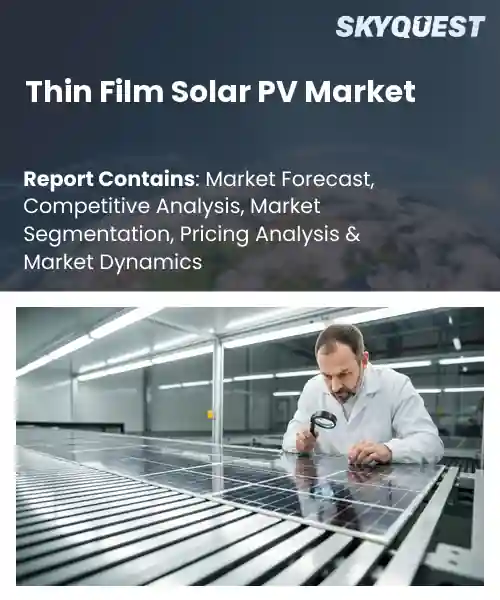
Thin Film Solar PV Market
Report ID: SQMIG55F2105
Report ID: SQMIG55F2105
[email protected]
USA +1 351-333-4748
Report ID:
SQMIG55F2105 |
Region:
Global |
Published Date: July, 2026
Pages:
157
|Tables:
145
|Figures:
78


Global Thin Film Solar PV Market size was valued at USD 18.5 Billion in 2024 and is poised to grow from USD 20.87 Billion in 2025 to USD 54.7 Billion by 2033, growing at a CAGR of 12.8% during the forecast period (2026-2033).
The thin film solar photovoltaic market consists of flexible panels that turn sunlight into electricity using semiconductor layers only a few micrometers thick. Its relevance lies in deploying power on curved surfaces, rooftops, and building facades where silicon modules are impractical.
The primary growth driver for the global thin film PV market is the expanding demand for building‑integrated photovoltaics (BIPV) that blend aesthetic appeal with energy generation. As urban planners prioritize green façades and zero‑energy buildings, designers turn to thin‑film modules because their variants can double as shading devices while producing power. This preference has spurred manufacturers to scale production of copper‑indium‑gallium‑selenide (CIGS) sheets, lowering per‑watt costs and enabling projects such as the 20‑MW solar canopy at a European logistics hub. Consequently, developers gain a revenue stream from both electricity sales and leasing of visually integrated assets, fueling further investment in thin‑film technology.
How is AI enhancing efficiency in the thin film solar PV market?
AI is reshaping thin film solar PV by automating material deposition, optimizing layer uniformity, and predicting performance degradation. Machine‑learning models analyze real‑time sensor data from sputtering and chemical vapor processes, allowing instant adjustments that improve crystal quality and reduce defects. These algorithms also streamline supply‑chain logistics, matching production schedules with demand forecasts and minimizing inventory waste. By integrating AI‑driven design tools, engineers can simulate novel material stacks faster, accelerating the path from lab to fab. The result is a more responsive manufacturing ecosystem that delivers higher‑efficiency modules while cutting energy and cost footprints, positioning thin‑film technology as a competitive alternative in a rapidly evolving market.
In April 2026, a breakthrough in AI‑driven process control was announced, demonstrating how predictive algorithms streamline deposition and reduce material waste, supporting market growth.
Market snapshot - (2026-2033)
Global Market Size
USD 18.5 Billion
Largest Segment
Cadmium Telluride (CdTe) Solar Cells
Fastest Growth
Copper Indium Gallium Selenide (CIGS) Solar Cells
Growth Rate
12.8% CAGR
To get more insights on this market click here to Request a Free Sample Report
Global thin film solar PV market is segmented by technology, installation type, end user, module type, distribution channel and region. Based on technology, the market is segmented into Cadmium Telluride (CdTe) Solar Cells, Amorphous Silicon (a-Si) Solar Cells, Copper Indium Gallium Selenide (CIGS) Solar Cells and Other Thin-Film Solar Technologies. Based on installation type, the market is segmented into Ground-Mounted Systems, Rooftop Systems and Flexible & Portable Systems. Based on end user, the market is segmented into Utilities, Commercial & Industrial Users, Residential Users and Government & Public Sector. Based on module type, the market is segmented into Rigid Thin-Film Modules and Flexible Thin-Film Modules. Based on distribution channel, the market is segmented into Direct Sales, EPC Contractors & Integrators and Distributors & Dealers. Based on region, the market is segmented into North America, Europe, Asia Pacific, Latin America and Middle East & Africa.
Cadmium telluride (CdTe) segment dominates with large thin film solar PV market share because its high conversion efficiency combined with low‑cost manufacturing gives it a clear advantage over other thin‑film options. The material’s ability to maintain performance under low light and elevated temperatures aligns with utility‑scale and commercial installations, reinforcing demand. Its mature supply chain, proven reliability, and compatibility with large‑area deposition processes further cement its leadership in the thin film solar PV market.
As per thin film solar PV market outlook, amorphous silicon segment is witnessing the strongest growth momentum as manufacturers refine deposition techniques that lower material usage and enable lightweight panels. This innovation expands applications in building‑integrated photovoltaics and portable devices, attracting new adopters. The resulting diversification of product offerings is accelerating market expansion and creating fresh revenue avenues.
As per thin film solar PV market forecast, rooftop systems segment dominates because the ease of integrating thin‑film modules onto existing structures reduces land acquisition costs and shortens permitting timelines. The low profile and flexibility of thin‑film panels match the aesthetic and weight constraints of commercial and residential roofs, encouraging widespread adoption. Their compatibility with building‑integrated designs also supports energy resilience initiatives, reinforcing the rooftop market’s central position in thin film solar PV deployment.
As per thin film solar PV market analysis, ground‑mounted systems segment is emerging as the key high‑growth area as developers favor large‑scale sites that exploit open land and economies of scale. Improvements in thin‑film durability and reduced balance‑of‑system expenses make these projects financially appealing, drawing utility planners’ interest. This momentum expands market reach and opens fresh capacity pipelines.
To get detailed segments analysis, Request a Free Sample Report
Asia Pacific leverages a combination of deep manufacturing expertise, extensive research infrastructure and proactive policy frameworks that prioritize cost‑effective renewable solutions. The region benefits from a mature supply chain for glass, metal and semiconductor materials, enabling rapid scaling of thin‑film production. Collaborative ecosystems linking universities, specialized firms and government agencies accelerate technology breakthroughs and drive adoption across residential, commercial and utility sectors. Strong emphasis on integration with building‑integrated photovoltaics and flexible applications further cements the region’s leadership, while export‑oriented strategies extend its influence to global markets.
As per thin film solar PV market regional outlook, Japan draws on a heritage of precision engineering and advanced material science, supported by coordinated incentives that promote rooftop and façade integration. Industry collaborations focus on enhancing efficiency and durability, while regulatory pathways streamline approvals for innovative installations. The market gains momentum through strong demand in urban environments where space constraints favor lightweight, flexible modules, reinforcing Japan’s status as a key hub for thin‑film technology advancement.
As per thin film solar PV market regional forecast, South Korea thrives on a vibrant high‑tech ecosystem that emphasizes renewable integration within smart city initiatives. Government programs provide targeted support for research and pilot projects, encouraging adoption in industrial parks and commercial complexes. The country’s robust electronics sector supplies critical components, fostering cost‑competitive production. A culture of rapid commercialization ensures that emerging thin‑film solutions move swiftly from laboratory to large‑scale deployment, strengthening South Korea’s competitive edge.
Europe’s expansion is propelled by ambitious climate objectives, comprehensive policy incentives and a mature engineering base that values sustainable, low‑impact technologies. The continent’s focus on building‑integrated photovoltaics aligns with dense urban fabrics, where thin‑film panels offer aesthetic and functional benefits. Strong research consortia across several nations accelerate efficiency gains and material innovations, while stable regulatory environments reduce barriers to market entry. Coupled with a growing preference for lightweight, adaptable solutions in residential and commercial settings, these factors collectively fuel Europe’s rapid uptake of thin‑film solar.
Germany is anchored by a deep industrial tradition and extensive renewable energy mandates that encourage diversified technology portfolios. Collaborative networks between research institutes and manufacturers emphasize reliability and performance, supporting large‑scale deployment on both new constructions and retrofits. Market participants benefit from clear policy signals and a skilled workforce, fostering steady growth and reinforcing Germany’s leadership in the European thin‑film landscape.
As per thin film solar PV industry analysis, United Kingdom experiences accelerated adoption driven by progressive building regulations and strong government backing for low‑carbon solutions. Innovation hubs focus on integrating thin‑film modules into historic and modern structures, where flexibility and visual appeal are paramount. Market dynamics are further shaped by active private investment and a supportive financing environment that encourages rapid scaling across residential and commercial sectors, positioning the United Kingdom at the forefront of continent‑wide expansion.
France is emerging through concerted efforts to blend renewable technologies with architectural heritage. Policy frameworks promote experimental installations on public buildings and urban renewal projects, creating visibility for thin‑film applications. Academic research centers collaborate closely with industry to enhance module durability and aesthetic integration, while government incentives stimulate early‑stage market participation. These combined initiatives nurture a growing ecosystem that is poised to expand France’s presence in the thin‑film segment.
North America advances its position by harnessing a robust innovation pipeline, strategic investment in domestic manufacturing and supportive policy climates that encourage diversified renewable portfolios. Collaborative ecosystems linking universities, start‑ups and established firms accelerate technology maturation and cost reductions. Emphasis on integrating thin‑film solutions into large‑scale solar farms, commercial rooftops and emerging electric mobility applications expands market relevance. Favorable financing structures and a focus on energy resilience further drive adoption, positioning the region as a dynamic contributor to global thin‑film growth.
United States benefits from a strong entrepreneurial culture and extensive research funding that promote rapid prototyping and scale‑up. Federal and state programs provide incentives for modular installations across commercial, industrial and utility sectors, emphasizing flexibility and land‑use efficiency. Partnerships between silicon manufacturers and thin‑film specialists foster cross‑technology innovation, while a growing emphasis on resilient grid solutions heightens demand for lightweight, adaptable photovoltaic options.
Canada is shaped by a commitment to clean energy transition and a supportive policy landscape that encourages innovation in northern and remote environments. The market leverages expertise in material science and cold‑climate engineering to develop modules that perform reliably under challenging conditions. Collaborative initiatives between research institutions and renewable developers focus on integrating thin‑film technology into building‑integrated projects and off‑grid solutions, reinforcing Canada’s emerging role in the sector.
To know more about the market opportunities by region and country, click here to
Buy The Complete Report
Enhanced Efficiency using Advanced Materials
Growing Deployment in Building Integration
High Production Cost Challenges
Limited Long-Term Reliability Perceptions
Request Free Customization of this report to help us to meet your business objectives.
The thin film solar PV industry is intensifying as incumbents and newcomers vie for cost‑effective, lightweight solutions. First Solar’s $270 million R&D center investment and Tandem PV’s $50 million Series A illustrate aggressive tech innovation, while Active Surfaces’ recent pre‑seed round and strategic OEM collaborations highlight rapid partnership‑driven scaling. These moves sharpen competition around efficiency gains and manufacturing scale.
SkyQuest’s ABIRAW (Advanced Business Intelligence, Research & Analysis Wing) is our Business Information Services team that Collects, Collates, Correlates, and Analyses the Data collected by means of Primary Exploratory Research backed by robust Secondary Desk research.
As per SkyQuest analysis, the thin film solar PV market growth is being propelled primarily by the growing deployment in building integration, where architects embed flexible modules into façades and rooftops, while a second driver comes from enhanced efficiency using advanced materials such as perovskites that raise conversion rates and open new applications. The market is led by the cadmium telluride (CdTe) segment, which benefits from high efficiency and low‑cost production, and Asia Pacific dominates globally due to its deep manufacturing base and supportive policies. However, high production‑cost challenges remain a restraint, limiting price competitiveness against mature silicon technologies and tempering rapid adoption. The global thin film solar PV market trend driven by increasing investments in renewable energy, supportive government policies, and rising demand for lightweight and flexible photovoltaic technologies.
| Report Metric | Details |
|---|---|
| Market size value in 2024 | USD 18.5 Billion |
| Market size value in 2033 | USD 54.7 Billion |
| Growth Rate | 12.8% |
| Base year | 2024 |
| Forecast period | (2026-2033) |
| Forecast Unit (Value) | USD Billion |
| Segments covered |
|
| Regions covered | North America (US, Canada), Europe (Germany, France, United Kingdom, Italy, Spain, Rest of Europe), Asia Pacific (China, India, Japan, Rest of Asia-Pacific), Latin America (Brazil, Rest of Latin America), Middle East & Africa (South Africa, GCC Countries, Rest of MEA) |
| Companies covered |
|
| Customization scope | Free report customization with purchase. Customization includes:-
|
To get a free trial access to our platform which is a one stop solution for all your data requirements for quicker decision making. This platform allows you to compare markets, competitors who are prominent in the market, and mega trends that are influencing the dynamics in the market. Also, get access to detailed SkyQuest exclusive matrix.
Table Of Content
Executive Summary
Market overview
Parent Market Analysis
Market overview
Market size
KEY MARKET INSIGHTS
COVID IMPACT
MARKET DYNAMICS & OUTLOOK
Market Size by Region
KEY COMPANY PROFILES
Methodology
For the Thin Film Solar PV Market, our research methodology involved a mixture of primary and secondary data sources. Key steps involved in the research process are listed below:
1. Information Procurement: This stage involved the procurement of Market data or related information via primary and secondary sources. The various secondary sources used included various company websites, annual reports, trade databases, and paid databases such as Hoover's, Bloomberg Business, Factiva, and Avention. Our team did 45 primary interactions Globally which included several stakeholders such as manufacturers, customers, key opinion leaders, etc. Overall, information procurement was one of the most extensive stages in our research process.
2. Information Analysis: This step involved triangulation of data through bottom-up and top-down approaches to estimate and validate the total size and future estimate of the Thin Film Solar PV Market.
3. Report Formulation: The final step entailed the placement of data points in appropriate Market spaces in an attempt to deduce viable conclusions.
4. Validation & Publishing: Validation is the most important step in the process. Validation & re-validation via an intricately designed process helped us finalize data points to be used for final calculations. The final Market estimates and forecasts were then aligned and sent to our panel of industry experts for validation of data. Once the validation was done the report was sent to our Quality Assurance team to ensure adherence to style guides, consistency & design.
Analyst Support
Customization Options
With the given market data, our dedicated team of analysts can offer you the following customization options are available for the Thin Film Solar PV Market:
Product Analysis: Product matrix, which offers a detailed comparison of the product portfolio of companies.
Regional Analysis: Further analysis of the Thin Film Solar PV Market for additional countries.
Competitive Analysis: Detailed analysis and profiling of additional Market players & comparative analysis of competitive products.
Go to Market Strategy: Find the high-growth channels to invest your marketing efforts and increase your customer base.
Innovation Mapping: Identify racial solutions and innovation, connected to deep ecosystems of innovators, start-ups, academics, and strategic partners.
Category Intelligence: Customized intelligence that is relevant to their supply Markets will enable them to make smarter sourcing decisions and improve their category management.
Public Company Transcript Analysis: To improve the investment performance by generating new alpha and making better-informed decisions.
Social Media Listening: To analyze the conversations and trends happening not just around your brand, but around your industry as a whole, and use those insights to make better Marketing decisions.
REQUEST FOR SAMPLE
 REQUEST FREE CUSTOMIZATION
Global Thin Film Solar Pv Market size was valued at USD 18.5 Billion in 2024 and is poised to grow from USD 20.87 Billion in 2025 to USD 54.7 Billion by 2033, growing at a CAGR of 12.8% during the forecast period (2026-2033).
The thin‑film solar PV market is intensifying as incumbents and newcomers vie for cost‑effective, lightweight solutions. First Solar’s $270 million R&D center investment and Tandem PV’s $50 million Series A illustrate aggressive tech innovation, while Active Surfaces’ recent pre‑seed round and strategic OEM collaborations highlight rapid partnership‑driven scaling. These moves sharpen competition around efficiency gains and manufacturing scale. 'First Solar, Inc.', 'MiaSolé Hi-Tech Corp.', 'Ascent Solar Technologies, Inc.', 'Avancis GmbH', 'Solar Frontier K.K.', 'Heliatek GmbH', 'Oxford PV Ltd.', 'Flisom AG', 'Sharp Corporation', 'Kaneka Corporation', 'Toshiba Corporation', 'Panasonic Holdings Corporation', 'Midsummer AB', 'Greatcell Energy Pty Ltd.', 'Global Solar Energy, Inc.', 'Apeva SE', 'Solarion GmbH', 'PowerFilm Solar, Inc.', 'HyET Solar B.V.', 'Saule Technologies Sp. z o.o.'
Enhanced Efficiency using Advanced Materials – The introduction of novel thin‑film materials such as perovskites and flexible substrates reduces energy losses and enables higher power conversion under diverse lighting conditions, which increases overall system performance. By delivering comparable output with lighter and more adaptable panels, manufacturers can target new applications, including portable and building‑integrated installations. This technological advancement stimulates demand from sectors seeking efficient, space‑saving solutions and encourages continued investment in research, thereby supporting sustained market expansion globally significantly over the next decade.
Solar Flexibility Growth: Manufacturers are capitalising on the inherent flexibility and lightweight characteristics of thin‑film modules, enabling integration onto curved and moving surfaces that conventional silicon cannot accommodate. This advantage is spurring adoption in emerging niches such as wearables, portable power packs, automotive roof‑integrated panels, and lightweight UAVs. Designers are exploiting the form‑factor freedom to create products with seamless aesthetics and reduced weight, while end‑users benefit from greater portability and resilience in diverse operating environments and longer service life under vibration and reliability.
Why does Asia Pacific Dominate the Global Thin Film Solar PV Market? |@12


Want to customize this report? This report can be personalized according to your needs. Our analysts and industry experts will work directly with you to understand your requirements and provide you with customized data in a short amount of time. We offer $1000 worth of FREE customization at the time of purchase.
Feedback From Our Clients


 USA (+1) 351-333-4748

