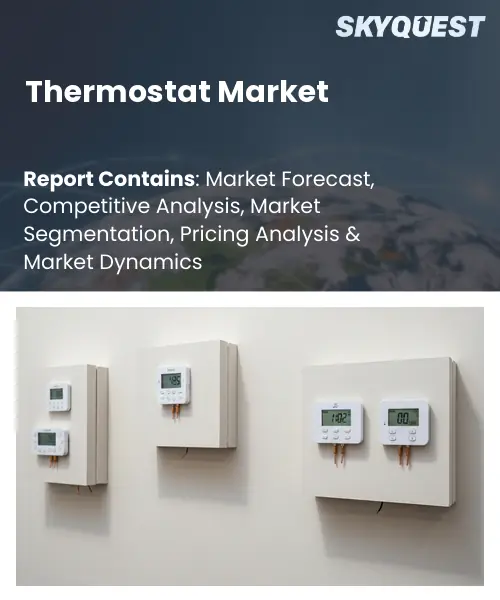
Thermostat Market
Report ID: SQMIG20D2635
Report ID: SQMIG20D2635
[email protected]
USA +1 351-333-4748
Report ID:
SQMIG20D2635 |
Region:
Global |
Published Date: June, 2026
Pages:
157
|Tables:
144
|Figures:
78


Global Thermostat Market size was valued at USD 3.52 Billion in 2024 and is poised to grow from USD 3.77 Billion in 2025 to USD 6.52 Billion by 2033, growing at a CAGR of 7.12% during the forecast period (2026-2033).
The thermostat industry comprises multiple products and systems designed to control the temperature indoors, such as mechanical devices, programmable thermostats, and smart thermostats that can be connected to each other, featuring built-in sensors, software, and networked control. This industry has grown substantially due to a growing emphasis on energy efficiency and the increased desire for convenience from both users and manufacturers, leading to the current variety of types of thermostats, which include analog, digital, learning algorithms and mobile applications.
An increased number of buildings use and create a tremendous amount of energy, so companies that manufacture and sell thermometers want to produce better thermometers to decrease expenses, decrease greenhouse gas emissions and allow utilities to provide a wider range of services to their customers. Many companies in this category (e.g., Nest, Honeywell) have to create products designed with the needs and wants of today’s consumers, with data analytics and interoperability being especially important characteristics.
As the use of connected devices and data analytics grows, the thermostat market will continue to expand due to the availability of devices that connect to networks providing users with fine-grain control and enabling users to achieve significant reductions in energy usage. The rapid growth of smart speakers in the home and buildings implementing building management systems has driven utilities to fund incentives for the installation of retrofit-interoperable thermostats which will result in increased revenues for vendors of these products.
How is AI improving energy efficiency in smart thermostats?
With respect to smart thermostats, AI is improving the energy efficiency of these devices in three primary ways. First, AI can now learn an occupant's routine. This ability enables the system to automatically adjust the temperature only during times when the occupant is expected to be home. The use of predictive analysis will allow a smart thermostat to determine how a building's thermal mass acts over time and react accordingly. This reduces the amount of time the heating/cooling system is in operation. Through access to real-time weather data from the grid, Occupants will be able to adjust their usage patterns for more reduced demand at non-peak hours.
There is an increasing trend in the marketplace towards integrated solutions that combine the use of sensors and cloud based analytics. Integrated solution providers like Google Nest are providing users with substantial energy savings while utilizing the AI Assist feature provided by "tado" which enables users to easily make adjustments to their heating systems as they accumulate occupancy history, resulting in more personalized comfort while minimizing energy waste.
Market snapshot - (2026-2033)
Global Market Size
USD 3.52 Billion
Largest Segment
Smart/Programmable Thermostats
Fastest Growth
Smart/Programmable Thermostats
Growth Rate
7.12% CAGR
To get more insights on this market click here to Request a Free Sample Report
Global thermostat market is segmented by type, technology, application, distribution, feature and region. Based on type, the market is segmented into Smart/Programmable Thermostats, Non-Programmable Thermostats and Line Voltage Thermostats. Based on technology, the market is segmented into Wi-Fi Connected, Zigbee/Z-Wave and Wired/Conventional. Based on application, the market is segmented into Residential, Commercial Buildings and Industrial. Based on distribution, the market is segmented into Online, Home Improvement Stores and HVAC Contractors. Based on feature, the market is segmented into Voice Control, Learning Capability and Basic Programmable. Based on region, the market is segmented into North America, Europe, Asia Pacific, Latin America and Middle East & Africa.
Wi-Fi connected segment dominates with large thermostat market share because ubiquitous home and building networks plus cloud platforms position these devices as the primary conduit for remote HVAC control and data-driven services. Seamless mobile apps and broad compatibility with third-party ecosystems reduce deployment friction and attract OEM and software investment. This fosters richer analytics, recurring service models, and integration with assistant platforms, which in turn drive installer preference and accelerate product innovation across the market.
As per thermostat market outlook, Zigbee/Z-wave is emerging as the fastest growing area because mesh networking provides reliable, low-power local automation suited to multi-device installations. Strong interoperability with dedicated hubs and emphasis on secure, low-latency control appeals to integrators and professional deployments, enabling differentiated solutions and new service offerings that expand adoption in sophisticated residential and commercial automation scenarios.
As per thermostat market analysis, learning capability segment leads because embedded machine learning and adaptive control transform thermostats into proactive energy management platforms that reduce manual tuning and improve occupant comfort. Autonomous schedule optimization based on the occupancy and environmental inputs increases perceived value and supports bundled analytics and subscription services.
As per thermostat market forecast, voice control is emerging as the fastest growing capability due to seamless integration with virtual assistants and consumer demand for hands-free interaction. Its intuitive interface lowers adoption barriers across product tiers, prompting vendors to embed voice features that broaden market appeal, foster partnerships with platform providers, and accelerate ecosystem uptake and channel expansion.
To get detailed segments analysis, Request a Free Sample Report
North America is a leader in the global thermostat market due to its established HVAC infrastructure, strong consumer demand for comfort and energy savings and increasing adoption of connected home technologies. There is a strong presence of established manufacturers and integrators, which drives continual product innovation and broad distribution. Energy efficiency rules and incentive programs are encouraging retrofit and smart controls in the business and residential segments. Adoption is supported by broad service and installation networks and the value proposition is enhanced by integration with building management systems and utility demand response projects. Continued market leadership is driven by strong investment in research and development, strategic alliances with utilities and technology companies, and growing consumer knowledge of lifetime costs, which promote continual upgrades and new service offerings.
As per global thermostat market regional outlook, United States is led by broad consumer awareness of smart home benefits and extensive availability of advanced HVAC systems. A well developed channel landscape with professional installers, energy service companies, and major retailers accelerates adoption. Manufacturers invest in interoperable platforms and cloud services to address residential and commercial needs. Partnerships with utilities support demand response programs, and innovation emphasizes usability, integration and lifecycle services and maintenance.
As per global thermostat market regional forecast, Canada features energy conservation, cold environment controls, and interaction with different heating systems. Special product features are encouraged by unique multi-zone and heat source control requirements. Utilities and provincial programs partner with manufacturers and installers to encourage efficient controls in residential and commercial buildings. Distribution networks include national stores and regional service providers. Vendors focus on ruggedized hardware, easy installation, bilingual interfaces and localized support.
As per global thermostat industry analysis, Europe market is growing due to energy efficiency requirements, large-scale building renovation initiatives, and growing consumer interest in smart home solutions. District heating networks are prevalent in the region and heat pumps are common. There is a need for flexible , interoperable thermostats . Strong standards and certification frameworks make for trustworthy goods, while the active participation of utilities and energy service providers encourages control upgrades through incentive programs. Strong manufacturing and engineering capabilities in core economies underpin innovation in connectivity, user experience and integrated building management. Europe is already a strong growing market for thermostats and its position is being further reinforced by cross-border supply chains and partnerships between manufacturers, installers and technology providers that are accelerating deployment in new builds and retrofits. The penetration across the residential and commercial sectors continues to be driven by consumer preference for ease of use and integration with energy management systems.
Germany benefits from a robust industrial base, deep engineering expertise, and stringent energy performance standards that drive demand for high quality controls. Local manufacturers and technology providers focus on reliability, interoperability, and advanced connectivity. Strong collaboration between utilities, building managers, and installers supports large scale adoption in commercial and residential segments. Emphasis on retrofit solutions and integration with building automation systems sustains demand and encourages product innovation.
UK market is driven by increased consumer acceptance of connected controls and a busy refit activity in both household and commercial buildings. An active installation and service network working with new startups and established manufacturers drives dissemination of technologies. Suppliers are capturing urban and suburban markets through a focus on user experience, mobile integration and seamless connectivity.
France is emerging through a focus on building renovation and national energy performance programs. Interest in smart heating controls grows across residential retrofits and public sector projects. Vendors tailor solutions with French language interfaces and compatibility with diverse heating systems. Partnerships with installers and energy service providers facilitate deployment. Priorities on reliability, simple installation, and integration with energy management platforms support steady market progression and consumer awareness
Asia Pacific is consolidating its position in the thermostat industry with rapid technology adoption, growing smart home ecosystems and localization innovation. Manufacturers in the region are focusing on compact, high quality hardware, multilingual interfaces and seamless interaction with residential and commercial HVAC solutions. Urbanization and new build dynamics provide major retrofit and new build opportunities. Utilities and technology companies partner on demand response and energy management experiments. The region is becoming a more significant participant in linked climate control technology, driven by its strong electronics manufacturing skills, competitive supply chains and an emerging pool of service providers that can deliver custom solutions for different climates and heating habits. Investments in platform interoperability, edge analytics, and localization of speech and app interfaces further drive user engagement. Partnerships with global vendors speed technology transfer and scalability.
Japan thermostat market is characterized by a focus on precision engineering, compact form factors, and smooth integration with home automation platforms. Manufacturers are stressing durability, algorithms for energy optimization and more sophisticated user interfaces for urban lifestyles. Strong OEM relationships and domestic electronics supply chains to support prototyping and localized features. Utilities and builders work together to promote control systems for effective heating and cooling. Service providers focus on maintenance, compatibility and support.
South Korea advances through strong consumer engagement with connected devices and leadership in electronics and IoT integration. Local manufacturers emphasize sleek design, advanced connectivity, and cloud enabled services that integrate with broader smart home platforms. Collaboration with telecom providers, utilities, and system integrators supports scalable deployments and innovative service models. Focus on compact, energy efficient solutions and rapid software updates enables quick rollout and strong satisfaction levels.
To know more about the market opportunities by region and country, click here to
Buy The Complete Report
Growing Energy Efficiency Demand
Smart Home Integration Growth
Consumer Privacy and Security Concerns
High Installation and Maintenance Costs
Request Free Customization of this report to help us to meet your business objectives.
Competition in the global thermostat industry centers on platform level energy management, differentiation through grid services, and channel partnerships. Corporates pursue M&A to secure software and grid integration, for example Generac's acquisition of ecobee. Smart home firms pursue tariff integrations and utility partnerships, as tado did when acquiring aWATTar to enable time of use pricing and load shifting. Tech innovation and white label deals drive positioning.
SkyQuest’s ABIRAW (Advanced Business Intelligence, Research & Analysis Wing) is our Business Information Services team that Collects, Collates, Correlates, and Analyses the Data collected by means of Primary Exploratory Research backed by robust Secondary Desk research.
As per SkyQuest analysis, the global thermostat market growth is being propelled primarily by growing demand for energy efficiency as consumers and regulators seek lower consumption and operating costs, and further accelerated by connectivity and data analytics that enable remote control, demand response and measurable savings. North America remains the dominant region due to mature HVAC infrastructure, incentive programs and strong OEM presence, while Wi‑Fi connected thermostats lead the product landscape due to cloud platforms and broad interoperability. A key restraint slowing adoption is consumer concern over data privacy and cybersecurity, which increases the need for secure design and transparent data practices to sustain growth.
| Report Metric | Details |
|---|---|
| Market size value in 2024 | USD 3.52 Billion |
| Market size value in 2033 | USD 6.52 Billion |
| Growth Rate | 7.12% |
| Base year | 2024 |
| Forecast period | (2026-2033) |
| Forecast Unit (Value) | USD Billion |
| Segments covered |
|
| Regions covered | North America (US, Canada), Europe (Germany, France, United Kingdom, Italy, Spain, Rest of Europe), Asia Pacific (China, India, Japan, Rest of Asia-Pacific), Latin America (Brazil, Rest of Latin America), Middle East & Africa (South Africa, GCC Countries, Rest of MEA) |
| Companies covered |
|
| Customization scope | Free report customization with purchase. Customization includes:-
|
To get a free trial access to our platform which is a one stop solution for all your data requirements for quicker decision making. This platform allows you to compare markets, competitors who are prominent in the market, and mega trends that are influencing the dynamics in the market. Also, get access to detailed SkyQuest exclusive matrix.
Table Of Content
Executive Summary
Market overview
Parent Market Analysis
Market overview
Market size
KEY MARKET INSIGHTS
COVID IMPACT
MARKET DYNAMICS & OUTLOOK
Market Size by Region
KEY COMPANY PROFILES
Methodology
For the Thermostat Market, our research methodology involved a mixture of primary and secondary data sources. Key steps involved in the research process are listed below:
1. Information Procurement: This stage involved the procurement of Market data or related information via primary and secondary sources. The various secondary sources used included various company websites, annual reports, trade databases, and paid databases such as Hoover's, Bloomberg Business, Factiva, and Avention. Our team did 45 primary interactions Globally which included several stakeholders such as manufacturers, customers, key opinion leaders, etc. Overall, information procurement was one of the most extensive stages in our research process.
2. Information Analysis: This step involved triangulation of data through bottom-up and top-down approaches to estimate and validate the total size and future estimate of the Thermostat Market.
3. Report Formulation: The final step entailed the placement of data points in appropriate Market spaces in an attempt to deduce viable conclusions.
4. Validation & Publishing: Validation is the most important step in the process. Validation & re-validation via an intricately designed process helped us finalize data points to be used for final calculations. The final Market estimates and forecasts were then aligned and sent to our panel of industry experts for validation of data. Once the validation was done the report was sent to our Quality Assurance team to ensure adherence to style guides, consistency & design.
Analyst Support
Customization Options
With the given market data, our dedicated team of analysts can offer you the following customization options are available for the Thermostat Market:
Product Analysis: Product matrix, which offers a detailed comparison of the product portfolio of companies.
Regional Analysis: Further analysis of the Thermostat Market for additional countries.
Competitive Analysis: Detailed analysis and profiling of additional Market players & comparative analysis of competitive products.
Go to Market Strategy: Find the high-growth channels to invest your marketing efforts and increase your customer base.
Innovation Mapping: Identify racial solutions and innovation, connected to deep ecosystems of innovators, start-ups, academics, and strategic partners.
Category Intelligence: Customized intelligence that is relevant to their supply Markets will enable them to make smarter sourcing decisions and improve their category management.
Public Company Transcript Analysis: To improve the investment performance by generating new alpha and making better-informed decisions.
Social Media Listening: To analyze the conversations and trends happening not just around your brand, but around your industry as a whole, and use those insights to make better Marketing decisions.
REQUEST FOR SAMPLE
 REQUEST FREE CUSTOMIZATION
Global Thermostat Market size was valued at USD 3.52 Billion in 2024 and is poised to grow from USD 3.77 Billion in 2025 to USD 6.52 Billion by 2033, growing at a CAGR of 7.12% during the forecast period (2026-2033).
Competition in the global thermostat market centers on platform level energy management, differentiation through grid services, and channel partnerships. Corporates pursue M&A to secure software and grid integration, for example Generac's acquisition of ecobee. Smart home firms pursue tariff integrations and utility partnerships, as tado° did when acquiring aWATTar to enable time of use pricing and load shifting. Tech innovation and white label deals drive positioning. 'Honeywell International', 'Nest Labs (Google)', 'Ecobee', 'Emerson Electric (Sensi)', 'Lennox International', 'Schneider Electric', 'Siemens AG', 'Johnson Controls', 'Danfoss A/S', 'Resideo Technologies', 'Carrier Global', 'Trane Technologies', 'White-Rodgers (Emerson)', 'Radio Thermostat Company', 'Stelpro Design', 'Lux Products Corp.', 'Mysa Smart Thermostats', 'Salus Controls', 'Climote Ltd.', 'uHoo Inc.'
Growing consumer and regulatory emphasis on reducing energy consumption has led homeowners and businesses to favor thermostats that actively optimize heating and cooling. Demand for devices that enable scheduling, adaptive control, and integration with energy-saving programs stimulates development and adoption of advanced thermostat products. Manufacturers respond by prioritizing features that deliver measurable reductions in energy use and operational cost, which broadens market appeal and supports product diversification. This demand-driven focus encourages investment in innovation and distribution, reinforcing growth across residential and commercial segments.
Smart Building Integration: Thermostat manufacturers prioritize integration with smart building ecosystems and management platforms, enabling coordinated HVAC, lighting and occupancy controls. Emphasis on interoperability and open protocols supports partnerships across suppliers and providers, while occupant interfaces and adaptive schedules enhance comfort and operational efficiency. Demand response readiness and cloud analytics support predictive maintenance and performance tuning, allowing systems to respond to dynamic grid and usage conditions. This trend accelerates adoption in commercial portfolios and residential projects, driving product modularity and ecosystem driven value.
Why does North America Dominate the Global Thermostat Market? |@12


Want to customize this report? This report can be personalized according to your needs. Our analysts and industry experts will work directly with you to understand your requirements and provide you with customized data in a short amount of time. We offer $1000 worth of FREE customization at the time of purchase.
Feedback From Our Clients


 USA (+1) 351-333-4748

