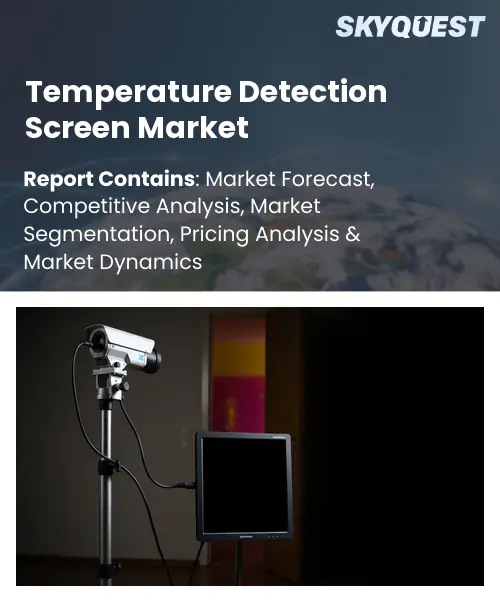
Temperature Detection Screen Market
Report ID: SQMIG45J2589
Report ID: SQMIG45J2589
[email protected]
USA +1 351-333-4748
Report ID:
SQMIG45J2589 |
Region:
Global |
Published Date: July, 2026
Pages:
157
|Tables:
142
|Figures:
78


Global Temperature Detection Screen Market size was valued at USD 1.90 Billion in 2024 and is poised to grow from USD 2.22 Billion in 2025 to USD 7.74 Billion by 2033, growing at a CAGR of 16.9% during the forecast period (2026-2033).
The primary driver of the temperature detection screen market is the global imperative to protect public health, which propelled rapid adoption of touchless screening. Temperature detection screens combine infrared sensors with display interfaces to screen individuals at entrances of airports, hospitals and office buildings, enabling fast identification of fever symptoms and reducing reliance on manual thermometers.
Historically the market evolved from handheld infrared guns to fixed kiosks and integrated building management solutions as accuracy, speed and integration capabilities improved. Government screening mandates, corporate health protocols and heightened consumer expectations continue to sustain demand and spur innovation.
A primary growth factor for the global temperature detection screen market is integration with security and building automation systems, which creates efficiencies and helps justify investment. When screens feed data into access control platforms organizations can automatically deny entry to febrile individuals and reduce transmission risk, delivering tangible benefits for airports, schools and manufacturing. Advances in AI and improved infrared sensor accuracy lower false positives and enable continuous screening, which in turn opens new use cases in retail and corporate wellness. As policymakers incentivize touchless solutions and remote monitoring lowers staffing needs, vendors expand revenues through software subscriptions and analytics.
How is AI improving accuracy and throughput in the temperature detection screen market?
AI is improving accuracy and throughput in temperature detection screens by combining smarter sensing with automated decision making. Key aspects include thermal image enhancement and multisensor fusion that pair thermal and visible data to confirm true anomalies. Edge AI enables real time screening so devices filter out environmental noise and reduce false alarms before human review. The current market favors systems that minimize manual checks while maintaining reliable detection in high traffic locations such as transit hubs and clinics. Vendors increasingly use deep learning to adapt to different scenes which improves consistency and lets operators process more people with confidence.
Axis Communications in June 2026, introduced an AI powered bispectral camera that pairs a high resolution thermal sensor with a 4K visible camera for on device verification. This reduces false positives and speeds throughput by enabling automated confirmation at the edge which supports wider deployment and greater operational efficiency.
Market snapshot - (2026-2033)
Global Market Size
USD 0.88 Billion
Largest Segment
Infrared Thermal Cameras (Non-Contact)
Fastest Growth
AI-Enabled Fever Detection
Growth Rate
8.02% CAGR
To get more insights on this market click here to Request a Free Sample Report
Global temperature detection screen market is segmented by type, application, accuracy, end-user, distribution and region. Based on type, the market is segmented into Infrared Thermal Cameras (Non-Contact), Thermal Kiosk Systems and AI-Enabled Fever Detection. Based on application, the market is segmented into Entry Screening (Buildings), Airport Screening and Healthcare Facilities. Based on accuracy, the market is segmented into ±0.5°C and ±1°C. Based on end-user, the market is segmented into Corporate Offices, Hospitals and Airports & Transport Hubs. Based on distribution, the market is segmented into System Integrators and Direct Sales. Based on region, the market is segmented into North America, Europe, Asia Pacific, Latin America and Middle East & Africa.
Infrared thermal cameras segment with large temperature detection screen market share dominates because these systems offer proven noncontact temperature sensing that integrates easily with access control and surveillance infrastructure, enabling continuous screening with minimal workflow disruption. Their technical maturity and broad vendor availability drive preference among buyers, while reliable thermal imaging performance lowers operational friction and supports centralized monitoring, causing procurement to favor cameras for fundamental detection needs and widespread deployment across varied end user environments.
As per temperature detection screen market analysis, AI-enabled fever detection is witnessing the strongest growth as machine learning reduces false alerts and adds contextual risk scoring. Software centric capabilities drive demand for analytics and cloud services, enabling advanced triage workflows and subscription models that invite vendor innovation and create recurring revenue streams that expand market opportunity.
Airport screening segment dominates because the need for high throughput coupled with stringent public safety expectations drives investment in robust, interoperable temperature detection solutions. Demand for continuous, nonintrusive screening incentivizes vendors to prioritize reliability, rapid processing and integration with baggage and identity systems, which in turn shapes procurement preferences toward enterprise grade products and comprehensive service offerings, reinforcing dominance of airport focused deployments in shaping vendor roadmaps and solution design.
As per temperature detection screen market outlook, entry screening (buildings) is the fastest growing segment as employers and facility managers adopt on site health policies that favor compact kiosks and integrated workflows. Ease of installation and adaptability to varied building footprints encourage rapid uptake, prompting vendors to offer turnkey solutions that broaden commercial demand and diversify distribution channels.
To get detailed segments analysis, Request a Free Sample Report
Asia Pacific leads due to a convergence of manufacturing strength, concentrated technology clusters, and proactive adoption by public and private stakeholders. Robust electronics and instrumentation ecosystems enable rapid prototyping and scalable production of temperature detection screens, while established supply chain networks ensure component availability. High urban density and busy travel hubs create sustained demand for mass screening solutions across transportation, healthcare, and commercial venues. Local manufacturers and systems integrators collaborate closely with research institutions to refine hardware and software integration, promoting user friendly deployments. Policy emphasis on public health preparedness and willingness to pilot new screening modalities further accelerates uptake. Cost competitiveness and regional coordination among suppliers and buyers reinforce market leadership, enabling faster roll out and iterative product improvement compared with other regions.
As per temperature detection screen market regional outlook, Japan benefits from advanced sensor manufacturing, deep expertise in thermal imaging, and collaboration between device makers and healthcare institutions. Integration with visitor management and workplace safety systems supports practical deployments, while domestic suppliers ensure high quality production. Focus on accuracy and user centered design drives product refinement, and clear regulatory pathways with established distribution channels support adoption across public and private environments and academic partners.
As per temperature detection screen market regional forecast, South Korea benefits from a sophisticated electronics supply chain in thermal sensor integration, enabling high performance screening solutions. Collaboration among system integrators, telecom providers, and urban infrastructure projects supports deployments in transit hubs and commercial sites. Focus on connectivity and intuitive interfaces eases integration with access control and building management. Local manufacturers and service providers provide customization and after sales support across broad installation environments.
Expansion in North America is driven by coordinated demand from healthcare systems, corporate enterprises, and public venues seeking reliable screening solutions alongside evolving operational priorities. Integration with enterprise IT, access control, and visitor management platforms positions temperature detection screens as components within broader security and safety ecosystems. Strong channels for procurement, service and maintenance contracts, and established system integrators enable scalable deployment and after sales support. Emphasis on user experience, privacy compliant data handling, and interoperability with existing infrastructure encourages organizational adoption. Additionally, collaboration between technology vendors and integrators accelerates solution customization for varied environments including transportation hubs, education facilities, and commercial campuses, reinforcing market momentum and broadening use cases beyond initial screening scenarios. Policy guidance and institutional funding mechanisms support pilot programs and broader rollouts, while vendor emphasis on accuracy, operator training, and service level agreements builds buyer confidence and supports longer term utilization across sectors.
As per temperature detection screen industry analysis, United States reflects procurement from healthcare networks, corporate campuses, transportation hubs, and retail chains seeking integrated screening solutions. Emphasis on privacy compliant data handling and interoperability with security and building systems informs technical requirements. Channel partners and service integrators enable broad deployment and maintenance. Vendor attention to operator training, customization, and lifecycle support helps organizations effectively embed screening into wider safety and operational processes.
Canada is influenced by procurement across health systems, transportation nodes, and corporate facilities seeking reliable screening tools for varied climatic conditions. Emphasis on privacy and interoperability with identity and access solutions shapes buying decisions. Strong ties among local integrators, vendors, and service partners support deployment and maintenance. Product durability, ease of maintenance, and flexible service arrangements appeal to buyers in urban centers and dispersed communities.
Europe is strengthening its position through a combination of regulatory alignment, institutional procurement practices, and focused technological development. Strong research ecosystems and specialized manufacturers contribute to incremental improvements in sensor accuracy, software analytics, and system integration. Harmonized standards and procurement frameworks across multiple markets encourage vendors to design solutions that meet stringent privacy and interoperability expectations. Public and private buyers increasingly favor systems that offer clear audit trails, low false alarm rates, and seamless integration with access control and facility management platforms. Collaborative initiatives among vendors, integrators, and research institutions support pilot programs and cross border deployments, while supplier emphasis on service frameworks and sustainability enhances long term appeal to buyers across the region. Well developed after sales networks, multilingual user interfaces, and emphasis on energy efficient designs further increase suitability for diverse public infrastructure, while competitive tendering encourages cost effective innovation and tailored solutions for national markets.
Germany benefits from an established engineering and manufacturing ecosystem that prioritizes precision, reliability, and compliance with technical standards. Procurement by healthcare institutions, transportation operators, and industrial facilities favors solutions that integrate with automation and control systems. Local integrators and calibration service providers support consistent deployment quality and operational reliability. Vendor attention to rigorous testing, documentation, and durable design aligns with buyer expectations in public applications.
United Kingdom reflects procurement across healthcare facilities, transport hubs, and commercial enterprises focused on accuracy and user confidence. Data protection requirements shape solution design, prompting robust privacy features and transparent reporting. Integration with security and building management platforms supports operational use. Local integrators and providers prioritize field calibration, operator training, and service contracts to maintain performance and enable deployments across public and private settings.
France is driven by demand from public healthcare institutions, transport operators, and commercial venues seeking solutions that meet national procurement and privacy standards. Vendor offerings emphasize multilingual interfaces and compliance to support public sector contracts. Integration with access control and facility management systems occurs, and local integrators provide calibration, maintenance, training. Focus on user experience and reliability underpins adoption across urban infrastructure and commercial deployments.
To know more about the market opportunities by region and country, click here to
Buy The Complete Report
Rising Demand For Thermal Monitoring
Integration With Smart Building Systems
High Initial Implementation Costs
Regulatory and Compliance Complexity
Request Free Customization of this report to help us to meet your business objectives.
Competitive landscape is defined by consolidation among imaging suppliers and feature differentiation by software vendors, driven by buyer demand for accuracy and integrated access workflows. Strategic moves include major acquisitions and product launches to secure sensor supply and distribution, for example Teledyne completing the FLIR acquisition and Seek Thermal releasing an integrated kiosk, while software vendors form partnerships that combine AI facial guidance with thermal sensors to win enterprise contracts.
SkyQuest’s ABIRAW (Advanced Business Intelligence, Research & Analysis Wing) is our Business Information Services team that Collects, Collates, Correlates, and Analyses the Data collected by means of Primary Exploratory Research backed by robust Secondary Desk research.
As per SkyQuest analysis, the global temperature detection screen market growth is propelled primarily by the imperative to protect public health and rapid adoption of touchless screening while high initial implementation costs remain a key restraint that slows uptake among budget-constrained buyers. Asia Pacific dominates the market supported by manufacturing strengths and proactive adoption, and infrared thermal cameras lead as the dominant segment due to proven noncontact sensing and easy integration with access control. A secondary growth driver is integration with smart building and security systems that enables automated responses and recurring software revenues, positioning vendors to expand through AI and analytics.
| Report Metric | Details |
|---|---|
| Market size value in 2024 | USD 0.88 Billion |
| Market size value in 2033 | USD 1.75 Billion |
| Growth Rate | 8.02% |
| Base year | 2024 |
| Forecast period | (2026-2033) |
| Forecast Unit (Value) | USD Billion |
| Segments covered |
|
| Regions covered | North America (US, Canada), Europe (Germany, France, United Kingdom, Italy, Spain, Rest of Europe), Asia Pacific (China, India, Japan, Rest of Asia-Pacific), Latin America (Brazil, Rest of Latin America), Middle East & Africa (South Africa, GCC Countries, Rest of MEA) |
| Companies covered |
|
| Customization scope | Free report customization with purchase. Customization includes:-
|
To get a free trial access to our platform which is a one stop solution for all your data requirements for quicker decision making. This platform allows you to compare markets, competitors who are prominent in the market, and mega trends that are influencing the dynamics in the market. Also, get access to detailed SkyQuest exclusive matrix.
Table Of Content
Executive Summary
Market overview
Parent Market Analysis
Market overview
Market size
KEY MARKET INSIGHTS
COVID IMPACT
MARKET DYNAMICS & OUTLOOK
Market Size by Region
KEY COMPANY PROFILES
Methodology
For the Temperature Detection Screen Market, our research methodology involved a mixture of primary and secondary data sources. Key steps involved in the research process are listed below:
1. Information Procurement: This stage involved the procurement of Market data or related information via primary and secondary sources. The various secondary sources used included various company websites, annual reports, trade databases, and paid databases such as Hoover's, Bloomberg Business, Factiva, and Avention. Our team did 45 primary interactions Globally which included several stakeholders such as manufacturers, customers, key opinion leaders, etc. Overall, information procurement was one of the most extensive stages in our research process.
2. Information Analysis: This step involved triangulation of data through bottom-up and top-down approaches to estimate and validate the total size and future estimate of the Temperature Detection Screen Market.
3. Report Formulation: The final step entailed the placement of data points in appropriate Market spaces in an attempt to deduce viable conclusions.
4. Validation & Publishing: Validation is the most important step in the process. Validation & re-validation via an intricately designed process helped us finalize data points to be used for final calculations. The final Market estimates and forecasts were then aligned and sent to our panel of industry experts for validation of data. Once the validation was done the report was sent to our Quality Assurance team to ensure adherence to style guides, consistency & design.
Analyst Support
Customization Options
With the given market data, our dedicated team of analysts can offer you the following customization options are available for the Temperature Detection Screen Market:
Product Analysis: Product matrix, which offers a detailed comparison of the product portfolio of companies.
Regional Analysis: Further analysis of the Temperature Detection Screen Market for additional countries.
Competitive Analysis: Detailed analysis and profiling of additional Market players & comparative analysis of competitive products.
Go to Market Strategy: Find the high-growth channels to invest your marketing efforts and increase your customer base.
Innovation Mapping: Identify racial solutions and innovation, connected to deep ecosystems of innovators, start-ups, academics, and strategic partners.
Category Intelligence: Customized intelligence that is relevant to their supply Markets will enable them to make smarter sourcing decisions and improve their category management.
Public Company Transcript Analysis: To improve the investment performance by generating new alpha and making better-informed decisions.
Social Media Listening: To analyze the conversations and trends happening not just around your brand, but around your industry as a whole, and use those insights to make better Marketing decisions.
REQUEST FOR SAMPLE
 REQUEST FREE CUSTOMIZATION
Global Temperature Detection Screen Market size was valued at USD 0.88 Billion in 2024 and is poised to grow from USD 0.95 Billion in 2025 to USD 1.75 Billion by 2033, growing at a CAGR of 8.02% during the forecast period (2026-2033).
Competitive landscape is defined by consolidation among imaging suppliers and feature differentiation by software vendors, driven by buyer demand for accuracy and integrated access workflows. Strategic moves include major acquisitions and product launches to secure sensor supply and distribution, for example Teledyne completing the FLIR acquisition and Seek Thermal releasing an integrated kiosk, while software vendors form partnerships that combine AI facial guidance with thermal sensors to win enterprise contracts. 'FLIR Systems (Teledyne)', 'Hikvision Digital Technology', 'Dahua Technology', 'Bosch Security Systems', 'Axis Communications (Canon)', 'Honeywell International', 'Seek Thermal', 'Optris GmbH', 'InfiRay (IRay Technology)', 'Guide Sensmart Technology', 'Fluke Corporation (Fortive)', 'Thermoteknix Systems', 'IDEMIA', 'Hanwha Vision', 'Uniview Technologies', 'Pelco (Motorola Solutions)', 'Avigilon (Motorola)', 'Genetec Inc.', 'ZKTeco Inc.', 'IFM Electronic'
The increasing emphasis on operational efficiency and equipment reliability has led organizations across manufacturing, healthcare, energy, and data center sectors to prioritize continuous temperature surveillance. Temperature detection screens enable early identification of hotspots and abnormal thermal patterns, allowing preventive maintenance and reducing unplanned downtime. As stakeholders seek to optimize asset utilization and extend equipment life, adoption of integrated thermal display solutions becomes a strategic choice that supports maintenance planning, safety protocols, and operational transparency, thereby driving broader deployment and procurement of temperature detection screen technologies.
Smart Building Integration: Integration of temperature detection screens into smart building ecosystems is accelerating as facility managers seek centralized environmental monitoring and occupant safety controls. Seamless connectivity with HVAC, access control and occupancy analytics enables coordinated responses, automating workflows and improving comfort. Vendors emphasize open APIs and interoperability to fit diverse building management platforms, facilitating remote configuration and unified dashboards. This trend drives demand for modular hardware, scalable deployment models and partnerships with systems integrators to deliver holistic tenant-focused health and environmental solutions.
Why does Asia Pacific Dominate the Global Temperature Detection Screen Market? |@12


Want to customize this report? This report can be personalized according to your needs. Our analysts and industry experts will work directly with you to understand your requirements and provide you with customized data in a short amount of time. We offer $1000 worth of FREE customization at the time of purchase.
Feedback From Our Clients


 USA (+1) 351-333-4748

