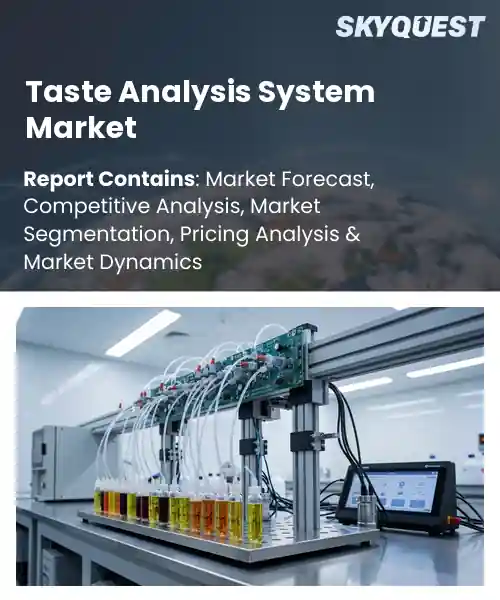
Taste Analysis System Market
Report ID: SQMIG35J2652
Report ID: SQMIG35J2652
[email protected]
USA +1 351-333-4748
Report ID:
SQMIG35J2652 |
Region:
Global |
Published Date: July, 2026
Pages:
157
|Tables:
144
|Figures:
78


Global Taste Analysis System Market size was valued at USD 386.5 Million in 2024 and is poised to grow from USD 418.19 Million in 2025 to USD 785.59 Million by 2033, growing at a CAGR of 8.2% during the forecast period (2026-2033).
At the heart of the global taste analysis system market lies the demand for nutrition, prompting manufacturers to adopt flavor‑profiling tools. The market includes electronic tongues, biosensors and software that quantify sweetness, bitterness, umami and other sensory attributes across food, beverage, pharmaceutical and cosmetic sectors. Its significance derives from the need to ensure product consistency, shorten formulation cycles and meet regulatory standards. Originating in the early 1990s as sensor arrays, the industry now offers integrated platforms that combine learning with data capture. Companies such as Alpha MOS with Heracles and Tastewise’s analytics demonstrate how sensory data become actionable insights for developers. The next factor shaping the market is the convergence of big‑data analytics with consumer‑experience platforms, which amplifies the value of taste data beyond quality control. As manufacturers embed sensory insights into product twins, they can simulate consumer responses, reduce prototyping and accelerate time‑to‑market. This capability has spurred collaborations such as Nestlé’s partnership with AI start‑up FlavourCloud to generate flavor libraries, enabling iteration of snack formulations. Consequently, demand for taste analysis services is rising, attracting investment and prompting sensor vendors to develop subscription models that include hardware, analytics and consulting. The ecosystem creates revenue streams while delivering flavor experiences to end‑users.
How is AI-driven automation improving the taste analysis system market?
AI driven automation reshapes taste analysis by linking electronic tongues with machine learning models that translate sensor signals into nuanced flavor profiles. Real‑time data processing replaces slow human panels, allowing manufacturers to iterate formulations faster and maintain consistency across batches. Integrated platforms collect raw sensor output, clean it, and feed it into predictive algorithms that flag off‑flavors before large‑scale production. This reduces waste, shortens development cycles and supports regulatory compliance. Companies adopt cloud based dashboards that visualize trends, enabling cross‑functional teams to collaborate on product optimization. The market’s rapid expansion reflects growing confidence that digital tasting can match, and often exceed, traditional sensory evaluation.In June 2024 a leading flavor analysis firm launched an AI driven platform that automates sensor calibration and cuts manual tasting steps, boosting efficiency and supporting market growth.
Market snapshot - (2026-2033)
Global Market Size
USD 386.5 Million
Largest Segment
Electronic Tongue Systems
Fastest Growth
Taste Analysis Software
Growth Rate
8.2% CAGR
To get more insights on this market click here to Request a Free Sample Report
Global taste analysis system market is segmented by product type, application, technology, end user, deployment and region. Based on product type, the market is segmented into Electronic Tongue Systems, Taste Sensors and Taste Analysis Software. Based on application, the market is segmented into Food & Beverage, Pharmaceuticals, Academic Research and Cosmetics. Based on technology, the market is segmented into Lipid Membrane Sensors, Electrochemical Sensors and Biosensors. Based on end user, the market is segmented into Food Manufacturers, Pharmaceutical Companies and Research Institutes. Based on deployment, the market is segmented into Laboratory and Production Line. Based on region, the market is segmented into North America, Europe, Asia Pacific, Latin America and Middle East & Africa.
Electronic tongue systems segment dominates because they provide comprehensive real time flavor profiling that aligns with manufacturers’ need for precision and reproducibility. Their ability to mimic human taste perception while delivering quantifiable data makes them indispensable for quality control, new product development and regulatory compliance. This versatility drives widespread adoption across multiple industries, cementing their central position in the market and supports continuous improvement initiatives throughout the value chain.
However, taste analysis software segment is witnessing the strongest growth momentum because modular data platforms enable integration with laboratory information systems and empower users to harness analytics. Machine learning models refine flavor prediction, attracting developers seeking scalable solutions. This innovation accelerates market expansion by opening service models and fostering cross functional collaborations.
Food & beverage segment dominates because taste analysis systems address the industry's relentless pursuit of consistent sensory quality and rapid product iteration. Manufacturers rely on precise flavor profiling to meet consumer expectations, comply with safety standards and differentiate brand experiences. The need for reliable reproducible data drives integration of electronic tongues and sensors throughout formulation labs, making taste analysis an essential pillar of product development and quality assurance across the sector.
Meanwhile, pharmaceutical segment emerges as the key high growth area because regulatory mandates require taste masking for oral formulations. Advanced taste sensors deliver objective data that speed formulation decisions and lower clinical risk. Expanding drug pipelines and focus on pediatric and geriatric markets boost demand, making taste analysis a strategic catalyst for therapeutic innovation.
To get detailed segments analysis, Request a Free Sample Report
North America maintains a leading position in the global Taste Analysis System market due to a combination of advanced research infrastructure, strong collaboration between food manufacturers and technology providers, and a mature regulatory environment that encourages innovation. The region benefits from a deep pool of scientific talent and substantial investment in sensory science, enabling rapid development and deployment of sophisticated analytical platforms. Consumer demand for high‑quality, health‑focused products further fuels adoption, while established supply chains and robust intellectual property protections support commercial scalability. In addition, the presence of leading academic institutions that specialize in sensory evaluation provides a continuous pipeline of expertise and innovative methodologies. The convergence of these strategic advantages ensures that North American firms remain at the forefront of technology adoption and product differentiation worldwide.
Taste Analysis System Market in the United States is driven by a highly integrated food and beverage sector that prioritizes sensory precision to meet diverse consumer expectations. Leading multinational corporations partner closely with technology innovators, fostering rapid prototyping and validation of new flavor profiles. Academic research centers contribute cutting‑edge methodologies, while regulatory frameworks encourage transparent labeling and quality assurance, creating a robust environment for sustained market activity and continued growth.
Taste Analysis System Market in Canada benefits from a collaborative ecosystem that blends strong research institutions with a vibrant food processing industry. Emphasis on clean‑label trends drives adoption of advanced sensory tools to verify flavor integrity. Government incentives support technology transfer and pilot projects, while consumer awareness of health and sustainability fuels demand for precise taste profiling. This synergy positions Canada as a key contributor to regional market evolution globally.
Europe’s rapid expansion in the Taste Analysis System market is propelled by a confluence of stringent food safety regulations, a deep‑rooted culture of culinary innovation, and substantial investment in sensory research across the continent. Collaborative networks linking universities, research institutes, and industry leaders foster the development of sophisticated analytical techniques that address both traditional flavor profiling and emerging consumer preferences for health‑focused and sustainable products. The presence of well‑established multinational food manufacturers encourages the integration of advanced taste assessment tools into product development pipelines, while consumer demand for transparency and authenticity drives continuous refinement of sensory methodologies. This ecosystem of regulatory support, academic excellence, and market demand creates a fertile ground for accelerated growth throughout Europe. Furthermore, collaborations supported by European research funding enable sharing of best practices and accelerate technology transfer, reinforcing the region’s competitive edge. These drivers position Europe as a leading arena for innovative taste analysis solutions.
Taste Analysis System Market in Germany is anchored by an engineering tradition and a regulated food sector that emphasizes precision and safety. Leading equipment manufacturers collaborate closely with research universities to develop sensory platforms, while major food producers integrate these tools to refine flavor consistency across product lines. The emphasis on sustainability and clean‑label initiatives further drives adoption of taste assessment technologies, reinforcing Germany’s position as a dominant market player.
Taste Analysis System Market in the United Kingdom is experiencing growth as food innovators aim to meet consumer expectations for flavor authenticity and health benefits. Collaborative ecosystems linking culinary schools, research institutes, and start‑ups accelerate deployment of sensory analytics, while retailers adopt these tools to enhance differentiation. Government support for technology research and a tradition of culinary excellence stimulate expansion, positioning the United Kingdom as a hub for taste analysis.
Taste Analysis System Market in France is emerging as manufacturers respond to growing consumer interest in artisanal flavors and natural ingredient profiles. Partnerships between boutique food producers and technology firms enable the adoption of sensory measurement tools that capture taste nuances. Academic research centers contribute innovative methodologies, while regulatory frameworks encourage transparency and quality assurance. This supportive environment fosters market development, positioning France as a landscape for taste analysis advancements.
Asia Pacific is strengthening its position in the Taste Analysis System market through a blend of technological innovation, rising consumer sophistication, and strategic investment in food science capabilities. Japan leverages its legacy of precision engineering and a deep culinary heritage to develop highly accurate sensory instruments that cater to both traditional and modern food products. South Korea, meanwhile, capitalizes on rapid digital transformation and a vibrant startup ecosystem to integrate artificial intelligence and data analytics into taste assessment, enabling faster product iteration. Regional food manufacturers are increasingly adopting these advanced tools to differentiate offerings in competitive markets, while government initiatives support research collaborations and export-oriented development. This convergence of expertise, digitalization, and supportive policy frameworks is propelling Asia Pacific toward greater influence and market share on the global stage.
Taste Analysis System Market in Japan benefits from a tradition of precision engineering and a culinary culture that values flavor profiling. Leading instrument manufacturers collaborate with research universities to create sensory devices, while major food producers integrate these solutions to ensure consistency across product lines. Government support for food technology research and a focus on export growth further accelerate continual market development, establishing Japan as a hub for taste analysis.
Taste Analysis System Market in South Korea is driven by adoption and a startup culture that blends artificial intelligence with sensory science. Leading technology firms partner with food manufacturers to embed data‑rich taste analytics into product development, enabling iteration and flavor solutions. Academic institutions contribute research, while government incentives promote commercialization of innovative taste technologies. This dynamic ecosystem accelerates market growth, positioning South Korea as a center for taste analysis.
To know more about the market opportunities by region and country, click here to
Buy The Complete Report
Increasing Consumer Preference for Flavor
Adopting AI for Taste Prediction
High Cost of Advanced Sensors
Regulatory Challenges in Food Testing
Request Free Customization of this report to help us to meet your business objectives.
The competitive landscape of the Global Taste Analysis System market is shaped by rapid AI‑driven innovation and aggressive capital deployment, with startups leveraging advanced sensory modeling to outpace traditional flavor houses. Recent funding rounds and strategic collaborations are accelerating product rollouts, while incumbents pursue acquisitions to integrate proprietary taste‑simulation capabilities and secure market share.
Top Player’s Company Profile
Recent Developments
SkyQuest’s ABIRAW (Advanced Business Intelligence, Research & Analysis Wing) is our Business Information Services team that Collects, Collates, Correlates, and Analyses the Data collected by means of Primary Exploratory Research backed by robust Secondary Desk research. As per SkyQuest analysis, the global taste analysis system market is being propelled primarily by the growing consumer demand for authentic, intense flavors, which pushes manufacturers to adopt precise profiling tools. A second strong driver is the integration of AI for taste prediction, enabling faster formulation cycles and reducing reliance on human panels. The market is led by North America, where advanced research infrastructure and strong food‑tech collaborations support rapid adoption. Within the market, electronic tongue systems dominate because they deliver comprehensive, real‑time flavor data across applications. However, the high cost of advanced sensors restrains broader uptake, especially among smaller firms, tempering overall growth.
| Report Metric | Details |
|---|---|
| Market size value in 2024 | USD 386.5 Million |
| Market size value in 2033 | USD 785.59 Million |
| Growth Rate | 8.2% |
| Base year | 2024 |
| Forecast period | (2026-2033) |
| Forecast Unit (Value) | USD Million |
| Segments covered |
|
| Regions covered | North America (US, Canada), Europe (Germany, France, United Kingdom, Italy, Spain, Rest of Europe), Asia Pacific (China, India, Japan, Rest of Asia-Pacific), Latin America (Brazil, Rest of Latin America), Middle East & Africa (South Africa, GCC Countries, Rest of MEA) |
| Companies covered |
|
| Customization scope | Free report customization with purchase. Customization includes:-
|
To get a free trial access to our platform which is a one stop solution for all your data requirements for quicker decision making. This platform allows you to compare markets, competitors who are prominent in the market, and mega trends that are influencing the dynamics in the market. Also, get access to detailed SkyQuest exclusive matrix.
Table Of Content
Executive Summary
Market overview
Parent Market Analysis
Market overview
Market size
KEY MARKET INSIGHTS
COVID IMPACT
MARKET DYNAMICS & OUTLOOK
Market Size by Region
KEY COMPANY PROFILES
Methodology
For the Taste Analysis System Market, our research methodology involved a mixture of primary and secondary data sources. Key steps involved in the research process are listed below:
1. Information Procurement: This stage involved the procurement of Market data or related information via primary and secondary sources. The various secondary sources used included various company websites, annual reports, trade databases, and paid databases such as Hoover's, Bloomberg Business, Factiva, and Avention. Our team did 45 primary interactions Globally which included several stakeholders such as manufacturers, customers, key opinion leaders, etc. Overall, information procurement was one of the most extensive stages in our research process.
2. Information Analysis: This step involved triangulation of data through bottom-up and top-down approaches to estimate and validate the total size and future estimate of the Taste Analysis System Market.
3. Report Formulation: The final step entailed the placement of data points in appropriate Market spaces in an attempt to deduce viable conclusions.
4. Validation & Publishing: Validation is the most important step in the process. Validation & re-validation via an intricately designed process helped us finalize data points to be used for final calculations. The final Market estimates and forecasts were then aligned and sent to our panel of industry experts for validation of data. Once the validation was done the report was sent to our Quality Assurance team to ensure adherence to style guides, consistency & design.
Analyst Support
Customization Options
With the given market data, our dedicated team of analysts can offer you the following customization options are available for the Taste Analysis System Market:
Product Analysis: Product matrix, which offers a detailed comparison of the product portfolio of companies.
Regional Analysis: Further analysis of the Taste Analysis System Market for additional countries.
Competitive Analysis: Detailed analysis and profiling of additional Market players & comparative analysis of competitive products.
Go to Market Strategy: Find the high-growth channels to invest your marketing efforts and increase your customer base.
Innovation Mapping: Identify racial solutions and innovation, connected to deep ecosystems of innovators, start-ups, academics, and strategic partners.
Category Intelligence: Customized intelligence that is relevant to their supply Markets will enable them to make smarter sourcing decisions and improve their category management.
Public Company Transcript Analysis: To improve the investment performance by generating new alpha and making better-informed decisions.
Social Media Listening: To analyze the conversations and trends happening not just around your brand, but around your industry as a whole, and use those insights to make better Marketing decisions.
REQUEST FOR SAMPLE
 REQUEST FREE CUSTOMIZATION


Want to customize this report? This report can be personalized according to your needs. Our analysts and industry experts will work directly with you to understand your requirements and provide you with customized data in a short amount of time. We offer $1000 worth of FREE customization at the time of purchase.
Feedback From Our Clients


 USA (+1) 351-333-4748

