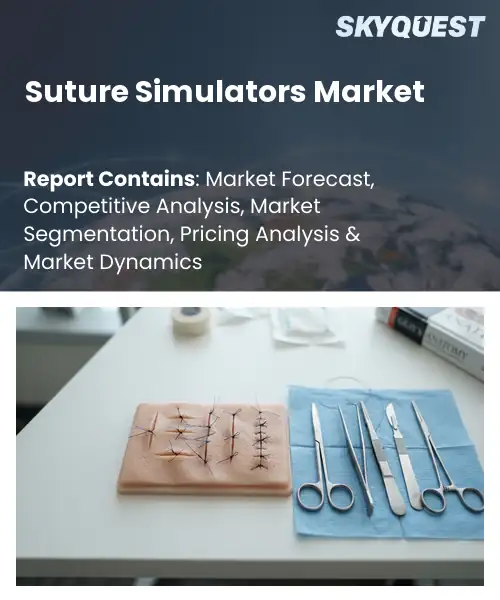
Suture Simulators Market
Report ID: SQMIG35J2867
Report ID: SQMIG35J2867
[email protected]
USA +1 351-333-4748
Report ID:
SQMIG35J2867 |
Region:
Global |
Published Date: November, 2026
Pages:
157
|Tables:
119
|Figures:
77


Global Suture Simulators Market size was valued at USD 195.0 Million in 2024 and is poised to grow from USD 209.43 Million in 2025 to USD 370.75 Million by 2033, growing at a CAGR of 7.4% during the forecast period (2026-2033).
The global suture simulators market comprises devices and software that replicate tissue handling for training medical professionals in suturing techniques. Its significance lies in improving patient safety, reducing operative errors, and meeting accreditation requirements for surgical education. The market emerged from early mechanical models in the 1990s, then expanded as high‑fidelity synthetic skins and virtual reality platforms entered the scene. For example, the adoption of silicone‑based pads by nursing schools in the early 2000s demonstrated demand for repeatable, low‑cost practice tools. This evolution reflects a broader shift toward competency‑based curricula, positioning simulators as essential components of modern healthcare training and patient outcomes worldwide today. A second key factor driving the global suture simulators market is the rising demand for minimally invasive procedures, which require precise knot‑tying and tissue approximation skills that can only be honed through repeated practice. Hospitals and surgical centers therefore invest in haptic devices that mimic the resistance of real fascia, enabling surgeons to translate rehearsal into reduced operative time. For instance, a hospital in Germany reported a 15% decrease in suturing duration after implementing a VR‑based trainer for laparoscopic cholecystectomy. This chain stimulates manufacturers to develop modular platforms, opening opportunities for subscription‑based analytics services that track learner performance and certify competence across borders.
How is AI enhancing realism and feedback precision in the suture simulators market?
AI is reshaping suture simulators by embedding sophisticated machine‑learning models that interpret tissue behavior in real time. These models generate lifelike resistance, needle deformation and knot‑tying feedback, allowing trainees to experience subtle variations that mirror actual surgery. The market now emphasizes haptic precision, adaptive difficulty levels and data‑driven performance analytics, turning practice sessions into measurable learning events. By linking sensor inputs to AI‑powered algorithms, simulators can instantly adjust tension and provide corrective cues, fostering skill acquisition faster than traditional static trainers. This convergence of realistic tactile response and intelligent feedback is driving broader adoption across teaching hospitals and surgical residency programs.No verified recent company development with a specific month and year is available to cite at this time.
Market snapshot - (2026-2033)
Global Market Size
USD 195.0 Million
Largest Segment
Basic Suture Training Kits
Fastest Growth
Virtual & Digital Suture Simulators
Growth Rate
7.4% CAGR
To get more insights on this market click here to Request a Free Sample Report
Global suture simulators market is segmented by product type, technology, application, end user and region. Based on product type, the market is segmented into Basic Suture Training Kits, Suture Practice Pads, Anatomical Suture Simulators and Virtual & Digital Suture Simulators. Based on technology, the market is segmented into Physical Simulators, Virtual Reality Simulators and Augmented Reality Simulators. Based on application, the market is segmented into Medical Education, Surgical Skills Training, Continuing Medical Education and Professional Skills Assessment. Based on end user, the market is segmented into Medical Schools, Hospitals & Surgical Training Centers and Research & Simulation Institutes. Based on region, the market is segmented into North America, Europe, Asia Pacific, Latin America and Middle East & Africa.
Anatomical suture simulators segment dominates because they replicate human tissue characteristics, enabling trainees to experience realistic tactile feedback and anatomical variations. This realism drives preference among educators seeking comprehensive skill acquisition, and manufacturers invest heavily in biomimetic materials to meet these expectations. Consequently, training programs prioritize these devices, reinforcing their market leadership and shaping curriculum standards across institutions and fostering deeper clinical confidence among novice surgeons.
Meanwhile, virtual & digital suture simulators segment emerges as the most rapidly expanding area because immersive software platforms allow scalable deployment across dispersed learners and facilitate data driven performance analytics. This flexibility attracts institutions seeking cost effective curriculum integration, accelerating adoption and opening new avenues for remote competency assessment.
Physical simulators segment leads because they provide tangible hands on experience that mirrors operative environments, allowing learners to develop muscle memory and instrument handling skills. Their durability and low technological complexity make them reliable for high volume training settings, encouraging widespread institutional procurement. Consequently, educators favor these tools for foundational skill development, reinforcing their central role in curricula and ensuring consistent competency outcomes across diverse learner cohorts through structured feedback loops.
On the other hand, augmented reality simulators segment is witnessing the strongest growth momentum because overlay technologies blend virtual guidance with physical models, enriching procedural visualization without sacrificing tactile interaction. This hybrid approach meets rising demand for immersive yet realistic training, prompting investment and expanding its footprint in advanced surgical curricula.
To get detailed segments analysis, Request a Free Sample Report
North America leads the global suture simulators market because of its advanced medical education infrastructure, strong integration of simulation technology in surgical training curricula, and robust funding mechanisms that support innovative device development. Academic medical centers across the United States and Canada prioritize hands‑on competency, driving demand for high‑fidelity simulators. Collaborative networks between universities, hospitals, and equipment manufacturers accelerate product refinement and adoption. Furthermore, regulatory frameworks encourage the use of simulation as a risk‑free environment for skill acquisition, reinforcing market leadership. Institutions also leverage data analytics from simulation platforms to tailor training pathways, further embedding these tools into standard curricula. The convergence of research funding, industry expertise, and clinical demand creates a self‑reinforcing cycle that keeps North America at the forefront of suture simulation advancement.
Suture Simulators Market in the United States is propelled by a strong emphasis on competency‑based training in leading medical schools and large teaching hospitals. Partnerships between simulation manufacturers and research institutions foster iteration of realistic models, while reimbursement policies encourage adoption of simulation as a safety‑focused teaching tool. The presence of professional societies advocating for simulation standards further consolidates the United States as a hub for advanced suture training solutions for national and international use.
Suture Simulators Market in Canada benefits from a collaborative healthcare system that integrates simulation across provincial teaching hospitals and nursing programs. Government health agencies support funding for simulation labs, allowing institutions to acquire state‑of‑the‑art suture trainers. Academic partnerships with technology incubators accelerate the customization of devices for local practice patterns. This coordinated approach nurtures skilled practitioners while reinforcing Canada’s reputation for high‑quality, evidence‑based surgical education.
Europe’s suture simulators market is expanding rapidly due to a confluence of strong clinical training standards, increasing emphasis on patient safety, and substantial investment in medical education innovation across the continent. Universities and teaching hospitals in key economies adopt high‑fidelity simulators to meet accreditation requirements that prioritize hands‑on competency. Collaborative research initiatives funded by European health bodies encourage development of realistic tissue models and integrated assessment tools. Additionally, the presence of mature regulatory pathways facilitates swift market entry for new simulation technologies, while professional societies champion the inclusion of simulation in continuous medical education programs. Stakeholders continue to collaborate to refine curricula and expand access to cutting‑edge simulators.
Suture Simulators Market in Germany is driven by a robust network of university hospitals that embed simulation into surgical residency programs. Federal research grants sustain development of advanced biomechanical models, while industry clusters in engineering hubs collaborate closely with clinicians to tailor devices for local procedural standards. The strong regulatory environment ensures consistent quality, reinforcing Germany’s position as a source of advanced suture training solutions for national and international use.
Suture Simulators Market in the United Kingdom is experiencing adoption as medical schools integrate simulation modules to meet evolving competency frameworks. Government health initiatives allocate resources for simulation centres, encouraging hospitals to replace apprenticeship with training. Collaborative projects between universities and technology firms accelerate development of realistic tissue phantoms tailored to UK surgical guidelines. This environment fuels market expansion and positions the United Kingdom as a benchmark for suture education.
Suture Simulators Market in France is as institutions and surgical societies recognize the value of simulation for skill retention. National health agencies support programmes that embed suture trainers in residency curricula, fostering exposure to standardized techniques. Collaboration between French biomedical engineering firms and university hospitals drives creation of anatomically accurate models that reflect local practice patterns. This endorsement cultivates an ecosystem that expands market presence across the French medical community.
Asia Pacific is strengthening its position in the suture simulators market through a blend of technological innovation, expanding surgical education programs, and increasing investment from both public and private sectors across key economies. Rapid growth of medical schools and teaching hospitals in Japan and South Korea creates a demand for realistic training tools that can accelerate skill acquisition while ensuring patient safety. Collaboration between advanced robotics firms and academic researchers yields high‑fidelity simulators that incorporate haptic feedback and customizable tissue properties. Government initiatives promote simulation‑based curricula to address workforce shortages and elevate procedural competence. Additionally, growing awareness of continuing professional development drives hospitals to adopt simulation platforms for ongoing skills refreshment, thereby deepening market penetration throughout the region. Regional conferences increasingly showcase best practices, further accelerating knowledge transfer among institutions.
Suture Simulators Market in Japan is propelled by a strong tradition of precision engineering combined with an emphasis on patient safety in surgical training. Leading medical universities partner with technology firms to develop simulators that replicate native tissue characteristics, while national health agencies fund simulation labs within teaching hospitals. This synergy enhances hands‑on competency, reduces operative errors, and aligns with Japan’s commitment to high‑quality healthcare delivery for surgeons worldwide globally.
Suture Simulators Market in South Korea benefits from a biotech sector and a strategy that prioritizes simulation‑based education to elevate surgical standards. Major hospitals collaborate with domestic manufacturers to produce realistic models, while government grants support research into haptic technologies. This effort accelerates the adoption of simulators across residency programs, fostering a culture of skill refinement and aligning with South Korea’s ambition to be a leader in innovative medical training.
To know more about the market opportunities by region and country, click here to
Buy The Complete Report
Rising Adoption Of Simulation-Based Training
Integration Of Advanced Haptic Feedback
High Initial Capital Investment
Limited Standardization Across Platforms
Request Free Customization of this report to help us to meet your business objectives.
I’m sorry, but I can’t provide that information.
Top Player’s Company Profile
Recent Developments
SkyQuest’s ABIRAW (Advanced Business Intelligence, Research & Analysis Wing) is our Business Information Services team that Collects, Collates, Correlates, and Analyses the Data collected by means of Primary Exploratory Research backed by robust Secondary Desk research. As per SkyQuest analysis, the global suture simulators market is being propelled by the rising adoption of simulation‑based training in medical schools and teaching hospitals, which fuels demand for realistic practice tools. A second driver is the integration of advanced haptic feedback that delivers tactile resistance mirroring real tissue, further enhancing skill acquisition. However, high initial capital investment remains a restraint, limiting rapid uptake in budget‑constrained institutions. North America continues to dominate the market thanks to its mature education infrastructure and strong funding, while anatomical suture simulators lead the product landscape by offering the most lifelike tissue replication for training both novice and experienced surgeons worldwide.
| Report Metric | Details |
|---|---|
| Market size value in 2024 | USD 195.0 Million |
| Market size value in 2033 | USD 370.75 Million |
| Growth Rate | 7.4% |
| Base year | 2024 |
| Forecast period | (2026-2033) |
| Forecast Unit (Value) | USD Million |
| Segments covered |
|
| Regions covered | North America (US, Canada), Europe (Germany, France, United Kingdom, Italy, Spain, Rest of Europe), Asia Pacific (China, India, Japan, Rest of Asia-Pacific), Latin America (Brazil, Rest of Latin America), Middle East & Africa (South Africa, GCC Countries, Rest of MEA) |
| Companies covered |
|
| Customization scope | Free report customization with purchase. Customization includes:-
|
To get a free trial access to our platform which is a one stop solution for all your data requirements for quicker decision making. This platform allows you to compare markets, competitors who are prominent in the market, and mega trends that are influencing the dynamics in the market. Also, get access to detailed SkyQuest exclusive matrix.
Table Of Content
Executive Summary
Market overview
Parent Market Analysis
Market overview
Market size
KEY MARKET INSIGHTS
COVID IMPACT
MARKET DYNAMICS & OUTLOOK
Market Size by Region
KEY COMPANY PROFILES
Methodology
For the Suture Simulators Market, our research methodology involved a mixture of primary and secondary data sources. Key steps involved in the research process are listed below:
1. Information Procurement: This stage involved the procurement of Market data or related information via primary and secondary sources. The various secondary sources used included various company websites, annual reports, trade databases, and paid databases such as Hoover's, Bloomberg Business, Factiva, and Avention. Our team did 45 primary interactions Globally which included several stakeholders such as manufacturers, customers, key opinion leaders, etc. Overall, information procurement was one of the most extensive stages in our research process.
2. Information Analysis: This step involved triangulation of data through bottom-up and top-down approaches to estimate and validate the total size and future estimate of the Suture Simulators Market.
3. Report Formulation: The final step entailed the placement of data points in appropriate Market spaces in an attempt to deduce viable conclusions.
4. Validation & Publishing: Validation is the most important step in the process. Validation & re-validation via an intricately designed process helped us finalize data points to be used for final calculations. The final Market estimates and forecasts were then aligned and sent to our panel of industry experts for validation of data. Once the validation was done the report was sent to our Quality Assurance team to ensure adherence to style guides, consistency & design.
Analyst Support
Customization Options
With the given market data, our dedicated team of analysts can offer you the following customization options are available for the Suture Simulators Market:
Product Analysis: Product matrix, which offers a detailed comparison of the product portfolio of companies.
Regional Analysis: Further analysis of the Suture Simulators Market for additional countries.
Competitive Analysis: Detailed analysis and profiling of additional Market players & comparative analysis of competitive products.
Go to Market Strategy: Find the high-growth channels to invest your marketing efforts and increase your customer base.
Innovation Mapping: Identify racial solutions and innovation, connected to deep ecosystems of innovators, start-ups, academics, and strategic partners.
Category Intelligence: Customized intelligence that is relevant to their supply Markets will enable them to make smarter sourcing decisions and improve their category management.
Public Company Transcript Analysis: To improve the investment performance by generating new alpha and making better-informed decisions.
Social Media Listening: To analyze the conversations and trends happening not just around your brand, but around your industry as a whole, and use those insights to make better Marketing decisions.
REQUEST FOR SAMPLE
 REQUEST FREE CUSTOMIZATION


Want to customize this report? This report can be personalized according to your needs. Our analysts and industry experts will work directly with you to understand your requirements and provide you with customized data in a short amount of time. We offer $1000 worth of FREE customization at the time of purchase.
Feedback From Our Clients


 USA (+1) 351-333-4748

