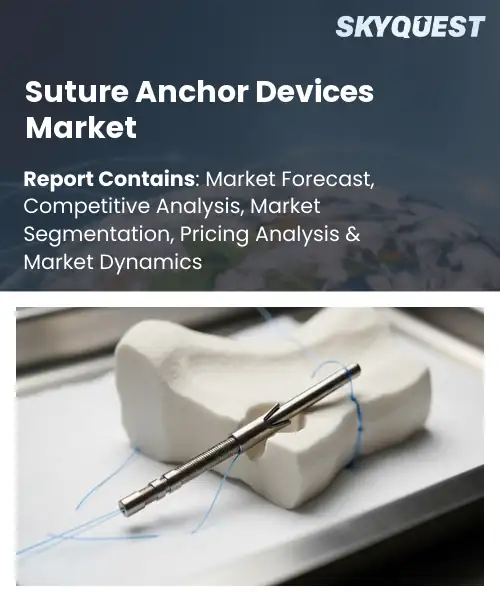
Suture Anchor Devices Market
Report ID: SQMIG35A4061
Report ID: SQMIG35A4061
[email protected]
USA +1 351-333-4748
Report ID:
SQMIG35A4061 |
Region:
Global |
Published Date: July, 2026
Pages:
157
|Tables:
176
|Figures:
79


Global Suture Anchor Devices Market size was valued at USD 820 Million in 2024 and is poised to grow from USD 860 Million in 2025 to USD 1220 Million by 2033, growing at a CAGR of 4.5% during the forecast period (2026-2033).
The suture anchor devices market trends for suture anchor devices consists of specialty orthopedic implants used to anchor soft tissue grafts to bone in procedures such as rotator-cuff repair, labral reconstruction, and anterior cruciate ligament augmentation. The demand for these devices has soared as an ageing population demands more minimally invasive joint surgeries with shorter recovery times and hospital stays. In the past, metallic anchors dominated the market, but the development of bioabsorbable polymer technology in the early 2000s led to wider clinical acceptance. For example, the introduction of poly-l-lactic acid anchors has reduced the complication rates from metal-induced osteolysis, which has led to hospitals across the world adopting the newer solutions to help facilitate better healing.
The second driver for the suture anchor devices market growth is the rapid adoption of arthroscopic techniques that employ suture anchors to provide fixation through small portals. Surgeons switch to less invasive procedures and hospitals spend budgets on training and multi-purpose anchor systems that can hold different tissues. Therefore, the manufacturers expand their portfolios with hybrid designs of metallic cores and bioabsorbable sleeves. One example is the 2023 collaboration between a device manufacturer and an orthopedic group which developed knot-less anchors that reduced operative time by 15 minutes, leading to cost savings and increased case throughput. That efficiency loop feeds demand worldwide.
How is AI-driven Automation Improving Surgical Outcomes in the Suture Anchor Devices Market?
The suture anchor segment is witnessing the rise of AI-driven automation, which is incorporating real-time imaging analysis, predictive tension control and robotic assistance into the implantation process. Surgeons now use algorithms to map bone quality and suggest optimal anchor placement, reducing guesswork and minimizing intra‑operative adjustments. The device uses built-in sensors to feed data to machine-learning models to predict the tissue response, allowing the device to adjust the insertion force to ensure a secure grasp without over-compression.
This precision reduces the risk of anchor failure and speeds patient recovery, resulting in more consistent procedures regardless of the surgeon's level of experience. The increasing adoption of these smart systems in hospitals is enhancing the overall efficiency of orthopedic surgeries, which is in turn supporting the growth trajectory of the market.
For instance, Arthrex launched an AI-powered suture anchor platform in July 2024, demonstrating how automated tension feedback can simplify placement and boost fixation reliability, thereby driving broader market adoption.
Market snapshot - (2026-2033)
Global Market Size
USD 0.82 Billion
Largest Segment
Knotted Suture Anchors
Fastest Growth
All-Suture Anchors
Growth Rate
4.5% CAGR
To get more insights on this market click here to Request a Free Sample Report
Global suture anchor devices market is segmented by product type, material type, application, end user, procedure type, patient group and region. Based on product type, the market is segmented into knotless suture anchors, knotted suture anchors, all-suture anchors, interference screw anchors and others. Based on material type, the market is segmented into metallic suture anchors, bioabsorbable suture anchors, PEEK suture anchors and biocomposite suture anchors. Based on application, the market is segmented into rotator cuff repair, shoulder instability repair, knee ligament repair, foot & ankle repair, hip repair and others. Based on end user, the market is segmented into hospitals, orthopedic clinics, ambulatory surgical centers and sports medicine centers. Based on procedure type, the market is segmented into arthroscopic procedures and open surgical procedures. Based on patient group, the market is segmented into adult and pediatric. Based on region, the market is segmented into North America, Europe, Asia Pacific, Latin America and Middle East & Africa.
The knotless suture anchors segment leads, as surgeons favor the ease of use and decreased operative time afforded by these devices owing to their self-locking mechanisms. It is designed to be knotless, thus reducing the risk of knot failure and increasing the strength of the tendon fixation. This simplicity fits with the growing demand for minimally invasive procedures, allowing broad use across orthopedic specialties. Thus, clinicians prefer knotless solutions for predictable results and procedural efficiency.
All suture anchors segment is the fastest growing segment owing to their ultralightweight architecture that allows preservation of bone stock and reduces post operative imaging artifacts. Continued development of fiberbased materials improves loadtofailure characteristics, encouraging their use by surgeons in complex repairs. This momentum drives market growth and new procedural possibilities.
Bioabsorbable suture anchors are the main type in this segment because they gradually dissolve, so there is no need for a second surgery to remove hardware and this reduces long-term foreign body complications. Clinicians appreciate the fact that they are compatible with tissue remodeling allowing natural healing without loss of initial fixation strength. They are approved by regulatory agencies as safe and are trusted by surgeons. Today, the orthopedic practice favors bioabsorbable solutions for the combination of patient comfort and clinical efficacy.
Conversely, biocomposite suture anchors segment is growing the fastest, as it combines resorbable polymers with osteoconductive ceramics, offering enhanced mechanical stability and bone integration. Recent advances make it possible to tailor the degradation to suit the patient’s healing time, which is appealing to surgeons who want to be both safe and strong. The innovation is driving the growth of the market and therapeutic opportunities.
To get detailed segments analysis, Request a Free Sample Report
North America holds a dominant position in the global market for suture anchor devices due to its mature healthcare infrastructure, wide reimbursement policies, and the large number of orthopedic surgery centers that embrace new fixation technologies. The region has strong R&D activity from leading medical device manufacturers, which helps to continuously upgrade products and to get regulatory approval fast. Adoption is also driven by strong physician awareness and preference for evidence-based solutions, with integrated supply chains ensuring efficient distribution. New digital health platforms and outcome-tracking registries refine device selection even further, encouraging clinicians to select anchors with proven long-term reliability. These dynamics together underpin a competitive advantage, translating to sustained market share.
Suture anchor devices market outlook in the United States thrives on an advanced orthopedic ecosystem, characterized by a dense network of specialized surgeons and leading academic hospitals. Strong reimbursement policies facilitate early adoption of next‑generation anchors, while extensive clinical research conducted by institutions drives continuous innovation. The presence of multiple global manufacturers with domestic production capabilities ensures rapid product availability, reinforcing the United States as a pivotal hub for market expansion.
Suture anchor devices market forecast in Canada is supported by a funded healthcare system that emphasizes cost‑effective yet orthopedic solutions. Collaborative ties between hospitals and research institutes promote early clinical evaluation of innovative anchors, accelerating market entry. Domestic regulatory pathways streamline approval processes, while a growing focus on minimally invasive procedures drives surgeon preference for advanced fixation options. These factors combine to position Canada as a significant contributor to regional market momentum.
Clinical adoption is strong, regulatory environments are supportive and there’s a move to value‑based healthcare, all of which are driving fast growth of the European suture anchor devices market. Evidence-based fixation techniques are supported by leading orthopedic societies and hospitals are implementing advanced anchors in a range of procedures. The harmonised medical device directives of the European Union facilitate market access and thus enable manufacturers to launch innovations efficiently in the member states. Reimbursement models increasingly incentivize outcome-based interventions, leading surgeons to choose anchors with better biomechanical performance. Collaborative research networks between academic centers and industry also accelerate clinical trials which create a pipeline of refined products. Sustainable investment in digital health platforms and patient registries also helps to inform device choice, increasing confidence in newer technologies. These collective dynamics further position Europe as a growing center for suture anchor innovation.
Suture anchor devices market penetration in Germany benefits from a robust medical device sector supported by rigorous clinical research and strong engineering expertise. Nationwide reimbursement policies favor evidence‑based orthopedic solutions, prompting hospitals to adopt high‑performance anchors. Collaborative initiatives between leading universities and manufacturers accelerate product refinement, while the country's export‑driven industry enhances global competitiveness. These elements collectively solidify Germany role within the European market for future growth.
Suture anchor devices market analysis in the United Kingdom is propelled by an agile healthcare ecosystem that embraces fixation technologies. National health guidelines increasingly prioritize minimally invasive procedures, driving demand for sophisticated anchors. Strong collaborations between research institutions and firms foster rapid clinical validation, while the regulatory environment encourages market entry. This confluence of policy support and innovation capacity positions the United Kingdom as a catalyst for market growth across Europe.
Suture anchor devices market regional forecast in France is emerging amid a growing emphasis on surgical precision and outcomes. Government initiatives support adoption of advanced orthopedic devices through funding for hospitals and research programs. Partnerships between academic centers and device makers enable clinical trials, fostering confidence in novel anchor designs. While reimbursement frameworks evolve to accommodate innovative solutions, the clinical culture encourages adoption, positioning France as a promising contributor to the broader European market.
Asia Pacific continues to consolidate its position in the suture anchor devices market due to the convergence of increasing volume of orthopedic surgeries, expanding healthcare infrastructure, and growing investments in indigenous innovation. Countries such as Japan and South Korea are focusing on advanced minimally invasive procedures, which is leading to an increased demand for high-performance anchors, improving surgical efficiency. The government has policies that promote domestic R&D and ease regulatory pathways for the rapid deployment of locally developed technologies. More collaboration among academic institutions, hospitals and device manufacturers accelerates clinical evaluation and the development of products to local anatomic considerations. Digital imaging and navigation systems also help surgeons place anchors more accurately, which gives them more confidence. The converging multifaceted developments collectively serve to elevate the Asia Pacific as an emerging and dynamic hub for suture anchor advancement.
Suture anchor devices indstry in Japan is characterized by an orthopedic landscape where procedural standards drive demand for reliable fixation solutions. Strong collaboration between leading medical universities and device manufacturers accelerates development of anchors tailored to patient anatomy. Government incentives for medical technologies facilitate rapid regulatory approval, while integration of imaging supports anchor deployment. These factors combine to position Japan as a pivotal contributor to the Asia Pacific market.
Suture anchor devices industry trends in South Korea benefits from a healthcare system that emphasizes minimally invasive orthopedic procedures. Governmental support for domestic R&D encourages creation of innovative anchor designs, while streamlined regulatory processes expedite market entry. Partnerships between hospitals and technology firms foster clinical testing and customization to surgical preferences. Integration of imaging and robotics enhances anchor placement accuracy, reinforcing surgeon confidence and solidifying South Korea role in the regional market.
To know more about the market opportunities by region and country, click here to
Buy The Complete Report
Advancements In Anchor Materials
Increasing Adoption Of Minimally Invasive Techniques
High Cost Of Advanced Devices
Regulatory Compliance Complexity Across Regions
Request Free Customization of this report to help us to meet your business objectives.
The global suture anchors market is highly competitive, with leading orthopedic device manufacturers focusing on product innovation, geographic expansion, and strategic collaborations to strengthen their market presence. Companies are increasingly investing in bioabsorbable materials, biologic-enhanced fixation technologies, and digital surgical planning solutions to improve clinical outcomes and support minimally invasive procedures. Strategic partnerships with research institutions and acquisitions of specialized orthopedic technology providers are enabling manufacturers to expand product portfolios, enhance distribution capabilities, and accelerate the development of next-generation suture anchor systems.
Top Player’s Company Profile
Recent Developments in the Suture Anchor Devices Market
SkyQuest’s ABIRAW (Advanced Business Intelligence, Research & Analysis Wing) is our Business Information Services team that Collects, Collates, Correlates, and Analyses the Data collected by means of Primary Exploratory Research backed by robust Secondary Desk research. As per SkyQuest analysis the global suture anchor devices market is majorly driven by the development of anchor materials for increased durability and reduced inflammation. The increasing use of minimally invasive arthroscopic procedures that reduce the duration of surgery and improve patient recovery is another major factor driving the market. The knotless suture anchors segment is expected to dominate the market owing to its ease of use and fewer operative steps, which surgeons prefer. North America leads thanks to its mature healthcare system, strong reimbursement and high R&D. However, the high cost of advanced devices is a restraint especially for budget-conscious hospitals and emerging economies, which is tempering the overall growth pace.
| Report Metric | Details |
|---|---|
| Market size value in 2024 | USD 0.82 Billion |
| Market size value in 2033 | USD 1.22 Billion |
| Growth Rate | 4.5% |
| Base year | 2024 |
| Forecast period | (2026-2033) |
| Forecast Unit (Value) | USD Billion |
| Segments covered |
|
| Regions covered | North America (US, Canada), Europe (Germany, France, United Kingdom, Italy, Spain, Rest of Europe), Asia Pacific (China, India, Japan, Rest of Asia-Pacific), Latin America (Brazil, Rest of Latin America), Middle East & Africa (South Africa, GCC Countries, Rest of MEA) |
| Companies covered |
|
| Customization scope | Free report customization with purchase. Customization includes:-
|
To get a free trial access to our platform which is a one stop solution for all your data requirements for quicker decision making. This platform allows you to compare markets, competitors who are prominent in the market, and mega trends that are influencing the dynamics in the market. Also, get access to detailed SkyQuest exclusive matrix.
Table Of Content
Executive Summary
Market overview
Parent Market Analysis
Market overview
Market size
KEY MARKET INSIGHTS
COVID IMPACT
MARKET DYNAMICS & OUTLOOK
Market Size by Region
KEY COMPANY PROFILES
Methodology
For the Suture Anchor Devices Market, our research methodology involved a mixture of primary and secondary data sources. Key steps involved in the research process are listed below:
1. Information Procurement: This stage involved the procurement of Market data or related information via primary and secondary sources. The various secondary sources used included various company websites, annual reports, trade databases, and paid databases such as Hoover's, Bloomberg Business, Factiva, and Avention. Our team did 45 primary interactions Globally which included several stakeholders such as manufacturers, customers, key opinion leaders, etc. Overall, information procurement was one of the most extensive stages in our research process.
2. Information Analysis: This step involved triangulation of data through bottom-up and top-down approaches to estimate and validate the total size and future estimate of the Suture Anchor Devices Market.
3. Report Formulation: The final step entailed the placement of data points in appropriate Market spaces in an attempt to deduce viable conclusions.
4. Validation & Publishing: Validation is the most important step in the process. Validation & re-validation via an intricately designed process helped us finalize data points to be used for final calculations. The final Market estimates and forecasts were then aligned and sent to our panel of industry experts for validation of data. Once the validation was done the report was sent to our Quality Assurance team to ensure adherence to style guides, consistency & design.
Analyst Support
Customization Options
With the given market data, our dedicated team of analysts can offer you the following customization options are available for the Suture Anchor Devices Market:
Product Analysis: Product matrix, which offers a detailed comparison of the product portfolio of companies.
Regional Analysis: Further analysis of the Suture Anchor Devices Market for additional countries.
Competitive Analysis: Detailed analysis and profiling of additional Market players & comparative analysis of competitive products.
Go to Market Strategy: Find the high-growth channels to invest your marketing efforts and increase your customer base.
Innovation Mapping: Identify racial solutions and innovation, connected to deep ecosystems of innovators, start-ups, academics, and strategic partners.
Category Intelligence: Customized intelligence that is relevant to their supply Markets will enable them to make smarter sourcing decisions and improve their category management.
Public Company Transcript Analysis: To improve the investment performance by generating new alpha and making better-informed decisions.
Social Media Listening: To analyze the conversations and trends happening not just around your brand, but around your industry as a whole, and use those insights to make better Marketing decisions.
REQUEST FOR SAMPLE
 REQUEST FREE CUSTOMIZATION
Global Suture Anchor Devices Market size was valued at USD 0.82 Billion in 2024 and is poised to grow from USD 0.86 Billion in 2025 to USD 1.22 Billion by 2033, growing at a CAGR of 4.5% during the forecast period (2026-2033).
The competitive landscape is shaped by leading manufacturers accelerating regional expansion and pursuing strategic acquisitions to broaden distribution networks, while simultaneously investing in bio‑absorbable material research and digital surgical planning tools. Recent partnership agreements between major device firms and orthopedic research institutes aim to co‑develop next‑generation suture anchor systems, and several companies have announced mergers to integrate advanced imaging technologies into their product portfolios. 'Stryker Corporation', 'Smith+Nephew plc', 'Zimmer Biomet Holdings, Inc.', 'Johnson & Johnson MedTech', 'CONMED Corporation', 'Enovis Corporation', 'Anika Therapeutics, Inc.', 'Bioretec Ltd.', 'Medartis Holding AG', 'Arthrex, Inc.', 'Parcus Medical, LLC', 'Shoulder Innovations, Inc.', 'Exactech, Inc.', 'RTI Surgical Holdings, Inc.', 'Tulpar Medical Solutions', 'NeoSys Medical Solutions', 'In2Bones Global, Inc.', 'Orthomed S.A.S.', 'KARL STORZ SE & Co. KG', 'Orthofix Medical Inc.'
The introduction of biocompatible polymers and novel metallic alloys enhances anchor durability while reducing inflammatory response, encouraging surgeons to prefer these devices for a broader range of orthopedic procedures. This material innovation expands clinical applicability, supports faster patient recovery, and aligns with the industry’s focus on long‑term outcomes, thereby stimulating demand among healthcare providers seeking reliable fixation solutions. As surgeons gain confidence in these improved anchors, procedural adoption accelerates, further driving market expansion. The perceived safety profile also facilitates inclusion in training curricula, which further entrenches usage across emerging markets.
Innovative Bioabsorbable Materials: The shift toward fully bioabsorbable suture anchors is reshaping product development. Manufacturers are investing in polymer science to create anchors that gradually dissolve, eliminating the need for hardware removal and reducing long‑term complications. This trend is driven by surgeon demand for cleaner postoperative imaging, patient preference for less invasive solutions, and growing evidence of comparable biomechanical performance. As regulatory pathways become clearer, adoption is accelerating across orthopedic and sports‑medicine practices worldwide and improving overall clinical outcomes.
Why does North America Dominate the Global Suture Anchor Devices Market? |@12


Want to customize this report? This report can be personalized according to your needs. Our analysts and industry experts will work directly with you to understand your requirements and provide you with customized data in a short amount of time. We offer $1000 worth of FREE customization at the time of purchase.
Feedback From Our Clients


 USA (+1) 351-333-4748

