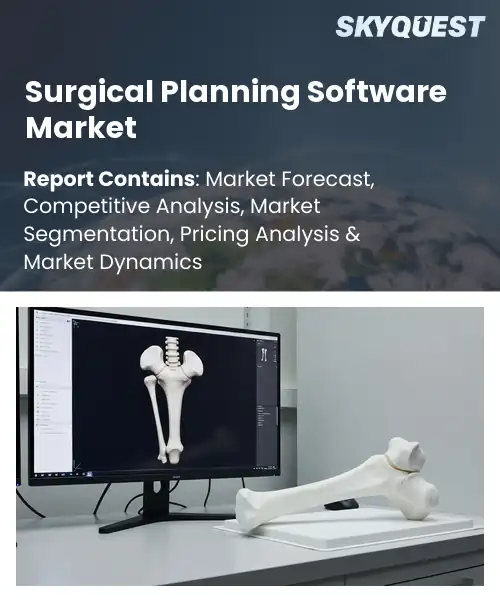
Surgical Planning Software Market
Report ID: SQMIG35G2476
Report ID: SQMIG35G2476
[email protected]
USA +1 351-333-4748
Report ID:
SQMIG35G2476 |
Region:
Global |
Published Date: June, 2026
Pages:
157
|Tables:
146
|Figures:
78


Global Surgical Planning Software Market size was valued at USD 1.22 Billion in 2024 and is poised to grow from USD 1.35 Billion in 2025 to USD 3.05 Billion by 2033, growing at a CAGR of 10.7% during the forecast period (2026-2033).
The primary driver of the surgical planning software market is the integration of advanced imaging, computational modeling and artificial intelligence that allows surgeons to plan procedures with greater precision and predictability. Surgical planning software refers to platforms that convert CT and MRI scans into three dimensional models, enable implant selection, and simulate surgical approaches, and it matters because improved planning shortens operative time, lowers complication rates and supports cost effective care. Over the last decade these systems have progressed from static visualization tools into interactive decision support suites; examples include orthopedic template planning, neurosurgical tractography and dental implant guides now.Building on that technological maturation, the key growth factor is the application of machine learning driven predictive analytics within surgical planning because better risk stratification and outcome forecasting directly influence hospital purchasing decisions. When algorithms can predict blood loss or functional outcomes from reconstructed anatomy, clinical teams reduce perioperative complications and justify investment in software, which accelerates vendor innovation and expands service contracts. Real world use cases include planning complex tumor resections to preserve function, customizing orthopedic implants from patient specific models, and optimizing robotic prostatectomy trajectories, and these successes create opportunities for cloud deployment, training services and payor engagement.
How is AI improving accuracy and adoption in the surgical planning software market?
AI is improving accuracy and adoption in surgical planning software by automating image segmentation and building patient specific 3D models that reduce manual variability and speed preoperative workflows. Machine learning models help predict tissue boundaries and likely surgical outcomes which makes plans more reliable and easier to communicate with surgical teams and patients. Integration with intraoperative navigation and robotics creates an end to end workflow that encourages hospital adoption. Regulatory clearances and clinical showcases further validate performance and drive trust. Real world examples include oncology and neurosurgical planning tools that demonstrate clearer benefits for complex cases and training scenarios.Medtronic Feb 2026, received FDA clearance for the Stealth AXiS system which brings planning navigation and robotics together and embeds AI enabled features, helping surgeons execute plans more consistently and helping hospitals adopt the technology through smoother workflows and reduced manual steps.
Market snapshot - (2026-2033)
Global Market Size
USD 1.22 Billion
Largest Segment
3D Planning Software
Fastest Growth
AI-Powered Planning Software
Growth Rate
10.7% CAGR
To get more insights on this market click here to Request a Free Sample Report
Global surgical planning software market is segmented by deployment mode, application, technology focus, end-user, sales channel and region. Based on deployment mode, the market is segmented into Cloud-Based and On-Premise. Based on application, the market is segmented into Neurosurgery, Orthopedic Surgery, Dental and Maxillofacial Surgery, Cardiovascular Surgery and Others. Based on technology focus, the market is segmented into AI-Driven Automation, Robotic Integration, Advanced Imaging and Visualization and Others. Based on end-user, the market is segmented into Hospitals, Specialized Clinics and Academic and Research Institutes. Based on sales channel, the market is segmented into Direct Institutional Sales, Medical Software Distributors and Online Licensing Platforms. Based on region, the market is segmented into North America, Europe, Asia Pacific, Latin America and Middle East & Africa.
Cloud Based segment dominates because it lowers barriers to adoption through minimal upfront infrastructure investment and rapid provisioning, enabling diverse clinical sites to access advanced planning tools quickly. Centralized cloud architectures facilitate seamless updates, interoperability with imaging repositories, and vendor driven analytics, which drive ongoing improvement. This ease of scaling and continuous feature delivery encourages procurement through subscription models, prompting broader clinical acceptance and tighter integration into care pathways.
However, On Premise is emerging as the most rapidly expanding deployment model because growing data control and compliance priorities drive demand for locally hosted solutions. Preference for deep customization and tight legacy integration prompts investments in tailored installations, enabling complex workflow adaptations and expanding opportunities for specialized implementation services and high value maintenance agreements.
AI Driven Automation segment leads because algorithmic planning and machine learning enhance preoperative workflows by automating routine tasks such as image segmentation and surgical trajectory suggestions, reducing cognitive burden on clinicians. The ability to standardize plans, surface predictive outcomes, and continuously improve from pooled data increases clinical confidence, accelerates adoption across care settings, and catalyzes vendor investment in interoperable platforms that embed intelligent decision support into routine surgical planning.
Meanwhile, Robotic Integration is emerging as the most rapidly expanding technology focus because growth in robot assisted procedures drives demand for end to end connectivity. Integration with robotic control enables automated execution of precise trajectories, encourages partnerships with device manufacturers, and creates bundled hardware and software offerings that broaden clinical applications and commercial opportunities.
To get detailed segments analysis, Request a Free Sample Report
North America dominates due to a convergence of advanced healthcare infrastructure, a concentrated base of leading vendors, and a clinical environment receptive to digital innovation. Health systems in the region prioritize integration of imaging, navigation, and robotics, enabling surgical planning software to become a core component of perioperative workflows. Strong collaboration between academic medical centers, technology companies, and specialty vendors accelerates validation and clinical adoption. Commercial models, service networks, and established reimbursement pathways support vendor investment in product refinement and user training. Availability of skilled clinicians and informatics professionals facilitates implementation and customization. The region also benefits from a mature regulatory and standards landscape that encourages interoperability and data security, creating a favorable environment for market leadership and sustained product development.
Surgical Planning Software Market in the United States benefits from a network of academic medical centers and specialty hospitals that collaborate with software developers. Clinical demand for integrated imaging, navigation and robotic procedures drives product refinement. A competitive commercial ecosystem and access to private investment enable commercialization and training infrastructure. Regulatory clarity, interoperability initiatives and skilled clinical informatics resources support deployment and customization for complex surgical specialties across care settings.
Surgical Planning Software Market in Canada is shaped by provincially organized health systems that emphasize standardized procurement and clinical integration. Academic centers and regional hospitals collaborate with vendors to tailor solutions across community sites. Emphasis on interoperability, clinician training and telehealth preoperative workflows supports adoption. Public funding mechanisms and collaborative procurement encourage scalable implementations and long term partnerships between health providers and technology suppliers focused on clinical outcomes and efficiency.
Europe rapid expansion is driven by a combination of coordinated healthcare modernization, strong clinical networks, and active engagement from both global and regional technology suppliers. Health systems across key markets are prioritizing digital tools that improve surgical planning, drive procedural efficiency and support minimally invasive and image guided approaches. Policy initiatives and interoperability frameworks encourage integration of planning software with hospital systems and imaging archives, facilitating deployment. Specialist surgical centers and academic hospitals are partnering with vendors to validate clinical workflows and develop localized solutions that reflect language and regulatory nuances. Reimbursement mechanisms and procurement programs in several markets support adoption, while clinician training programs and professional societies promote best practice dissemination, collectively accelerating meaningful market growth across the region.
Surgical Planning Software Market in Germany is centered on specialty hospitals and a strong medtech manufacturing base that supports development and testing. Collaboration between clinical teams, engineering units and industry fosters tailored solutions for complex surgical disciplines. National initiatives for digital health and interoperability encourage hospital system integration. Procurement processes favor validated clinical outcomes and technical robustness, enabling established vendors to scale implementations through coordinated training and clinical validation programs.
Surgical Planning Software Market in the United Kingdom is supported by national health modernization efforts and a strong life sciences cluster that fosters clinical innovation. Hospitals and specialist centers pilot planning tools with attention to workflow integration and clinician training. Procurement pathways and partnership models promote scale, while regulatory engagement shapes clinical evidence and guidelines. Focus on interoperability and remote planning enables broader adoption across hospital and community care settings.
Surgical Planning Software Market in France is emerging through initiatives that link academic hospitals, regional networks and technology firms. Public hospital systems and specialty centers evaluate planning tools that enhance care coordination and preoperative workflows. Emphasis on user friendly interfaces, language adaptation and data protection aligns solutions with clinician and patient needs. Procurement pilots and collaborative validation projects help demonstrate clinical value, supporting adoption and wider integration into surgical pathways.
Asia Pacific is strengthening its position through a blend of domestic innovation, targeted healthcare investment and strategic partnerships with global vendors. Regional markets prioritize modernization of surgical suites and expansion of image guided and minimally invasive procedures, creating demand for planning platforms that integrate with imaging, navigation and robotic systems. Local technology firms and academic centers collaborate to adapt solutions to regional clinical pathways and language needs. Regulatory modernization and pilot programs support evaluation, while public and private hospital networks implement training and interoperability initiatives. Cross border partnerships, increased clinical validation and a focus on scalable deployment across urban and regional hospitals are enhancing the region's role in the global market. Investment in advanced analytics, cloud native platforms and clinician education programs further accelerates adoption and supports localization of features for complex procedures. Government led digital health strategies and public private collaborations create testing grounds for scaled roll outs.
Surgical Planning Software Market in Japan is driven by integration between imaging companies, robotics manufacturers and hospital networks that emphasize precision surgery. Domestic vendors work with global partners to ensure interoperability with surgical systems and high fidelity anatomical modeling tailored to local clinical practice. Strong focus on clinical validation and institutional procurement supports acceptance. National government programs encourage solutions that enhance perioperative workflows and training across urban and regional hospitals.
Surgical Planning Software Market in South Korea benefits from advanced hospital IT infrastructure and strong capabilities in medical imaging. Hospitals and specialty centers collaborate with domestic tech firms and multinational vendors to integrate planning platforms with hospital records and navigation systems. Focus on high quality imaging, user centered design and clinical validation encourages adoption. Government support for digital health pilots and industry cooperation fosters scalable implementations across national clinical networks.
To know more about the market opportunities by region and country, click here to
Buy The Complete Report
Advanced Imaging and AI Integration
Growing Demand For Personalized Care
High Implementation And Integration Costs
Regulatory And Data Privacy Challenges
Request Free Customization of this report to help us to meet your business objectives.
The competitive landscape in the global surgical planning software market is driven by strategic M&A, partnerships, and rapid technology innovation that raise the bar for clinical integration. Large medtechs acquire niche planning platforms for vertical integration, for example Globus Medical’s acquisition of Surgimap, while OEM product launches like Stryker’s Ortho Guidance system show how vendor-led software introductions reshape clinical procurement and interoperability expectations.
Top Player’s Company Profile
Recent Developments
SkyQuest’s ABIRAW (Advanced Business Intelligence, Research & Analysis Wing) is our Business Information Services team that Collects, Collates, Correlates, and Analyses the Data collected by means of Primary Exploratory Research backed by robust Secondary Desk research. As per SkyQuest analysis, the global surgical planning software market is driven primarily by integration of advanced imaging and AI that enable precise, predictive preoperative models, with a secondary driver being rising demand for personalized patient specific care pathways. North America remains the dominating region due to advanced infrastructure, vendor concentration and favorable clinical adoption. The dominating segment is cloud based deployment which lowers barriers and enables rapid scale. Adoption is tempered by high implementation and integration costs that challenge budget constrained providers and lengthen rollout timelines. Vendors focusing on interoperable, scalable cloud solutions and validated AI workflows are best positioned to capture growth as clinical evidence and robotic integration expand use cases.
| Report Metric | Details |
|---|---|
| Market size value in 2024 | USD 1.22 Billion |
| Market size value in 2033 | USD 3.05 Billion |
| Growth Rate | 10.7% |
| Base year | 2024 |
| Forecast period | (2026-2033) |
| Forecast Unit (Value) | USD Billion |
| Segments covered |
|
| Regions covered | North America (US, Canada), Europe (Germany, France, United Kingdom, Italy, Spain, Rest of Europe), Asia Pacific (China, India, Japan, Rest of Asia-Pacific), Latin America (Brazil, Rest of Latin America), Middle East & Africa (South Africa, GCC Countries, Rest of MEA) |
| Companies covered |
|
| Customization scope | Free report customization with purchase. Customization includes:-
|
To get a free trial access to our platform which is a one stop solution for all your data requirements for quicker decision making. This platform allows you to compare markets, competitors who are prominent in the market, and mega trends that are influencing the dynamics in the market. Also, get access to detailed SkyQuest exclusive matrix.
Table Of Content
Executive Summary
Market overview
Parent Market Analysis
Market overview
Market size
KEY MARKET INSIGHTS
COVID IMPACT
MARKET DYNAMICS & OUTLOOK
Market Size by Region
KEY COMPANY PROFILES
Methodology
For the Surgical Planning Software Market, our research methodology involved a mixture of primary and secondary data sources. Key steps involved in the research process are listed below:
1. Information Procurement: This stage involved the procurement of Market data or related information via primary and secondary sources. The various secondary sources used included various company websites, annual reports, trade databases, and paid databases such as Hoover's, Bloomberg Business, Factiva, and Avention. Our team did 45 primary interactions Globally which included several stakeholders such as manufacturers, customers, key opinion leaders, etc. Overall, information procurement was one of the most extensive stages in our research process.
2. Information Analysis: This step involved triangulation of data through bottom-up and top-down approaches to estimate and validate the total size and future estimate of the Surgical Planning Software Market.
3. Report Formulation: The final step entailed the placement of data points in appropriate Market spaces in an attempt to deduce viable conclusions.
4. Validation & Publishing: Validation is the most important step in the process. Validation & re-validation via an intricately designed process helped us finalize data points to be used for final calculations. The final Market estimates and forecasts were then aligned and sent to our panel of industry experts for validation of data. Once the validation was done the report was sent to our Quality Assurance team to ensure adherence to style guides, consistency & design.
Analyst Support
Customization Options
With the given market data, our dedicated team of analysts can offer you the following customization options are available for the Surgical Planning Software Market:
Product Analysis: Product matrix, which offers a detailed comparison of the product portfolio of companies.
Regional Analysis: Further analysis of the Surgical Planning Software Market for additional countries.
Competitive Analysis: Detailed analysis and profiling of additional Market players & comparative analysis of competitive products.
Go to Market Strategy: Find the high-growth channels to invest your marketing efforts and increase your customer base.
Innovation Mapping: Identify racial solutions and innovation, connected to deep ecosystems of innovators, start-ups, academics, and strategic partners.
Category Intelligence: Customized intelligence that is relevant to their supply Markets will enable them to make smarter sourcing decisions and improve their category management.
Public Company Transcript Analysis: To improve the investment performance by generating new alpha and making better-informed decisions.
Social Media Listening: To analyze the conversations and trends happening not just around your brand, but around your industry as a whole, and use those insights to make better Marketing decisions.
REQUEST FOR SAMPLE
 REQUEST FREE CUSTOMIZATION


Want to customize this report? This report can be personalized according to your needs. Our analysts and industry experts will work directly with you to understand your requirements and provide you with customized data in a short amount of time. We offer $1000 worth of FREE customization at the time of purchase.
Feedback From Our Clients


 USA (+1) 351-333-4748

