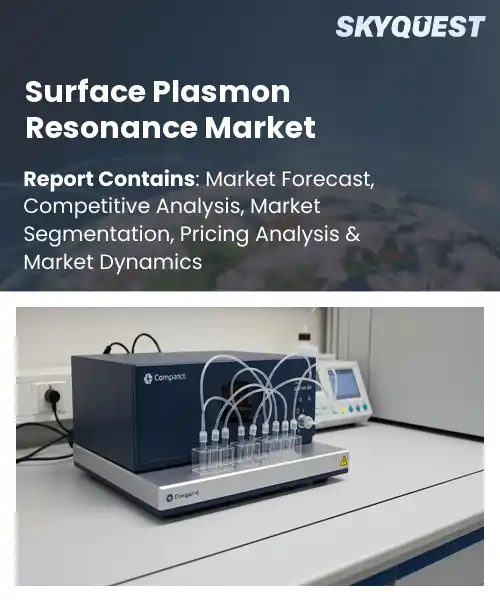
Surface Plasmon Resonance Market
Report ID: SQMIG35J2575
Report ID: SQMIG35J2575
[email protected]
USA +1 351-333-4748
Report ID:
SQMIG35J2575 |
Region:
Global |
Published Date: July, 2026
Pages:
157
|Tables:
94
|Figures:
76


Global Surface Plasmon Resonance Market size was valued at USD 1.24 Billion in 2024 and is poised to grow from USD 1.32 Billion in 2025 to USD 2.25 Billion by 2033, growing at a CAGR of 6.8% during the forecast period (2026-2033).
High adoption of label-free biomolecular analysis, increasing adoption of precision medicine, rising investments in drug discovery research, advancements in biosensor technologies, and expanding use of real-time molecular interaction analysis are driving sales of surface plasmon resonance solutions.
Rising emphasis on efficient drug discovery and increasing demand for real-time biomolecular interaction analysis are expected to primarily drive surface plasmon resonance market growth. Rising adoption of surface plasmon resonance systems across pharmaceutical research, biotechnology, clinical diagnostics, and academic laboratories is supporting market expansion. Increasing investments in personalized medicine, biomarker discovery, microfluidic technologies, cloud-based analytics, and advanced biosensor platforms are also contributing to growth. Continuous advancements in label-free detection technologies, automated assay platforms, and high-throughput molecular analysis are further improving research efficiency and analytical accuracy. In addition, expanding collaborations between research institutions, healthcare organizations, and pharmaceutical companies are expected to create new growth opportunities for the market worldwide.
On the contrary, high instrument costs, complex operational requirements, limited availability of skilled professionals, and competition from alternative analytical technologies are anticipated to slow down surface plasmon resonance market penetration across the study period and beyond.
How is AI Enhancing Sensitivity And Throughput In Surface Plasmon Resonance Technologies?
The use of AI technologies is helping the surface plasmon resonance industry to become more efficient, more effective, and faster when it comes to analyzing biomolecules. Through the use of machine learning algorithms for analyzing huge volumes of spectral data, AI technologies are able to discover very small changes in the molecules, which would not be easy to spot otherwise. AI technologies allow automating the process of data analysis, which makes the analysis of data faster, saving time and allowing conducting more analyses.
Market snapshot - (2026-2033)
Global Market Size
USD 1.24 Billion
Largest Segment
Single-Channel / Dual-Channel Systems
Fastest Growth
Imaging SPR (iSPR) Systems
Growth Rate
6.8% CAGR
To get more insights on this market click here to Request a Free Sample Report
Global surface plasmon resonance market is segmented by system type, application, end user, and region. Based on system type, the market is segmented into single-channel / dual-channel systems, multi-channel mid-throughput systems, high-throughput automated platforms, and imaging SPR (iSPR) Systems. Based on application, the market is segmented into drug discovery & development, biosimilar comparability, basic research, environmental monitoring, and food safety testing. Based on end user, the market is segmented into pharmaceutical & biotechnology companies, academic & research institutions, CDMOs & CROs, and government research laboratories. Based on region, the market is segmented into North America, Europe, Asia Pacific, Latin America, and Middle East & Africa.
The single channel dual channel segment is estimated to lead the global surface plasmon resonance market revenue generation in the future. It provides a simple process flow, which is suitable for the budget and skill level of most labs, hence it becomes the first option in carrying out kinetics studies. Its user-friendly nature saves training time, while its accuracy helps to provide consistent results, thus increasing confidence levels of the users. Such features help it maintain high usage rates, hence maintaining its place at the heart of the market, and it keeps being adopted in new assay platforms.
Meanwhile, multi channel mid throughput segment is witnessing the strongest growth momentum as per this surface plasmon resonance market forecast, as laboratories look for denser data without compromising on analysis. The capacity to carry out more interactions at once speeds up the process, while incorporation with automated systems reduces hands-on time. This kind of advancement increases the scope of the market as it appeals to faster projects.
The drug discovery and development segment is slated to account for the highest global surface plasmon resonance market share going forward. It is the technology that directly helps in driving the engines that generate revenue for both biotechnology companies and pharma companies, making SPR a very important tool for studying molecular interactions at an early stage of drug discovery processes. Label-free format of SPR allows faster validation of hits while real-time kinetics of the reactions helps in optimizing leads.
On the other hand, biosimilar comparability is emerging as the key high growth subsegment as more stringent regulations are imposed upon biosimilarity. SPR allows for precise characterization of affinities and epitopes. This is an economical way of proving biosimilarity and will encourage further implementation. These developments create more markets and drive technological advancement.
To get detailed segments analysis, Request a Free Sample Report
Presence of world-class research institutions, a mature pharmaceutical and biotechnology ecosystem, and sustained investment in advanced analytical technologies are helping this region hold sway over others. The US is home to an important concentration of innovation hubs where scientific know-how is combined with R&D at businesses, enabling the speedy adaptation of SPR technologies to the pharmaceutical and diagnostic fields. In turn, Canada offers complimentary advantages with regard to active government involvement in research cooperation initiatives and a developing life sciences industry focused on precise analytics. Intellectual property rights, open innovation practices, and a solid supply chain for high-performance optics only strengthen the region’s leadership in the global marketplace.
Surface plasmon resonance market activity in the United States is driven by extensive academic research programs and a high concentration of biotech firms that prioritize label‑free interaction analysis. Collaborative initiatives between universities and industry accelerate technology adoption, while venture capital streams support emerging device manufacturers. The regulatory environment encourages rigorous validation, positioning the United States as a premier destination for both instrument development and end‑user application across therapeutic discovery.
Surface plasmon resonance demand in Canada benefits from governmental programs that nurture research partnerships and encourage commercialization of analytical tools. Innovation clusters within provinces integrate experience in nano photonics with the increasing numbers of startups in the life sciences, providing a continuous flow of SPR technologies that are used for environmental and biomedical tests. Research institutes pay attention to the development of interdisciplinary programs, whereas public-private alliances ensure availability of financial resources and equipment.
Rigorous academic research, strong governmental incentives, and a collaborative industrial landscape that emphasizes precision therapeutics and advanced diagnostics support consistent surface plasmon resonance demand in Europe. Germany stands out as the country that provides leadership to the region through their renowned engineering capabilities along with an extensive use of optical technology in their pharmaceutical development processes. The United Kingdom is characterized by rapid adoption as evidenced by the existence of biotech hubs, forward-thinking regulatory policies, and generous funding of research through government agencies. In France, there is momentum being created through interdisciplinary projects that combine nanotechnology with biomedical applications.
Surface plasmon resonance market in Germany is bolstered by the nation’s reputation for precision engineering and a dense network of photonics research institutes. Collaborative projects between leading universities and pharmaceutical firms drive customized SPR platforms tailored for drug target validation. Governmental technology programmes provide strategic funding, while industry clusters facilitate rapid prototyping and scale‑up. This ecosystem reinforces Germany’s position as the dominant force shaping European SPR advancements.
Surface plasmon resonance adoption in the United Kingdom thrives on a vibrant biotech ecosystem that integrates academic excellence with entrepreneurial vigor. Leading research hospitals and university labs champion label-free interaction studies, while government innovation grants accelerate commercialization of next-generation SPR sensors. The regulatory framework encourages swift validation of diagnostic applications, attracting multinational firms to establish R&D hubs. Consequently, the United Kingdom emerges as the fastest‑growing market within Europe for SPR technologies.
Surface plasmon resonance market progress in France is propelled by emerging interdisciplinary initiatives that fuse nano photonics with biomedical research. Research funding from government bodies is channeled towards creating consortia that collaborate between universities, early-stage companies, and well-established players in life sciences for the development of cost-effective SPR devices for use in clinical and environmental diagnostics. Such focus on translational science and open science facilitates quick knowledge transfer, while regional innovation centers offer access to dedicated fabrication laboratories. Such trends put France as a rising hotbed for future-generation SPR technology.
Rapid technological adoption, expanding research capacity, and strategic government investments that prioritize advanced analytical instrumentation support steady surface plasmon resonance innovation in the region. Utilizing Japan’s past optical technologies, Japan can develop high-efficiency SPR instruments and build connections with foreign pharmaceutical companies. Meanwhile, South Korea is concentrated on integrating SPR technology into their new industry of bi-electronics and precision medicine using the help of aggressive public investment into research parks. The emphasis made on the cost-effectiveness and scalability of the region helps in making the surface plasmon resonance technology accessible and encouraging researchers to use label-free analysis in the whole Asia Pacific region.
Surface plasmon resonance market activity in Japan is anchored by a deep heritage of optical engineering and a strong emphasis on miniaturized, high‑sensitivity detection systems. Collaborative networks between national research institutes and leading pharmaceutical companies accelerate the translation of SPR technology into real‑time drug screening platforms. Government programs provide targeted support for instrument innovation, while industry consortia promote standardization and talent development. This confluence of expertise and policy solidifies Japan’s role as a leading driver of SPR advancement in the region.
Surface plasmon resonance market development in South Korea benefits from a national drive toward bio‑convergence and smart healthcare solutions. Strong collaboration between electronics manufacturers and life‑science firms results in integrated SPR platforms that combine optical precision with data analytics. Government funding agencies prioritize projects that enhance label‑free screening for personalized medicine, while university incubators nurture start‑ups focused on portable SPR devices. This ecosystem accelerates South Korea’s emergence as a dynamic contributor to the regional SPR landscape.
To know more about the market opportunities by region and country, click here to
Buy The Complete Report
Increasing Sensitivity and Accuracy
Integration With Microfluidic Technologies
High Equipment Acquisition Costs
Complex Data Interpretation Requirements
Request Free Customization of this report to help us to meet your business objectives.
The competitive landscape is shaped by incumbents leveraging advanced SPR sensor chips and integrated analytics platforms, while newer entrants accelerate growth through strategic M&A, cross‑industry partnerships, and rapid tech innovation such as AI‑driven data interpretation and microfluidic integration, exemplified by recent collaborations between sensor manufacturers and biotech firms to expand real‑time kinetic assay capabilities.
SkyQuest’s ABIRAW (Advanced Business Intelligence, Research & Analysis Wing) is our Business Information Services team that Collects, Collates, Correlates, and Analyses the Data collected by means of Primary Exploratory Research backed by robust Secondary Desk research.
As per SkyQuest analysis, demand for label-free biomolecular analysis, increasing adoption of precision medicine, rising investments in drug discovery research, and advancements in biosensor technologies are anticipated to drive the demand for surface plasmon resonance solutions going forward. However, high instrument costs and competition from alternative analytical technologies are slated to slow down the adoption of surface plasmon resonance solutions in the future. North America is slated to spearhead the demand for surface plasmon resonance solutions owing to strong pharmaceutical and biotechnology research, advanced healthcare infrastructure, high investment in life science research, and the presence of leading analytical instrument manufacturers. AI-powered data analysis and integration of microfluidic biosensor technologies are anticipated to be key trends driving the surface plasmon resonance industry in the long run.
| Report Metric | Details |
|---|---|
| Market size value in 2024 | USD 1.24 Billion |
| Market size value in 2033 | USD 2.25 Billion |
| Growth Rate | 6.8% |
| Base year | 2024 |
| Forecast period | (2026-2033) |
| Forecast Unit (Value) | USD Billion |
| Segments covered |
|
| Regions covered | North America (US, Canada), Europe (Germany, France, United Kingdom, Italy, Spain, Rest of Europe), Asia Pacific (China, India, Japan, Rest of Asia-Pacific), Latin America (Brazil, Rest of Latin America), Middle East & Africa (South Africa, GCC Countries, Rest of MEA) |
| Companies covered |
|
| Customization scope | Free report customization with purchase. Customization includes:-
|
To get a free trial access to our platform which is a one stop solution for all your data requirements for quicker decision making. This platform allows you to compare markets, competitors who are prominent in the market, and mega trends that are influencing the dynamics in the market. Also, get access to detailed SkyQuest exclusive matrix.
Table Of Content
Executive Summary
Market overview
Parent Market Analysis
Market overview
Market size
KEY MARKET INSIGHTS
COVID IMPACT
MARKET DYNAMICS & OUTLOOK
Market Size by Region
KEY COMPANY PROFILES
Methodology
For the Surface Plasmon Resonance Market, our research methodology involved a mixture of primary and secondary data sources. Key steps involved in the research process are listed below:
1. Information Procurement: This stage involved the procurement of Market data or related information via primary and secondary sources. The various secondary sources used included various company websites, annual reports, trade databases, and paid databases such as Hoover's, Bloomberg Business, Factiva, and Avention. Our team did 45 primary interactions Globally which included several stakeholders such as manufacturers, customers, key opinion leaders, etc. Overall, information procurement was one of the most extensive stages in our research process.
2. Information Analysis: This step involved triangulation of data through bottom-up and top-down approaches to estimate and validate the total size and future estimate of the Surface Plasmon Resonance Market.
3. Report Formulation: The final step entailed the placement of data points in appropriate Market spaces in an attempt to deduce viable conclusions.
4. Validation & Publishing: Validation is the most important step in the process. Validation & re-validation via an intricately designed process helped us finalize data points to be used for final calculations. The final Market estimates and forecasts were then aligned and sent to our panel of industry experts for validation of data. Once the validation was done the report was sent to our Quality Assurance team to ensure adherence to style guides, consistency & design.
Analyst Support
Customization Options
With the given market data, our dedicated team of analysts can offer you the following customization options are available for the Surface Plasmon Resonance Market:
Product Analysis: Product matrix, which offers a detailed comparison of the product portfolio of companies.
Regional Analysis: Further analysis of the Surface Plasmon Resonance Market for additional countries.
Competitive Analysis: Detailed analysis and profiling of additional Market players & comparative analysis of competitive products.
Go to Market Strategy: Find the high-growth channels to invest your marketing efforts and increase your customer base.
Innovation Mapping: Identify racial solutions and innovation, connected to deep ecosystems of innovators, start-ups, academics, and strategic partners.
Category Intelligence: Customized intelligence that is relevant to their supply Markets will enable them to make smarter sourcing decisions and improve their category management.
Public Company Transcript Analysis: To improve the investment performance by generating new alpha and making better-informed decisions.
Social Media Listening: To analyze the conversations and trends happening not just around your brand, but around your industry as a whole, and use those insights to make better Marketing decisions.
REQUEST FOR SAMPLE
 REQUEST FREE CUSTOMIZATION
Global Surface Plasmon Resonance Market size was valued at USD 1.24 Billion in 2024 and is poised to grow from USD 1.32 Billion in 2025 to USD 2.25 Billion by 2033, growing at a CAGR of 6.8% during the forecast period (2026-2033).
The competitive landscape is shaped by incumbents leveraging advanced SPR sensor chips and integrated analytics platforms, while newer entrants accelerate growth through strategic M&A, cross‑industry partnerships, and rapid tech innovation such as AI‑driven data interpretation and microfluidic integration, exemplified by recent collaborations between sensor manufacturers and biotech firms to expand real‑time kinetic assay capabilities. 'Cytiva (Biacore - formerly GE Healthcare Life Sciences)', 'Bruker Corporation', 'AMETEK, Inc.', 'HORIBA, Ltd.', 'Bio-Rad Laboratories, Inc.', 'Carterra Inc.', 'Malvern Panalytical (Spectris PLC)', 'Reichert Technologies (AMETEK)', 'Biosensing Instrument Inc.', 'NeaSPEC GmbH (Attocube Systems AG)', 'Lumos Networks', 'Xantec Bioanalytics GmbH', 'ICx Photonics Inc. (BAE Systems)', 'Bionavis Oy', 'Nicoya Lifesciences Inc.', 'Sensia Oy', 'Wasatch Photonics', 'Hartland Scientific, LLC', 'Diagnostic Photonics, Inc.', 'Chandler Instruments Company'
The enhanced sensitivity and accuracy of surface plasmon resonance instruments enable detection of lower analyte concentrations and finer kinetic distinctions, encouraging adoption across pharmaceutical, biotech, and environmental testing sectors. Researchers value the ability to obtain reliable real‑time interaction data without labeling, which streamlines assay development and reduces experimental complexity. This performance advantage drives demand for advanced SPR platforms, prompting laboratories to upgrade existing equipment and motivating manufacturers to expand product portfolios with higher‑resolution sensors and integrated data analysis tools solutions.
Ai-Driven Data Interpretation Rise: The integration of artificial intelligence into surface plasmon resonance platforms is accelerating the speed and accuracy of biomolecular analysis. Machine learning algorithms now automate baseline correction, peak detection, and kinetic modeling, reducing reliance on specialist expertise. This shift enables broader adoption across pharmaceutical research, diagnostics, and academic labs, as users can obtain reliable insights with minimal manual intervention. Consequently, vendors are embedding AI modules directly into instrument software, positioning their offerings as turnkey solutions for rapid, reproducible results globally today.
Why does North America Dominate the Global Surface Plasmon Resonance Market? |@12


Want to customize this report? This report can be personalized according to your needs. Our analysts and industry experts will work directly with you to understand your requirements and provide you with customized data in a short amount of time. We offer $1000 worth of FREE customization at the time of purchase.
Feedback From Our Clients


 USA (+1) 351-333-4748

