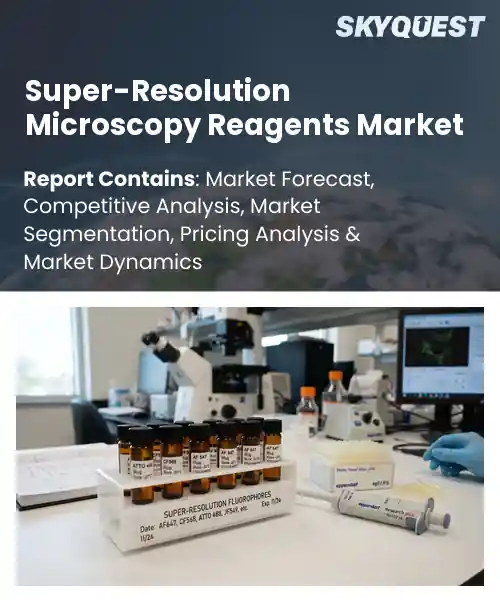
Super-Resolution Microscopy Reagents Market
Report ID: SQMIG35J2788
Report ID: SQMIG35J2788
[email protected]
USA +1 351-333-4748
Report ID:
SQMIG35J2788 |
Region:
Global |
Published Date: September, 2026
Pages:
157
|Tables:
126
|Figures:
77


Global Super-Resolution Microscopy Reagents Market size was valued at USD 2.11 Billion in 2024 and is poised to grow from USD 2.26 Billion in 2025 to USD 3.92 Billion by 2033, growing at a CAGR of 7.1% during the forecast period (2026-2033).
The super‑resolution microscopy reagents market provides fluorophores, labeling kits, and mounting media that enable imaging beyond the diffraction limit, a capability essential for cellular and molecular research. Its importance lies in visualizing sub‑cellular structures such as protein clusters, synaptic vesicles, and chromatin loops with precision, which directly informs drug target validation and biomarker discovery. The market originated in the early 2000s when STED and PALM were first commercialized; academic labs studying neuronal synapses were early adopters. In the last decade reagent portfolios have expanded to support STORM, DNA‑PAINT, and expansion microscopy, fostering broader adoption across pharmaceutical, biotech, and diagnostic sectors. The growing need for multiplexed imaging in immuno‑oncology and neuroscience drives market growth because researchers must label several targets while maintaining super‑resolution quality. Suppliers that launch photostable dyes compatible with STED or DNA‑PAINT gain advantage, as shown by a recent partnership between a fluorophore company and a biotech firm developing CAR‑T therapies, where improved synaptic visualization accelerated preclinical validation. Simultaneously, analysis demands reagents with background and predictable blinking, which enhances algorithmic segmentation and creates a feedback loop encouraging reagent refinement. These trends generate opportunities for probe design, contract manufacturing, and expansion into regions where academic cores are adopting resolution platforms.
How is AI accelerating innovation in the super-resolution microscopy reagents market?
AI is reshaping the super‑resolution microscopy reagents market by streamlining probe design, optimizing labeling chemistry, and accelerating validation cycles. Machine‑learning models predict fluorophore brightness and photostability, enabling manufacturers to tailor reagents for specific imaging modalities. Automated image analysis feeds back performance data, shortening the time from concept to commercial product. These capabilities are expanding the portfolio of compatible dyes, nanobodies and DNA‑PAINT strands, making high‑resolution imaging more accessible to academic and industrial labs. The market is responding with a surge of innovative kits that combine AI‑driven selection with streamlined workflows, driving broader adoption of super‑resolution techniques.No verified recent development can be cited at this time.
Market snapshot - (2026-2033)
Global Market Size
USD 2.11 Billion
Largest Segment
Fluorescent Dyes
Fastest Growth
Labeling Kits
Growth Rate
7.1% CAGR
To get more insights on this market click here to Request a Free Sample Report
Global super-resolution microscopy reagents market is segmented by reagent type, microscopy technique, application, end user and region. Based on reagent type, the market is segmented into Fluorescent Dyes, Fluorescent Proteins, Antibodies, Labeling Kits, Mounting Media and Others. Based on microscopy technique, the market is segmented into STED, PALM, STORM, SIM and Others. Based on application, the market is segmented into Cell Biology, Molecular Biology, Neuroscience, Drug Discovery and Others. Based on end user, the market is segmented into Academic & Research Institutions, Pharmaceutical Companies, Biotechnology Companies, Clinical Laboratories and Others. Based on region, the market is segmented into North America, Europe, Asia Pacific, Latin America and Middle East & Africa.
Fluorescent dyes segment dominates because they provide the highest photon output and photostability essential for achieving the nanometer‑scale resolution demanded by super‑resolution platforms. Their broad spectral versatility enables multiplexed imaging, satisfying diverse research needs. Continuous chemical innovations reduce blinking and improve brightness, which directly enhances image quality. Consequently, researchers preferentially select dyes over alternative reagents, sustaining robust demand across academic and commercial laboratories throughout the entire product lifecycle and beyond.
Meanwhile, labeling kits segment emerges as the most rapidly expanding because they simplify conjugation workflows, enabling non‑specialist labs to adopt super‑resolution techniques with minimal training. Integrated kits combine dyes, antibodies and protocols, speeding setup and lowering error rates. This convenience broadens adoption in emerging research areas, fueling market expansion and creating growth opportunities.
STED segment dominates because its depletion‑laser approach delivers consistent sub‑20 nm resolution, making it the preferred technique for high‑precision structural biology. The method demands highly photostable dyes and optimized mounting media that can endure intense laser exposure, prompting manufacturers to prioritize product lines tailored for STED. Consequently, reagent developers invest heavily in chemistry that enhances dye resilience and reduces photobleaching, reinforcing STED’s central role in market demand. These focused innovations also attract collaborations with instrument vendors, further consolidating its market leadership.
On the other hand, SIM segment is witnessing the strongest growth momentum because its gentle illumination reduces phototoxicity, enabling live‑cell super‑resolution studies. Simpler optics lower equipment costs, encouraging labs with limited budgets to adopt the technique. This broader user base fuels demand for compatible fluorophores and labeling kits, accelerating market expansion.
To get detailed segments analysis, Request a Free Sample Report
North America benefits from a dense concentration of world‑leading research universities and a mature biotech ecosystem that drives early adoption of advanced imaging technologies. Robust public and private research funding creates a supportive environment for continuous innovation in probe design and labeling chemistry. Close collaboration between academic laboratories, pharmaceutical manufacturers, and specialized reagent suppliers accelerates product development cycles. A well‑established regulatory framework and strong intellectual‑property protection further encourage investment, while a culture of interdisciplinary science ensures that super‑resolution techniques become integral to a broad range of biomedical investigations, reinforcing the region’s leadership position.
Super-Resolution Microscopy Reagents Market in the United States thrives on a vibrant network of academic medical centers that prioritize cutting‑edge imaging for disease research. Close ties between research institutions and commercial reagent developers enable rapid translation of novel fluorophores into laboratory practice. Strategic partnerships with biotechnology firms foster customized solutions, while extensive grant programs support exploratory studies that expand application breadth. The market is reinforced by ongoing demand from pharmaceutical pipelines seeking detailed molecular insights.
Super-Resolution Microscopy Reagents Market in Canada is propelled by collaborative initiatives between universities and government‑funded research councils that emphasize innovative imaging approaches. Strong emphasis on translational science encourages the integration of high‑performance reagents into both basic and clinical research settings. Emerging biotech clusters in key provinces create a fertile ground for localized reagent production, while a supportive policy landscape nurtures sustained investment in microscopy infrastructure and skill development across the scientific community.
Europe’s rapid expansion is anchored by a cohesive research funding landscape that encourages cross‑border collaboration and shared scientific resources. Leading universities and specialized institutes across the continent champion the adoption of super‑resolution methods, fostering a culture of methodological excellence. Strong governmental support for life‑science innovation and a thriving network of niche reagent manufacturers accelerate product diversification. The region’s focus on precision medicine and cellular biology fuels demand, while robust regulatory harmonization simplifies market entry for new technologies, collectively propelling growth.
Super-Resolution Microscopy Reagents Market in Germany benefits from a deep integration of advanced imaging within its renowned biomedical research clusters. Close cooperation between university laboratories and industrial partners drives the co‑development of specialized labeling kits. National research programs prioritize high‑resolution techniques for cellular and molecular studies, encouraging widespread adoption. The market is further strengthened by a skilled scientific workforce that sustains continuous methodological refinement and bespoke reagent customization.
Super-Resolution Microscopy Reagents Market in the United Kingdom experiences accelerated growth through vibrant academic consortia that champion novel imaging solutions. Collaborative funding schemes between research councils and private enterprises stimulate the creation of tailored reagents for diverse biological applications. A proactive biotechnology sector leverages super‑resolution tools to enhance drug discovery pipelines, while regulatory alignment with broader European standards facilitates smoother market access for innovative products.
Super-Resolution Microscopy Reagents Market in France is emerging as a dynamic niche driven by strong governmental investment in scientific infrastructure. Research hospitals and academic laboratories actively integrate high‑resolution imaging into translational projects, fostering demand for versatile reagents. Partnerships with European reagent manufacturers enable access to cutting‑edge fluorophores, while interdisciplinary initiatives promote the use of super‑resolution techniques across life‑science disciplines, positioning France as an increasingly influential player.
Asia Pacific is strengthening its position through a concerted focus on expanding research capabilities and fostering innovation in imaging science. Growing investment in state‑of‑the‑art microscopy facilities across leading universities and research institutes drives demand for high‑performance reagents. Regional biotech hubs are increasingly adopting super‑resolution techniques to differentiate their research output, while collaborative networks among academia, industry, and government entities facilitate knowledge exchange and localized reagent development. This synergy creates a fertile environment for sustained market advancement.
Super-Resolution Microscopy Reagents Market in Japan is propelled by an entrenched culture of precision engineering and a strong emphasis on advanced biomedical research. Leading scientific institutions prioritize high‑resolution imaging for cellular and molecular investigations, encouraging the integration of sophisticated reagents. Collaborative projects between universities and specialized reagent manufacturers foster tailored solutions that meet specific research needs. The market benefits from strategic government initiatives that support cutting‑edge microscopy infrastructure and skill development.
Super-Resolution Microscopy Reagents Market in South Korea gains momentum through rapid expansion of its biotechnology sector and a robust academic research framework. Universities and research centers adopt super‑resolution approaches to deepen understanding of disease mechanisms, driving demand for innovative labeling chemistries. Close cooperation with domestic reagent producers accelerates the availability of customized probes, while national science programs encourage interdisciplinary projects that embed high‑resolution imaging into a broad spectrum of life‑science endeavors.
To know more about the market opportunities by region and country, click here to
Buy The Complete Report
Increasing Adoption of Live‑Cell Imaging
Researchers are turning to super‑resolution microscopy to visualize dynamic processes within living cells, and the growing availability of specialized reagents enables prolonged imaging with minimal phototoxicity. This capability supports high‑impact studies in drug discovery, neuroscience, and developmental biology, driving laboratories to upgrade their toolkits. As protocols become more robust, scientists are increasingly confident in applying these techniques to complex biological questions, creating sustained demand for high‑quality fluorophores, labeling kits, and mounting media tailored for live‑cell applications and enabling more precise quantitative analyses of subcellular structures.
Expansion of Commercial Imaging Platforms
Manufacturers of super‑resolution microscopes are integrating reagent compatibility into their system designs, simplifying workflow for end‑users. By offering pre‑validated kits and automated dispensing modules, they reduce setup complexity and lower barriers for laboratories transitioning from conventional to advanced imaging. This seamless integration encourages broader adoption across academic, pharmaceutical, and clinical settings, as scientists can achieve consistent results without extensive protocol optimization. Consequently, the market experiences amplified demand for reagents that are certified to perform reliably with these turnkey platforms efficiently.
High Cost of Proprietary Reagents
Many super‑resolution reagents are supplied by a limited number of specialized vendors, and their proprietary formulations command premium pricing. Laboratories operating under constrained budgets must allocate funds carefully, often prioritizing core equipment over consumables. This financial pressure can lead to reduced purchasing frequency or the selection of lower‑cost alternatives that may not deliver optimal performance. As a result, the overall market expansion is slowed because potential customers delay adoption until pricing structures become more competitive or more cost‑effective options emerge.
Technical Complexity of Protocols
Super‑resolution imaging requires precise sample preparation, including specific labeling densities, buffer conditions, and meticulous mounting techniques. Researchers must master these intricate steps to avoid artifacts and achieve the promised resolution, which often demands extensive training and iterative optimization. Laboratories lacking experienced personnel may encounter reproducibility challenges, leading to frustration and reluctance to invest in new reagents. Consequently, the perceived difficulty discourages broader market uptake, as institutions opt for more straightforward imaging methods until protocol robustness improves and reliable outcomes for routine studies.
Request Free Customization of this report to help us to meet your business objectives.
The competitive landscape of the global super‑resolution microscopy reagents market is shaped by intense rivalry among established biotech firms and emerging innovators, driving rapid advances in fluorophore chemistry, labeling kits, and sample preparation protocols. Recent strategic moves include a major acquisition of a niche fluorophore developer by a leading life‑science conglomerate, a partnership between a reagent supplier and a leading microscopy hardware manufacturer to co‑develop integrated imaging solutions, and the launch of next‑generation DNA‑PAINT reagents that enable higher spatial resolution and multiplexing capabilities.
Top Player’s Company Profile
Recent Developments
SkyQuest’s ABIRAW (Advanced Business Intelligence, Research & Analysis Wing) is our Business Information Services team that Collects, Collates, Correlates, and Analyses the Data collected by means of Primary Exploratory Research backed by robust Secondary Desk research. As per SkyQuest analysis, the global super‑resolution microscopy reagents market is projected to reach $3.92 billion by 2033, driven first by the rising adoption of live‑cell imaging that pushes demand for photostable fluorophores and labeling kits, and second by the expansion of commercial imaging platforms that bundle pre‑validated reagents, simplifying workflow for laboratories. The market is led by North America, where dense research ecosystems and strong funding accelerate uptake, while fluorescent dyes remain the dominant segment because of their superior photon output and multiplexing capability. However, the high cost of proprietary reagents restrains broader diffusion, especially in budget‑constrained institutions and slows adoption across smaller labs.
| Report Metric | Details |
|---|---|
| Market size value in 2024 | USD 2.11 Billion |
| Market size value in 2033 | USD 3.92 Billion |
| Growth Rate | 7.1% |
| Base year | 2024 |
| Forecast period | (2026-2033) |
| Forecast Unit (Value) | USD Billion |
| Segments covered |
|
| Regions covered | North America (US, Canada), Europe (Germany, France, United Kingdom, Italy, Spain, Rest of Europe), Asia Pacific (China, India, Japan, Rest of Asia-Pacific), Latin America (Brazil, Rest of Latin America), Middle East & Africa (South Africa, GCC Countries, Rest of MEA) |
| Companies covered |
|
| Customization scope | Free report customization with purchase. Customization includes:-
|
To get a free trial access to our platform which is a one stop solution for all your data requirements for quicker decision making. This platform allows you to compare markets, competitors who are prominent in the market, and mega trends that are influencing the dynamics in the market. Also, get access to detailed SkyQuest exclusive matrix.
Table Of Content
Executive Summary
Market overview
Parent Market Analysis
Market overview
Market size
KEY MARKET INSIGHTS
COVID IMPACT
MARKET DYNAMICS & OUTLOOK
Market Size by Region
KEY COMPANY PROFILES
Methodology
For the Super-Resolution Microscopy Reagents Market, our research methodology involved a mixture of primary and secondary data sources. Key steps involved in the research process are listed below:
1. Information Procurement: This stage involved the procurement of Market data or related information via primary and secondary sources. The various secondary sources used included various company websites, annual reports, trade databases, and paid databases such as Hoover's, Bloomberg Business, Factiva, and Avention. Our team did 45 primary interactions Globally which included several stakeholders such as manufacturers, customers, key opinion leaders, etc. Overall, information procurement was one of the most extensive stages in our research process.
2. Information Analysis: This step involved triangulation of data through bottom-up and top-down approaches to estimate and validate the total size and future estimate of the Super-Resolution Microscopy Reagents Market.
3. Report Formulation: The final step entailed the placement of data points in appropriate Market spaces in an attempt to deduce viable conclusions.
4. Validation & Publishing: Validation is the most important step in the process. Validation & re-validation via an intricately designed process helped us finalize data points to be used for final calculations. The final Market estimates and forecasts were then aligned and sent to our panel of industry experts for validation of data. Once the validation was done the report was sent to our Quality Assurance team to ensure adherence to style guides, consistency & design.
Analyst Support
Customization Options
With the given market data, our dedicated team of analysts can offer you the following customization options are available for the Super-Resolution Microscopy Reagents Market:
Product Analysis: Product matrix, which offers a detailed comparison of the product portfolio of companies.
Regional Analysis: Further analysis of the Super-Resolution Microscopy Reagents Market for additional countries.
Competitive Analysis: Detailed analysis and profiling of additional Market players & comparative analysis of competitive products.
Go to Market Strategy: Find the high-growth channels to invest your marketing efforts and increase your customer base.
Innovation Mapping: Identify racial solutions and innovation, connected to deep ecosystems of innovators, start-ups, academics, and strategic partners.
Category Intelligence: Customized intelligence that is relevant to their supply Markets will enable them to make smarter sourcing decisions and improve their category management.
Public Company Transcript Analysis: To improve the investment performance by generating new alpha and making better-informed decisions.
Social Media Listening: To analyze the conversations and trends happening not just around your brand, but around your industry as a whole, and use those insights to make better Marketing decisions.
REQUEST FOR SAMPLE
 REQUEST FREE CUSTOMIZATION


Want to customize this report? This report can be personalized according to your needs. Our analysts and industry experts will work directly with you to understand your requirements and provide you with customized data in a short amount of time. We offer $1000 worth of FREE customization at the time of purchase.
Feedback From Our Clients


 USA (+1) 351-333-4748

