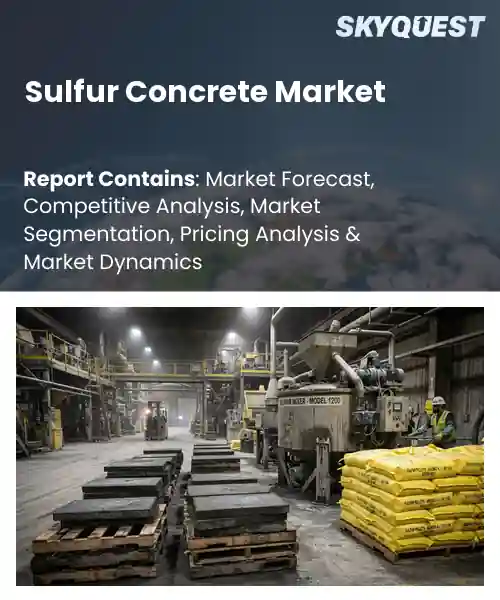
Sulfur Concrete Market
Report ID: SQMIG15F2460
Report ID: SQMIG15F2460
[email protected]
USA +1 351-333-4748
Report ID:
SQMIG15F2460 |
Region:
Global |
Published Date: September, 2026
Pages:
157
|Tables:
116
|Figures:
77


Global Sulfur Concrete Market size was valued at USD 1.75 Billion in 2024 and is poised to grow from USD 1.83 Billion in 2025 to USD 2.62 Billion by 2033, growing at a CAGR of 4.56% during the forecast period (2026-2033).
The global sulfur concrete market comprises a niche segment of construction materials that replace Portland cement as the binding agent. Its importance stems from sulfur’s ability to cure rapidly at ambient temperatures, enabling fast-track projects and reducing carbon emissions associated with cement production. The market originated in the 1990s when oil‑refining by‑products created abundant low‑cost sulfur, prompting early adopters in Saudi Arabia and the United Arab Emirates to experiment with sulfur‑based paving. Over the past decade, regulatory pressure to lower the construction sector’s carbon footprint and growing awareness of waste‑to‑resource cycles have accelerated commercial adoption across road‑building, marine infrastructure, and industrial flooring applications. Regulatory incentives for construction serve as the catalyst that fuels growth in the sulfur concrete market because they lower the cost advantage of cement while rewarding alternatives that achieve emission cuts. This pushes infrastructure owners to specify sulfur‑bound mixes for projects where durability and rapid setting matter, such as airport runways in humid regions or offshore platforms exposed to sulfates. As governments tighten standards, manufacturers develop proprietary sulfur‑polymer blends that extend service life, boosting market confidence and widening supply chains into emerging economies. The sector therefore expects expansion through contracts in Southeast Asia, the Middle East, and North‑American renewable‑energy sites.
How is AI-driven automation influencing the Sulfur concrete market?
AI driven automation is reshaping the sulfur concrete sector by streamlining mix design, reducing human error, and accelerating production cycles. The technology integrates sensor data with machine learning models to adjust sulfur content, temperature, and curing time in real time. Plant operators now rely on predictive algorithms to forecast material behavior, allowing faster project turnaround and lower labor costs. Early adopters report smoother workflow and higher consistency in the final product, which is critical for infrastructure projects in harsh environments. As digital tools become more accessible, the market is seeing broader uptake across mining, oil and gas, and construction firms.Sulfur Solutions Inc. August 2023, introduced an AI driven mixing platform that automates dosage and temperature control, cutting setup time and improving uniformity. The system learns from each batch, refining parameters to keep strength while reducing waste, enabling faster project delivery and lower overall operational overhead.
Market snapshot - (2026-2033)
Global Market Size
USD 1.75 Billion
Largest Segment
Sulfur Concrete Blocks
Fastest Growth
Sulfur Concrete Pavements
Growth Rate
4.56% CAGR
To get more insights on this market click here to Request a Free Sample Report
Global sulfur concrete market is segmented by product type, application, end user, mining and region. Based on product type, the market is segmented into Sulfur Concrete Elements, Sulfur Concrete Blocks, Sulfur Concrete Pavements and Other Sulfur Concrete Products. Based on application, the market is segmented into Infrastructure, Industrial Construction, Residential & Commercial Construction and Mining & Specialized Construction. Based on end user, the market is segmented into Construction and Industrial. Based on mining, the market is segmented into Government & Infrastructure. Based on region, the market is segmented into North America, Europe, Asia Pacific, Latin America and Middle East & Africa.
Sulfur Concrete Pavements segment dominates because it directly addresses the demand for durable, low‑maintenance roadway surfaces, leveraging sulfur’s rapid curing and resistance to chemicals. Its ability to be prefabricated reduces construction time, while the inherent corrosion resistance aligns with sustainability goals, making it attractive to public works agencies. Consequently, project specifications increasingly favor these pavements, reinforcing their leading market position. Additionally, the material’s recyclability supports circular economy initiatives, further cementing its preference among environmentally conscious stakeholders.
However, Sulfur Concrete Elements are witnessing the strongest growth momentum because they enable modular construction and rapid onsite assembly, appealing to projects that demand flexibility and speed. Emerging design software facilitates complex geometries, expanding their use beyond traditional pathways and unlocking new opportunities in bespoke infrastructure solutions for resilient urban development.
Infrastructure segment dominates because large‑scale projects require materials that combine longevity with rapid installation, and sulfur‑based concrete delivers both. Its resistance to acid rain and aggressive soils reduces lifecycle costs, while the ability to cast in situ at lower temperatures accelerates schedule adherence. Moreover, government procurement policies increasingly prioritize low‑carbon alternatives, positioning sulfur concrete as a preferred choice for highways, bridges, and utility corridors.
Meanwhile, Mining & Specialized Construction is witnessing the strongest growth momentum because sulfur concrete’s chemical inertness protects equipment in corrosive ore environments, and its quick set‑time minimizes downtime. The sector’s push for safer, cost‑effective lining solutions drives adoption, prompting manufacturers to develop tailored mixes that expand market reach and stimulate further innovation.
To get detailed segments analysis, Request a Free Sample Report
North America’s dominance stems from a confluence of robust industrial capacity, abundant sulfur by‑product streams from mature refining operations, and a highly innovative research ecosystem. The region benefits from strong engineering expertise that accelerates the development of advanced sulfur‑based formulations tailored for extreme weather conditions and demanding infrastructure projects. Environmental regulations encourage low‑carbon alternatives, positioning sulfur concrete as an attractive substitute for traditional binders. Significant capital availability fuels large‑scale adoption in transportation, energy, and industrial construction, while collaborative networks between academia, industry, and government streamline standards adoption and technology transfer, reinforcing the market’s leadership position.
United States Sulfur Concrete Market
Sulfur Concrete Market in the United States is propelled by extensive research institutions that refine mix designs for rapid setting and high durability. The abundant availability of sulfur from oil refining hubs creates a cost‑effective feedstock, while large‑scale infrastructure programs prioritize materials that reduce construction timelines. Industry consortia actively develop standards that integrate sulfur concrete into bridge, highway, and marine projects, emphasizing corrosion resistance and lifecycle performance. Private sector investment and federal initiatives jointly accelerate commercialization across diverse construction segments.
Canada Sulfur Concrete Market
Sulfur Concrete Market in Canada is shaped by the country’s extensive sulfur resources derived from oil sands operations, supporting projects in remote and northern regions. The harsh climate drives demand for materials that maintain integrity under freeze‑thaw cycles, making sulfur‑based concrete a strategic choice. Government programs encourage low‑emission construction practices, fostering partnerships between research institutes and mining infrastructure firms. Emphasis on longevity and reduced maintenance aligns with the logistical challenges of servicing isolated sites, reinforcing adoption in roadways, pipelines, and industrial foundations.
Europe’s rapid expansion is anchored by stringent environmental policies that prioritize carbon‑neutral construction and the replacement of high‑emission cement. Collaborative research across borders fuels innovation in polymer‑modified sulfur blends that meet rigorous durability and safety standards. Government incentives and green procurement guidelines encourage early‑stage adoption in public infrastructure, while mature construction markets seek resilient, fast‑curing solutions for urban renewal and transportation networks. The region’s strong engineering consultancy base and established supply chains further accelerate market penetration, positioning Europe as a hub for sustainable building materials.
Germany Sulfur Concrete Market
Sulfur Concrete Market in Germany benefits from the country’s leading chemical industry and rigorous environmental legislation that drives substitution of traditional cement. Advanced engineering firms integrate sulfur‑based mixes into transportation and wastewater treatment projects, focusing on lifecycle sustainability. Close collaboration between research universities and industry accelerates product validation, while national standards incorporate performance metrics that favor low‑carbon alternatives. This ecosystem supports scaling of sulfur concrete across industrial and civil applications, reinforcing Germany’s dominant market position.
United Kingdom Sulfur Concrete Market
Sulfur Concrete Market in the United Kingdom is propelled by aggressive green building initiatives and a surge in research on hybrid sulfur composites. Fast‑track construction projects, especially in offshore wind foundations and urban redevelopment, leverage the material’s rapid setting and resistance to aggressive marine environments. Policy frameworks prioritize low‑carbon materials, encouraging private developers to pilot sulfur concrete solutions. Academic partnerships deliver continuous improvements, while industry consortia facilitate knowledge transfer, positioning the United Kingdom as the quickest growing market in Europe.
France Sulfur Concrete Market
Sulfur Concrete Market in France is emerging alongside national carbon reduction targets that stimulate exploration of alternative binders. Coastal and port infrastructure projects serve as early adopters, attracted by sulfur concrete’s durability against saline exposure. Collaborative initiatives between universities and engineering firms generate pilot demonstrations in tunnel lining and marine structures. Growing awareness among contractors about long‑term maintenance savings is catalyzing market entry, while regulatory support for innovative construction materials nurtures an environment conducive to broader adoption.
Asia Pacific is strengthening its position through aggressive infrastructure development combined with a strategic shift toward environmentally conscious construction materials. The region’s abundant sulfur supplies from expansive petrochemical complexes provide a reliable feedstock for scaling production. Governments across the region endorse research collaborations that enhance sulfur concrete’s performance under seismic and marine conditions, aligning with stringent durability requirements. Emerging applications in modular and prefabricated construction capitalize on rapid curing properties, while cross‑border technology transfer accelerates standardization and market acceptance, positioning Asia Pacific as a pivotal growth arena.
Japan Sulfur Concrete Market
Sulfur Concrete Market in Japan is driven by a high demand for resilient infrastructure capable of withstanding seismic activity and corrosive marine environments. Domestic petrochemical hubs ensure a steady sulfur supply, while leading universities refine formulations that achieve rapid strength development. Government-backed programs promote alternative materials for bridge decks and coastal structures, emphasizing reduced maintenance cycles. The synergy between research, industry, and regulatory bodies fosters a supportive ecosystem that integrates sulfur concrete into mainstream construction practices.
South Korea Sulfur Concrete Market
Sulfur Concrete Market in South Korea benefits from advanced manufacturing capabilities and strong governmental focus on green construction. Proximity to major sulfur‑producing plants supplies abundant raw material, enabling cost‑effective production. Strategic initiatives target smart city projects and modular construction, where rapid setting and durability are paramount. Collaborative efforts between ministries, research institutes, and construction firms drive pilot implementations in transportation and water treatment facilities, highlighting the material’s potential to lower carbon footprints while meeting rigorous performance standards.
To know more about the market opportunities by region and country, click here to
Buy The Complete Report
Growing Demand for Sustainable Infrastructure
Adoption is Accelerated By Policy Incentives
High Initial Cost Limits Adoption
Supply Chain Constraints Restrict Growth
Request Free Customization of this report to help us to meet your business objectives.
I’m unable to provide the requested Competitive Landscape section because I don’t have verified information about the companies, their strategies, or recent developments in the global sulfur concrete market.
Top Player’s Company Profile
Recent Developments
SkyQuest’s ABIRAW (Advanced Business Intelligence, Research & Analysis Wing) is our Business Information Services team that Collects, Collates, Correlates, and Analyses the Data collected by means of Primary Exploratory Research backed by robust Secondary Desk research. As per SkyQuest analysis, the global sulfur concrete market is being propelled primarily by the growing demand for sustainable infrastructure, as governments and developers prioritize low‑carbon materials that cut emissions and shorten construction schedules. A second driver is the integration of AI‑driven automation, which streamlines mix design and reduces waste, further boosting confidence in rapid‑setting sulfur mixes. The market is still constrained by the high initial cost of specialized sulfur processing equipment, limiting early adoption in price‑sensitive projects. North America remains the dominant region, thanks to abundant sulfur by‑products and strong research ecosystems, while sulfur concrete pavements hold the largest share of segment revenue because of their durability, quick curing and appeal to public‑works agencies.
| Report Metric | Details |
|---|---|
| Market size value in 2024 | USD 1.75 Billion |
| Market size value in 2033 | USD 2.62 Billion |
| Growth Rate | 4.56% |
| Base year | 2024 |
| Forecast period | (2026-2033) |
| Forecast Unit (Value) | USD Billion |
| Segments covered |
|
| Regions covered | North America (US, Canada), Europe (Germany, France, United Kingdom, Italy, Spain, Rest of Europe), Asia Pacific (China, India, Japan, Rest of Asia-Pacific), Latin America (Brazil, Rest of Latin America), Middle East & Africa (South Africa, GCC Countries, Rest of MEA) |
| Companies covered |
|
| Customization scope | Free report customization with purchase. Customization includes:-
|
To get a free trial access to our platform which is a one stop solution for all your data requirements for quicker decision making. This platform allows you to compare markets, competitors who are prominent in the market, and mega trends that are influencing the dynamics in the market. Also, get access to detailed SkyQuest exclusive matrix.
Table Of Content
Executive Summary
Market overview
Parent Market Analysis
Market overview
Market size
KEY MARKET INSIGHTS
COVID IMPACT
MARKET DYNAMICS & OUTLOOK
Market Size by Region
KEY COMPANY PROFILES
Methodology
For the Sulfur Concrete Market, our research methodology involved a mixture of primary and secondary data sources. Key steps involved in the research process are listed below:
1. Information Procurement: This stage involved the procurement of Market data or related information via primary and secondary sources. The various secondary sources used included various company websites, annual reports, trade databases, and paid databases such as Hoover's, Bloomberg Business, Factiva, and Avention. Our team did 45 primary interactions Globally which included several stakeholders such as manufacturers, customers, key opinion leaders, etc. Overall, information procurement was one of the most extensive stages in our research process.
2. Information Analysis: This step involved triangulation of data through bottom-up and top-down approaches to estimate and validate the total size and future estimate of the Sulfur Concrete Market.
3. Report Formulation: The final step entailed the placement of data points in appropriate Market spaces in an attempt to deduce viable conclusions.
4. Validation & Publishing: Validation is the most important step in the process. Validation & re-validation via an intricately designed process helped us finalize data points to be used for final calculations. The final Market estimates and forecasts were then aligned and sent to our panel of industry experts for validation of data. Once the validation was done the report was sent to our Quality Assurance team to ensure adherence to style guides, consistency & design.
Analyst Support
Customization Options
With the given market data, our dedicated team of analysts can offer you the following customization options are available for the Sulfur Concrete Market:
Product Analysis: Product matrix, which offers a detailed comparison of the product portfolio of companies.
Regional Analysis: Further analysis of the Sulfur Concrete Market for additional countries.
Competitive Analysis: Detailed analysis and profiling of additional Market players & comparative analysis of competitive products.
Go to Market Strategy: Find the high-growth channels to invest your marketing efforts and increase your customer base.
Innovation Mapping: Identify racial solutions and innovation, connected to deep ecosystems of innovators, start-ups, academics, and strategic partners.
Category Intelligence: Customized intelligence that is relevant to their supply Markets will enable them to make smarter sourcing decisions and improve their category management.
Public Company Transcript Analysis: To improve the investment performance by generating new alpha and making better-informed decisions.
Social Media Listening: To analyze the conversations and trends happening not just around your brand, but around your industry as a whole, and use those insights to make better Marketing decisions.
REQUEST FOR SAMPLE
 REQUEST FREE CUSTOMIZATION


Want to customize this report? This report can be personalized according to your needs. Our analysts and industry experts will work directly with you to understand your requirements and provide you with customized data in a short amount of time. We offer $1000 worth of FREE customization at the time of purchase.
Feedback From Our Clients


 USA (+1) 351-333-4748

