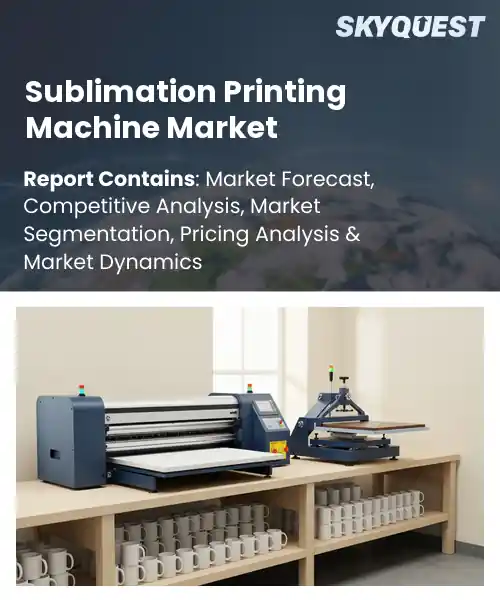
Sublimation Printing Machine Market
Report ID: SQMIG45I2354
Report ID: SQMIG45I2354
[email protected]
USA +1 351-333-4748
Report ID:
SQMIG45I2354 |
Region:
Global |
Published Date: March, 2026
Pages:
157
|Tables:
116
|Figures:
77


Global Sublimation Printing Machine Market size was valued at USD 17.0 Billion in 2024 and is poised to grow from USD 18.87 Billion in 2025 to USD 43.49 Billion by 2033, growing at a CAGR of 11.0% during the forecast period (2026-2033).
The primary driver of the sublimation printing machine market is rising demand for personalization and strong dye affinity in polyester substrates. This market comprises hardware, inks and consumables that enable heat-transfer of sublimation dyes onto textiles, ceramics and substrates, and it matters because it reduces lead times while enabling vibrant prints for apparel, soft signage and promotional goods. Historically, adoption progressed from analog screen-print methods to digital direct-to-sublimation workflows as ink chemistry and printing heads improved, which expanded use from sports jerseys and fashion to home décor and e-sports merchandise. These technological shifts have lowered barriers for small operators.One key factor accelerating the global sublimation printing machine market is convergence of digital retail and localized manufacturing, which causes demand for short-run, customizable production and incentivizes investment in compact printers. As ink formulations and print head resolutions improved, businesses could transfer richer color profiles onto polyester garments and coated ceramics, enabling platforms such as on-demand apparel services and gift producers to scale without large inventory. Consequently, manufacturers find opportunities in modular machines, integrated color management software and inks that reduce waste, while sports teams, interior designers and promotional suppliers adopt sublimation because it lowers per-unit cost for personalized orders.
How is AI transforming productivity in the sublimation printing machine market?
AI is reshaping productivity in the sublimation printing machine market through smarter color management, predictive maintenance and workflow automation. Key aspects are real time color correction, AI assisted RIP optimization and vision based inspection that reduce manual setup and rejects. The current state shows vendors and print shops integrating sensors and cloud analytics to support on demand personalization and textile applications and to keep machines running consistently across varied jobs. Market context favors integrated hardware and software so operators gain faster job changeovers and steadier output. Examples include inline spectrophotometers for automated calibration and machine learning that schedules service before failures.Mimaki January 2026, announced the TS330-1800 a wider sublimation transfer printer, and this suggests an inference that when paired with AI driven color management and predictive maintenance tools its higher capacity and streamlined workflow can lead to faster turnarounds and reduced unplanned downtime supporting market growth and operational efficiency.
Market snapshot - (2026-2033)
Global Market Size
USD 17.0 Billion
Largest Segment
Wide Format
Fastest Growth
Super-wide Format
Growth Rate
11.0% CAGR
To get more insights on this market click here to Request a Free Sample Report
Global sublimation printing machine market is segmented by machine configuration, printing technology, ink type compatibility, application vertical and region. Based on machine configuration, the market is segmented into Small Format, Wide Format and Super-wide Format. Based on printing technology, the market is segmented into Direct-to-Fabric Sublimation and Transfer-based Sublimation. Based on ink type compatibility, the market is segmented into Aqueous Sublimation Inks and Solvent/UV-curable Sublimation. Based on application vertical, the market is segmented into Apparel & Textiles, Soft Signage & Banners, Promotional Products and Interior Decor & Home Furnishing. Based on region, the market is segmented into North America, Europe, Asia Pacific, Latin America and Middle East & Africa.
Wide Format segment dominates because it hits the production sweet spot between roll length and print versatility, enabling efficient manufacturing of apparel, soft signage and banners with consistent color fidelity. Its balance of throughput and print area drives adoption among mid to large producers, while integration with automated feeding, drying and finishing systems reduces operational bottlenecks and total cost of ownership, reinforcing preference in commercial environments.
However, Small Format is witnessing the strongest growth momentum as on demand personalization and direct retail fulfillment gain traction. Compact machines lower capital barriers, enable short runs and rapid product turnover, and integrate with e-commerce workflows, empowering small brands and shops to adopt sublimation printing and expand addressable applications.
Transfer-based Sublimation segment dominates because its decoupled workflow provides predictable color accuracy and broad material compatibility, making it the default choice for high mix production across apparel and promotional goods. The reliance on proven transfer papers and established drying processes simplifies scale up and quality control, while mature supply chains for ink and media reduce operational risk, prompting manufacturers to favor transfer systems for stable throughput and repeatable results.
Meanwhile, Direct-to-Fabric Sublimation is emerging as the fastest growing area due to advances in ink chemistry and printhead reliability that allow direct textile printing without transfer paper. Removing the transfer stage shortens lead times, lowers material waste and enables fast customization, attracting brands focused on sustainable on demand production.
To get detailed segments analysis, Request a Free Sample Report
Asia Pacific dominates the global sublimation printing machine market due to a convergence of manufacturing scale, diversified textile demand, and rapid technology adoption across both established and emerging industrial clusters. Large integrated supply chains for fabrics, inks, and components support efficient production and local innovation. High demand for personalized apparel, sportswear, and home textiles creates steady commercial use cases for a range of machine types. Competitive cost structures and proximity to major export markets make the region attractive for both OEMs and contract printers. Strong R and D capabilities in key markets, combined with extensive after sales networks and a skilled engineering workforce, enable rapid customization of machines and swift adaptation to evolving fabric technologies and application needs and innovation.
Sublimation Printing Machine Market in Japan benefits from advanced materials research, precision engineering heritage, and strong OEM capabilities. Demand from high quality textile and industrial printing segments drives focus on innovation, reliability, and compact high performance equipment. Close collaboration between machine manufacturers, ink producers, and fabric specialists fosters tailored solutions. Robust service networks and emphasis on automation support sustained adoption among commercial printers and specialized brands seeking premium print finishes.
Sublimation Printing Machine Market in South Korea is driven by rapid technology adoption, strong electronics integration, and a dynamic textile sector focused on performance apparel and customization. Manufacturers prioritize compact, high throughput systems with advanced color management tailored for premium finishes. Close ties between component suppliers and machine builders enable quick iterations. Active aftercare networks and collaboration with print providers broadly facilitate market penetration across domestic and exporting textile producers.
Rapid expansion in Europe is driven by a combination of demand for customization, strong fashion and textile traditions, and a widespread move toward digital printing technologies. Market dynamics favor agile production and localized manufacturing models that reduce lead times and respond to shifting consumer preferences. Sustainability considerations and regulatory attention to resource usage encourage adoption of efficient, low waste dyeing solutions, complementing sublimation capabilities. Established machinery manufacturers and material specialists collaborate closely with designers and brand owners to create tailored workflows. Investment in after sales service, training, and regional support networks further enables smaller printers and specialized converters to embrace sublimation for high value apparel, soft signage, and interior textiles. Regional trade events and supplier collaboration accelerate knowledge transfer. Flexible purchasing models offered by equipment suppliers reduce barriers for small adopters, while partnerships with material innovators improve ink chemistry and substrate compatibility.
Sublimation Printing Machine Market in Germany benefits from a concentrated manufacturing base, strong automation expertise, and deep ties to textile machinery suppliers. Industrial buyers seek robust, high throughput equipment optimized for integration into existing production lines. Close cooperation between OEMs and component specialists supports continuous product refinement. A mature service network and reputation for engineering excellence encourage adoption among textile firms and printers focusing on reliability and cost effective operations.
Sublimation Printing Machine Market in United Kingdom is characterized by rapid uptake among small and medium printers, bespoke apparel brands seeking agile production. Emphasis on digital workflows and on demand personalization drives interest in compact, versatile systems. Collaboration between machine makers and design incubators accelerates product adaptation to niche needs. Growing service models and rental offerings reduce entry barriers, broadly enabling wider experimentation across promotional, fashion, and interior textile segments.
Sublimation Printing Machine Market in France reflects strong design heritage and artisanal textile producers seeking high fidelity color and refined finishes. Demand focuses on premium interior textiles and limited collections that prioritize aesthetic differentiation. Suppliers collaborate with dye and ink specialists to deliver accurate color reproduction and adaptable production runs. Interest from regional textile clusters and design schools supports experimentation and gradual adoption among boutique manufacturers and small local brands.
North America is reinforcing its role through concentrated investment in service infrastructure, adoption of hybrid manufacturing models, and close linkages between machine manufacturers and end users. The region benefits from a diverse application base including apparel, sportswear, signage, and promotional printing that encourages varied equipment specifications. Emphasis on quick turnarounds, customization, and integration with digital order management suits on demand production. Suppliers emphasize reliable after sales support, training, and localized spare parts networks to reduce downtime. Collaboration with ink and textile suppliers, as well as partnerships between technology firms and brand owners, fosters tailored solutions and steady market development. Nearshoring trends and a preference for lead time production strengthen interest in localized printing capacity. Investment in sustainability initiatives, including energy efficient equipment and low waste workflows, complements demand for environmentally responsible manufacturing. Regional training centers and partnerships support skill development and accelerate adoption across small and midsized printers.
Sublimation Printing Machine Market in United States combines a breadth of end use sectors, from sportswear and active apparel to signage and promotional printing. Demand for flexible, high reliability equipment supports adoption by both large printers and agile startups. Strong training and service networks and aftermarket parts encourage uptime. Close collaboration with technology providers and brand owners helps develop tailored workflows that integrate e commerce ordering and rapid production cycles.
Sublimation Printing Machine Market in Canada emphasizes sustainability and regional supply chain resilience, with many printers focused on small batch production and customization for local brands. Proximity to United States markets supports cross border partnerships and technology transfer. Demand from niche sportswear, outerwear, and home textile segments favors compact, energy efficient systems. Strong service relationships and partnerships with material suppliers enable reliable implementation among independent print shops and textile manufacturers.
To know more about the market opportunities by region and country, click here to
Buy The Complete Report
Growing Demand For Personalized Products
Advancements In Printer Technology
High Initial Equipment Costs
Limited Availability Of Skilled Workforce
Request Free Customization of this report to help us to meet your business objectives.
Competition in the global sublimation printing machine market is intensifying as OEMs and new entrants deploy technology innovation, acquisitions, and distribution partnerships to capture rising demand for on demand customization and textile personalization. For example, Kornit Digital acquired Custom Gateway to strengthen software and service offerings, while Epson expanded its industrial dye sublimation lineup with new SureColor F series models emphasizing automation and workflow integration.
Top Player’s Company Profile
Recent Developments
SkyQuest’s ABIRAW (Advanced Business Intelligence, Research & Analysis Wing) is our Business Information Services team that Collects, Collates, Correlates, and Analyses the Data collected by means of Primary Exploratory Research backed by robust Secondary Desk research. As per SkyQuest analysis, the global sublimation printing machine market is propelled primarily by rising demand for personalized products and the strong dye affinity of polyester substrates, while a second driving force is the convergence of digital retail and localized manufacturing that favors short-run, customizable production. Growth is tempered by high initial equipment costs which limit adoption among smaller operators. Asia Pacific leads the market due to integrated supply chains, competitive manufacturing and high textile demand, and the wide format configuration dominates commercially by balancing throughput and versatility for apparel, signage and banners. Opportunities lie in compact systems, AI-enabled color management and sustainable ink solutions.
| Report Metric | Details |
|---|---|
| Market size value in 2024 | USD 17.0 Billion |
| Market size value in 2033 | USD 43.49 Billion |
| Growth Rate | 11.0% |
| Base year | 2024 |
| Forecast period | (2026-2033) |
| Forecast Unit (Value) | USD Billion |
| Segments covered |
|
| Regions covered | North America (US, Canada), Europe (Germany, France, United Kingdom, Italy, Spain, Rest of Europe), Asia Pacific (China, India, Japan, Rest of Asia-Pacific), Latin America (Brazil, Rest of Latin America), Middle East & Africa (South Africa, GCC Countries, Rest of MEA) |
| Companies covered |
|
| Customization scope | Free report customization with purchase. Customization includes:-
|
To get a free trial access to our platform which is a one stop solution for all your data requirements for quicker decision making. This platform allows you to compare markets, competitors who are prominent in the market, and mega trends that are influencing the dynamics in the market. Also, get access to detailed SkyQuest exclusive matrix.
Table Of Content
Executive Summary
Market overview
Parent Market Analysis
Market overview
Market size
KEY MARKET INSIGHTS
COVID IMPACT
MARKET DYNAMICS & OUTLOOK
Market Size by Region
KEY COMPANY PROFILES
Methodology
For the Sublimation Printing Machine Market, our research methodology involved a mixture of primary and secondary data sources. Key steps involved in the research process are listed below:
1. Information Procurement: This stage involved the procurement of Market data or related information via primary and secondary sources. The various secondary sources used included various company websites, annual reports, trade databases, and paid databases such as Hoover's, Bloomberg Business, Factiva, and Avention. Our team did 45 primary interactions Globally which included several stakeholders such as manufacturers, customers, key opinion leaders, etc. Overall, information procurement was one of the most extensive stages in our research process.
2. Information Analysis: This step involved triangulation of data through bottom-up and top-down approaches to estimate and validate the total size and future estimate of the Sublimation Printing Machine Market.
3. Report Formulation: The final step entailed the placement of data points in appropriate Market spaces in an attempt to deduce viable conclusions.
4. Validation & Publishing: Validation is the most important step in the process. Validation & re-validation via an intricately designed process helped us finalize data points to be used for final calculations. The final Market estimates and forecasts were then aligned and sent to our panel of industry experts for validation of data. Once the validation was done the report was sent to our Quality Assurance team to ensure adherence to style guides, consistency & design.
Analyst Support
Customization Options
With the given market data, our dedicated team of analysts can offer you the following customization options are available for the Sublimation Printing Machine Market:
Product Analysis: Product matrix, which offers a detailed comparison of the product portfolio of companies.
Regional Analysis: Further analysis of the Sublimation Printing Machine Market for additional countries.
Competitive Analysis: Detailed analysis and profiling of additional Market players & comparative analysis of competitive products.
Go to Market Strategy: Find the high-growth channels to invest your marketing efforts and increase your customer base.
Innovation Mapping: Identify racial solutions and innovation, connected to deep ecosystems of innovators, start-ups, academics, and strategic partners.
Category Intelligence: Customized intelligence that is relevant to their supply Markets will enable them to make smarter sourcing decisions and improve their category management.
Public Company Transcript Analysis: To improve the investment performance by generating new alpha and making better-informed decisions.
Social Media Listening: To analyze the conversations and trends happening not just around your brand, but around your industry as a whole, and use those insights to make better Marketing decisions.
REQUEST FOR SAMPLE
 REQUEST FREE CUSTOMIZATION


Want to customize this report? This report can be personalized according to your needs. Our analysts and industry experts will work directly with you to understand your requirements and provide you with customized data in a short amount of time. We offer $1000 worth of FREE customization at the time of purchase.
Feedback From Our Clients


 USA (+1) 351-333-4748

