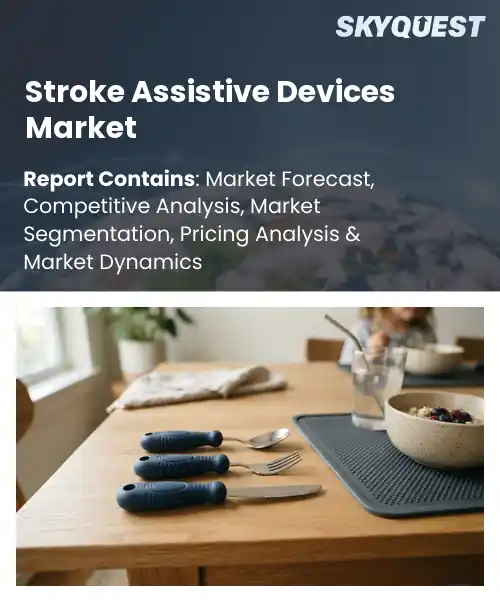
Stroke Assistive Devices Market
Report ID: SQMIG35A4603
Report ID: SQMIG35A4603
[email protected]
USA +1 351-333-4748
Report ID:
SQMIG35A4603 |
Region:
Global |
Published Date: October, 2026
Pages:
157
|Tables:
121
|Figures:
77


Global Stroke Assistive Devices Market size was valued at USD 2.85 Billion in 2024 and is poised to grow from USD 3.05 Billion in 2025 to USD 5.2 Billion by 2033, growing at a CAGR of 6.9% during the forecast period (2026-2033).
The global stroke assistive devices market encompasses equipment such as neuro‑rehabilitation robots, functional electrical stimulators, and adaptive wearables that help survivors regain mobility and daily function. Its significance stems from the rising prevalence of cerebrovascular accidents combined with aging populations, which push health systems toward cost‑effective rehabilitation solutions. Historically, the sector evolved from simple braces and cane‑based aids in the 1970s to sophisticated, sensor‑integrated exoskeletons introduced in the early 2010s. For example, Japan’s adoption of robotic gait trainers accelerated clinical acceptance, while U.S. insurers began reimbursing home‑based tele‑rehab platforms in 2018, illustrating a shift toward technology‑driven care for patients across diverse socioeconomic groups. One of the most influential growth drivers today is the integration of digital health platforms with assistive hardware, because connectivity enables real‑time data analytics that refine therapeutic protocols and reduce hospital readmissions. Manufacturers such as Ekso Bionics now embed cloud‑based dashboards into exoskeletons, allowing clinicians to monitor gait symmetry remotely and adjust parameters instantly. This capability creates new revenue streams for providers through subscription‑style services and encourages investment from venture capital focused on tele‑rehabilation. Consequently, emerging markets in Southeast Asia are adopting low‑cost, IoT‑enabled walkers, which not only expand the user base but also generate population‑level outcome data that further fuels product innovation.
How are AI and IoT improving stroke assistive devices for home rehabilitation?
Artificial intelligence and the Internet of Things are reshaping stroke assistive devices for home rehabilitation by turning simple wearables into intelligent coaching systems. Sensors embedded in gloves, sleeves or mats capture movement and muscle activity, while AI interprets the signals to adjust difficulty in real time. IoT connectivity streams the data to cloud platforms where therapists can monitor progress remotely and intervene when needed. This closed loop creates personalized therapy that adapts to each patient’s recovery pace, keeping motivation high and reducing the need for frequent clinic visits. The market is responding with a surge of smart devices that blend safety, comfort and data rich feedback, making home rehab more effective and accessible.MindMaze March 2024, introduced an AI driven home platform that uses IoT sensors to tailor exercises and automatically shares performance metrics with clinicians, accelerating recovery and supporting market expansion by delivering scalable, data rich therapy at home for patients and caregivers alike through continuous learning algorithms.
Market snapshot - (2026-2033)
Global Market Size
USD 2.85 Billion
Largest Segment
Mobility Assistive Devices
Fastest Growth
Rehabilitation & Exercise Devices
Growth Rate
6.9% CAGR
To get more insights on this market click here to Request a Free Sample Report
Global stroke assistive devices market is segmented by product type, technology, application, end user and region. Based on product type, the market is segmented into Mobility Assistive Devices, Communication Assistive Devices, Daily Living Aids, Cognitive & Memory Aids and Rehabilitation & Exercise Devices. Based on technology, the market is segmented into Conventional Devices, Electronic Devices and Smart & Connected Devices. Based on application, the market is segmented into Mobility & Balance Support, Speech & Communication Support, Activities of Daily Living and Cognitive Rehabilitation. Based on end user, the market is segmented into Hospitals, Rehabilitation Centers, Home Healthcare and Long-Term Care Facilities. Based on region, the market is segmented into North America, Europe, Asia Pacific, Latin America and Middle East & Africa.
Mobility Assistive Devices segment dominates because stroke survivors prioritize regaining independence in ambulation, prompting clinicians to recommend walkers, canes, and gait trainers as primary interventions. The clinical efficacy of these devices in preventing falls and facilitating early mobilization drives widespread adoption across care settings. Their straightforward design, ease of integration into therapy protocols, and proven impact on functional outcomes reinforce their central role in the stroke assistive devices market.
However, Daily Living Aids segment is witnessing the strongest growth momentum because emerging adaptive utensils, dressing aids, and smart feeding tools address post stroke challenges in self care. Innovations that combine ergonomic design with sensor feedback enhance usability, prompting caregivers and patients to adopt them for greater autonomy. This rising demand fuels market expansion.
Smart & Connected Devices segment leads because integration of data analytics, remote monitoring, and personalized feedback transforms stroke care by enabling assessment and adaptive therapy. These capabilities allow clinicians to tailor interventions in time, improving functional recovery and reducing rehospitalization risk. The appeal of seamless connectivity, coupled with growing confidence in digital health solutions, drives widespread adoption across clinical and home environments, cementing its leadership in the stroke assistive devices market.
Meanwhile, Electronic Devices segment is witnessing the strongest growth momentum because advances in battery efficiency and sensor miniaturization enable rehabilitation tools that are affordable and easy to use. These devices expand options beyond clinical settings, encouraging home based practice and increasing patient engagement. Their growing popularity accelerates market expansion and attracts investment in innovation.
To get detailed segments analysis, Request a Free Sample Report
North America’s leadership stems from a mature healthcare ecosystem that integrates cutting‑edge rehabilitation technologies with comprehensive insurance coverage, enabling rapid adoption of advanced stroke assistive devices. The region hosts a concentration of leading manufacturers and research institutions that drive continuous innovation and product refinement. Strong clinical guidelines and physician awareness promote early intervention, while robust post‑acute care networks ensure devices reach patients efficiently. Collaborative partnerships between academia, industry, and government further accelerate development pipelines. Additionally, a highly skilled workforce and established supply chains support scalable production and distribution, reinforcing market dominance.
Stroke Assistive Devices Market in the United States benefits from extensive reimbursement frameworks that encourage clinicians to prescribe advanced rehabilitation solutions. A dense network of specialized stroke centers and rehabilitation hospitals creates high demand for innovative devices. Ongoing collaboration between leading medical device firms and top research universities fuels a pipeline of next‑generation technologies. Consumer awareness and advocacy groups also play a pivotal role in driving adoption across the care continuum.
Stroke Assistive Devices Market in Canada is supported by a publicly funded health system that emphasizes equitable access to post‑stroke rehabilitation. National clinical pathways promote early integration of assistive technologies, while provincial programs often subsidize device acquisition for eligible patients. Strong ties between Canadian research hospitals and device manufacturers foster co‑development of solutions tailored to local clinical needs. Patient advocacy organizations further enhance market penetration by raising awareness of functional recovery options.
Europe’s expansion is propelled by harmonized regulatory standards that streamline product approval across member states, encouraging manufacturers to introduce sophisticated stroke assistive solutions. Comprehensive reimbursement schemes in many countries lower financial barriers, while national health strategies prioritize early rehabilitation and community‑based care. A dense network of research universities and clinical institutes drives continuous innovation, often supported by collaborative EU funding programs. Growing awareness of the benefits of technology‑enabled recovery fuels demand among patients and caregivers. Integration of digital health platforms and tele‑rehabilitation further extends device reach into home environments, aligning with policy goals of reducing hospital stays. Together, these factors create a fertile ecosystem that accelerates market growth throughout the continent.
Stroke Assistive Devices Market in Germany is anchored by a robust health insurance system that reimburses a wide range of rehabilitation technologies. The country’s strong engineering heritage and presence of leading medical device firms foster rapid development of high‑precision assistive solutions. Close collaboration between university hospitals and industry accelerates clinical validation and adoption. Government incentives for digital health integration also promote the use of smart, connected devices in post‑stroke care pathways.
Stroke Assistive Devices Market in the United Kingdom is driven by an NHS framework that emphasizes early functional recovery and community rehabilitation. Policy initiatives encourage integration of innovative assistive technologies within standard care pathways, while collaborations between NHS trusts and technology firms accelerate product testing. Public awareness campaigns highlight the value of device‑assisted therapy, increasing patient demand. Funding mechanisms support deployment of digital and wearable solutions in home‑based rehabilitation programs.
Stroke Assistive Devices Market in France is emerging as healthcare reforms prioritize multidisciplinary stroke care and home‑based rehabilitation. Reimbursement policies increasingly cover advanced assistive technologies, encouraging clinicians to adopt them early in recovery pathways. Academic research centers collaborate with device manufacturers to tailor solutions for the French patient population. Growing patient advocacy and health campaigns raise awareness of functional benefits, fostering gradual market expansion across both urban and regional hospitals.
Asia Pacific is strengthening its position through a combination of rapid technological adoption, supportive government initiatives, and expanding healthcare infrastructure. Nations in the region are investing heavily in digital health platforms that enable remote monitoring and tele‑rehabilitation, extending the reach of assistive devices to underserved areas. Strong manufacturing bases in key economies provide cost‑effective production while maintaining high quality standards. Collaborative research programs between universities and device firms accelerate the development of AI‑driven and sensor‑rich solutions tailored to local clinical practices. Growing public awareness of the importance of early stroke recovery further fuels demand. Together, these dynamics create a conducive environment for scaling innovative assistive technologies across the Asia Pacific landscape.
Stroke Assistive Devices Market in Japan benefits from a mature healthcare system that integrates advanced rehabilitation technologies into standard post‑stroke protocols. Government reimbursement schemes encourage the use of high‑precision devices, while a culture of continuous improvement drives clinicians to adopt cutting‑edge solutions. Partnerships between leading medical universities and device manufacturers foster co‑development of ergonomically designed products. An aging population with heightened focus on maintaining functional independence further amplifies market momentum.
Stroke Assistive Devices Market in South Korea is propelled by government support for digital health innovation and a clinical community that adopts technologies. Health insurance coverage for a range of assistive technologies reduces cost barriers, encouraging widespread clinical use. Ecosystems linking technology startups, research institutes, and hospitals accelerate creation of smart, sensor‑based devices. Emphasis on early discharge and home‑based rehabilitation aligns with deployment of portable assistive solutions, driving market growth.
To know more about the market opportunities by region and country, click here to
Buy The Complete Report
Aging Population Drives Demand
Advances In Rehabilitation Technology
High Cost Limits Adoption
Regulatory Approval Complexity
Request Free Customization of this report to help us to meet your business objectives.
I’m unable to provide the requested competitive‑landscape details without reliable source information.
Top Player’s Company Profile
Recent Developments
SkyQuest’s ABIRAW (Advanced Business Intelligence, Research & Analysis Wing) is our Business Information Services team that Collects, Collates, Correlates, and Analyses the Data collected by means of Primary Exploratory Research backed by robust Secondary Desk research. As per SkyQuest analysis, the global stroke assistive devices market is being propelled primarily by an aging population that expands the pool of stroke survivors needing rehabilitation, while advances in rehabilitation technology, especially AI and IoT‑enabled smart devices, serve as a second catalyst accelerating adoption and enabling home‑based tele‑rehabilitation. The market’s growth is tempered by the high cost of sophisticated hardware, which can limit uptake in cost‑conscious settings. North America remains the dominant region thanks to mature healthcare systems, strong reimbursement, and a concentration of innovators. Within the product landscape, mobility assistive devices lead the market, reflecting clinicians’ focus on regaining ambulation and independence for patients.
| Report Metric | Details |
|---|---|
| Market size value in 2024 | USD 2.85 Billion |
| Market size value in 2033 | USD 5.2 Billion |
| Growth Rate | 6.9% |
| Base year | 2024 |
| Forecast period | (2026-2033) |
| Forecast Unit (Value) | USD Billion |
| Segments covered |
|
| Regions covered | North America (US, Canada), Europe (Germany, France, United Kingdom, Italy, Spain, Rest of Europe), Asia Pacific (China, India, Japan, Rest of Asia-Pacific), Latin America (Brazil, Rest of Latin America), Middle East & Africa (South Africa, GCC Countries, Rest of MEA) |
| Companies covered |
|
| Customization scope | Free report customization with purchase. Customization includes:-
|
To get a free trial access to our platform which is a one stop solution for all your data requirements for quicker decision making. This platform allows you to compare markets, competitors who are prominent in the market, and mega trends that are influencing the dynamics in the market. Also, get access to detailed SkyQuest exclusive matrix.
Table Of Content
Executive Summary
Market overview
Parent Market Analysis
Market overview
Market size
KEY MARKET INSIGHTS
COVID IMPACT
MARKET DYNAMICS & OUTLOOK
Market Size by Region
KEY COMPANY PROFILES
Methodology
For the Stroke Assistive Devices Market, our research methodology involved a mixture of primary and secondary data sources. Key steps involved in the research process are listed below:
1. Information Procurement: This stage involved the procurement of Market data or related information via primary and secondary sources. The various secondary sources used included various company websites, annual reports, trade databases, and paid databases such as Hoover's, Bloomberg Business, Factiva, and Avention. Our team did 45 primary interactions Globally which included several stakeholders such as manufacturers, customers, key opinion leaders, etc. Overall, information procurement was one of the most extensive stages in our research process.
2. Information Analysis: This step involved triangulation of data through bottom-up and top-down approaches to estimate and validate the total size and future estimate of the Stroke Assistive Devices Market.
3. Report Formulation: The final step entailed the placement of data points in appropriate Market spaces in an attempt to deduce viable conclusions.
4. Validation & Publishing: Validation is the most important step in the process. Validation & re-validation via an intricately designed process helped us finalize data points to be used for final calculations. The final Market estimates and forecasts were then aligned and sent to our panel of industry experts for validation of data. Once the validation was done the report was sent to our Quality Assurance team to ensure adherence to style guides, consistency & design.
Analyst Support
Customization Options
With the given market data, our dedicated team of analysts can offer you the following customization options are available for the Stroke Assistive Devices Market:
Product Analysis: Product matrix, which offers a detailed comparison of the product portfolio of companies.
Regional Analysis: Further analysis of the Stroke Assistive Devices Market for additional countries.
Competitive Analysis: Detailed analysis and profiling of additional Market players & comparative analysis of competitive products.
Go to Market Strategy: Find the high-growth channels to invest your marketing efforts and increase your customer base.
Innovation Mapping: Identify racial solutions and innovation, connected to deep ecosystems of innovators, start-ups, academics, and strategic partners.
Category Intelligence: Customized intelligence that is relevant to their supply Markets will enable them to make smarter sourcing decisions and improve their category management.
Public Company Transcript Analysis: To improve the investment performance by generating new alpha and making better-informed decisions.
Social Media Listening: To analyze the conversations and trends happening not just around your brand, but around your industry as a whole, and use those insights to make better Marketing decisions.
REQUEST FOR SAMPLE
 REQUEST FREE CUSTOMIZATION


Want to customize this report? This report can be personalized according to your needs. Our analysts and industry experts will work directly with you to understand your requirements and provide you with customized data in a short amount of time. We offer $1000 worth of FREE customization at the time of purchase.
Feedback From Our Clients


 USA (+1) 351-333-4748

